‘A silent eloquence’
21 Friday Apr 2017
Posted in flowers, nature, spring, wildflowers
21 Friday Apr 2017
Posted in flowers, nature, spring, wildflowers
18 Tuesday Apr 2017
Posted in flowers, nature, wildflowers
Tags
Cardamine pratensis, Cuckooflower, Lady's smock, Milkmaid, Spring colour, spring flowers, wildflowers

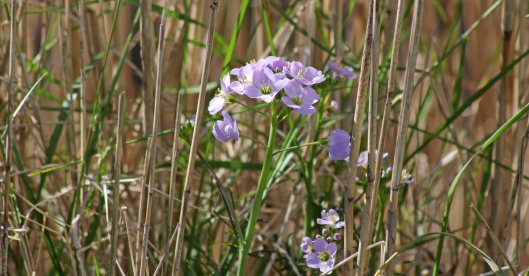
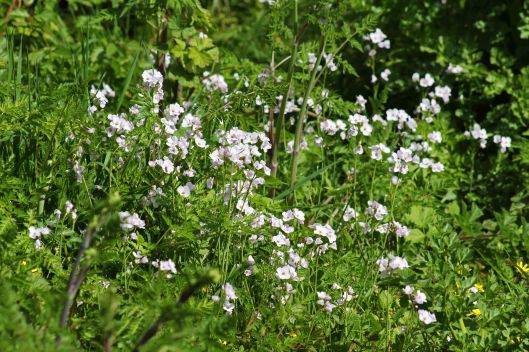
It seems that everywhere I walk at the moment there’s Cuckooflower. With its penchant for damp soggy ground, it can be found sprinkled amongst the reeds at the edge of Cardiff Bay wetlands, underlining the willow scrub along the edges of the River Taff, accentuating the lines of a drying drain at Cosmeston Lakes Country Park. And it’s such a pretty little thing, with its pale lilac flowers sitting high on an upright stalk, all the better for the bees and butterflies to find them.
Its scientific name is Cardamine pratensis and, if you don’t know it as Cuckooflower (it flowers at the time the cuckoos return to Britain), then you may know it by its other popular names, Milkmaid and Lady’s smock. Milkmaid is the older name, possibly a reference to its feminine colour and blousy shape when the flowers are first opening and I read, in an article in the Darlington & Stockton Times 23 June 2006, that
‘When Christianity came to these islands, that feminine association was transferred to the Virgin Mary, which led to a host of other names for the flower, such as my lady’s smock, lady’s glove and dozens more.
There is one old story which says that St Helena found Our Lady’s smock in a cave near Bethlehem, an article of clothing she left behind. It was later taken to St Sophia and then to Aix la Chapelle, where it was venerated for centuries, with this little wild flower being named in several European countries in honour of that relic.
‘In Europe, a lot of superstition used to surround this flower. It was thought that if anyone picked it, a thunderstorm would break out. It was also thought to generate lightning and for this reason was never taken into a house. In parts of England, it was believed to attract adders, Britain’s only poisonous snake, with a notion that anyone picking the flower would be bitten before the year was out.’
Luckily, I prefer to leave wildflowers where they are for everyone to enjoy so haven’t picked any, though I’m now almost tempted, just to see what happens … almost.

07 Friday Apr 2017
Posted in flowers, nature, spring, wildflowers
22 Friday Jul 2016
Tags
We have a mixture of genuinely wild and cultivated wildflowers today, a selection from those I saw on my afternoon walk around Cardiff’s magnificent Bute Park, from the vibrant red of the poppy to the bluey-purples of the Field scabious that were abuzz with bees. Here’s wishing you all a flower-full weekend!
07 Tuesday Jun 2016
Posted in nature
Tags
biodiversity, Cathays Cemetery, Green Flag Award, Site of Importance for Nature Conservation, Wales Biodiversity Week, wildflowers
For day four of Wales Biodiversity Week we’re heading to a wonderfully biodiverse location just 10 minutes’ walk from where I live – my local cemetery!

Although Cathays Cemetery was first opened in 1859, its 110-acre grounds have remained largely undisturbed since the cemetery closed to new burials about 35 years ago, so it is the perfect environment for native plants to thrive, and that means it also provides a rich habitat for the birds, animals and insects that live in, amongst and on those plants. The cemetery also contains an arboretum of trees, both native and exotic, and some remnants of shrubs and flowers planted in Victorian times. No wonder the cemetery has been classified by Cardiff Council as a Site of Importance for Nature Conservation, and has held the Green Flag Award since 2009.

When it first opened, the cemetery wasn’t just a place to bury Cardiff’s dead; with few parks and recreation spaces available at that time, this was also considered a pleasant place to walk – and it still is!
05 Sunday Jun 2016
Posted in nature
For day two of Wales Biodiversity Week (and day 5 of 30 Days Wild, which I am also following – more information on that Wildlife Trust initiative here) – I went for a wander around one of my local nature reserves, Nant Fawr Woodlands. Established as a green corridor by Cardiff City Council in 1993 and following the Nant Fawr stream from Roath Park Lake to Llanishen Reservoir, the woodlands are managed by a group of local conservation-minded residents, ‘The Friends of Nant Fawr’.

As well as two parcels of woodland harbouring some magnificent old trees, the area also includes three ancient meadows, once part of Rhyd-y-blewn farm, which are valuable habitats for wildflowers and the insects that thrive on them. The Friends are part of the Cardiff Biodiversity Partnership, have a well-developed biodiversity action plan, and manage the woodlands and meadows in accordance with agreed guidelines to conserve and enhance this wonderful environment.

It’s a wonderful place for a ramble, taking you from city to countryside, with much to enjoy along the way.
29 Friday Apr 2016
Posted in 'Dedicated Naturalist' Project, flowers, nature
A snippet from my volunteer work on the ‘Dedicated Naturalist’ Project, helping to decipher and digitise, record and publicise the life’s work of naturalist extraordinaire, Dr Mary Gillham.
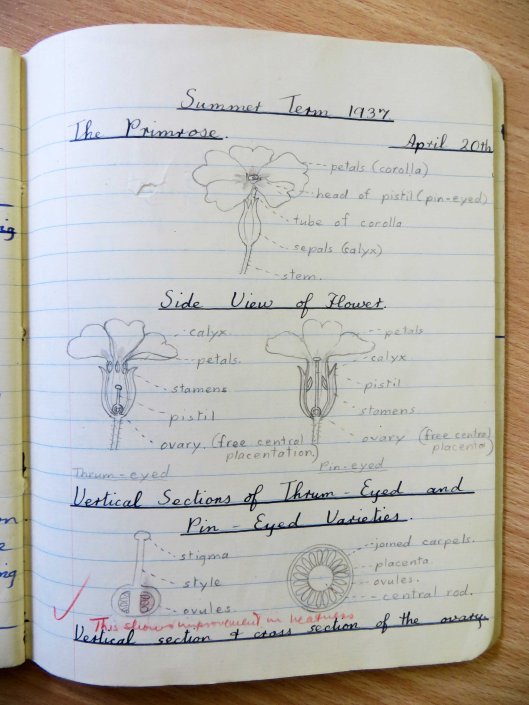
It’s almost 79 years to the day since fifteen-year-old Mary Gillham drew these very precise illustrations of the anatomy of a primrose. (Note the teacher’s comment: ‘This shows improvement in neatness’!)

She was in her final, fifth form year at Ealing Grammar School for Girls, and, as you can see from her work, she already had well-developed powers of observation and a fine drawing style. Though she was raised in the London suburb of Ealing, Mary’s love of the natural world began early,
looking at birds and flowers in the local parks and on family Saturdays in the country. I brought bits and pieces for the wild flower shelf in my Junior School and began collecting and pressing specimens of the commoner species. One such collection, classified not very scientifically under flower colour, was sent by the school to a museum in Russia, as an example of an eleven-year-old’s work.
From small beginnings come great naturalists!
You can follow our progress with this project on Facebook and on Twitter. A website will follow soon.

24 Sunday Apr 2016
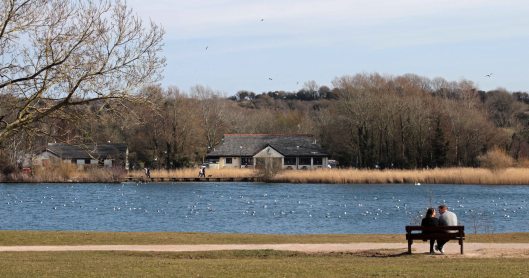
I’ve mentioned Cosmeston Lakes Country Park a couple of times previously in this blog so I thought I would show you what a wonderful place it is for a visit. With two lakes and over 100 hectares of woodland and meadows, it’s a place you can get lost in – or, at least, find somewhere to escape the madding crowd.

Where the lakes now provide homes to a myriad of waterbirds there used to be limestone quarries, providing the raw material for the since demolished British Portland Cement works. And the northern part of the park, which was once the site of two rubbish tips – the air vents can still be seen dotted around the grasslands, is now the perfect environment for wildflowers, birds and insects. It is a splendid example of a landscape reclaimed from the ravages of mankind to provide a home for wildlife, and so successful has that transformation been that some areas are now designated Sites of Special Scientific Interest.

The park is not far from Penarth, a seaside town on the outskirts of Cardiff. It is easily accessible by car or public bus, though I prefer to catch the train to Penarth then walk along the now-disused railway track that has been converted to a tree-lined trail heading west. For me, that provides the perfect start to a wonderful long wander in the park.
15 Tuesday Mar 2016
Tags
Foetid hellebore, hellebore, Helleborus foetidus, poisonous plant, Stinking helebore, Stinkwort, wildflowers
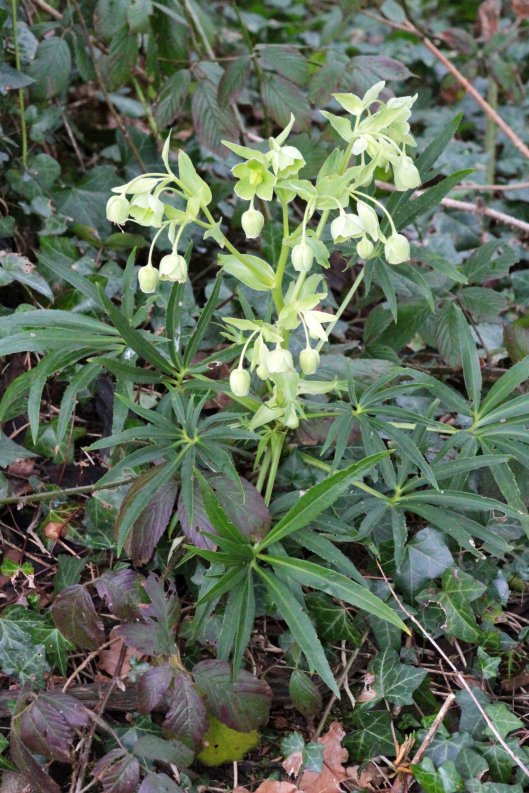
With a scientific name of Helleborus foetidus and common names of Stinking hellebore, Foetid hellebore and Stinkwort, you might well assume that this wildflower has a bad smell. Well, I didn’t smell a thing when I took a close look at it and I’ve since read that you need to crush the leaves to release a smell described as ‘beefy’. However, I’m actually very glad I didn’t crush the leaves, or even touch the plant, because every part of this native wildflower is poisonous. Though it was used in times gone by as a remedy for intestinal worms, it did, on occasion, kill the patient as well as the worms! At the very least, if ingested, it will cause vomiting and nausea, delirium and diarrhoea, and some of its poisons can also be absorbed through the skin, so best look but don’t touch.

In the wild, the Stinking hellebore grows in scrub and woodlands (which is where I found it) but, perhaps surprisingly, people do grow it in their gardens. Though it has a very pretty flower, I think its hazardous properties would be enough to put me off.

26 Tuesday Jan 2016
Posted in flowers, nature, nature photography, spring, wildflowers
Tags

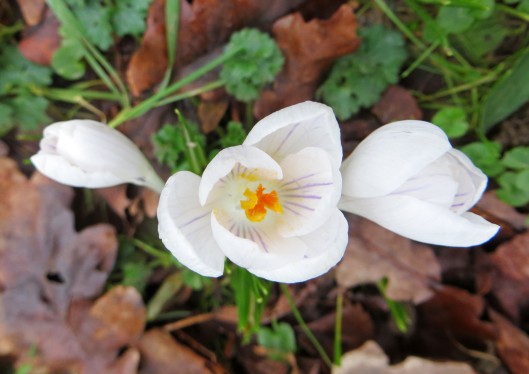
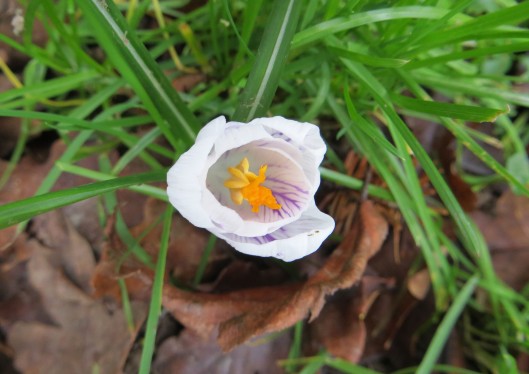
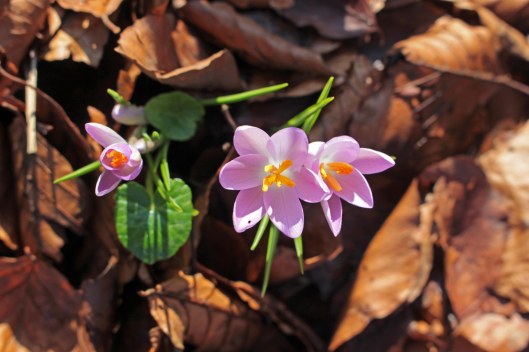
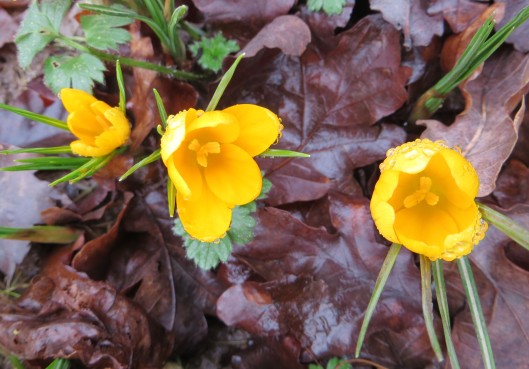
‘Soon as the frost will get out of my bed,
From this cold dungeon to free me,
I will peer up with my little bright head;
And all will be joyful to see me.
Then from my heart will young petals diverge,
As rays of the sun from their focus;
I from the darkness of earth shall emerge
A happy and beautiful Crocus!’
From the poem ‘The Crocus’s Soliloquy’ by Miss H. F. Gould in The Poetry of Flowers and Flower of Poetry, ed. Frances Sargent Locke Osgood, J. B. Lippincott & Co, Philadelphia, 1863.


You must be logged in to post a comment.