
Tags
Common spangle gall, Currant gall, galls on oak, Neuroterus quercusbaccarum, Oak gall, Oak gall wasp, oak tree, Spangle gall
This is part one of the story of Oak galls – there will be a sequel (possibly two) because the poor old oak tree, one of the most iconic of British trees, the one almost everyone can identify, is also one of the trees most attacked by galls (though, in this case, the galls do little, if any, damage to the actual tree). This first Oak attack story is a bit like the chicken and the egg – which came first? – as Neuroterus quercusbaccarum, a wasp so tiny that only expert spotters ever actually see it, has the ability to reproduce both sexually and asexually, producing two types of gall on oak trees: the sexual generation is produced inside the Currant galls and the asexual generation develops inside the Common spangle galls.


Let’s start with the Currants. As their name suggests, they look a little like currants or berries, maturing in colour from yellow and green to red and purple. In spring, you can find these attached to an Oak’s catkins or to the undersides of leaves.
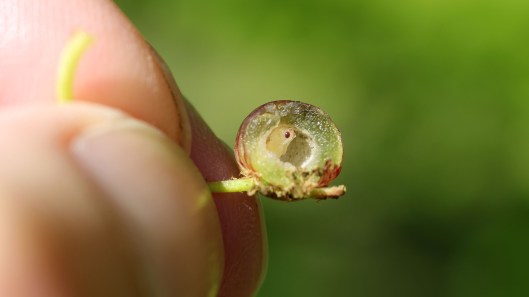
Inside, tiny larvae develop, emerging as adult wasps in June. These wasps are either male or female, they mate soon after emerging, then lay their eggs within the epidermis on the undersides of oak leaves.


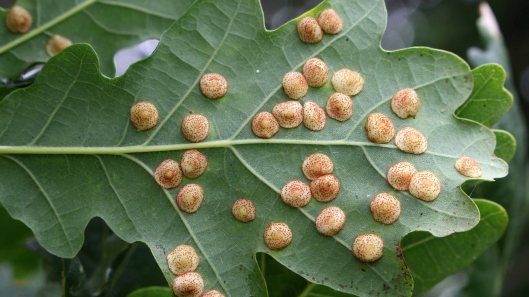
Now to the Spangles. When the eggs of the Currant gall generation hatch and their larvae begin to develop within the oak leaves, they create Spangle galls on the undersides of those leaves. The galls look a little like inverted saucers, with a slight hump in the middle. They are hairy and often quite a bright pinkish red to begin with, maturing eventually to a dull brown. Once mature, in late summer, the spangles detach and fall to the ground to be covered by the leaves of the oak, when they fall in autumn. The larvae overwinter in their cosy spangles, hatching in the spring when, without the need to mate, they lay their eggs on the oak’s leaves and catkins, thus producing the alternate generation of Currant galls. And so the cycle continues …
 earthstar
Pingback: 268/366 Gone galling | earthstar
Pingback: Oak galls: spangles & oysters | earthstar
Pingback: Oak galls: marbles and apples | earthstar
Pingback: Oak galls: knoppers and artichokes | earthstar
Masses of spangles galls on a young oak in my garden. Pics on my argyllgarden blog.
LikeLiked by 1 person
Fascinating, I always wondered what they were, oaks are amazing to say the least. really enjoyed reading this and look forward to part two and maybe three.
LikeLiked by 1 person
Thanks, Ralph. I’m glad you enjoyed the blog. More galls today and tomorrow. 🙂
LikeLike