
Tags
British flora, British wildflowers, Fox and cubs, Grim the collier, orange hawkweed, Pilosella aurantiaca
Although Pilosella aurantiaca (more commonly known as Fox-and-cubs) is a native of northern Europe, it must’ve been introduced to Britain a very long time ago as it gets a mention in Gerard’s 1633 Herbal. Gerard called it Grimme the Collier, which seems to me a most intriguing name.
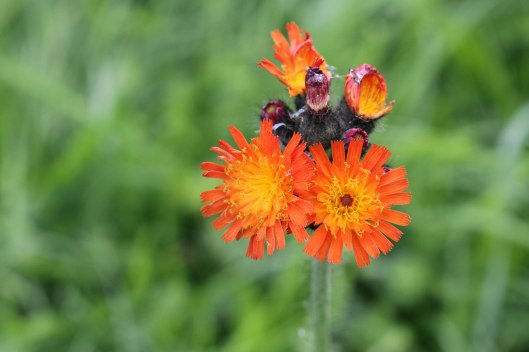
I’ve read speculation that the name may have been coined because the plant’s hairs resemble coal dust on a miner’s beard (really?) but there was also a play that originated in the early 1600s called Grim the Collier of Croydon and that was apparently based on a real-life character from the mid 16th century.

It would seem more likely that the plant’s name relates to the person or the play but, in that case, I can’t help wondering: was Grim tall with a head of bright orange hair? Was Grim an invader from northern Europe? Were these particular flowers mentioned in the play? So many questions! If you can shed any light on the collier story, please do tell.
 earthstar
H, it is worth noting that the collier being referred to is what we today would call a charcoal maker. Croydon, a heavily wooded area in the 16th century, was famous for the amount of colliers making charcoal to serve London. The archbishop of London in the late 16th century, Whitgift, had a residence in Croydon and unsuccessfully petitioned for the reduction of charcoal making near his palace as the smoke was such a nuisance. There is little left of this today but, a clue to the production of charcoal in South London can be found in the name Colliers Wood. I, for a hobby, portray a Tudor collier at various events and if you are interested I have a blog about my research into the subject at http://tudorwoodcollier.blogspot.com/
LikeLiked by 1 person
Fascinating stuff, James. Thanks for sharing, and I’ll certainly head over for a look at your blog.
LikeLike
Hi, I’m also a kiwi but living in Norfolk, and I’ve also been puzzling over the name ‘Grim the Collier’ given by Gerard.
Following your reference to the play, I think I’ve tracked down the reason for the name – you were right about the link to redheads! So: there was a play ‘Damon and Pythias’ by Richard Edwardes (about 1564), which was performed for Elizabeth the First (therefor popular). It had a character called Grim the collier (he seems to have been an architype), who was described as being ‘of a right Croydon sanguine’. From what I’ve been able to find, a ‘Croydon sanguine’ was a physical type with auburn hair and tawny skin – I guess it may have been a common Croydon type.
I also think that this plant must have been introduced as a garden plant in about 1620 give-or-take: it’s not in Gerard’s original Herbal (1597), and in the later revision (1636) Thomas Johnson says that it’s ‘a stranger and only to be found in some few gardens’. It has a strong scent and bees love it, so I’m not surprised it was grown in gardens!
Thanks for the clue…this has been bugging me for ages!
LikeLiked by 1 person
Brilliant research, Rowena. Thanks so much for sharing your findings – fascinating! 🙂
LikeLike
Pingback: 173/365 Orange hawkweed | earthstar