
Tags
Andricus aries, gall wasps, galls on oak trees, Neuroterus numismalis, oak galls, oak tree, Ram’s-horn gall wasp, Silk button gall wasp
I can’t resist just one more post about oak galls, because I’ve just this week found one that’s not commonly recorded. So, today we have one that’s uncommon and one that’s very common. Let’s start with the former.
First identified in eastern Europe in 1859, the Ram’s-horn gall wasp, Andricus aries, has slowly been heading westwards and finally reached Britain in 1997. Since that first sighting in Berkshire, it has spread over much of southern England and into Wales. Though there are only a few records in the Aderyn database of Welsh biological records, two of my friends have also found Ram’s-horn galls in the past week so I suspect it’s more common that records suggest.


Like other gall-inducing wasps, Andricus aries lays its eggs on various species of oak and its larvae cause the oak to produce a gall, in this case with an elongated, sometimes spiralling shape, hence aries and its common name Ram’s-horn. Not much is yet known about this wasp, so if you see the gall, please do record it.
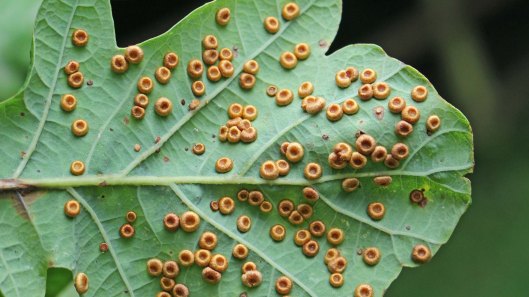
My second gall today is one many people will have seen, I’m sure, as its beautifully crafted silk-like button-shaped galls are very common on the undersides of oak leaves during the summer months. This gall contains the agamic generation (females needing no males to reproduce) of the Silk button gall wasp, Neuroterus numismalis. The galls fall to the ground in autumn and the larvae within pupate over the winter months. When the all-female wasps emerge in springtime, they lay their eggs on the edges of oak leaves and on the male catkins, where their larvae cause a different blister-shaped gall – that’s another one for me to seek out next spring. It is the female and male wasps of this second, sexual generation produced in the Blister gall that go on to mate and lay the eggs that result in the silk buttons. And so the cycle continues …


 earthstar
Pingback: 268/366 Gone galling | earthstar
This is a fantastic blog Annie, the photos and writing are superb – I love it!
Phil
LikeLiked by 1 person
…although I would have liked to have spelt my own name correctly 🙂
LikeLiked by 1 person
Hehe … happens to us all! 😉
LikeLike
Thanks a lot for your comments, Phil – they’re very much appreciated!
LikeLike
I find galls fascinating but also bewildering as I try tto o understand how the physiology works.
LikeLiked by 1 person
I know! Or rather, I don’t know! Chemical reactions? But how? Also, this whole thing of two different generations, sexual and agamic – makes you wonder how/why that developed too.
LikeLiked by 1 person
Never seen the Ram’s-horn before. Great photos and info, Annie! One I shall look out for. I do like my plant galls, too 🙂
LikeLiked by 1 person
There are just so many galls to be found once you start looking. There’s a relatively new ‘British Plant Galls’ group on facebook that may interest you, Pete. 🙂
LikeLiked by 1 person
I will have a look, thank you, Annie 🙂
LikeLiked by 1 person
Looks interesting!
LikeLiked by 1 person
Thanks, Ilze. 🙂
LikeLike