
Am I the only person who used to pronounce this word wrongly: coton-easter instead of cot-own-e-aster?
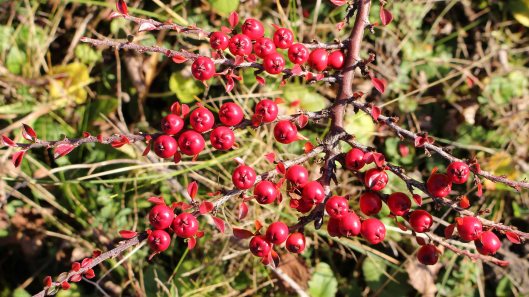
Now that I’ve got the pronunciation right, I want to have a moan about the plant itself. Don’t get me wrong – with those charming, heart-shaped leaves and luscious red berries, it’s very attractive … when it’s in a garden. The problem is that birds find its berries luscious and attractive too, and they eat them, and they fly away, and they poop. And a few months later, up pops another Cotoneaster plant but not always where it’s wanted. (There are Cotoneaster plants by the score at Cosmeston Lakes Country Park, where I regularly go walking.)


So, now, because it has a habit of spreading easily, damaging native vegetation, and is difficult to get rid of, the Cotoneaster has been classified as a ‘non-native invasive’ on Schedule 9 of the Wildlife and Countryside Act in England and Wales making it an offence to plant or otherwise cause to grow these species in the wild. And it’s going to take a lot of back-breaking effort by someone to get rid of all the plants growing where they’re not wanted.

 earthstar
Birds eat the apples & then poop on Chudleigh Knighton heath, the seeds germinate, grow in to strong healthy trees, bear fruit, & then I collect the windfalls & make chutney etc.
LikeLiked by 1 person
I wonder what would be growing on the heath if the apple trees weren’t there. I wonder if the large quantity of fruit helps the local blackbird population. I wonder what else eats the apples – voles, mice? I wonder how good your chutney tastes! 😉
LikeLike
I spent weeks digging a big patch up once, a bit at a time.
LikeLiked by 1 person
Sounds like hard work!
LikeLike
Yikes, the cotoneaster is one of the very best plants to grow to encourage and feed birds! ‘They’ should be encouraging any plant that birds eat because many of the birds that eat them are endangered. (Like bees. Bees love cotoneaster flowers.) How ridiculous!
I do understand your annoyance at the birds’ poo from these berries, our patio is covered in it each year but we put up with it because it keeps the birds happy.
Oh and, for fun, we also pronounce it cotton-easter, but know the correct pronunciation too. 🙂
LikeLike
I understand what you’re saying, Val, and I know both birds and bees love this plant. I guess the solution would be to plant more native plants that the birds and bees like just as well. 🙂
LikeLiked by 1 person
Yes, and presumably this only affects Cotoneasters in the wild, not in people’s gardens?
LikeLike
I didn’t know that Cotoneaster was considered as an invasive plant. I am sure in years gone by I have grown the this plant in my garden. I really can not see what difference there is in growing this plant in your garden or in the wild. The birds are still going to eat the berries and redistribute the seeds anywhere.
LikeLiked by 1 person
Apparently, there is a native cotoneaster, Joyce, but it only grows on the Great Orme and there are only 6 plants so it’s extremely rare. All the others are non-native invasives, and their growth in the wild causes problems for other native plants. It’s an age-old story, whether it’s plants or creatures living outside their native homeland.
LikeLiked by 1 person
Thanks, Annie. I probably wouldn’t plant one now anyway, but if I did I would look for a native Cotoneaster.
LikeLiked by 1 person
I thought it was pronounced ‘coton-easter’ too! I have one in the front garden haha, Thanks for informing me of the correct pronunciation!
LikeLiked by 1 person
I’m glad I’m not the only one! 🙂
LikeLike
It doesnt matter how it’s pronounced Annie. I have great fun upsetting my French friends with my pronunciations!
LikeLiked by 1 person
Sacre bleu, Paul, would that be French with a Welsh accent? 😉
LikeLiked by 1 person
No just an awful accent
LikeLiked by 1 person
I’m not a huge fan of it, but I didn’t know that it causes such a problem. Thanks for enlightening me.
LikeLiked by 1 person
You’re welcome. Thanks for dropping by. 🙂
LikeLike