
Tags
beetle grub eating Rosemary, British beetles, British insects, Chrysolina americana, Rosemary beetle, Rosemary beetle larva
Normally, I would be quietly cursing the inefficiencies of the rail system when I am forced to wait an extra 20 minutes due to my scheduled train being cancelled, as happened to me yesterday morning, but, trying to be positive, I decided to have a poke around the station’s plants. I should perhaps clarify that this is not one of those stations where volunteers plant up gorgeous flowering displays in planters and hanging baskets – far from it. There are two planter boxes with small shrubs that get hacked with something resembling an electric hedge trimmer every couple of years, and a tiny embankment under trees that must once have had wildflower seeds sprinkled on it but is now quite wild and unkempt.

I focused on the planter boxes and almost immediately noticed that something had been nibbling on the leaves of the Rosemary bushes in each of the planters.

I wasn’t that hopeful of finding anything but bent in for a closer look at the damaged areas, and bingo! Despite the temperature hovering around 4ºC, the little creature above was happily munching its way down the side of one of the leaves. And then I found a second one, the little grub shown below.
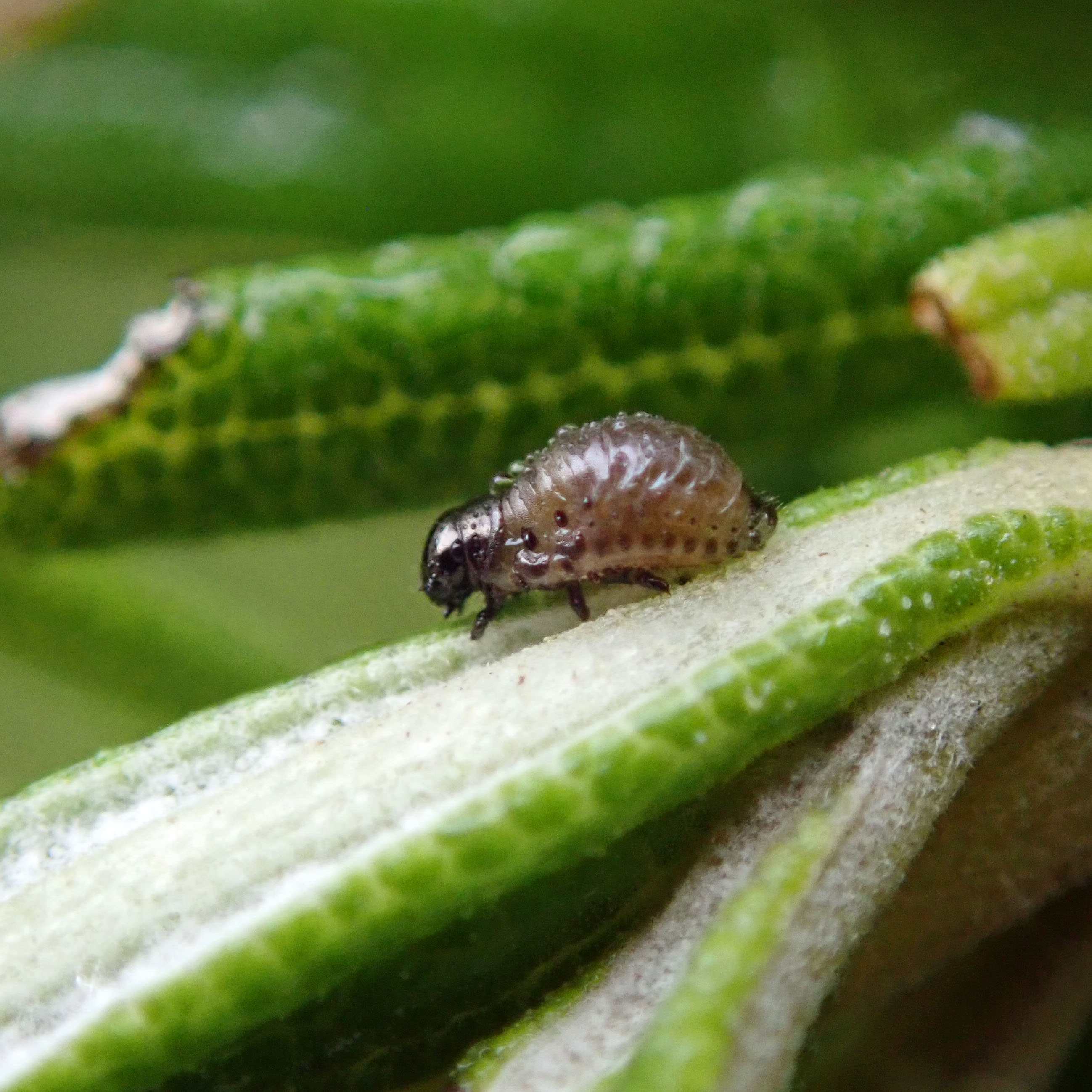
It turns out that I had just found my first larvae of the Rosemary beetle (Chrysolina americana), a beetle that arrived in Britain from Europe in the 1990s and is rapidly spreading out from its original landing point in the south east of England. Gardeners are probably not very happy about this, as the beetle will also do damage to other plant species – Lavender, Sage, Thyme – as well as the Rosemary for which it is named, but the adult beetle is very attractive, so I’m looking forward to checking these planters for them later in the year.
 earthstar
Does the beetle have any predators in the UK yet? I get it on my rosemary most years, though I don’t think I noticed it this year.
I have just listened to a webinar by a Dr Ian Bedford an entomologist who gave gardeners sound advice. Don’t get rid of the bugs such as aphids and these little critters, no doubt too, at the first sight of infestation as the predators have to have time to do their work, or we will lose them, killed by the same chemical as kills the aphids. But they multiple much less fast than the pests, so in the end we don’t have any predators left! And that means in the end there won’t be any birds either!
LikeLiked by 2 people
That webinar sounds interesting, Jillian, and he’s certainly right about leaving Nature as long as possible to sort out the problems, rather than using chemicals. I don’t know a huge amount about Rosemary beetles but I imagine birds and other, predatory beetles will eat them.
And, to be honest, though I included a photo of the damage the beetle larvae were doing to the Rosemary, that was a close up – when you stood back from the plant, it was hardly noticeable. At a distance, the plant looked fine. 🙂
LikeLiked by 1 person