• ABOUT
  • BIRDING 2018
  • Birding 2019
  • BLOG POSTS
  • Butterflies 2018
  • Resources

earthstar

~ a celebration of nature

earthstar

Author Archives: sconzani

And then there were two

18 Saturday Nov 2023

Posted by sconzani in autumn, birds

≈ Leave a comment

Tags

birding, birdwatching, Black redstart, British birds, Cardiff Bay birding, female Black redstart

On 8 November I posted about the return of a male Black redstart to a location this species has, in recent years, favoured for over-wintering in Cardiff Bay. I’m pleased to report that a female has now been sighted in the same area – I spotted her hopping around the top of the BBC building last Tuesday. A female was also spotted on waste ground a couple of blocks away later in the day, which may be a third bird or it may be the same female exploring the area. We will have to wait for more sightings and photographs to be sure but it is wonderful to have these little characters back with us again.

231118 black redstart

Like Loading...

Lumpy brackets

17 Friday Nov 2023

Posted by sconzani in fungi

≈ Leave a comment

Tags

bracket fungi, British fungi, Lumpy bracket, Trametes gibbosa, white bracket fungus

How to identify Lumpy brackets (Trametes gibbosa) (courtesy of the First Nature website):
– found on most kinds of hardwood trees but most commonly on Beech (these were on Beech)
– the pale upper surface is often discoloured by green algae, particularly away from the edges
– the pores are slot-like, rather than round or oval as found on other whitish Trametes
I found this impressive array of Lumpy brackets on a huge fallen Beech in Cardiff’s Heath Park.

Like Loading...

Dog sick

16 Thursday Nov 2023

Posted by sconzani in fungi

≈ Leave a comment

Tags

British slime moulds, Dog sick, Dog sick slime on grass, Dog vomit, Dog vomit slime on wood, Fuligo septica, Mucilago crustacea, slime mould

There are two slime moulds that are named for their resemblance to dogs’ vomit. One is called Dog sick (Mucilago crustacea), which starts off yellow but fades to white, then eventually looks much darker due to its mass of black spores. The key thing with this slime mould is that it grows on grass or other vegetation.

231116 Mucilago crustacea

The other is Fuligo septica, commonly known as the Dog vomit or Scrambled egg slime (though, obviously, it’s not something anyone would ever want to eat, regardless of how much its yellow lumpy appearance resembles scrambled egg). Although it can look very similar to Mucilago crustacea, it grows on wood, on dead trees and branches in woodland areas but also on wood chip and bark mulches, according to the Naturespot website.

231116 Fuligo septica

The Dog sick shown here was found in a cemetery last week; the Dog vomit image is from my photo library. (I hope you weren’t having your breakfast when you read this!)

Like Loading...

A bird’s verdict

15 Wednesday Nov 2023

Posted by sconzani in birds

≈ 6 Comments

Tags

birding, birdwatching, British birds, horror plastic grass, Pied wagtail, plastic grass bad for environment

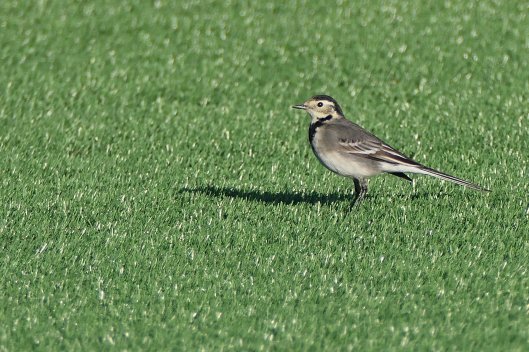
Hate is a strong word but I can honestly say that I hate plastic grass! Not only does it look fake, it’s incredibly bad for the environment. (Rather than me arguing the points for and against plastic grass, there’s a great article on Plymouth University website that answers the question ‘Why are artificial lawns bad for the environment?‘.) I particularly hate the plastic grass in the photo below – it’s literally at the beach, with just the coastal path separating the property from the sand and rocks, so its very presence spoils the natural environment that surrounds it. When I walk that way, I feel angry and sad and also baffled that someone who lives in such a beautiful location has chosen to cover their front yard with a carpet of plastic. When I passed by last week, for the first time I also felt amused, because the Pied wagtail, when it realised it would find no insects in this plastic desert, raised its tail and pooped, before flying off to more productive pastures. The bird’s reaction seemed perfect to me and entirely appropriate!

231115 pied wagtail on plastic

Like Loading...

A mess of Hare’s-foot fungi

14 Tuesday Nov 2023

Posted by sconzani in fungi

≈ 2 Comments

Tags

British fungi, Coprinopsis lagopus, fungi in leaf litter, Hare's-foot, Hare's-foot inkcap, inkcaps, leaf litter

When I take photos of fungi, I often try to tidy up the scene a little first, plucking away stray twigs or flattening with my shoe the grass that’s obscuring the view of the actual fungi. In this particular situation, that was not possible, partly because I couldn’t get any closer to the fungi (which were on private land) and partly because, even if I could’ve moved closer, there was simply too much vegetation to remove without damaging their fragile forms. So, I decided to present these Hare’s-foot inkcaps (Coprinopsis lagopus) as they really were, small and elegant black-and-white parasols partially obscured amidst a colourful mess of small branches and leaf litter. A very autumnal scene.

Like Loading...

Leafmines: Coleophora gryphipennella

13 Monday Nov 2023

Posted by sconzani in insects, leaves

≈ Leave a comment

Tags

Coleophora gryphipennella, leaf-mining moth larvae, leaf-mining moths, moth larvae in leaf mines

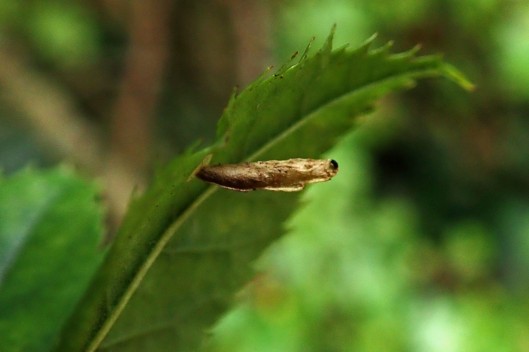
Another leaf-turning session recently resulted in another leafminer, the tiny moth Coleophora gryphipennella whose larvae feed on various species of Rosa. (You can see the adult moth on the UK Moths website here.)

231113 Coleophora gryphipennella on Rosa sp (1)

According to the British Leafminers website, the larvae, which create a tiny case to live in, can initially be found mining leaves from late August to late October. They hibernate in their cases over the colder winter months before emerging to feed again from April to mid May in a newly constructed case. These moths are apparently common, though this is the first I’ve spotted in all my time spent staring at and turning over leaves.

231113 Coleophora gryphipennella on Rosa sp (2)

Like Loading...

59!

12 Sunday Nov 2023

Posted by sconzani in autumn, flowers, wildflowers

≈ 4 Comments

Tags

autumn colour, autumn wildflowers, British wildflowers, wildflowers in bloom

I was surprised at the start of the week to find wildflowers blooming that should long since have gone to seed and that inspired me to see just how many wild flowers I could find during this week’s walks. The answer, of course, is in the title of this post – 59! That is to say, I have 59 images to share but there were a few more plants in flower that I didn’t manage, for one reason or another, to photograph. Some wildflowers were quite unexpected, like the Carline thistle that had one flower open and 3 more buds still to develop; some were abundant, like the Yellow-wort still standing tall in a field at Cosmeston; others, like the Common stork’s-bill, were the last survivors of the strimmers that have been very active this month. Here they all are …

Like Loading...

Seven

11 Saturday Nov 2023

Posted by sconzani in birds

≈ Leave a comment

Tags

birding, birdwatching, British birds, Cardiff Bay, Cardiff Bay birding, cygnets, Mute swan, Mute swan cygnets

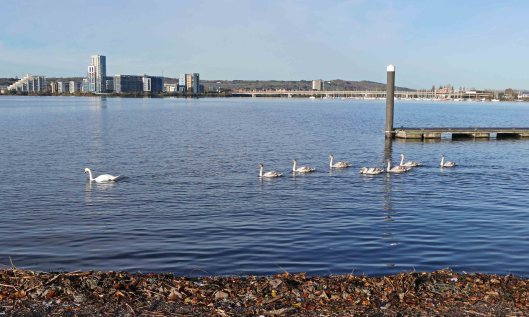
This was the scene earlier today in Cardiff Bay, a glorious morning for mother (or father) Mute swan to take their seven cygnets for a glide along the edge of the Barrage.

231111 seven cygnets

Like Loading...

Purple jelly

10 Friday Nov 2023

Posted by sconzani in autumn, fungi

≈ Leave a comment

Tags

Ascocoryne sarcoides, British fungi, purple fungi, Purple Jellydisc

I don’t see Purple jellydisc (Ascocoryne sarcoides) very often in my area – not sure why, so it was a lovely surprise to spot it on some felled trees in Cardiff’s Grangemoor Park last week. As the First Nature website explains, this fungus has two stages: the telemorphic stage where the fungus forms cup-like structures in which ascospores are produced and the anamorphic stage that I found in which asexual (cloned) conidia are produced. There is a very similar fungus, Ascocoryne cylichnium, but it only has cup-shaped fruit bodies.

231110 purple jelly disc

Like Loading...

Hide and huddle

09 Thursday Nov 2023

Posted by sconzani in autumn, insects, leaves

≈ 2 Comments

Tags

autumn leaves, British insects, importance of leaves, insect decline, insects in leaves, over-wintering insects in leaves, snails in leaves

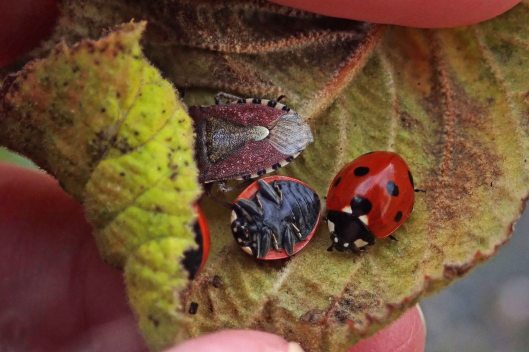
When the weather’s cold and wet, it’s time to hide and huddle. I found five 7-spot ladybirds and a Hairy shieldbug in this rolled-up leaf. (And, don’t fret, I rolled it up again so they could get back to their snoozing.)

231109 hide huddle hairy shieldbug 7spots

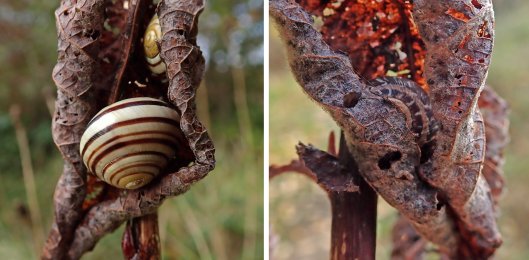
And they’re not the only ones choosing leaves for home and shelter as the colder weather approaches. All sorts of creatures creep or crawl or slide inside a conveniently place leaf-roll. Like these earwigs and, below, those snails.

231109 hide huddle earwigs

Though these leaves will eventually fall to the ground, they’ll be home to a diverse abundance of creatures during the winter months, which is why it’s always best to let some leaves remain on the ground – please don’t be tempted to rake or blow them all away for the sake of tidiness. Nature is not tidy and, given there’s been a 60% decline in flying insects in the UK in the last 20 years (just one example of Nature’s overall decline), leaving leaves in place is the very least we can do.

231109 hide huddle snails

Like Loading...
← Older posts
Newer posts →

About me

sconzani

sconzani

I'm a writer and photographer; researcher and blogger; birder and nature lover; countryside rambler and city strider; volunteer and biodiversity recorder.

View Full Profile →

Follow earthstar on WordPress.com

Enter your email address to follow this blog and receive notifications of new posts by email.

Recent blog posts

  • Gorse and its weevil April 5, 2026
  • Chiffchaffs chiffchaffing April 4, 2026
  • Bearded tit!!! April 3, 2026
  • A Portland Bill Kestrel April 2, 2026
  • A proliferation of Peacocks April 1, 2026

From the archives

COPYRIGHT

Unless otherwise acknowledged, the text and photographs on this blog are my own and are subject to international copyright. Nothing may be downloaded or copied without my permission.

Fellow Earth Stars!

  • Unknown's avatar
  • Unknown's avatar
  • Unknown's avatar
  • Unknown's avatar
  • Unknown's avatar
  • Unknown's avatar
  • Unknown's avatar
  • Unknown's avatar
  • Unknown's avatar
  • Unknown's avatar
  • Unknown's avatar
  • Unknown's avatar
  • Unknown's avatar
  • Unknown's avatar
  • Unknown's avatar
  • Unknown's avatar
  • Unknown's avatar
  • Unknown's avatar
  • Unknown's avatar
  • Unknown's avatar
  • Unknown's avatar
  • Unknown's avatar
  • Unknown's avatar
  • Unknown's avatar
  • Unknown's avatar
  • Unknown's avatar
  • Unknown's avatar
  • Unknown's avatar
  • Unknown's avatar
  • Unknown's avatar
  • Unknown's avatar
  • Unknown's avatar
  • Unknown's avatar
  • Unknown's avatar
  • Unknown's avatar
  • Unknown's avatar
  • Unknown's avatar
  • Unknown's avatar
  • Unknown's avatar
  • Unknown's avatar
  • Unknown's avatar
  • Unknown's avatar
  • Unknown's avatar
  • Unknown's avatar
  • Unknown's avatar
  • Unknown's avatar
  • Unknown's avatar
  • Unknown's avatar
  • Unknown's avatar
  • Unknown's avatar

Blog at WordPress.com.

Privacy & Cookies: This site uses cookies. By continuing to use this website, you agree to their use.
To find out more, including how to control cookies, see here: Cookie Policy
  • Subscribe Subscribed
    • earthstar
    • Join 642 other subscribers
    • Already have a WordPress.com account? Log in now.
    • earthstar
    • Subscribe Subscribed
    • Sign up
    • Log in
    • Report this content
    • View site in Reader
    • Manage subscriptions
    • Collapse this bar
 

Loading Comments...
 

You must be logged in to post a comment.

    %d