The owner of these feet approached me yesterday, looking for food. A bigger clue to its identity I could not give! So, whose feet are these?
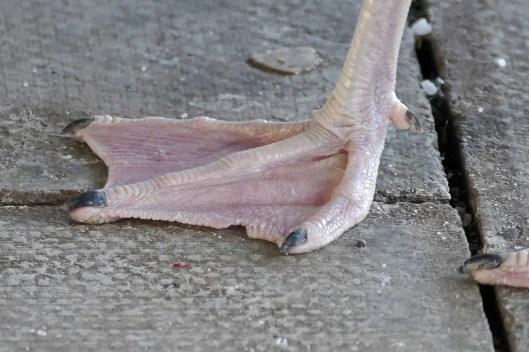
The big reveal …

Have you worked it out now? It’s a Herring gull.

19 Friday Jan 2024
Posted in birds
The owner of these feet approached me yesterday, looking for food. A bigger clue to its identity I could not give! So, whose feet are these?
The big reveal …
Have you worked it out now? It’s a Herring gull.
18 Thursday Jan 2024
This handsome bird, a Red-necked grebe (Podiceps grisegena), was first sighted on north Cardiff’s reservoirs last Thursday 11 January by our county bird recorder, who lives very near this location. He says this bird is only his ninth ever at the site and the first since September 2001 – by anyone’s definition, a local rarity.

The reservoirs are just a train ride and a half mile walk from where I live so I headed up on Thursday to see if I could spot it. I did, firstly on the much larger Llanishen Reservoir from where it flew across to neighbouring Lisvane Reservoir but, at least while I was there, it remained very distant. As is the way with birding, later that day the grebe moved very close to the reservoir edge nearest the café, so afternoon visitors got very good views of the bird.

As I needed to go to north Cardiff again this past Monday on another matter, I thought I’d visit the reservoirs for a second look. And this time my luck was in, both with the sunny, less windy weather and with the grebe, which had returned to Llanishen Reservoir but, fortunately, was cruising around much closer to the western edge.

According to the RSPB website, ‘Less than 20 individuals spend the summer in the UK each year, with numbers increasing slightly in the winter when birds move here from colder Europe’, so I feel particularly privileged to have spent time observing and photographing this Red-necked grebe. Oh, and if you think its neck doesn’t look very red, it’s because the bird is in its winter plumage. Take a look at the RSPB website for photos of how stunning this bird is in breeding plumage.

15 Monday Jan 2024
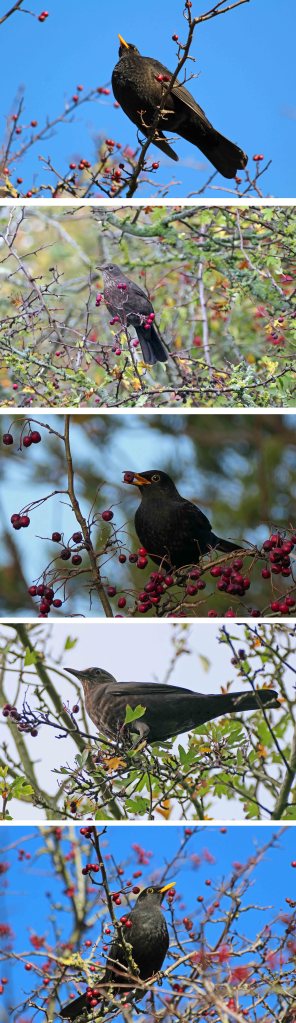
I mentioned yesterday that any remaining berries are fast disappearing as hungry birds search for sustenance in the cold winter weather. Well, here’s one of those berry eaters, the one that I find a bit more cooperative when it comes to photographs than many of the other berry-eating birds, the beautiful Blackbird. (I find Redwing and Fieldfare, Song and Mistle thrushes all tend to be a little more elusive.)
13 Saturday Jan 2024
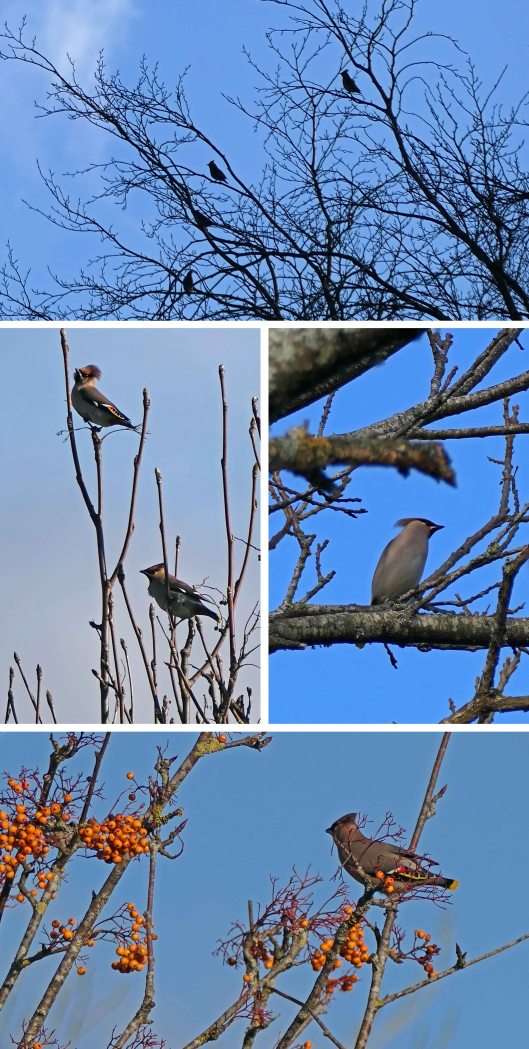
I’ve been waiting, and waiting, and waiting, trying to be patient, not always succeeding. Then, finally, this week, Waxwings arrived at a park in north Cardiff, just a train ride away from home. I’m sure the four Scandinavian stunners felt right at home in the freezing temperatures today – not so the 20 or so birders waiting for the birds to come down from the treetops to eat the berries on the row of Rowan trees edging the park’s central path. Unfortunately, the Waxwings only came down to feed for a very short time while I was there but these were my first ever Waxwings so I was more than happy! Have you seen any this year?
11 Thursday Jan 2024
Tags
birding, birdwatching, British birds, Cardiff Bay birding, colour rings on Redshank, Peter Redshank, Redshank
Every year I worry just a little about our local ringed Redshank, affectionately named Peter for the fact that s/he was ringed at Peterstone Great Wharf, just along the coast from Cardiff (see Tracking Mr Redshank, March 2017). This handsome bird is at least eight years old, possibly older, as it was ringed as an adult in February 2016. And each year our local Redshanks brave the perilous north Atlantic twice, to fly to Iceland to breed and then return to our shores to over-winter. Fortunately, our Pete has made it safely back; s/he was seen by another local birder late last year, and I finally caught up with our local celebrity last Sunday.

08 Monday Jan 2024
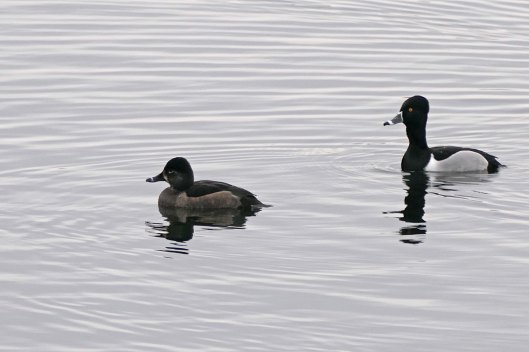
I timed my visit to the north Cardiff reservoirs extremely well last Thursday because, unbeknown to me, the previous day had seen the arrival of a handsome male Ring-necked duck, drawn no doubt by the presence of a female, who has spent much of the winter cruising about Lisvane Reservoir. She had enjoyed the company of another female for a short while and a male – perhaps the same male – for a few days as well, but has spent most of her days with the good numbers of Tufted ducks, Mallards, Coots and Little grebes that live in this reservoir’s shallow waters. I was also lucky that they were relatively close to the edge of the reservoir, which enabled me to get some reasonable photos of the male and female together. I’m not sure what had attracted their attention when I took this image – I never realised their necks could extend this far!
06 Saturday Jan 2024
Tags
birding, birdwatching, British birds, Common loon, Gavia immer, Great northern diver, Llanishen Reservoir, Loon
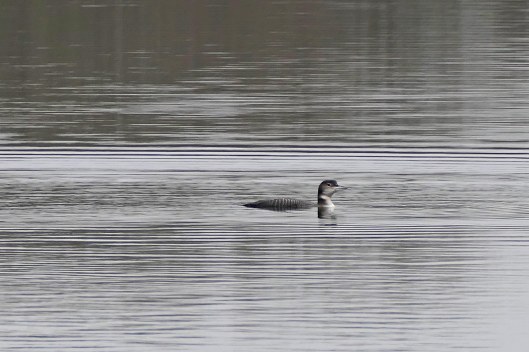
Finally, on Thursday, we had a break in the almost constant procession of wet and windy weather that made miserable many of my winter walks in December. To make the most of this, I caught the train to north Cardiff and enjoyed a wonderful walk around the recently reopened Llanishen and Lisvane Reservoirs, through the still muddy Nant Fawr woodland, and on down to Roath Park Lake. The highlight for me of this walk was getting relatively close views of the Great northern diver (Gavia immer) (what my American viewers would call a Common loon) that has been overwintering in Llanishen Reservoir. The bird was still some distance from me so my photos don’t do justice to how beautifully patterned this bird is but it was a pleasure to watch its constant diving.
02 Tuesday Jan 2024
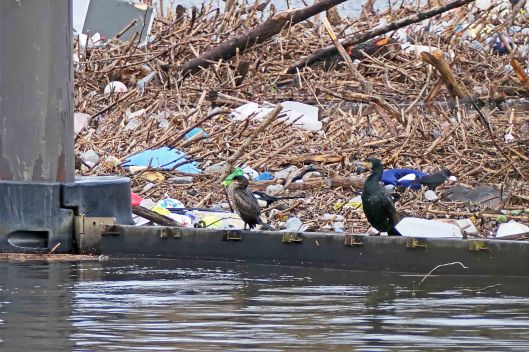
This was originally going to be yesterday’s blog post but that Otter intervened. As I mentioned yesterday, my New Year’s Day walk around Cardiff Bay is becoming a personal tradition, as I challenge myself to see how many birds I can find. There was also one particular bird that’s a local rarity that I wanted to see, so let’s start with that. This juvenile Shag (on the left) has been present on the River Taff for a few days, hanging out with the local Cormorants (one on the right of the Shag). Fortunately, it seems quite settled and, presumably, is feeding well, despite the huge amount of detritus that has been flowing down the river following all the recent rain (as you can see behind the birds).
Another star bird, of the 48 species I counted during my walk, was a male Black redstart. I blogged about these now-regular Bay visitors last year (And then there were two, 18 November) but they are still special enough to get a mention. And, in recent weeks, there have, at various times, been two males and two females in their favourite area around the BBC buildings.

This female Goldeneye was another beauty that we don’t often see in the Bay so I was grateful to one of my fellow local birders who put out the word of its presence on the water behind the ice rink. I was so lucky with my first birding walk of the year, and I’m very much looking forward to how 2024 develops, though the almost constant rain needs to stop first!

31 Sunday Dec 2023
Tags
birding, birdwatching, British birds, Cardiff Bay birding, Dreissena polymorpha, invasive mollusc, Zebra mussel
Despite there being ‘ between 10 and 35 million of them covering every hard surface’ in the waters of Cardiff Bay, I’d never heard of the Zebra mussel (Dreissena polymorpha) until I posted a photo on Twitter back in March, asking what this Coot was eating (The Coot and the Zebra mussels, 11 March). Since then, I’ve noticed Coots eating these mussels on a regular basis but, even with the hundreds of Coots in Cardiff Bay, I doubt they’ll make much of a dent on those Zebra mussel numbers.

30 Saturday Dec 2023
Posted in birds
Tags
autumn migration, birding, birdwatching, British birds, Cosmeston Lakes Country Park, Yellow wagtail
The absolute highlight of autumn migration this year was an influx of Yellow wagtails at Cosmeston (Yellow wags, 7 September). By sheer co-incidence, their passage coincided perfectly with the grass in one of the outer fields being cut for hay, which created the perfect habitat for these insect-eating wagtails. The presence of a few attracted more birds as they passed through so that there were more than 30 birds present at one stage, a record for the park according to long-time-birding locals. It was an absolute delight to watching them hopping through the clumps of cut grass, searching for the food that would help fuel their onward journey, and they only moved on when, after a week’s drying, the hay was baled.

 earthstar
You must be logged in to post a comment.