• ABOUT
  • BIRDING 2018
  • Birding 2019
  • BLOG POSTS
  • Butterflies 2018
  • Resources

earthstar

~ a celebration of nature

earthstar

Category Archives: coastal fauna

October on the Ely embankment

31 Tuesday Oct 2017

Posted by sconzani in birds, coastal fauna, nature, walks

≈ Leave a comment

Tags

birding, birdwatching, British birds, Cardiff Bay, Ely embankment, Great Crested Grebe, Linnet, little grebe, Pied wagtail, Redshank, River Ely, Rock pipit, Turnstone, Wheatear

At least once a week I take a turn along the embankment where the River Ely flows out into Cardiff Bay as it makes a nice circular walk from my home on the cliff-top above in Penarth. (It’s good exercise too, as what goes down there must walk back up!) I always record what I see – usually birds – so thought I would share my sightings in an end-of-monthly post.

171031a Ely embankment map
171031b turnstone & coot

A variety of birds make their home in this stretch of water, which they share with a yachting marina and associated water traffic coming and going. There are almost always Turnstones in varying quantities (from one to nine), Mallards, Mute swans, one or two Great Crested Grebes (including their progeny this year), a proliferation of Coots, the occasional Cormorant fishing, usually a couple of Grey wagtails and a couple of Pieds. Gulls fly overhead and there are plenty of hirundines, in the season.

171031c Wheatear
171031d Pied wagtail
171031e Rock pipit

2 October: A Wheatear, an unusual visitor, almost certainly on a migration stopover, was dotting about on the embankment stones; a Pied wagtail was doing its morning stretches, and a Rock pipit was browsing for titbits.

171031f Little grebe

171031g Great crested grebe (1)
171031g Great crested grebe (2)
171031g Great crested grebe (3)

16 October: This was the day before ex-hurricane Ophelia made her presence felt, the day of the jaundiced yellow sky and the rusty red sun, which you can see reflected in my photo of the four Little grebes that were sheltering from the incoming weather. A juvenile Grey wagtail was dotting along the embankment, calling incessantly for its parent; and a Great crested grebe was enjoying a very successful fishing session, coming up with fish in two successive dives.
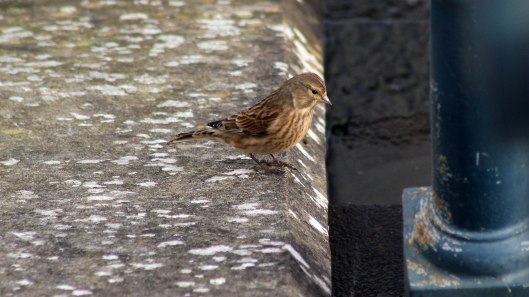
171031h Linnet

22 October: The day after Storm Brian I walked the embankment to see if any unusual birds had been blown in. The usual suspects were present, except that, most unusually, there wasn’t a single Turnstone. A solitary Linnet flitted back and forth from pavement to stones, and three rather exhausted-looking Redshanks dozed warily along the water line. One of these was colour-ringed and might possibly be the bird I saw back in March but I couldn’t see its rings well enough to be sure.

171031i Redshank

Like Loading...

Birding at Chesil Beach

21 Saturday Oct 2017

Posted by sconzani in birds, coastal fauna, nature

≈ Leave a comment

Tags

birding, birdwatching, Brent geese, British birds, Chesil Beach, Dorset Wildlife Trust Centre, Little egret, Mediterranean gulls, Oystercatchers, Sandwich terns, The Fleet

171021 Chesil Beach (2)

After exploring RSPB Lodmoor, our birding road trip moved on to Chesil Beach, and what an amazing place it is!

171021 Chesil Beach (1)

To quote a brochure I picked up: ‘Chesil Beach is a natural wonder – a bank of 180 billion pebbles stretching for 18 miles along Dorset’s coast, linking Portland to the mainland. Trapped behind the beach is the Fleet, one of the largest saline lagoons in the country and a haven for bird and marine life’.

171021 Med gulls Sandwich terns171021 Brent geese Med gulls

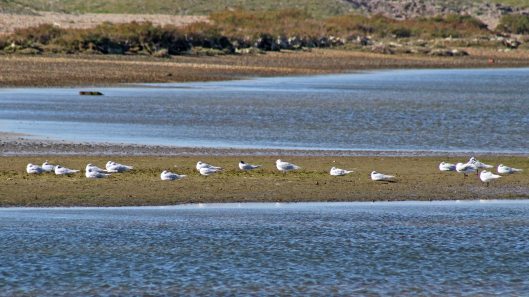
Here we staked ourselves out behind the Dorset Wildlife Trust Centre, trying, somewhat ineffectually, to shelter from the bracing winds. The wind chill was worth it though, as we had good views of a gaggle of Brent geese and a large flock of Mediterranean gulls.

171021 Sandwich terns

Amongst the gulls were two Sandwich terns, and the beach was also hosting the ubiquitous Oystercatchers and more common gulls, a Bar-tailed godwit and a solitary Dunlin.

171021 Oystercatchers Gull

A Wheatear dotted about on the grass below the pebble bank and, when we briefly stopped here again on our way home on Sunday, a Little egret entertained with its fishing antics, paddling about very successfully in the waterways. Next time I need to climb that bank!

171021 Little egret

Like Loading...

Birding on Gower

10 Tuesday Oct 2017

Posted by sconzani in birds, coastal fauna, nature, seaside, walks

≈ 4 Comments

Tags

birding, birdwatching, British birds, coastal cliffs, dramatic coastline, Glamorgan Bird Club, Gower, Mewslade, Rhossili Beach, Worm's Head

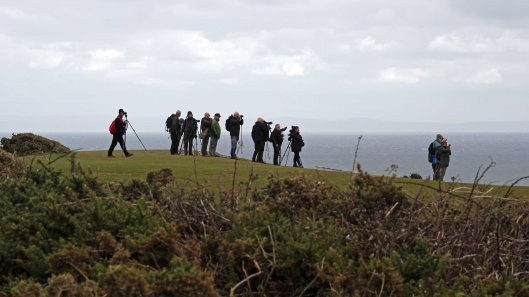
It was a wild and windy but not wet day last week when I ventured for the first time to the incredible Gower peninsula, on a birding trip with my Glamorgan Bird Club friends.

171010 Glamorgan bird clubbers

We parked near Mewslade Beach, then walked a circuit from there along the cliff-top coastal path, across the medieval field system of The Vile, through the little village of Rhossili and then back to the car park. Most of the birds were best viewed through binoculars or ’scopes so I don’t have many images of them to share but the scenery was just stunning! High stone cliffs honed in places to a razor edge by millennia of wind and rain, secret little coves nestled between tall protective hills, the long stretch of golden-sand beach at Rhossili that was recently named the best beach in Britain and one of the world’s top ten – Gower really does deserve the adjective ‘awesome’!

171010 Gower (1)
171010 Gower (2)
171010 Gower (4)
171010 Gower (3)
171010 Gower (5)
171010 Gower (6)

Oh, and getting back to the birds – I saw a total of 34 species: Cormorant, Sparrowhawk, Common Buzzard, Kestrel, Peregrine, Oystercatcher, Lesser Black-backed Gull, Herring Gull, Woodpigeon, Collared Dove, Pheasant, Magpie, Jackdaw, Carrion Crow, Raven, Blue Tit, Great Tit, Coal Tit, Long-tailed Tit, Chiffchaff, Goldcrest, Wren, Blackbird, Robin, Stonechat, Dunnock, House Sparrow, Pied Wagtail, Meadow Pipit, Chaffinch, Goldfinch, Linnet, and the two highlights for me, Common Scoter (a group of perhaps 20 floating together on the sea – seen through a ’scope) and several Gannets, flying low to the waves not far offshore, plus a bonus sighting of at least one Grey seal lolling about in the waves in one of the bays.

171010 Linnets
171010 Meadow pipits
171010 Goldfinches

The group total was 46 species as I was too busy admiring the scenery to notice these: Shag, Kittiwake, Guillemot, Razorbill, Green Woodpecker, Great Spotted Woodpecker, Chough, Rook, Bullfinch, Song Thrush, Common Gull, and Great Black-backed Gull. Thanks to John and Glamorgan Bird Club members for yet another fantastic day out!

171010 Rhossili beach

Like Loading...

Two go cuckoo at Camber

25 Thursday May 2017

Posted by sconzani in birds, coastal fauna, nature, walks

≈ 2 Comments

Tags

birding, birdwatching, Black-headed gull, Common tern, Gadwall, Lapwing, Marsh harrier, Oystercatchers, Ringed plover, Rye Harbour Nature Reserve, sheep, Shelduck, Skylark, Sussex Wildlife Trust guided walk

I celebrated my birthday, with my friend Jill, with a quick morning romp around the bird hides at Rye Harbour Nature Reserve, followed by an afternoon Sussex Wildlife Trust guided walk around the inland part of the reserve, including a peek inside the normally locked Camber Castle. And what a superb day it was!

170524 Rye Harbour fauna (10)

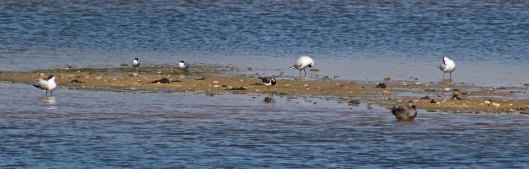
I’ve already blogged about one of the highlights, the gorgeous Avocets and their chicks; another was hearing, and catching a fleeting glimpse of my very first Cuckoo. Here are a few more (not so crisp) photos of the wonderful (but mostly distant) wildlife we saw: Common terns, Skylark, Oystercatchers and Dunlin, Black-headed gull, Ringed plover, Gadwall and Shelduck, Lapwing and a Pied wagtail, Marsh harrier, and a number 72; plus, not pictured, Redshank, Coot, Cormorant, Tufted duck, Mallard, Little ringed plover, Grey heron, Kestrel and Whitethroat, as well as the more common birds. A birthday to remember!

170524 Rye Harbour fauna (1)
170524 Rye Harbour fauna (2)
170524 Rye Harbour fauna (3)
170524 Rye Harbour fauna (4)
170524 Rye Harbour fauna (5)
170524 Rye Harbour fauna (6)
170524 Rye Harbour fauna (7)
170524 Rye Harbour fauna (8)
170524 Rye Harbour fauna (9)
Like Loading...

A lunchtime fossick at Cuckmere Haven

22 Monday May 2017

Posted by sconzani in coastal fauna, nature

≈ Leave a comment

Tags

British coastal fauna, chalk cliffs, Cuckmere Haven, Cuttlefish bone, limpet shell, Mermaid's purse, Seven Sisters Country Park, shingle beach, Whelk egg cases, whelk shells

170522 Cuckmere Haaven 7 sisters

To me, this is one of the most beautiful views in the world so what better place to sit and enjoy a picnic lunch after our wildlife walk around Seaford Head.

170522 Cuckmere Haven Whelk egg cases
170522 Cuckmere Haven Mermaid-s-purse

And, of course, I couldn’t resist a little fossick to see what the sea had washed in. Jill found the first Mermaid’s purse, one of the leathery brown-black egg cases of rays and sharks, then I found two more. The cream-coloured egg cases of Whelks were scattered all around, and Jill also discovered a sizeable chunk of Cuttlefish bone. Empty seashells lay everywhere amongst the shingle and flint, with limpets and whelks the most numerous. But then my eyes were drawn back to just soaking in the views of the incredible chalk cliffs of the Seven Sisters.

170522 Cuckmere Haven sea fauna

Like Loading...

Seaford Head wildlife walk

21 Sunday May 2017

Posted by sconzani in birds, coastal fauna, nature, plants, wildflowers

≈ Leave a comment

Tags

Brown-tail moth caterpillars, Fulmar, Green-winged orchid, Rock pipit, Rook, Seaford Head Nature Reserve, Seaford Head wildlife walk, Stonechat, Sussex Wildlife Trust, Thrift

One of the highlights of my recent short break in Sussex was a guided wildlife walk around Seaford Head, organised by the Sussex Wildlife Trust and led by knowledgeable and amusing local naturalist Michael Blencowe.

170521 1 Seaford Head walk

The day was very windy and scattered showers kept us clad in rain jackets until lunchtime but that didn’t spoil the walk. The scenery on this coast is magnificent and it’s one of my favourite places in the whole of Britain so, even if we’d not seen any wildlife, I would’ve been happy. As it was, we saw more than I expected, and our guide was a mine of funny stories and fascinating facts.

170521 2 Seaford Head Hound's-tongue
170521 3 Seaford Head Stonechat
170521 4 Seaford Head Fulmar
170521 5 Seaford Head group
170521 6 Seaford Head Rock pipit
170521 7 Seaford Head Flower
170521 8 Seaford Head Brown-tail moth
170521 9 Seaford Head Green-winged orchid
170521 10 Seaford Head Rook

Our flora and fauna sightings included many different plants in flower, like Green alkanet, Hound’s-tongue and Thrift; plus several Stonechats and Linnets, and Rock pipits and Rooks aplenty. We had Fulmars soaring up from the cliffs to the left of us and Skylarks serenading us high in the sky to the right. A grass snake was discovered snoozing under a sheet of corrugated iron, the webs of Brown-tail moth caterpillars adorned the bramble bushes, and Green-winged orchids provided striking bursts of colour in the rough alongside the local golf course. If you ever get the chance, I’d highly recommend this walk.

170521 11 Seaford Head Thrift

Like Loading...

The Russian who came in from the cold

20 Saturday May 2017

Posted by sconzani in birds, coastal fauna, nature

≈ Leave a comment

Tags

Anser albifrons, birding, birdwatching, Greylag goose, Rye Harbour Nature Reserve, White-fronted goose

That title sounds like something from a James Bond movie, sorry, but the sentiment is true enough. I’m referring to the White-fronted goose (Anser albifrons) I saw hanging out with a flock of Greylags during my recent visit to Rye Harbour Nature Reserve in Sussex (on the left in the photo below).
170520 White-fronted & Greylag geese (3)

The ‘white front’ in its name refers to the white patch on the front of its head around the beak and, as you can see, it’s quite a bit smaller than the Greylags, though its diet is similar: grass, clover, grain, wheat and potatoes.

170520 White-fronted & Greylag geese (2)
170520 White-fronted & Greylag geese (1)

These birds don’t breed in Britain but geese from two separate races frequently over-winter here; the birds with orange beaks breed in Greenland, and those with pink beaks, like the one I saw, breed in Siberia. The Greenland birds tend to over-winter in western Scotland and in Ireland, while the Greenland birds prefer southern England. They’re usually only seen from October through to March but the ranger said this one appeared with this flock of Greylags and has stayed on at the reserve with them. Maybe it doesn’t like the cold!

170520 Greylag geese

More Greylags flying in

Like Loading...

The awesome avocet

16 Tuesday May 2017

Posted by sconzani in birds, coastal fauna, nature

≈ 3 Comments

Tags

Avocet, Avocet chicks, Avocet in flight, birding, birdwatching, British birds, Recurvirostra avosetta, RSPB logo, Rye Harbour Nature Reserve

Awesome is a much overused word but I feel my use of it here is justified – I truly was in awe of these most beautiful birds, seen at the Rye Harbour Nature Reserve in East Sussex last Saturday.

170516 avocets (1)

The Avocet (Recurvirostra avosetta) is one of Britain’s conservation success stories, hence its use as a logo by the Royal Society for the Protection of Birds. After years of being killed for food and taxidermy and having its eggs robbed by collectors, the Avocet disappeared from its British breeding sites around 1842, and it wasn’t until 1947 that just four pairs were rediscovered breeding in Suffolk. Incredibly, this was, in part, due to the Second World War: damage from an exploding bomb had inadvertently recreated their ideal habitat of shallow ponds and muddy islands near the seaside at Havergate and, at Minsmere, where the coastal marshes had been flooded to prevent enemy troops invading, shallow ponds also formed when the marshes began to dry up.

170516 avocets (3)
170516 avocets (4)
170516 avocets (5)
170516 avocets (6)

Further breeding sites have now been created and protected (at Rye Harbour, with electric fences to deter predators like foxes and badgers) in suitable areas around Britain’s coastline, and the number of breeding pairs is estimated to be around 500. Long may their success continue!

170516 avocets (2)

Like Loading...

The sad tale of the hungry limpet

19 Sunday Feb 2017

Posted by sconzani in coastal fauna, nature

≈ 4 Comments

Tags

Common limpet, limpets, molluscs, Patella vulgata, Penarth cliffs

I never find many shells on the scrap of beach at the bottom of Penarth cliffs, though it’s a good place for dollops of seaglass and the very occasional fossil but, if I do manage to find any shells, they’re usually limpets, probably Common limpets (Patella vulgata).

170219-limpets-2
170219-limpets-4

Things I didn’t know about limpets until just now:
— they can live to the ripe old age of 16
— they are herbivores, feeding on the exceedingly tiny algae that cover the seaside rocks
— they have a tongue with teeth that are so sharp they can scrape the algae off the rocks like a file
— the ‘glue’ they use to attach their single foot to the rocks is so strong it can withstand a force of 75lbs per square inch
— well-fed less-stressed limpets produce flatter shells, whereas hungry limpets produce more dome-shaped shells, so the former inhabitant of the peachy coloured shell I picked up may well have died hungry!

170219-limpets-3
170219-limpets-1
Like Loading...

Barnacles

12 Thursday Jan 2017

Posted by sconzani in coastal fauna, nature

≈ 4 Comments

Tags

arthropod, barnacle, intertidal zone, suspension feeder

As there are more than 1200 species of barnacles and my knowledge of coastal flora and fauna is virtually non-existent, I’m afraid I have no idea which barnacle species this is.

170112-barnacles-1

It is, however, one of the 25% of species that occupy the intertidal zone, that area of the coast line that is covered by water at high tide but out of the water at low tide, and this means it has to be able to protect itself from dehydration. To this end, the barnacle has developed an impermeable shell and a system of secure plates to effectively seal its top opening.

170112-barnacles-2
170112-barnacles-5

Although they are active swimmers in their larval stages, once they clamp on to their particular piece of coastal rock in adulthood and secrete the calcium mix that becomes their shell, barnacles never move again. When the tide comes in and covers them, they feed on minute organisms suspended in the water, using their hairy legs as filters and gatherers.

170112-barnacles-4
170112-barnacles-3
Like Loading...
Newer posts →

About me

sconzani

sconzani

I'm a writer and photographer; researcher and blogger; birder and nature lover; countryside rambler and city strider; volunteer and biodiversity recorder.

View Full Profile →

Follow earthstar on WordPress.com

Enter your email address to follow this blog and receive notifications of new posts by email.

Recent blog posts

  • The Marl Med gull January 29, 2026
  • Recording Grey squirrels January 28, 2026
  • Jimmy Wren January 27, 2026
  • Millipede: Nanogona polydesmoides January 26, 2026
  • Mid-winter 10 January 25, 2026

From the archives

COPYRIGHT

Unless otherwise acknowledged, the text and photographs on this blog are my own and are subject to international copyright. Nothing may be downloaded or copied without my permission.

Fellow Earth Stars!

  • Unknown's avatar
  • Unknown's avatar
  • Unknown's avatar
  • Unknown's avatar
  • Unknown's avatar
  • Unknown's avatar
  • Unknown's avatar
  • Unknown's avatar
  • Unknown's avatar
  • Unknown's avatar
  • Unknown's avatar
  • Unknown's avatar
  • Unknown's avatar
  • Unknown's avatar
  • Unknown's avatar
  • Unknown's avatar
  • Unknown's avatar
  • Unknown's avatar
  • Unknown's avatar
  • Unknown's avatar
  • Unknown's avatar
  • Unknown's avatar
  • Unknown's avatar
  • Unknown's avatar
  • Unknown's avatar
  • Unknown's avatar
  • Unknown's avatar
  • Unknown's avatar
  • Unknown's avatar
  • Unknown's avatar
  • Unknown's avatar
  • Unknown's avatar
  • Unknown's avatar
  • Unknown's avatar
  • Unknown's avatar
  • Unknown's avatar
  • Unknown's avatar
  • Unknown's avatar
  • Unknown's avatar
  • Unknown's avatar
  • Unknown's avatar
  • Unknown's avatar
  • Unknown's avatar
  • Unknown's avatar
  • Unknown's avatar
  • Unknown's avatar
  • Unknown's avatar
  • Unknown's avatar
  • Unknown's avatar
  • Unknown's avatar

Blog at WordPress.com.

Privacy & Cookies: This site uses cookies. By continuing to use this website, you agree to their use.
To find out more, including how to control cookies, see here: Cookie Policy
  • Subscribe Subscribed
    • earthstar
    • Join 670 other subscribers
    • Already have a WordPress.com account? Log in now.
    • earthstar
    • Subscribe Subscribed
    • Sign up
    • Log in
    • Report this content
    • View site in Reader
    • Manage subscriptions
    • Collapse this bar
 

Loading Comments...
 

You must be logged in to post a comment.

    %d