Big picture, small picture
17 Saturday Feb 2018
27 Saturday Jan 2018
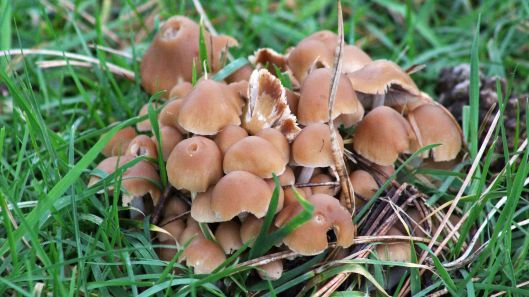
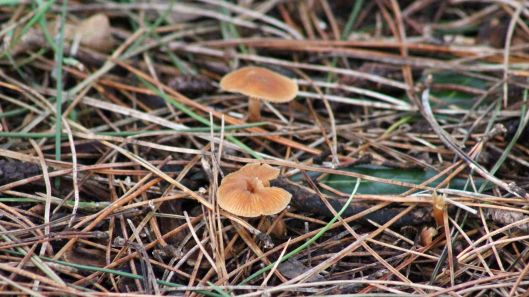
Though I have since learnt that this expression is also used by birders, ‘Little brown job’ is a term I first heard used in relation to fungi, the many and varied, brownish-hued conglomerations of fungi that have few distinguishing characteristics (unless you’re a whizz with a microscope) and so can often be notoriously difficult to identify. Here are some I’ve seen this week.


05 Friday Jan 2018
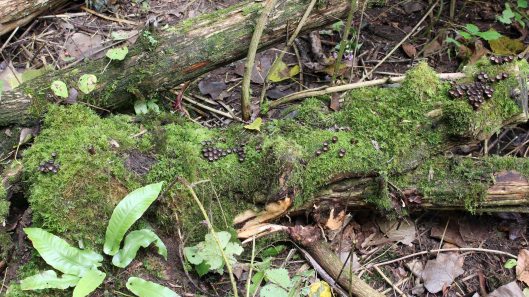
My local fungus group has a new challenge going for the month of January, to find a ‘living fossil fungus’. Sounds weird? Well, the ‘living fossil’ is the Ginkgo tree (Ginkgo biloba), a tree that’s been around since the time of the dinosaurs (read more about this beautiful tree on my sconzani blog here), and the fungus is Bartheletia paradoxa, a basidiomycete that only grows on Ginkgo leaves and has characteristics that are unique amongst basidiomycetes (for the science geeks out there, here’s a link to an expert article).

The fungus was not formally recognised until 1932 and was first found in Britain, on the leaves of a Ginkgo at Kew Gardens, in 2008. There are still very few official records for it but, as members of our fungus group are now discovering, it seems to be on almost every Ginkgo tree we can find.
As you can see from the photos, the fungus looks like black spots on the fallen leaves. Of course, autumn is long gone and the winter winds that have been roaring across Britain this past week have blown away a lot of fallen leaf litter but it’s still worth looking look around any Ginkgo trees you know of in your local parks. I found these leaves on Wednesday around the magnificent Ginkgo avenue in Bute Park, behind Cardiff Castle, and I have another couple of places to go looking in the next few days. So, do see if you can find yourself a ‘living fossil fungus’ as well.

24 Friday Nov 2017
17 Friday Nov 2017
10 Friday Nov 2017
Look what I found hiding in the grass at Cathays Cemetery during a recent walk around: gorgeous fungal gems!


18 Wednesday Oct 2017
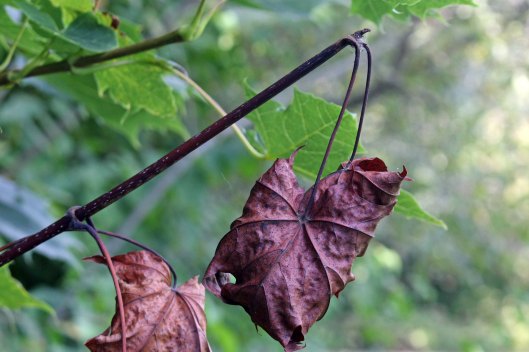
Thanks in part to following favourite author Robert Macfarlane (@RobGMacfarlane) on Twitter (he tweets a daily word) and in part to working through naturalist extraordinaire Dr Mary Gillham’s archives, I’ve been learning a lot of new words so I thought I would share the occasional one here. To start the stone rolling, we have marcescent, an adjective, which the Oxford Dictionary defines as ‘withering but remaining attached to the stem’. This is particularly noticeable during autumn and winter, as the leaves of some trees wilt and fade but remained attached to their branches. Some palms continuously retain a marcescent ‘skirt’ of dried fronds, and the term is, apparently, also used to refer to those species of fungi that can dry out but subsequently be rehydrated and continue to shed spores.

07 Saturday Oct 2017
Tags
bracket fungus, fungi, fungus, National Fungus Day, Trametes versicolor, Turkey tail, Turkeytail, UK Fungus Day
Sadly, I don’t see a lot of fungi in my local parks and nature reserves, and I’ve found this year that other events have clashed with the fungi forays organised by the Glamorgan Fungus Group so I haven’t been out with them much either. However, I have been taking photos of the fungi I do find and so, in honour of today being National Fungus Day here in Britain, I thought I’d share these photos of Turkeytail (Trametes versicolor).

Turkeytail is one of the most common bracket fungi and you can find it growing on dead logs and fallen trees in almost every forest and woodland but what I love about this fungus is its incredible variation. With colours ranging from beige, yellow and orange through to green, brown and even blue, each bracket is a work of art.
11 Monday Sep 2017
How lucky am I? In the short space of just two weeks, I’ve been privileged to see two different types of Bird’s-nest fungi (the post about the Common Bird’s-nests is here), both with eggs in their nests. This second lot are Fluted Bird’s-nest fungi (Cyathus striatus; Cyathus from the Greek kyath, meaning cup-shaped, and striatus to indicate the striated or ribbed sides).

Fungi expert Pat O’Reilly (on his First Nature website) likens the reproduction of these fungi to a game of Tiddlywinks: I wrote about their ‘eggs’ in my previous post but Pat’s description is much the better read, of course.
Although these fungi are probably common, both their preferred habitat (of rotting logs in shady woodlands) and their excellent camouflage make them difficult to spot so they are rarely seen. As you can probably imagine, I was very excited when told their location by a friend and then to see them for myself. Many photographs were taken!
03 Sunday Sep 2017
Ten days ago I spent the day bioblitzing with my friend Hilary at Amelia Trust Farm (with their permission, of course). Hilary volunteers there so was keen to see what we might discover around the grounds.

The habitats were a mix of woodland, arable fields, and flower and vegetable gardens, though we kept to the various footpaths, only looked at the fields from the fence lines, and didn’t venture far into the vegie patch. As previously, Hilary surveyed the plants and I did everything else. For a late summer’s day, in a site full of noisy families, I thought my total of 59 species was respectable enough. Here are some of the things I spotted …

You must be logged in to post a comment.