• ABOUT
  • BIRDING 2018
  • Birding 2019
  • BLOG POSTS
  • Butterflies 2018
  • Resources

earthstar

~ a celebration of nature

earthstar

Category Archives: fungi

Fungi Friday: Velvet shanks

06 Friday Jan 2017

Posted by sconzani in fungi, nature

≈ 9 Comments

Tags

#FungiFriday, Enoki mushroom, Enokitake, Flammulina velutipes, fungus, Velvet shank

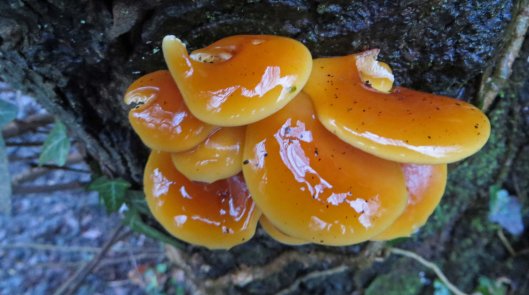
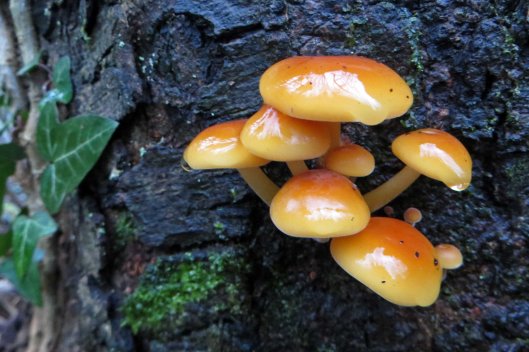
Starting as I mean to continue, I braved the chill wind and annoying drizzle on New Year’s Day for a walk around one of my local parks and was rewarded with the sight of these lovely fungi Flammulina velutipes, otherwise known as Velvet shanks (due to their velvety lower stems).

170106-flammulina-velutipes-velvet-shank1

They’re wood rotters, and it might surprise you to know that these are exactly the same fungi as the white Enoki (or Enokitake), much favoured by the Japanese and occasionally available in supermarkets in Britain and other countries. As they’re commercially grown in a dark environment Enoki are longer, smaller and very pale but the natural colour of the Velvet shank is the vibrant golden orange shown in my photos (flammulina means little flame).

170106-flammulina-velutipes-velvet-shank2

Like Loading...

Scarlet elfcups

03 Tuesday Jan 2017

Posted by sconzani in fungi, nature

≈ 5 Comments

Tags

British fungi, Elfcups, fungus, Ruby elfcup, Sarcoscypha austriaca, Sarcoscypha coccinea, Scarlet elfcup

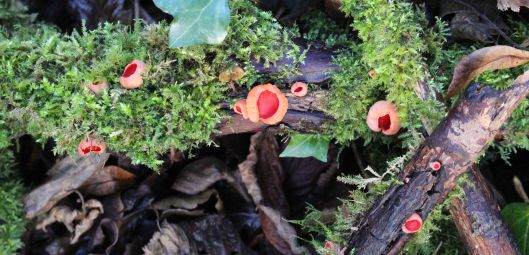
It’s elfcup fruiting time! There’s a spot in one of my local woodlands where these vibrant Scarlet elfcups (Sarcoscypha austriaca) grow in profusion so I made sure to head that way on yesterday’s wander, and I was not disappointed. In their hundreds, these little beauties are pushing up through the dense moss that covers the rotting branches and logs on the forest floor.

170103-scarlet-elfcup-1

I blogged about these gorgeous fungi last year and noted then that there are two species of red elfcups, the Scarlet (Sarcoscypha austriaca) and the Ruby (Sarcoscypha coccinea). They can only be differentiated, one from the other, through microscopic examination, but I know that the elfcups in my favoured spot are the Scarlet variety as a friend very kindly checked them for me. My mission now is to find the Ruby.

170103 Scarlet Elfcup (2)
170103 Scarlet Elfcup (3)
170103 Scarlet Elfcup (4)
170103 Scarlet Elfcup (5)
Like Loading...

Fungi Friday: Alder bracket

30 Friday Dec 2016

Posted by sconzani in fungi, nature, trees

≈ 1 Comment

Tags

Alder, Alder bracket, bracket fungus, Inonotus radiatus

Though fungi frequently defy the rules we humans assign to them, the Alder bracket (Inonotus radiatus) does, amazingly, almost always (note the qualifier) grow on alder trees. Sadly, its presence usually means the tree is on its last legs and the fungus itself contributes to the tree’s death by assisting white rot to form within the tree.

161230-alder-bracket-young-1
161230-alder-bracket-young-2

Yet, Alder bracket can be rather beautiful, especially when young, as it produces quite striking orangey-red globules of liquid which sparkle in the sunshine. As it matures, it develops from pale-coloured well-rounded velvet-textured fruiting bodies into the more regular shelf-like shape you would expect from a bracket fungus, and the pores on its underside become more apparent.

161230-alder-bracket-maturing-1
161230-alder-bracket-maturing-2
161230-alder-bracket-maturing-3

As it reaches old age, the bracket become rougher and tougher, the spots which once produced those gorgeous droplets develop into ugly pits, and its delicate apricot-coloured upper surface dulls to a brown so dark it looks black.

161230-alder-bracket-mature-1
161230-alder-bracket-mature-2
Like Loading...

Fungi Friday: Of stagshorns and spindles

23 Friday Dec 2016

Posted by sconzani in fungi, nature

≈ 4 Comments

Tags

Calocera cornea, Calocera pallidospathulata, Clavaria fragilis, Clavaria fumosa, Pale Stagshorn, Small stagshorn, Smoky Spindles, White Spindles

Though the word stagshorn might conjure up images of majestic antlered beasts, I’ve got more small stuff for you today. In fact, the Small stagshorns (Calocera cornea) grow no more than 12mm tall so small is an over-statement.

161223-1-calocera-cornea-small-stagshorn
161223-2-calocera-cornea-small-stagshorn

The Stagshorns are jelly fungi so feel spongy when poked and that’s reflected in their scientific name: Calo comes from the ancient Greek καλός (kalos) which means beautiful, cēra is Latin for wax, and cornea is from the Latin cornu meaning horn-shaped, thus beautiful wax horns. The English name staghorn seems a little odd though as these fungi usually remain single stalked and unbranching.

161223-3-calocera-pallidospathulata-pale-stagshorn
161223-4-calocera-pallidospathulata-pale-stagshorn

There are two other species of Calocera to be found in Britain, though I have only photographed one so far, the Pale Stagshorn (Calocera pallidospathulata), shown above. All are small and grow on wood, and this is one of the characteristics that distinguishes them from the Spindles, as they grow in unimproved grassland (i.e. grassland which has not been improved with fertilisers or lime – I find Spindles often in my local cemetery which has been closed to burials for more than 30 years).

161223-5-clavaria-fragilis-white-spindles
161223-6-clavaria-fumosa-smokey-spindles

The White Spindles (Clavaria fragilis), above left, and Smoky Spindles (Clavaria fumosa), right, are two examples of these. Though sometimes forming clumps, Stagshorns tend to grow singly, whereas Spindles prefer to clump together, like little beds of eels or worms standing on end. Clavaria comes from the Latin word for club, which is why the Spindles as a group are often referred to as Club fungi.

Like Loading...

The right snuff

19 Monday Dec 2016

Posted by sconzani in fungi, nature

≈ 11 Comments

Tags

Beechmast Candlesnuff, bioluminescent fungi, Candlesnuff fungus, Xylaria carpophila, Xylaria hypoxylon

You might think that Candlesnuff Fungus (Xylaria hypoxylon) got its common name from its physical resemblance to a candle but no!

161219-xylaria-hypoxylon-candlesnuff-1

This tiny fungus is, in fact, bioluminescent – in a very very dark place it can be seen to emit light because, as Pat O’Reilly explains on his First Nature website (one of my go-to places for fungi identification), the phosphorus that accumulates within the mycelium reacts with oxygen and other chemicals in the fungus. Pat goes on to say that you really need night-vision goggles to see such weak luminescence or take a long-exposure image. Must try that some time!

161219-xylaria-hypoxylon-candlesnuff-5
161219-xylaria-hypoxylon-candlesnuff-3
161219-xylaria-hypoxylon-candlesnuff-2

161219-xylaria-hypoxylon-candlesnuff-6

Candlesnuff is an extremely common wood-rotting fungus that can be seen all year round in its various stages of growth. Though the fruiting bodies start out black at the base and white on top, they will eventually blacken all over and, from a single stem, they often develop multiple branches at the top.

161219-xylaria-carpophila-beechmast-candlesnuff-1
161219-xylaria-carpophila-beechmast-candlesnuff-2

Another member of the Xylaria genus is Xylaria carpophila, Beechmast Candlesnuff. It looks very similar to normal Candlesnuff but it is incredibly tiny and only grows on the rotting seeds of Beech trees (known as beechmast).

Like Loading...

Fungi Friday: A load of tripe

16 Friday Dec 2016

Posted by sconzani in fungi, nature, trees

≈ 9 Comments

Tags

Auricularia auricula-judae, Auricularia mesenterica, Dutch Elm disease, Elm tree, Jelly Ear fungus, Tripe fungus

If you’re wondering how the Tripe fungus, Auricularia mesenterica, got its name, well, according to Pat O’Reilly’s most excellent First Nature website, ‘The specific epithet mesenterica is a Latinised adjective derived from the Ancient Greek word mesenterion meaning ‘middle intestine’.’ I checked – he’s not talking tripe! Auricularia comes from the Latin word for ear, a nod to its fleshy ear-like shape. (Fungi fans will notice that it resembles the Jelly Ear fungus, Auricularia auricula-judae, which is in the same genus.)

161215-tripe-fungus-3

This is not a particularly common fungus these days as it usually grows on dead elm trees but, with the devastating effects of Dutch Elm disease, which has killed over 60 million British elm trees, there are now not many elms left, even dead ones. I had first noticed this particularly fungus in one of my local woodlands several months ago when the hot dry summer had left it shrivelled up and unidentifiable but, as soon as the autumn rains came, it almost immediately fleshed out and began creating new growth. It’s very variable in colour, with bands of brown, grey, white or purple on top, and it is a rather odd combination of hairy above and jelly-like below.

161215-tripe-fungus-5
161215-tripe-fungus-6
161215-tripe-fungus-4
161215-tripe-fungus-2
161215-tripe-fungus-1
Like Loading...

Fungi Friday: The Holly parachute challenge

09 Friday Dec 2016

Posted by sconzani in fungi, nature

≈ 8 Comments

Tags

fungus challenge, Glamorgan Fungus Group, Holly leaves, Holly parachute, Holly tree, Marasmius hudsonii

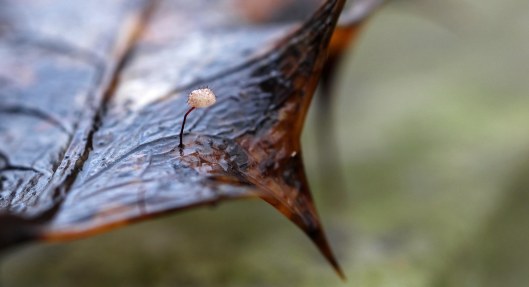
My friends and I from the Glamorgan Fungus Group have a team challenge going on and, if you live in Britain and enjoy fungi forays, this is something you might also like to have a go at. The Holly parachute fungus (Marasmius hudsonii) is usually described in fungi guides, if it’s included at all, as being a rare find but we wonder if it is, in fact, just rarely recorded because of its incredibly tiny size – its maximum cap size is 5mm and it’s frequently less than half that measurement.

161209-holly-parachute-1

As the name suggests, this small and very delicate mushroom is shaped a little like a parachute, though it has one interesting feature that makes identification easy – it’s covered in microscopic hairs that are a real challenge to see with the naked eye but are easier if you use a hand lens or a macro lens on a camera.

As its name also suggests, the Holly parachute grows exclusively on holly, specifically on dead and damp holly leaves like those you can find in the leaf litter beneath a holly tree. You might think that would make it easy to find but it’s not. Holly trees are usually evergreen so shed few leaves and they often grow amongst deciduous trees so, at this time of year, the ground is awash with all kinds of leaves that often smother the few holly leaves that have fallen.

161209-holly-parachute-2
161209-holly-parachute-4

However, members of our group have found Holly parachutes in more than 20 locations in our county since we began our challenge a month ago (I’ve found it twice) so we are leaning towards the idea that it is more common that the records might suggest. How about taking up the challenge and seeing if you can find it in your area?

161209-holly-parachute-3

Like Loading...

Fungi Friday: Purple Jellydisc fungi, maybe

02 Friday Dec 2016

Posted by sconzani in fungi, nature

≈ 4 Comments

Tags

Ascocoryne, Ascocoryne cylichnium, Ascocoryne sarcoides, fungi identification, Purple Jellydisc

I am frequently frustrated in my quest to identify the fungi I find on my daily walks and today’s fungi provide yet another example of how difficult a task identification can be.

161202-ascocoryne-sp-1

I can say with a high degree of certainty that the fungi shown in my photos are of the Ascocoryne species, but there are two species of Ascocoryne that look almost identical at certain stages in their development, A. sarcoides and A. cylichnium. The latter only ever forms a cup shape, whereas the former goes through a cup-shaped stage but then goes on to form gelatinous brain-like blobs, hence the common name Purple Jellydisc. (One stage is asexual, the other a sexual spore-producing stage.) It’s highly likely, then, that the blobby fungi in my photos are indeed Purple Jellydisc. In fact, it’s highly likely that all my photos show Ascocoryne sarcoides, as that is said to be the most common species, but is it really? It could be that people assume they have found A. sarcoides and record their finds as such, even though the only way to be absolutely certain is to examine the spores of the fungi under a microscope.

161202-ascocoryne-sp-2
161202-ascocoryne-sp-3
161202-ascocoryne-sp-4

I am booked on a course to learn how to use a microscope in February. Until then, I’ll just have to content myself with admiring Ascocoryne’s beautiful colours, shapes and textures. I hope you enjoy them too.

161202-ascocoryne-sp-5
161202-ascocoryne-sp-6
161202-ascocoryne-sp-7
161202-ascocoryne-sp-8
161202-ascocoryne-sp-9
161202-ascocoryne-sp-10
Like Loading...

No bees in these bonnets

29 Tuesday Nov 2016

Posted by sconzani in fungi, nature

≈ 8 Comments

Tags

Bonnet fungi, Bonnet mushroom, Mycena, Mycena fungus, Mycenoid fungi

As mushroom expert Michael Kuo writes, Mycena fungi are ‘some of the most beautiful and elegant mushrooms on earth’ but, due to their often tiny size, they’re frequently overlooked. His advice is that we should all slow down and take the time to appreciate the beauty of small things. And I couldn’t agree more!

161129-mycena-fungi-2

I think you can easily see why the Mycenoid fungi usually have a common name that includes the word bonnet: that cap shape is a dead giveaway. And their common names are often delightful, sometimes intriguing: Pinkedge bonnet, Frosty bonnet, Snapping bonnet, Pelargonium bonnet, Bleeding bonnet, Ferny bonnet, Nitrous bonnet, Vulgar bonnet and Cryptic bonnet, to name just a few. Like nearly all fungi, the Mycenoids can be difficult to identify and I don’t know the names of all of those in my photographs but I do think they’re all rather lovely.

161129-mycena-fungi-1
161129-mycena-fungi-5
161129-mycena-fungi-3
161129-mycena-fungi-4
161129-mycena-fungi-6
Like Loading...

Fungi Friday: Not just a park bench

25 Friday Nov 2016

Posted by sconzani in fungi, nature, parks

≈ 4 Comments

Tags

Dacryomyces stillatus, Orange Jelly fungus, park bench, Tremella mesenterica, Yellow Brain Fungus

This looks like an ordinary park bench, right?

161125-roath-park-bench-1

But, if you look closer …

161125-roath-park-bench-2

No, closer …

161125-roath-park-bench-3

Then you will see that, even here, on a presumably treated and processed and painted (or stained) piece of wood, fungi are active.

161125-dacryomyces-stillatus-orange-jelly
161125-tremella-mesenterica-yellow-brain

The bright orange blobs are the aptly named Orange Jelly fungus (Dacryomyces stillatus) and the washed-out yellow blobs are probably Yellow Brain Fungus (Tremella mesenterica) – I say probably because there’s another fungus that looks a lot like this one, Tremella aurantia, but it’s parasitic on a third fungus, Hairy Curtain crust (Stereum Hirsutum), which does not appear to be present here – but who knows what’s lurking inside the wood?

Like Loading...
← Older posts
Newer posts →

About me

sconzani

sconzani

I'm a writer and photographer; researcher and blogger; birder and nature lover; countryside rambler and city strider; volunteer and biodiversity recorder.

View Full Profile →

Follow earthstar on WordPress.com

Enter your email address to follow this blog and receive notifications of new posts by email.

Recent blog posts

  • Cuttlebones March 16, 2026
  • No woodland here March 15, 2026
  • Family comes first March 14, 2026
  • Local Little egrets March 13, 2026
  • Cormorants, young and old March 12, 2026

From the archives

COPYRIGHT

Unless otherwise acknowledged, the text and photographs on this blog are my own and are subject to international copyright. Nothing may be downloaded or copied without my permission.

Fellow Earth Stars!

  • Unknown's avatar
  • Unknown's avatar
  • Unknown's avatar
  • Unknown's avatar
  • Unknown's avatar
  • Unknown's avatar
  • Unknown's avatar
  • Unknown's avatar
  • Unknown's avatar
  • Unknown's avatar
  • Unknown's avatar
  • Unknown's avatar
  • Unknown's avatar
  • Unknown's avatar
  • Unknown's avatar
  • Unknown's avatar
  • Unknown's avatar
  • Unknown's avatar
  • Unknown's avatar
  • Unknown's avatar
  • Unknown's avatar
  • Unknown's avatar
  • Unknown's avatar
  • Unknown's avatar
  • Unknown's avatar
  • Unknown's avatar
  • Unknown's avatar
  • Unknown's avatar
  • Unknown's avatar
  • Unknown's avatar
  • Unknown's avatar
  • Unknown's avatar
  • Unknown's avatar
  • Unknown's avatar
  • Unknown's avatar
  • Unknown's avatar
  • Unknown's avatar
  • Unknown's avatar
  • Unknown's avatar
  • Unknown's avatar
  • Unknown's avatar
  • Unknown's avatar
  • Unknown's avatar
  • Unknown's avatar
  • Unknown's avatar
  • Unknown's avatar
  • Unknown's avatar
  • Unknown's avatar
  • Unknown's avatar
  • Unknown's avatar

Blog at WordPress.com.

Privacy & Cookies: This site uses cookies. By continuing to use this website, you agree to their use.
To find out more, including how to control cookies, see here: Cookie Policy
  • Subscribe Subscribed
    • earthstar
    • Join 668 other subscribers
    • Already have a WordPress.com account? Log in now.
    • earthstar
    • Subscribe Subscribed
    • Sign up
    • Log in
    • Report this content
    • View site in Reader
    • Manage subscriptions
    • Collapse this bar
 

Loading Comments...
 

You must be logged in to post a comment.

    %d