• ABOUT
  • BIRDING 2018
  • Birding 2019
  • BLOG POSTS
  • Butterflies 2018
  • Resources

earthstar

~ a celebration of nature

earthstar

Category Archives: insects

Snug as a bug

14 Sunday Feb 2016

Posted by sconzani in insects, nature, nature photography

≈ 2 Comments

Tags

carrion beetle, European carrion beetle, Phosphuga atrata, Silpha atrata

Well, these bugs were snug until I lifted up the bark they were snoozing under on a fallen tree at my local cemetery but, rest assured, I covered them back up again once I’d taken a few photos. These snug bugs are European carrion beetles (now Phosphuga atrata, originally Silpha atrata) and, yes, they do indeed feed on the decaying flesh of dead animals but are much more likely to be found chewing on snails, earthworms and insects.

160214 Carrion beetle Phosphuga atrata(1)

When disturbed, or snoozing, they retract their head so you can’t really see in my photos that the head is relatively long and perfectly adapted for reaching into snail shells. Apparently, they spray their snail prey with a digestive fluid before eating it – I guess that’s a bit like us marinating meat before we cook it, and the adult beetles also have a poisonous bite, but it doesn’t affect humans.

160214 Carrion beetle Phosphuga atrata(2)

Usually black but sometimes brown, the carrion beetle grows between 10 and 15mm long. It can be found throughout Britain and Europe but is seldom seen as it usually hunts at night and sleeps, as these were, under bark or in mossy areas during the day.
Like Loading...

The blood spewer

07 Sunday Feb 2016

Posted by sconzani in insects, nature, nature photography

≈ 6 Comments

Tags

beetle, Blood spewer beetle, Bloody-nosed beetle, British beetle, Brynna Woods

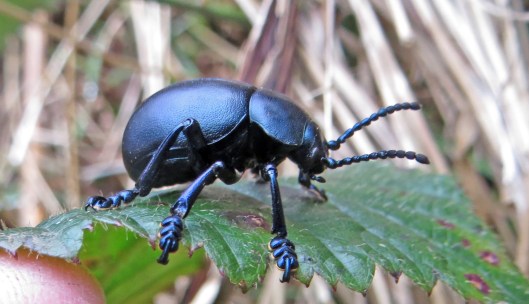
With a name like blood spewer, you might expect this post to be about some gigantic ravaging beast, but no! This is a beetle, large for a beetle at 2cm long, but nevertheless slow and bumbling and flightless and harmless, and really rather delightful, with body parts of a very pretty, slightly metallic-looking blue-purple-black. We found it amongst the bracken during a walk through Brynna Woods, in East Glamorgan, earlier this week.

160207 bloody nosed beetle (6)

Timarcha tenebricosa, or the bloody-nosed beetle, as it is more commonly known, gets its gruesome name from a defence strategy it has developed in response to predators. When threatened, it discharges small globules of unsavoury red fluid from its mouth. It seems we weren’t perceived as threatening, as this little creature didn’t perform its party trick for us.

160207 bloody nosed beetle (4)

This is a leaf beetle, most often seen during the spring and summer months in grassy areas, in hedgerows and on heathland in Britain and in southern and central Europe. It is particularly partial to nibbling on the plant Lady’s bedstraw, and has the most amazing-looking segmented antennae and lower legs, as you can see in my photos. Ours was a charming and colourful encounter on a rather grey day.

160207 bloody nosed beetle (5)

Like Loading...

He of the many many legs

01 Monday Feb 2016

Posted by sconzani in insects, nature, nature photography

≈ Leave a comment

Tags

flat-backed millipede, millipede, minibeasts

Though the word millipede comes from the Latin for ‘thousand feet’, the Common flat-backed millipede (Polydesmus angustus) only usually has between 40 and 70 feet, and no species of millipede has more than 750. I guess whoever originally named them got tired of counting!

160201 Millipede (Polydesmus complanatus) (3)

Growing up to 25mm long, this little creature is actually the largest and most common millipede in Britain, though it’s seen more frequently in England and Wales. Just like the woodlice it’s with here, it prefers damp shaded places, perhaps under logs, stones or bark, or amongst leaf litter, in woods and on farm lands but also in the home garden. Although it has many many legs, it actually moves quite slowly so, rather than running away from perceived danger, it secretes an unpleasant chemical from pores along its body to deter predators.

160201 Millipede (Polydesmus complanatus) (2)

The millipede’s favourite foods include fungi and dead vegetation, and it is a useful recycler of nutrients back into the soil. This little millipede gets its name from its broad body armour which makes its body look rather flat and helps it push its way into narrow crevices under bark or beneath stones.

Like Loading...

Hawthorn Shield Bug

25 Monday Jan 2016

Posted by sconzani in insects, nature, nature photography

≈ 4 Comments

Tags

Hawthorn Shield Bug, minibeasts, shield bugs

Some might think the Hawthorn Shield Bug has a rather unfortunate scientific name, Acanthosoma haemorrhoidale, but it’s really quite descriptive: acantho is from the ancient Greek for thorn, soma means body, and haemorrhoida derives from the Greek for discharging blood or bleeding, so this bug has a thorn-like body with red patterning that looks like bleeding. The common name is also appropriate: it has a body shaped like the shields of knights of olden times, and the food of choice for its larvae is the hawthorn berry (though they will also eat the berries of rowan, cotoneaster and whitebeam).

160125 Hawthorn Shieldbug (3)

Growing up to 17mm (0.67in) long, the Hawthorn Shield Bug is the largest and most common of the five types of shield bug found in Britain, and is also found throughout Europe, in woodlands, parks and gardens. Its colouring means it is usually very well camouflaged and I only found these three bugs by chance today – my eye was attracted to their leaf and they were inside when I uncurled it. The adult bugs usually hibernate during the winter months but often emerge to snack on the leaves during milder weather. I curled them back up in their leaf after taking these photographs so they could continue their snooze.

160125 Hawthorn Shieldbug (2)160125 Hawthorn Shieldbug (1)


Like Loading...

Sleeping caterpillar

21 Thursday Jan 2016

Posted by sconzani in insects, nature, nature photography

≈ 2 Comments

Tags

caterpillar, cutworm, Large Yellow Underwing moth, moth

You never know what might be lurking under a piece of bark on a dead tree but I certainly didn’t expect this little guy, especially in the middle of winter. It’s the caterpillar of the Large Yellow Underwing moth (Noctua pronuba) and, as well as being one of Britain’s most common moths, it can also be found throughout Europe and the Middle East, in central Asia and in North America. This moth also migrates so often arrives in southern Britain in huge numbers.

160121 Large Yellow Underwing moth caterpillar

Though the moth is a harmless nectar-feeder, the caterpillar is a ‘cutworm’, a nasty critter that chews through the base of herbaceous plants, both in the garden and on the farm, causing the plants to die. Though I would have expected it to overwinter as a pupa, it seems these minibeasts usually overwinter in their final caterpillar stage and, in mild weather, even emerge to continue feeding. This little guy certainly had a cosy spot for himself under the tree bark … until I came along.

Big thanks to Steve Ogden at Wildlife Insight, who very kindly identified this caterpillar for me. Check out his most excellent website on British moths and butterflies, birds and things to see when watching the sea.

Like Loading...

Slater, woodlouse or chiggy pig?

10 Sunday Jan 2016

Posted by sconzani in insects, nature, nature photography

≈ Leave a comment

Tags

cemetery, crustaceans, insects, slater, woodlouse

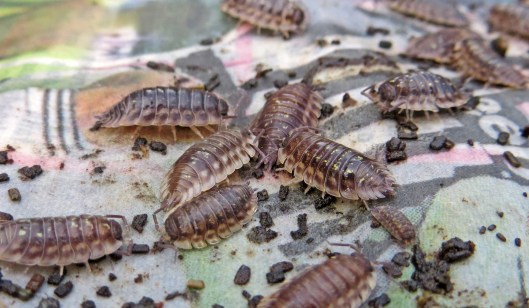
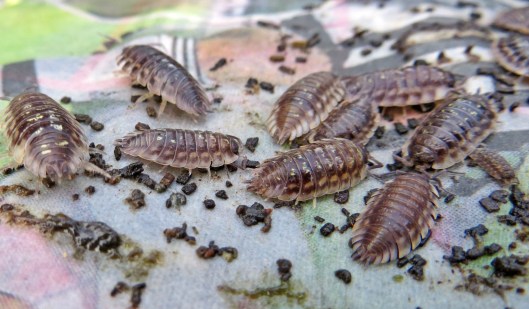
As I was walking through my local cemetery today, I spotted a very thick, very wet newspaper lying on a fallen tree and I simply couldn’t resist taking a peek underneath. These are what I found, Common shiny woodlice (Oniscus asellus), one of the 45 (yes, 45!) native or naturalised species of woodlice in Britain.

160110 woodlice (1)

Did you know:

  • A woodlouse has fourteen jointed limbs, and breathes using lungs in its rear legs.
  • Although it’s a crustacean (like the oh-so-tasty lobsters and crabs), a woodlouse tastes like strong urine. I wonder who the crazy person was who discovered that interesting fact!
  • Just like earthworms, woodlice are good for the garden because they produce compost, aerate the soil and help control pests.
  • Woodlice prefer damp places because they lose a lot of moisture through excretion (plenty of evidence of that to be seen in my photos!).
  • In New Zealand it’s called a slater; in Reading, England it’s a cheeselog; in Devon it’s a chiggy pig; and in Cornwall it goes by the name of gramersow. Do you have a special name for this little critter? Let me know in the comments below.

160110 woodlice (2)

Like Loading...

It’s ivy berry time

05 Tuesday Jan 2016

Posted by sconzani in birds, insects, nature, nature photography, winter

≈ Leave a comment

Tags

berries, birds, ivy, winter

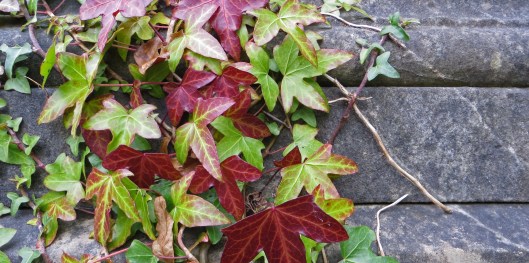
Though its roots can creep between gaps in stonework causing severe damage to ancient ruins, stone walls, grave monuments and the like, ivy (Hedera helix, also known as English ivy, common ivy or just plain ivy) is of great importance to wildlife. Not only does it provide shelter and nesting places for insects, birds, bats and other beasties, it is also an important food source.

english ivy 1

Ivy’s flowering period begins in August and continues right through to November, sometimes later, and the flowers produce plentiful quantities of nectar and pollen. Over 70 species of nectar-loving insects feast on the flowers, including wasps and bumblebees, Red admiral, Small tortoiseshell and Peacock butterflies.

English ivy

Once the berries begin to ripen, they turn a deep purple-black colour, and provide an important winter source of food when most other berries are finished. At this time, the ivy becomes a favourite snacking place for lots of berry-eating birds, blackbirds and thrushes in particular, but also starlings and jays, finches and wood pigeons.

english ivy 2

Like Loading...

There’s a cannibal in my kitchen

12 Saturday Dec 2015

Posted by sconzani in insects, ladybird, nature, nature photography, winter

≈ Leave a comment

Tags

harlequin ladybird, hibernation, insect, invasive species, ladybird, ladybug, winter

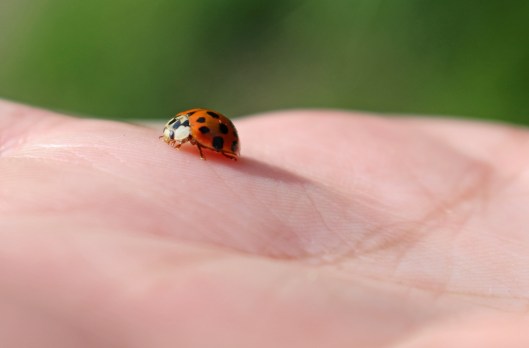
For the third time in as many weeks a Harlequin ladybird (Harmonia axyridis) has appeared as if from nowhere in my kitchen. They like to find somewhere cosy to hibernate the winter away so I’m sure a warm spot near my gas boiler would suit them very well and normally I wouldn’t mind but this is the most invasive ladybird on earth.
151212 ladybird harlequin (1)

The voracious little Harlequin originated in Asia but was introduced firstly to North America and later to Europe to control aphids. Though it only arrived in Britain in 2004 – perhaps blown across the Channel, or it may have hitched a ride on a vehicle – it has already spread throughout half these isles. The problem is that the Harlequin doesn’t just eat aphids; not only does it compete with native ladybirds for food but it also devours their eggs and larvae, as well as the eggs and caterpillars of butterflies and moths. It may look cute but it has the devastating potential to wipe out all 26 resident species of ladybird.

This is one time when I really wish this ladybird would fly away home!

151212 ladybird harlequin (2)

Like Loading...
Newer posts →

About me

sconzani

sconzani

I'm a writer and photographer; researcher and blogger; birder and nature lover; countryside rambler and city strider; volunteer and biodiversity recorder.

View Full Profile →

Follow earthstar on WordPress.com

Enter your email address to follow this blog and receive notifications of new posts by email.

Recent blog posts

  • The return of the Willow warblers April 23, 2026
  • Bug: Harpocera thoracica April 22, 2026
  • A female Tawny April 21, 2026
  • NFY: Orange-tip April 20, 2026
  • All the yellows April 19, 2026

From the archives

COPYRIGHT

Unless otherwise acknowledged, the text and photographs on this blog are my own and are subject to international copyright. Nothing may be downloaded or copied without my permission.

Fellow Earth Stars!

  • Unknown's avatar
  • Unknown's avatar
  • Unknown's avatar
  • Unknown's avatar
  • Unknown's avatar
  • Unknown's avatar
  • Unknown's avatar
  • Unknown's avatar
  • Unknown's avatar
  • Unknown's avatar
  • Unknown's avatar
  • Unknown's avatar
  • Unknown's avatar
  • Unknown's avatar
  • Unknown's avatar
  • Unknown's avatar
  • Unknown's avatar
  • Unknown's avatar
  • Unknown's avatar
  • Unknown's avatar
  • Unknown's avatar
  • Unknown's avatar
  • Unknown's avatar
  • Unknown's avatar
  • Unknown's avatar
  • Unknown's avatar
  • Unknown's avatar
  • Unknown's avatar
  • Unknown's avatar
  • Unknown's avatar
  • Unknown's avatar
  • Unknown's avatar
  • Unknown's avatar
  • Unknown's avatar
  • Unknown's avatar
  • Unknown's avatar
  • Unknown's avatar
  • Unknown's avatar
  • Unknown's avatar
  • Unknown's avatar
  • Unknown's avatar
  • Unknown's avatar
  • Unknown's avatar
  • Unknown's avatar
  • Unknown's avatar
  • Unknown's avatar
  • Unknown's avatar
  • Unknown's avatar
  • Unknown's avatar
  • Unknown's avatar

Blog at WordPress.com.

Privacy & Cookies: This site uses cookies. By continuing to use this website, you agree to their use.
To find out more, including how to control cookies, see here: Cookie Policy
  • Subscribe Subscribed
    • earthstar
    • Join 642 other subscribers
    • Already have a WordPress.com account? Log in now.
    • earthstar
    • Subscribe Subscribed
    • Sign up
    • Log in
    • Report this content
    • View site in Reader
    • Manage subscriptions
    • Collapse this bar
 

Loading Comments...
 

You must be logged in to post a comment.

    %d