• ABOUT
  • BIRDING 2018
  • Birding 2019
  • BLOG POSTS
  • Butterflies 2018
  • Resources

earthstar

~ a celebration of nature

earthstar

Category Archives: insects

Springtime in the shrubbery

16 Monday May 2016

Posted by sconzani in insects, nature, spring

≈ 4 Comments

Tags

crane fly, Green dock beetle, harlequin ladybird, St Mark's flies

I took myself off on a long walk yesterday afternoon, no backpack full of camera gear, just my point ‘n’ shoot in my hand, intending to walk not look for critters. But, no sooner had I got to the start of the walk proper than the critters began presenting themselves, and I began to feel rather like a voyeur.
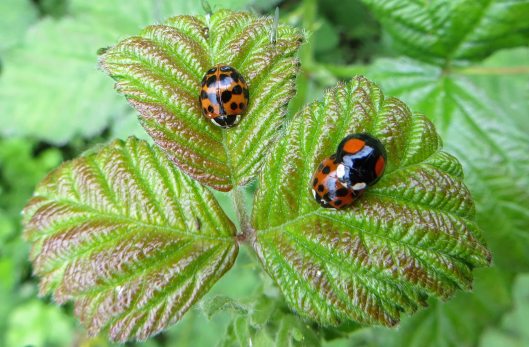
160516 Harlequin Ladybirds

First it was the Harlequin ladybirds, on the very top leaves of a bramble so hard to miss, and three of them. Was the second female waiting her turn, basking in the afterglow, or something of a voyeur herself?
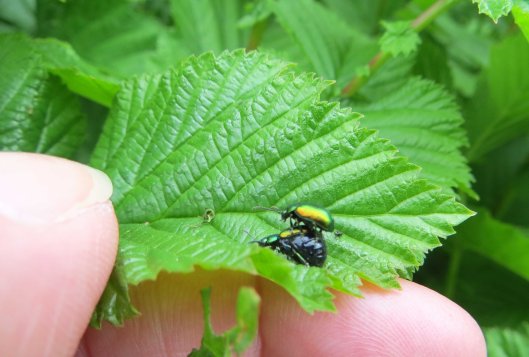
160516 Green Dock Beetle

A metallic flash on the neighbouring bush caught my eye and there were a couple of Green dock beetles, also getting into the swing of spring, though I think the male was a little confused as to how to go about things. He won’t accomplish much just riding on the female’s back.
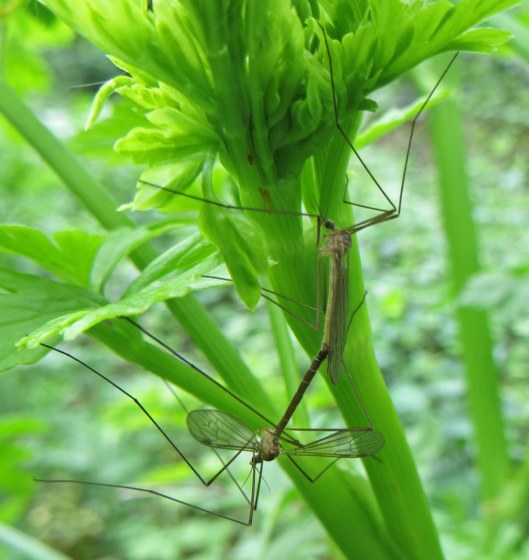
160516 crane flies

Further on, I bent down to re-tie my shoelace and what should I see but two Crane flies, making more Crane flies.

160516 Long-horned black legionnaire

And I almost stood on these final two, blatantly having it off in the middle of the footpath. I think they’re Long-horned black legionnaire beetles**, though I’m not entirely sure. They, like all the other minibeasts, were certainly feeling stimulated by the Sunday sunshine.

** Many thanks to Paul Challinor. These are actually St Mark’s flies (Bibio marci).
Like Loading...

Black oil beetles

12 Thursday May 2016

Posted by sconzani in insects, nature

≈ 6 Comments

Tags

beetles, black oil beetles, Brynna Woods, BugLife, Meloe proscarabaeus, oil species recovery programme

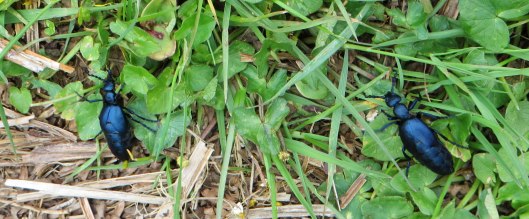
I went to Brynna Woods in search of bluebells and found beetles instead, the black oil beetle no less, Meloe proscarabaeus.

160512 Black oil beetle (3)

I was extremely lucky as oil beetles are an endangered species in Britain, with three native species already declared extinct and the remaining five under threat. The main reason for this is because their lifecycle depends on the solitary bee and changes in the way the environment is managed means bee numbers are also declining.

160512 Black oil beetle (1)

You see, oil beetles are most peculiar little critters. Their larvae strategically position themselves on flowers awaiting the arrival of solitary bees out collecting pollen and nectar. Then, using special hooks on their feet, they hitch a ride on the bees when they depart. Back in the bees’ nests, the larvae feed on the bees’ supplies of nectar and pollen, and also the bees’ eggs. The larvae continue to develop inside the bees’ nests until they emerge as adult beetles, ready to mate, lay their eggs, and begin the lifecycle all over again. No bees, no beetles!

160512 Black oil beetle (2)

With the support of Natural England, Buglife are working with the National Trust and the Oxford University Museum of Natural History on an oil beetle species recovery programme. You can read more here.

Like Loading...

Damsels or dragons?

30 Saturday Apr 2016

Posted by sconzani in insects, nature

≈ 4 Comments

Tags

Aeshna grandis, Beautiful Demoiselle, Brown Hawker, Calopteryx Virgo, damselfly, dragonfly

One of the best things about writing this blog is that I’m constantly learning new things. When this gorgeous creature flitted across my path in Bute Park on Wednesday, I thought ‘Ooooo, my first dragonfly of the year!’ Wrong! This is a damselfly, a female of the very aptly named species Beautiful Demoiselle (Calopteryx Virgo).

damselfly Beautiful Demoiselle female (2)

So, I asked myself, ‘how do I tell the difference between a dragonfly and a damselfly?’ It seems there are four basic differences that even I should be able to spot:
1) Body shape: dragonflies are bulkier, shorter and thicker, whereas damselflies are slender and delicate.
2) Eyes: a dragonfly’s eyes are much larger, wrapping around from the side to the front of the head, often touching. The eyes of the damselfly are also big, but tend to be more to the side of the head, with a definite gap between.

Damselfly Beautiful Demoiselle female

3) Wing shape: the hind wings of the dragonfly are larger than the fore wings and broaden at the base, but the damselfly’s wings are both the same size and shape, and narrow markedly where they connect to the body.
4) Wing position: when resting, the dragonfly always spreads its wings, whereas the damselfly rests with its wings together above its body.

dragonfly brown hawker female

Above is a photo of a female Brown Hawker dragonfly (Aeshna grandis), taken last year, so you can see the differences. And, hopefully, my rather early Beautiful Demoiselle will just be the first of many of these heavenly creatures.

Like Loading...

Fluttering butterflies, no.1

26 Tuesday Apr 2016

Posted by sconzani in insects, nature, nature photography

≈ 14 Comments

Tags

Aglais io, butterflies, butterfly, Cabbage white, Pararge aegeria, Peacock, Pieris rapae, Small white, Speckled wood

‘The butterfly counts not months but moments, and has time enough,’ wrote Bengali Nobel Laureate Rabindranath Tagore – perhaps a lesson for us all.

The first butterflies of spring-summer 2016 have now begun fluttering around me when I’m out walking. Like the bees and the hoverflies, I find they add an extra dimension to my wanderings, a whisper of magic, a hint of fairies …

Small White male Pieris rapae Bute 100416

The Small white (Pieris rapae) was the first butterfly I saw, a couple of weeks ago, during a walk around Cardiff Bay, but it eluded my attempts to photograph it. Both this and the Large white are known as the ‘Cabbage Whites’ for the damage their caterpillars do to the cabbage and other vegetable plants; I have childhood memories of my father regularly checking the undersides of his cabbage leaves and cursing those caterpillars! Though this butterfly has been known to fly as far as 100 miles in its lifetime, it couldn’t fly to New Zealand – in the days before strict agricultural border controls, it was accidentally introduced there, to Australia and to North America.

Peacock Aglais io Cosmeston 200416
Peacock Ty Rhiw

What a glorious creature the Peacock butterfly is and how lovely it looks on this blackthorn blossom, though this Peacock has seen better days; it’s a little faded and has parts of its wings missing. Aglais io gets its common name, obviously, from the unmistakable ‘eyes’ on its wings, so reminiscent of a peacock’s spectacular tail, but its underwings are quite the opposite, dark and easily mistaken for dead leaves in a woodland setting.

Speckled wood Cathays Cem 240416 (4)
Speckled wood Pararge aegeria Penarth railtrail 200416

The Speckled Wood (Pararge aegeria) is the butterfly I’ve seen most often in the past couple of weeks, in the woodlands of Cosmeston and Bute Park and also in tree-filled Cathays Cemetery, where the two shown together above charmed me with their delicate spiralling dance. Is it love or the love of the chase, I wonder?

Like Loading...

Coed Ty Rhiw critters

16 Saturday Apr 2016

Posted by sconzani in insects, nature

≈ 8 Comments

Tags

Bombus hortorum, Coed Ty Rhiw, Garden bumblebee, Glomeris marginata, Gymnochaeta viridis, Pill millipede, Tachypodoiulus niger, White-legged snake millipede

As well as the wonderful selection of fungi I posted yesterday, my foray with friends to the Coed Ty Rhiw woodland also produced a few small critters – easy to spot when your eyes are focused downward, searching the ground and around trees and rotten logs for fungi. Here are just a few that we found …

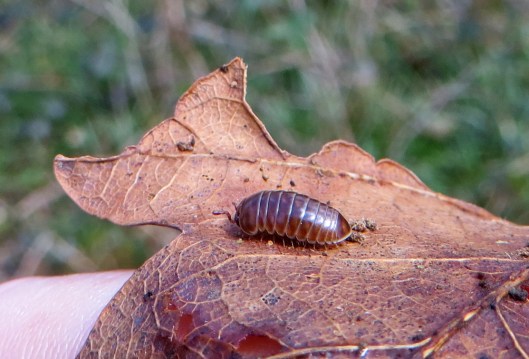
160416 Glomeris marginata Pill millipede

Pill millipede (Glomeris marginata). Like the pill woodlouse, these little creatures can roll into a ball when threatened, and live in damp places below stones and logs or in leaf litter.

160416 Tachypodoiulus niger White legged snake millipede

The White-legged snake millipede (Tachypodoiulus niger) also prefers a moist habitat, under rocks or logs or the bark of trees, and curls up when feeling vulnerable.

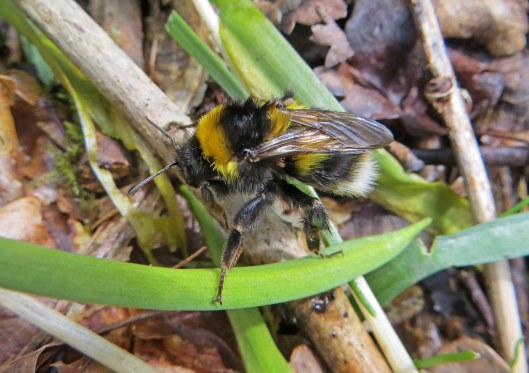
160416 Bombus hortorum Garden bumblebee Ty Rhiw

Garden bumblebee queen (Bombus hortorum), newly emerged from hibernation. She has the distinction of having the longest tongue of all British bumblebee species, which means she’s essential for agriculture, for pollinating flowers of the pea, bean and clover families.

160416 Gymnochaeta viridis

Gymnochaeta viridis, a bright metallic-green fly with prominent bristles on its thorax and abdomen that is mostly seen in woodlands in the springtime.

Like Loading...

Four more hoverflies

07 Thursday Apr 2016

Posted by sconzani in insects, nature, nature photography

≈ 8 Comments

Tags

Chequered hoverfly, Episyrphus balteatus, hoverfly, Long hoverfly, Marmalade hoverfly, Melanostoma scalare, Meliscaeva auricollis, Sphaerophoria scripta

Of the 250 different hoverfly species in Britain I now have photos of seven – just a wee way to go yet then. At least it’s still early in the season – hoverflies are normally around from March to November, and numbers tend to peak in the hottest months of summer. Here are my four new finds:

160407 Episyrphus balteatus cathays cem

Episyrphus balteatus
Rather deliciously called the Marmalade hoverfly, presumably not because it tastes good but because of the orange and black bands of colour on its upper abdomen. These give it a wasp-like appearance, which helps to deter predators but can scare people into thinking they’re a swarm of wasps when they group together. It’s the most common hoverfly in Britain, and large numbers also migrate here from Europe.

160407 Meliscaeva auricollis cathays cem

Meliscaeva auricollis
Like that previous one, I found this little guy enjoying the wood anemones at Cathays Cemetery. The cemetery has large numbers of mature trees, which is the perfect environment for Meliscaeva auricollis. This is one of the earliest hoverflies to wake from hibernation, sometimes appearing as early as January if the winter’s been mild.

160407 Melanostoma scalare  merthyr mawr

Melanostoma scalare
Though its name literally means ‘Laddered Black-mouth’, this little creature’s common name is the Chequered hoverfly and you can perhaps just make out the chequerboard pattern on its upper abdomen. I found this one  at Merthyr Mawr National Nature Reserve last weekend. It prefers open grassland, damp rather than dry, and is usually to be found flying and feeding close to ground level.

160407 Sphaerophoria scripta methyr mawr

Sphaerophoria scripta
This was another find from Merthyr Mawr. Its common name is the Long hoverfly, presumably because, as you can see in my photo, the body of the male extends past the end of the wings which is unusual in hoverflies. This critter is a prolific breeder, with the ability to complete a full life cycle (eggs to adult) in just 16 days, which means up to 9 generations can occur in one year. Amazing!

Like Loading...

The larva before the worm

04 Monday Apr 2016

Posted by sconzani in insects, nature, nature photography

≈ 7 Comments

Tags

glow worm, glow worm larva, Lampyris noctiluca, Merthyr Mawr National Nature Reserve

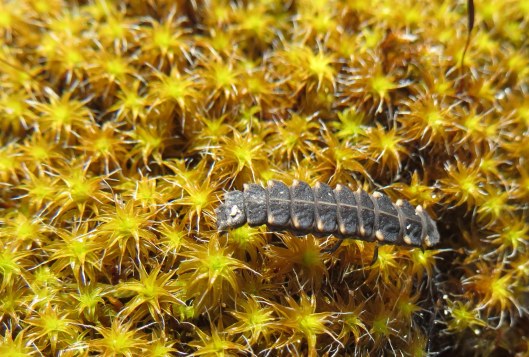
I saw my first Glow worm (Lampyris noctiluca) larva last weekend at the Merthyr Mawr National Nature Reserve, though I admit to thinking it was a caterpillar of some kind at first glance and needed an expert – luckily, I was with one! – to explain my mistake. Even more luckily, my expert Mike has two sons who are wildlife-obsessed and extremely talented young wildlife filmmakers. So, rather than attempt to tell you about this fascinating little insect myself, I am delighted that Rudi and Finn have very kindly agreed to let me link to their video. This is a must watch!

160404 Glow worm larva


Like Loading...

The return of the bumblebees

02 Saturday Apr 2016

Posted by sconzani in insects, nature

≈ 3 Comments

Tags

Bombus hypnorum, Bombus terrestris, Buff-tailed bumblebee, bumblebee, bumblebee mites, Tree bumblebee

As the Mary Kay Ash quote goes: ‘Aerodynamically, the bumblebee shouldn’t be able to fly but the bumblebee doesn’t know it so it goes on flying anyway.’ And flying they are, now that spring is here. The warmer weather brings the bumblebees – all queens – out of their long sleep, to begin the process of nest building and egg laying. In the past week I’ve seen several in flight and managed to get photos of two different species.

160402 Bombus hypnorum Tree bumblebee

Though it’s common in Europe and Asia, this Tree bumblebee (Bombus hypnorum) is not a British native. In fact, its ancestors only arrived in Britain in 2001. It has, however, made itself right at home and, as far as scientists can tell, is not damaging the native bee populations. It’s important we monitor its spread and population though, so please help by reporting your sightings to the Bees, Wasps and Ants Recording Society (BWARS).

160402 Bombus terrestris Buff-tailed bumblebee

The Buff-tailed bumblebee (Bombus terrestris) is often the first to be seen each year, emerging as early as February if the weather’s warm enough. Its nests, occupying old mouse and vole holes underground, can house as many as 500 individuals.

You will notice in my photo that this bumblebee has some hitchhikers. These are mites but please do not be concerned for this little creature. The mites are normal, they actually help keep bumblebee nests clean, and only in extreme cases do they affect the bumblebee’s health and welfare. You can read more here.

Like Loading...

Hoverflies: handsome and harmless

31 Thursday Mar 2016

Posted by sconzani in insects, nature, nature photography

≈ 3 Comments

Tags

Eristalis pertinax, Helophilus pendulus, hoverfly, Platycheirus albimanus, Tapered Drone Fly, The Footballer, The Sunfly, White-footed Hoverfly, Wood anemone

How is it that I am only just discovering hoverflies? Of course, I’ve seen them before, hovering silently over the garden bed and feeding on flower nectar, like the humming birds of the insect world, but I wasn’t aware of all their good qualities. For one thing, they’re clever – they mimic wasps and bees to deter predators, but they don’t sting. For another, because they feed on nectar and pollen, they’re excellent pollinators. And, for a third, many types of hoverfly larvae eat aphids and other plant-suckers so they’re every gardener’s friend and can potentially be used for biological control of those hugely damaging pests.

What I also discovered last weekend was that hoverflies love wood anemones and I found three species feasting on the beautiful drifts of plants currently flowering in my local cemetery. These are they – and I’m sure this is just the start of a beautiful new fascination!

Eristalis pertinax

Meet Eristalis pertinax, otherwise know as the Tapered Drone Fly. It’s a common sight throughout Britain, from March right through to November, and loves hedgerows and woodland trails.

Helophilus pendulus

As it’s a lover of fine sunny days, Helophilus pendulus is commonly known as The Sunfly, though some call it The Footballer because its stripy thorax resembles a team strip. Personally, I prefer its scientific name, which means ‘dangling marsh-lover’, a reference to its liking for watery places.

Platycheirus albimanus

And last and smallest for today is Platycheirus albimanus, the White-footed Hoverfly (though only the swelling on the front foot of the male is, in fact, pale). It’s another to be found throughout Britain, in gardens and hedgerows, from March to November.

Like Loading...

Itsy bitsy, teenie weenie

11 Friday Mar 2016

Posted by sconzani in insects, nature

≈ 3 Comments

Tags

Halyzia secedimguttata, ladybird, Orange ladybird

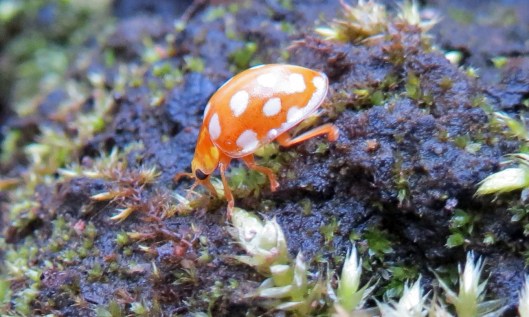
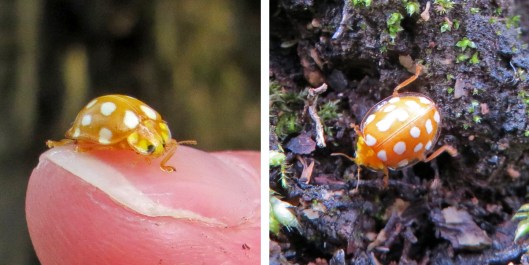
It seems you never know what you might find inside an old rubbery Jelly ear fungus. I certainly didn’t expect to find this delightful little creature, an Orange ladybird (Halyzia secedimguttata). They usually overwinter in a cosy spot amongst the leaf litter or tucked away in a crack in tree bark but the Jelly ear was on a fallen branch and I guess it looked like a snug cave to an insect that’s only 4-6mm long.

160311 orange ladybird (1)

Until 1987 the orange ladybird was thought to live only in ancient woodland but then it discovered it rather liked living on sycamore trees and later developed a liking for ash trees as well, so now you can find it in any woodland, park or garden in Wales and England where these trees grow. It is less common in Scotland apparently – perhaps too cold?

160311 orange ladybird (2)

The Orange ladybird feeds on the powdery mildew fungi that grows on trees and has an interesting lifecycle, laying batches of up to 40 eggs at a time, which hatch as larvae, which eventually pupate while the adult ladybird develops. Fascinating!

Like Loading...
← Older posts
Newer posts →

About me

sconzani

sconzani

I'm a writer and photographer; researcher and blogger; birder and nature lover; countryside rambler and city strider; volunteer and biodiversity recorder.

View Full Profile →

Follow earthstar on WordPress.com

Enter your email address to follow this blog and receive notifications of new posts by email.

Recent blog posts

  • The return of the Willow warblers April 23, 2026
  • Bug: Harpocera thoracica April 22, 2026
  • A female Tawny April 21, 2026
  • NFY: Orange-tip April 20, 2026
  • All the yellows April 19, 2026

From the archives

COPYRIGHT

Unless otherwise acknowledged, the text and photographs on this blog are my own and are subject to international copyright. Nothing may be downloaded or copied without my permission.

Fellow Earth Stars!

  • Unknown's avatar
  • Unknown's avatar
  • Unknown's avatar
  • Unknown's avatar
  • Unknown's avatar
  • Unknown's avatar
  • Unknown's avatar
  • Unknown's avatar
  • Unknown's avatar
  • Unknown's avatar
  • Unknown's avatar
  • Unknown's avatar
  • Unknown's avatar
  • Unknown's avatar
  • Unknown's avatar
  • Unknown's avatar
  • Unknown's avatar
  • Unknown's avatar
  • Unknown's avatar
  • Unknown's avatar
  • Unknown's avatar
  • Unknown's avatar
  • Unknown's avatar
  • Unknown's avatar
  • Unknown's avatar
  • Unknown's avatar
  • Unknown's avatar
  • Unknown's avatar
  • Unknown's avatar
  • Unknown's avatar
  • Unknown's avatar
  • Unknown's avatar
  • Unknown's avatar
  • Unknown's avatar
  • Unknown's avatar
  • Unknown's avatar
  • Unknown's avatar
  • Unknown's avatar
  • Unknown's avatar
  • Unknown's avatar
  • Unknown's avatar
  • Unknown's avatar
  • Unknown's avatar
  • Unknown's avatar
  • Unknown's avatar
  • Unknown's avatar
  • Unknown's avatar
  • Unknown's avatar
  • Unknown's avatar
  • Unknown's avatar

Blog at WordPress.com.

Privacy & Cookies: This site uses cookies. By continuing to use this website, you agree to their use.
To find out more, including how to control cookies, see here: Cookie Policy
  • Subscribe Subscribed
    • earthstar
    • Join 642 other subscribers
    • Already have a WordPress.com account? Log in now.
    • earthstar
    • Subscribe Subscribed
    • Sign up
    • Log in
    • Report this content
    • View site in Reader
    • Manage subscriptions
    • Collapse this bar
 

Loading Comments...
 

You must be logged in to post a comment.

    %d