• ABOUT
  • BIRDING 2018
  • Birding 2019
  • BLOG POSTS
  • Butterflies 2018
  • Resources

earthstar

~ a celebration of nature

earthstar

Category Archives: insects

Leafmines: Stigmella anomalella

27 Monday Nov 2023

Posted by sconzani in insects, leaves, plants

≈ Leave a comment

Tags

British leafminers, Dog rose, leaf-mining moth larvae, leaf-mining moths, leafminers, moth leafmines on Dog rose, Stigmella anomalella

This particular Dog rose (Rosa canina) was generous with its leafminers. Not only did I see the feeding signs and case-bearing larva of Coleophora gryphipennella (see my 13 November blog post) but I also found my first leafmines of Stigmella anomalella, also known appropriately enough as the Rose leaf miner (there are photos of the adult moth on the UK Moths website).

231127 Stigmella anomalella

As you can see, the larvae create long meandering galleries that are initially narrow and completely filled with frass, then later widen to show clear space on either side of the line of frass. The British Leafminers website notes that the gallery often ‘crosses back over itself’ as my image shows – well, actually, it’s crossing back under itself, but you get the idea. I was also lucky to spot larvae in mines on two of the leaves I looked at. These mines can be found around July and then again between October and December, so check out those Dog rose leaves before they all fall.

231127 Stigmella anomalella (2)

Like Loading...

Saw-fly

25 Saturday Nov 2023

Posted by sconzani in insects

≈ Leave a comment

Tags

Arge pagana, British sawflies, Dog rose, sawfly egg scar, Sawfly name, sawfly scar on rose

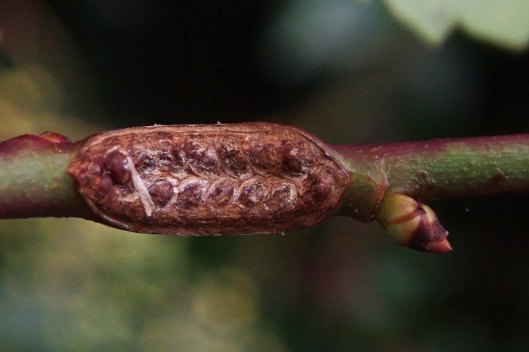
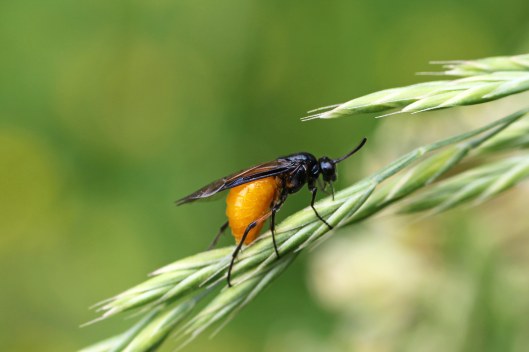
Did you know that the sawfly gets its name from the way it lays its eggs? Innocuous little flies, like the beauty shown below (Arge pagana, one of the UK species that uses the rose as its larval plant), have an in-built saw-like body part that they use to cut a slot in their larval plant material and in that slot they lay their eggs.

231125 Arge pagana

On some plants, like the stems of the various Rosa species used by Arge pagana, the slot leaves quite a substantial scar and, this week, for the first time, I noticed one of these when checking Dog roses for leafmines. As you can see, there’s a healthy leaf bud right next to the scar so the plant doesn’t seem to have been damaged by the slot-making process, though the voracious larvae that hatched from the eggs earlier in the year may well have stripped the rose of many of its leaves.

231125 sawfly egg scar

Like Loading...

Leafmines: Phyllonorycter viminiella

20 Monday Nov 2023

Posted by sconzani in insects, leaves, trees

≈ Leave a comment

Tags

British leafminers, British moths, leaf-mining moth larvae, leaf-mining moths, leafmines on willow, Phyllonorycter viminiella

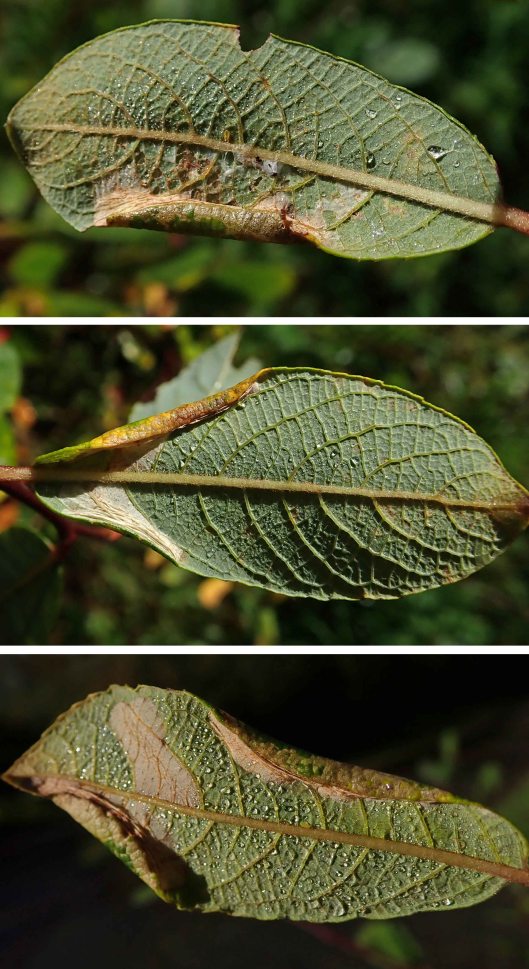
This was just the second time I’ve spotted these particular leafmines: they got a mention in On narrow-leaved willows, 26 December 2022, but I thought they deserved their own post. The larvae of the moth Phyllonorycter viminiella munch on the underside of Willows (usually those Salix species with smooth leaves), their feeding causing the edges of leaves to fold over and develop strong creasing in the mine, as you can see in my images below. These attractive little moths are bivoltine, so you can find the larval mines first around July and then again around October.

Like Loading...

Leafmines: Coleophora gryphipennella

13 Monday Nov 2023

Posted by sconzani in insects, leaves

≈ Leave a comment

Tags

Coleophora gryphipennella, leaf-mining moth larvae, leaf-mining moths, moth larvae in leaf mines

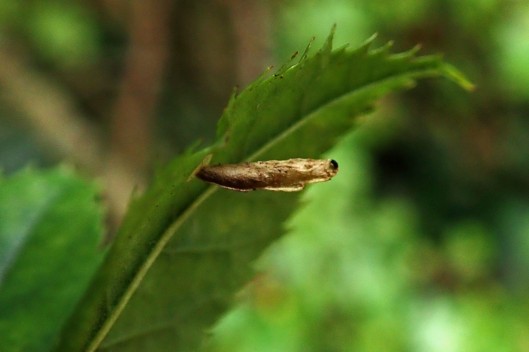
Another leaf-turning session recently resulted in another leafminer, the tiny moth Coleophora gryphipennella whose larvae feed on various species of Rosa. (You can see the adult moth on the UK Moths website here.)

231113 Coleophora gryphipennella on Rosa sp (1)

According to the British Leafminers website, the larvae, which create a tiny case to live in, can initially be found mining leaves from late August to late October. They hibernate in their cases over the colder winter months before emerging to feed again from April to mid May in a newly constructed case. These moths are apparently common, though this is the first I’ve spotted in all my time spent staring at and turning over leaves.

231113 Coleophora gryphipennella on Rosa sp (2)

Like Loading...

Hide and huddle

09 Thursday Nov 2023

Posted by sconzani in autumn, insects, leaves

≈ 2 Comments

Tags

autumn leaves, British insects, importance of leaves, insect decline, insects in leaves, over-wintering insects in leaves, snails in leaves

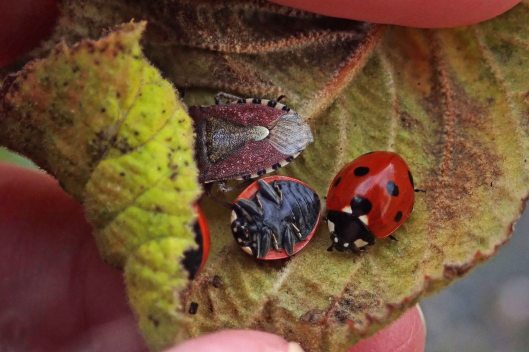
When the weather’s cold and wet, it’s time to hide and huddle. I found five 7-spot ladybirds and a Hairy shieldbug in this rolled-up leaf. (And, don’t fret, I rolled it up again so they could get back to their snoozing.)

231109 hide huddle hairy shieldbug 7spots

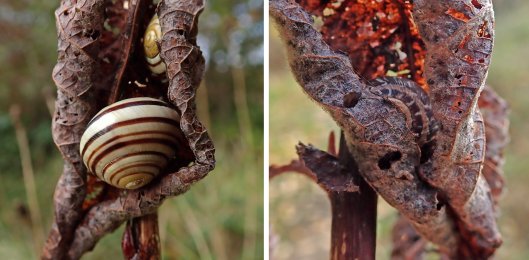
And they’re not the only ones choosing leaves for home and shelter as the colder weather approaches. All sorts of creatures creep or crawl or slide inside a conveniently place leaf-roll. Like these earwigs and, below, those snails.

231109 hide huddle earwigs

Though these leaves will eventually fall to the ground, they’ll be home to a diverse abundance of creatures during the winter months, which is why it’s always best to let some leaves remain on the ground – please don’t be tempted to rake or blow them all away for the sake of tidiness. Nature is not tidy and, given there’s been a 60% decline in flying insects in the UK in the last 20 years (just one example of Nature’s overall decline), leaving leaves in place is the very least we can do.

231109 hide huddle snails

Like Loading...

Leaf grazers: Carcina quercana

06 Monday Nov 2023

Posted by sconzani in insects, plants, trees

≈ Leave a comment

Tags

British moths, Carcina quarcana, leaf-grazing moth larvae, moth larvae on Blackthorn, moth larvae on Bramble, moth larvae on Buckthorn, moth larval foodplants

I found these first on Blackthorn when looking for leafminers but couldn’t find any examples on the British Leafminers website, so I posted photos on Twitter and asked my ecologically minded followers ‘what’s this?’.

231106 Carcina quercana on blackthorn

The response was almost instant: ‘Carcina quercana does that on several trees. The silk tube is always against the midrib or a vein and they venture out to graze from there’.

231106 carcina quercana on bramble

Carcina quercana is a lovely little moth and the little silken tubes are created by its larvae. The UK Moths website says ‘The foodplants are various deciduous trees, including oak (Quercus) [hence the quercana, in its name] and beech (Fagus)’, but, as my examples here show, the larvae don’t seem too fussy about what they eat. My photos here, showing both the upper and lower sides of the leaves, are on Blackthorn, Bramble, and Buckthorn.

231106 carcina quercana on buckthorn (1)

And why did I not find this species on the British Leafminers website? Well, strictly speaking, it’s not a miner – the larvae graze on the underside of the leaf when they venture out from their protective silken homes. You might just be able to spot the larva in the photo below.

231106 carcina quercana on buckthorn (2)

Like Loading...

T is for plume

31 Tuesday Oct 2023

Posted by sconzani in insects

≈ Leave a comment

Tags

Amblyptilia acanthadactyla, Beautiful plume, British moths, Common plume, Emmelina monodactyla, moth, plume moths

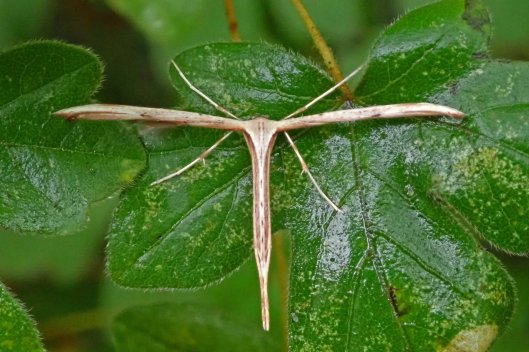
‘T is for plume’ may sound an odd title but it’s the T shape these moths make when they’re resting that makes them recognisable as plume moths, the Pterophorinae. And why plume? Well, when their wings are spread, the deep indentations look like feathers (the photos of a White plume on the UK Moths website show a beautiful example).

231031 common plume

Common plume (Emmelina monodactyla)
As you’d expect from its name, this pretty moth is quite common – in fact, I’ve seen several in the last few weeks.

231031 Beautiful plume

Beautiful plume (Amblyptilia acanthadactyla)
Though this moth can be confused with another that’s very similar (Brindled plume, Amblyptilia punctidactyla), the reddish-brown hue confirms it as a Beautiful plume.

Like Loading...

A spider’s lunch

30 Monday Oct 2023

Posted by sconzani in insects, spiders

≈ Leave a comment

Tags

caterpillar in spider web, flies in spider web, insects in spiders' webs, spider food, wasp in spider web, what spiders eat

What’s on the menu at the Web Café? Probably anything that makes the unfortunate mistake of colliding with a silken web of sticky fibres but, in this case, a couple of varieties of fly – one that appears to have been beheaded; a species of caterpillar; and a well-wrapped wasp. Definitely not a vegetarian café!

231030 spiders lunch

Like Loading...

Hoverfly larvae

26 Thursday Oct 2023

Posted by sconzani in insects

≈ Leave a comment

Tags

British hoverflies, Dasysyrphus species, Dasysyrphus species larva, Epistrophe grossulariae larva, hoverfly, hoverfly larvae, Syrphus species, Syrphus species larvae

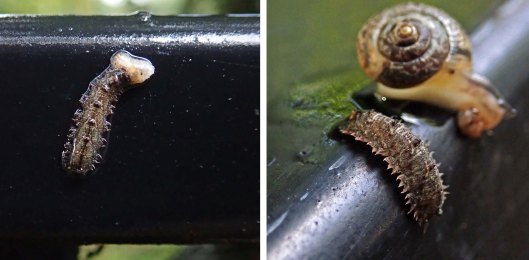
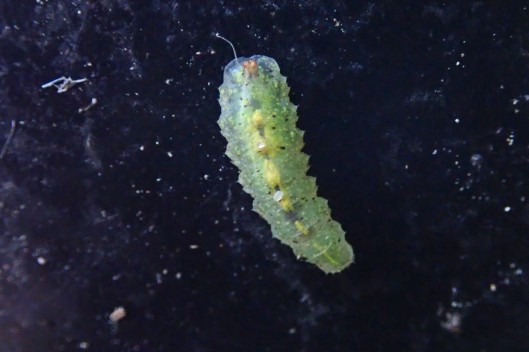
It’s that time of year when, especially after rain, hoverfly larvae can be found washed off their leaves on to fence posts, railings and stones (e.g. gravestones), particularly under Sycamore trees. Twice in the past week I’ve checked the roadside railings of a local park and found several larvae each time, of three different species.

First, a little cannibalism. The first shot shows a Dasysyrphus species larva that has almost finished eating a larva of one of the Syrphus species of hoverfly. When I returned this way a couple of hours later, the Dasysyrphus sp. larva hadn’t moved far (image on the right) and almost looked like it was considering the snail as prey but I think that would be biting off more than it could chew!

This is just the second Epistrophe grossulariae I’ve seen so I was very pleased to spot it. If you’re wondering what it will grow in to, click this link.

Syrphus species larvae were the most abundant (as with many of these larvae, it’s almost impossible to identify them accurately unless they’re retained and breed through to adulthood). And, as a final treat (?), here’s a little video of one of those Syrphus larvae munching on an aphid (slightly gross but compelling viewing!).

Like Loading...

Aphids: Tuberolachnus salignus

25 Wednesday Oct 2023

Posted by sconzani in insects, trees

≈ Leave a comment

Tags

aphids on willow, British aphids, Giant willow aphid, Tuberolachnus salignus

I know, I know. I said there’d probably be no more aphids during the winter months but they overwinter as adults, and I just happened to be looking at the leaves of a willow while waiting for a train when I spotted these and couldn’t resist a few photos. These are Giant willow aphids (Tuberolachnus salignus), and I happened to catch them in various sizes and forms: the winged aphid is an adult (the scientific term is alate).

231026 Tuberolachnus salignus on willow (1)

The Influential Points website gives some fascinating information about these aphids:

Tuberolachnus salignus is anholocyclic and no males have ever been found, so all reproduction is assumed to be parthenogenetic. The females produce live young which are all genetically identical (clones) … [and]
One part of the giant willow aphid’s life cycle remains shrouded in mystery. Tuberolachnus salignus have only been found on willow trees from July through to early March. Numbers tend to peak in October, but by February few are left on the trees and none has been seen from April to July. [So, where do they go?]

231026 Tuberolachnus salignus on willow (2)

Though I didn’t catch it on camera as my train was pulling in to the station, the aphids got annoyed with my lens being so close to them and started waving their legs at me, apparently something they do to frighten off potential predators.

Like Loading...
← Older posts
Newer posts →

About me

sconzani

sconzani

I'm a writer and photographer; researcher and blogger; birder and nature lover; countryside rambler and city strider; volunteer and biodiversity recorder.

View Full Profile →

Follow earthstar on WordPress.com

Enter your email address to follow this blog and receive notifications of new posts by email.

Recent blog posts

  • Bearded tit!!! April 3, 2026
  • A Portland Bill Kestrel April 2, 2026
  • A proliferation of Peacocks April 1, 2026
  • Little owl March 31, 2026
  • Distant seabirds March 30, 2026

From the archives

COPYRIGHT

Unless otherwise acknowledged, the text and photographs on this blog are my own and are subject to international copyright. Nothing may be downloaded or copied without my permission.

Fellow Earth Stars!

  • Unknown's avatar
  • Unknown's avatar
  • Unknown's avatar
  • Unknown's avatar
  • Unknown's avatar
  • Unknown's avatar
  • Unknown's avatar
  • Unknown's avatar
  • Unknown's avatar
  • Unknown's avatar
  • Unknown's avatar
  • Unknown's avatar
  • Unknown's avatar
  • Unknown's avatar
  • Unknown's avatar
  • Unknown's avatar
  • Unknown's avatar
  • Unknown's avatar
  • Unknown's avatar
  • Unknown's avatar
  • Unknown's avatar
  • Unknown's avatar
  • Unknown's avatar
  • Unknown's avatar
  • Unknown's avatar
  • Unknown's avatar
  • Unknown's avatar
  • Unknown's avatar
  • Unknown's avatar
  • Unknown's avatar
  • Unknown's avatar
  • Unknown's avatar
  • Unknown's avatar
  • Unknown's avatar
  • Unknown's avatar
  • Unknown's avatar
  • Unknown's avatar
  • Unknown's avatar
  • Unknown's avatar
  • Unknown's avatar
  • Unknown's avatar
  • Unknown's avatar
  • Unknown's avatar
  • Unknown's avatar
  • Unknown's avatar
  • Unknown's avatar
  • Unknown's avatar
  • Unknown's avatar
  • Unknown's avatar
  • Unknown's avatar

Blog at WordPress.com.

Privacy & Cookies: This site uses cookies. By continuing to use this website, you agree to their use.
To find out more, including how to control cookies, see here: Cookie Policy
  • Subscribe Subscribed
    • earthstar
    • Join 642 other subscribers
    • Already have a WordPress.com account? Log in now.
    • earthstar
    • Subscribe Subscribed
    • Sign up
    • Log in
    • Report this content
    • View site in Reader
    • Manage subscriptions
    • Collapse this bar
 

Loading Comments...
 

You must be logged in to post a comment.

    %d