• ABOUT
  • BIRDING 2018
  • Birding 2019
  • BLOG POSTS
  • Butterflies 2018
  • Resources

earthstar

~ a celebration of nature

earthstar

Category Archives: insects

Ladybirds galore

11 Thursday Nov 2021

Posted by sconzani in insects, ladybird

≈ 2 Comments

Tags

British ladybirds, harlequin ladybird, Harlequin ladybird larva, ladybird larva

I was really surprised during Tuesday’s walk to see so many ladybirds still about – not only adults but also a lot of larvae, and this one pair of adults that obviously thought it was springtime not late autumn.

On one small section of nettles growing along the road verge there were over 20 ladybirds.

211111 ladybirds (2)

Unfortunately, every single one was a Harlequin ladybird – not a 7-spot or other species to be seen.

211111 ladybirds (3)
211111 ladybirds (4)
211111 ladybirds (5)
211111 ladybirds (6)
Like Loading...

Face to face

10 Wednesday Nov 2021

Posted by sconzani in autumn, insects

≈ 2 Comments

Tags

British wasps, male wasps, Vespula vulgaris, wasp, wasps on ivy

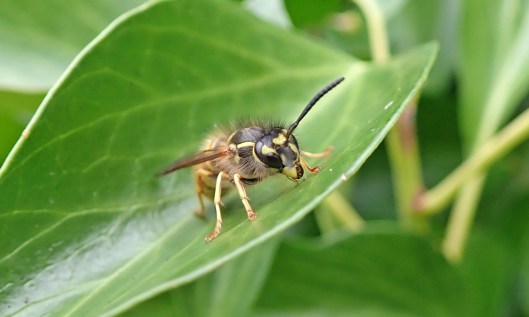
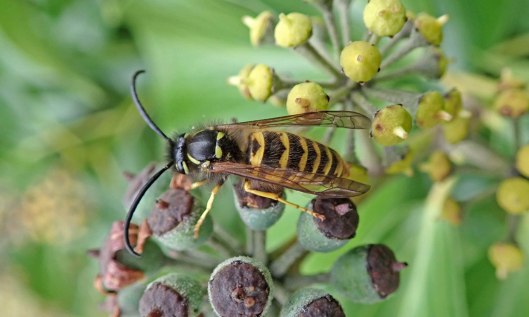
A long section of the coastal path where I walked yesterday was lined with Ivy, covered in ripening clusters of berries … and wasps. It seemed like each nest of wasps (all Vespula vulgaris, as far as I could tell) had laid claim to its own bush, where they sat preening on leaves, wandered over the berries, or just snoozed, and I was able to get quite close for some photos.

211110 wasp (1)

I’ve just been reading on the really informative Eakringbirds website that ‘Many wasps found on flowers from August onwards will often be males. These tend to be more docile and slightly less active than workers and often make better photographic subjects’, and that was certainly the case for me yesterday.

211110 wasp (2)

Like Loading...

Leafmines: on Columbine

08 Monday Nov 2021

Posted by sconzani in insects, plants

≈ Leave a comment

Tags

British leafmines, leaf-mining fly larvae, leafmines on Aquilejia, leafmines on Columbine, Phytomyza aquilegiae, Phytomyza minuscula

Here’s one – actually, two – for the gardeners out there, if you grow Columbine (Aquilegia vulgaris, also known as Granny’s bonnets) in your flower beds (though you can also find this plant growing in the wild, where it’s an indicator of ancient woodland, or perhaps as a naturalised garden escapee).

211108 (1) phytomyza minuscula

This first leafmine has been created by a larva of the tiny fly, Phytomyza minuscula. As you can see, the mine takes the form of a wavering tunnel with the larva’s frass, in blobs and lines, easily visible.

211108 (2) Phytomyza aquilegiae
211108 (3) Phytomyza aquilegiae

And this second lot of mines, in the form of large blotches, have been created by a related fly species, Phytomyza aquilegiae. Often, these mines contain more than one larva – you may be able to spot the two larvae in the photo on the right above – and the purplish blotches in these mines are also typical.

Like Loading...

Syrphus hoverfly larvae

06 Saturday Nov 2021

Posted by sconzani in autumn, insects, leaves, trees

≈ Leave a comment

Tags

British hoverflies, hoverfly larva, hoverfly larva on Sycamore, insects on Sycamore, sycamore, Syrphus sp larvae, Syrphus species

We’ve seen the Godzilla of hoverfly larvae, one of the Dasysyrphus species, and, back in February 2020, I featured my very first hoverfly larva, one of the Platycheirus family, and then in September we saw the larva and adult of Scaeva pyrastri. However, I haven’t yet shown you the larvae I see most often, those of the Syrphus species of hoverfly.

211106 syrphus sp (1)

I usually find these on Sycamore leaves, the undersides of which are home to thriving families of aphids, the hoverfly larvae’s favourite food. Occasionally, I’ve found larvae on the tops of leaves or on branches, perhaps on the move to a new leaf. And yesterday, on Twitter, I saw a short video by my go-to hoverfly larvae expert on the various species of hoverfly larvae he had found on gravestones under Sycamore trees in his local cemetery. I’ll be checking out that idea during one of next week’s nature walks. Meantime, try turning over some Sycamore leaves – you never know what might be lurking underneath.

211106 syrphus sp (2)
211106 syrphus sp (3)
211106 syrphus sp (4)
211106 syrphus sp (5)

Like Loading...

Dasineura fraxini galls

03 Wednesday Nov 2021

Posted by sconzani in insects, leaves, trees

≈ Leave a comment

Tags

Ash tree galls, Dasineura fraxini, gall causing midge, gall midges, galls, galls made by midges, galls on Ash leaves, midge gall

One of the benefits of checking the leaves of various trees, and other plants, for leafmines is that, even when I don’t find them, I do find other things just as interesting, and this is one of those. I didn’t know what it was, of course, until I got home and checked my Field Studies Council Guide to plant galls in Britain fold-out guide. (If you’re not familiar with these, check the FSC online shop here. I have a few of these and find them really useful.)

211103 Dasineura fraxini (1)
211103 Dasineura fraxini (2)

My guide informed me that these galls on the leaves of Ash trees were created by the larvae of Dasineura fraxini, a species of tiny midge. Few people have ever seen the adult midge but I did have a look at one of the galls that was partly open and spotted one of the miniscule orange larvae. These galls can be found from May through to October, at which time the leaves will fall to the ground, where the larvae will pupate and over-winter until emerging as adult midges in the springtime.

211103 Dasineura fraxini (3)

Like Loading...

Leafmines: Phyllonorycter platani

01 Monday Nov 2021

Posted by sconzani in insects, leaves, trees

≈ Leave a comment

Tags

British leafmines, leaf mines, leaf-mining moth, leaf-mining moth larvae, leafmines on Plane trees, Phyllonorycter platani, Plane trees

Another #LeafmineMonday, another new leafmine discovery – new to me, that is, not to science or Wales.

Top of leaf on the left; underside on the right

This is another mine that’s created by the larva of a moth, the rather handsome micro moth Phyllonorycter platani, whose larvae feed on the leaves of Plane trees. This moth only appeared in Britain 30 years ago – as it can be found in many countries around the globe, it’s not possible to say where it came from or how it got to London but, since 1989, it has colonised much of southern Britain. Of course, no one knows how it’s managed that either, though I did read some speculation on Twitter that, as the first Cardiff records were noted very near the main car and coach parks, the moths could well have hitched a ride on passing vehicles. As I’ve sometimes seen small moths on trains, I can quite believe that possibility.

211101 phyllonorycter platani (1)
211101 phyllonorycter platani (2)

Like Loading...

The Godzilla of hoverfly larvae

26 Tuesday Oct 2021

Posted by sconzani in insects, trees

≈ 2 Comments

Tags

British hoverflies, Dasysyrphus larva, hoverfly larva, hoverfly larva eating an aphid, hoverfly larva on Sycamore

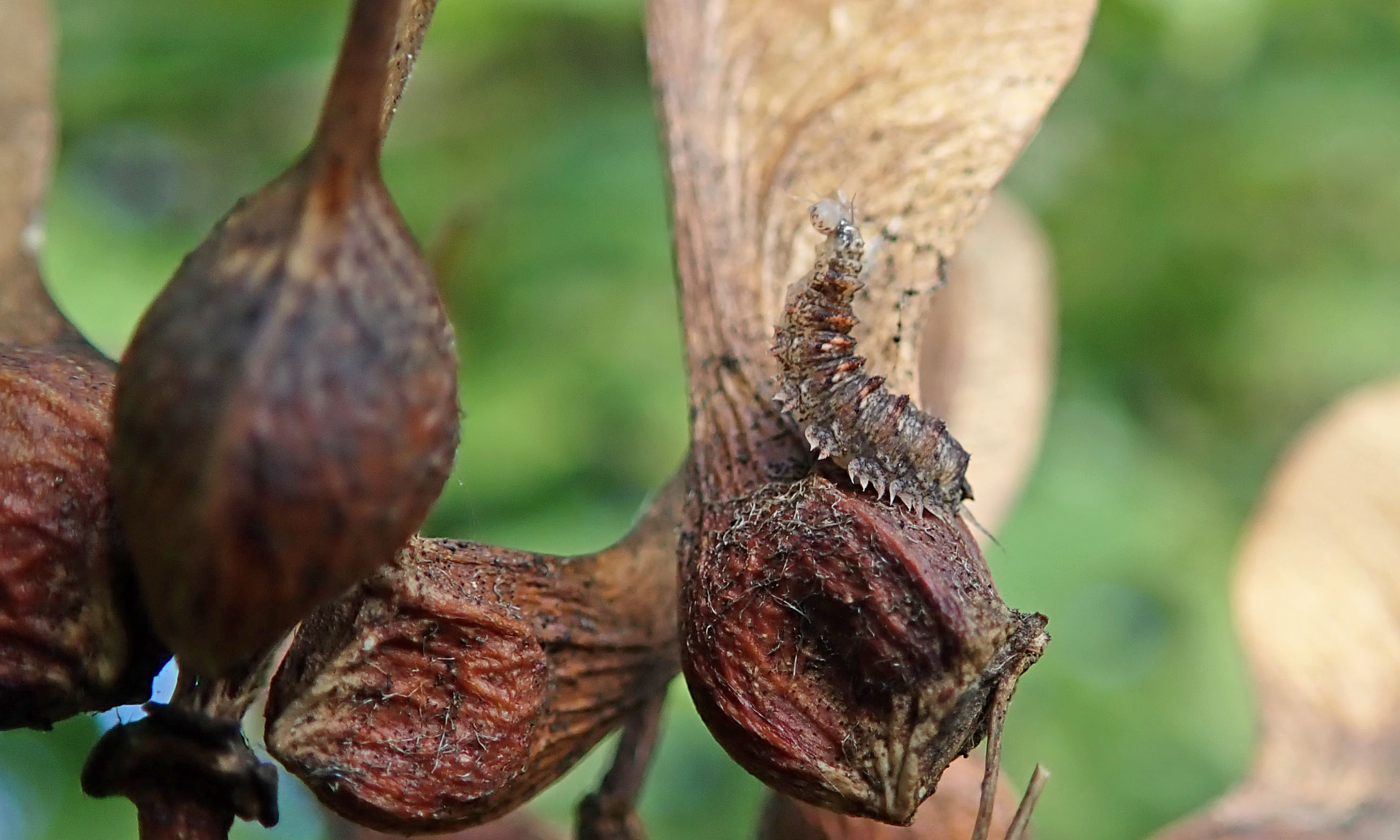
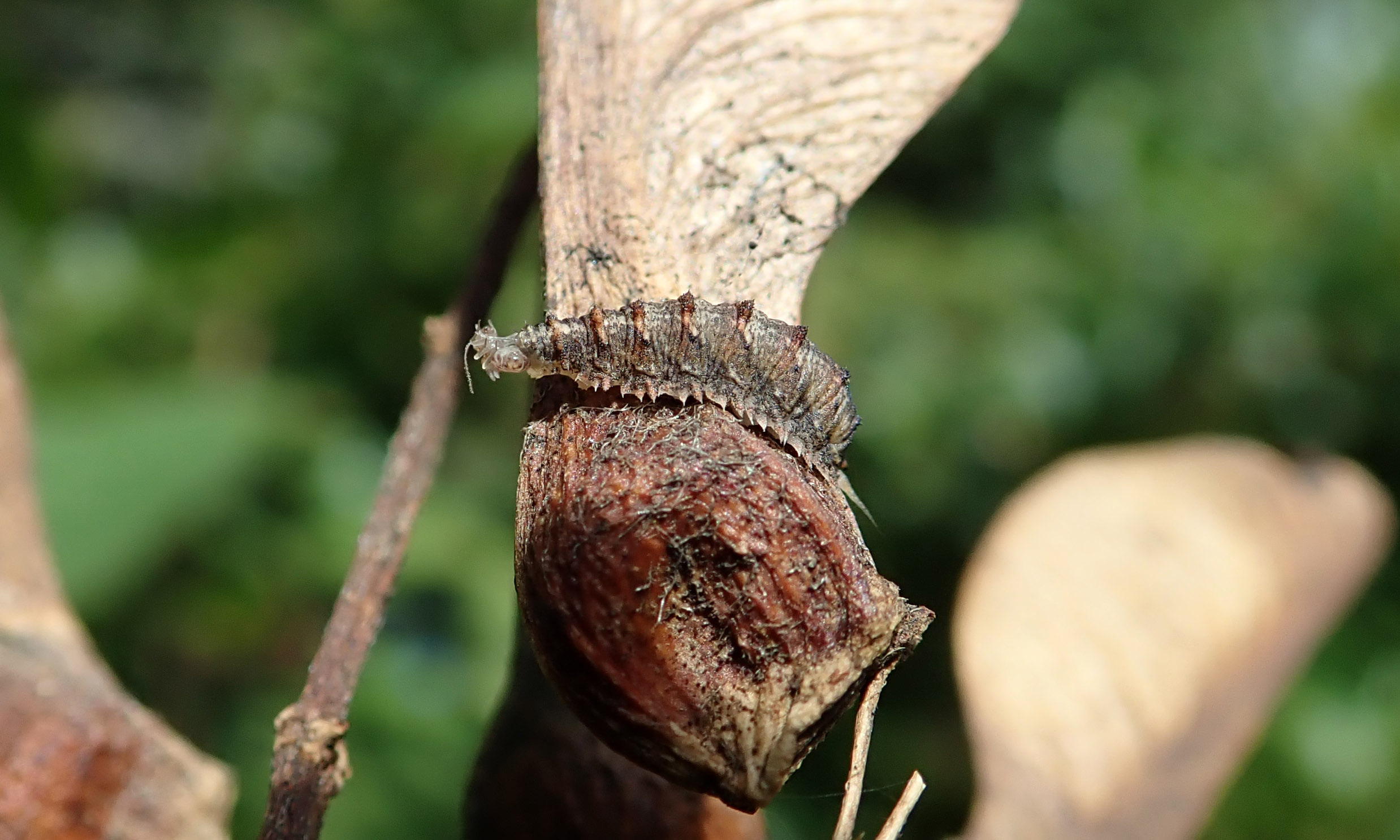
The highlight of Friday’s walk was marvelling at this hoverfly larva catch an aphid. The larva sat, perfectly camouflaged on its Sycamore seed, waiting for an unsuspecting aphid to tootle past. Though these larvae are blind, they can obviously sense movement, as this one rapidly twisted its body towards any approaching larvae. As I watched, it missed the first one but the next larva to chance its luck was grabbed and was in the process of having its life juices sucked out when I moved on.

211026 hoverfly larva (1)

Geoff, a hoverfly larvae expert I consulted on Twitter, was able to confirm a species but not a precise identification: ‘The Godzilla of hoverfly larvae! Certainly Dasysyrphus sp. probably albostriatus. Need a dorsal view of the rear breathing tube to be certain.’ Yes, you read that right – not only is the larva blind but it also breathes through tubes in its rear end!

211026 hoverfly larva (2)

Like Loading...

Leafmines: Coleophora badiipennella

25 Monday Oct 2021

Posted by sconzani in insects, leaves, trees

≈ 2 Comments

Tags

Case-bearing moth, Coleophora badiipennella, leaf-mining moth, leafminer, leafmines on Wych elm, Pale elm case-bearer

This might not look like much but I’ve been looking for one of these for perhaps a year, at least during the months when it was around to be found. And if I hadn’t been looking closely at the leaves of this Wych elm, I could so easily have missed it. These are the leafmine and the case of Coleophora badiipennella, the Pale Elm Case-bearer (click on the link here to see the adult moth on the UK Moths website).

211025 coleophora badiipennalla (1)
211025 coleophora badiipennalla (3)

According to the British Leafminers website, the larva:

initially forms a gallery along the midrib, which then goes out along a vein (see photo). The end of this gallery is then excised to construct the first case. It then feeds close to this and makes several small mines …

211025 coleophora badiipennalla (2)

If you look at my photo above, you can see where the larva has made a second mine below the first – you can see the tiny hole where it would have attached itself – before moving to the third mine where it was then feeding. I haven’t been able to find much information about pupation but I presume the larva remains in its case, falls to the ground either still attached to its leaf when the leaf falls or after detaching itself, and over-winters on the ground. It seems many of these leafminers are not very well studied … yet.

Like Loading...

Zorro comes to Wales

21 Thursday Oct 2021

Posted by sconzani in insects, leaves, trees

≈ 2 Comments

Tags

Aproceros leucopoda, British sawflies, Elm zigzag sawfly, sawfly feeding marks on elm leaves, sawfly on Wych elm

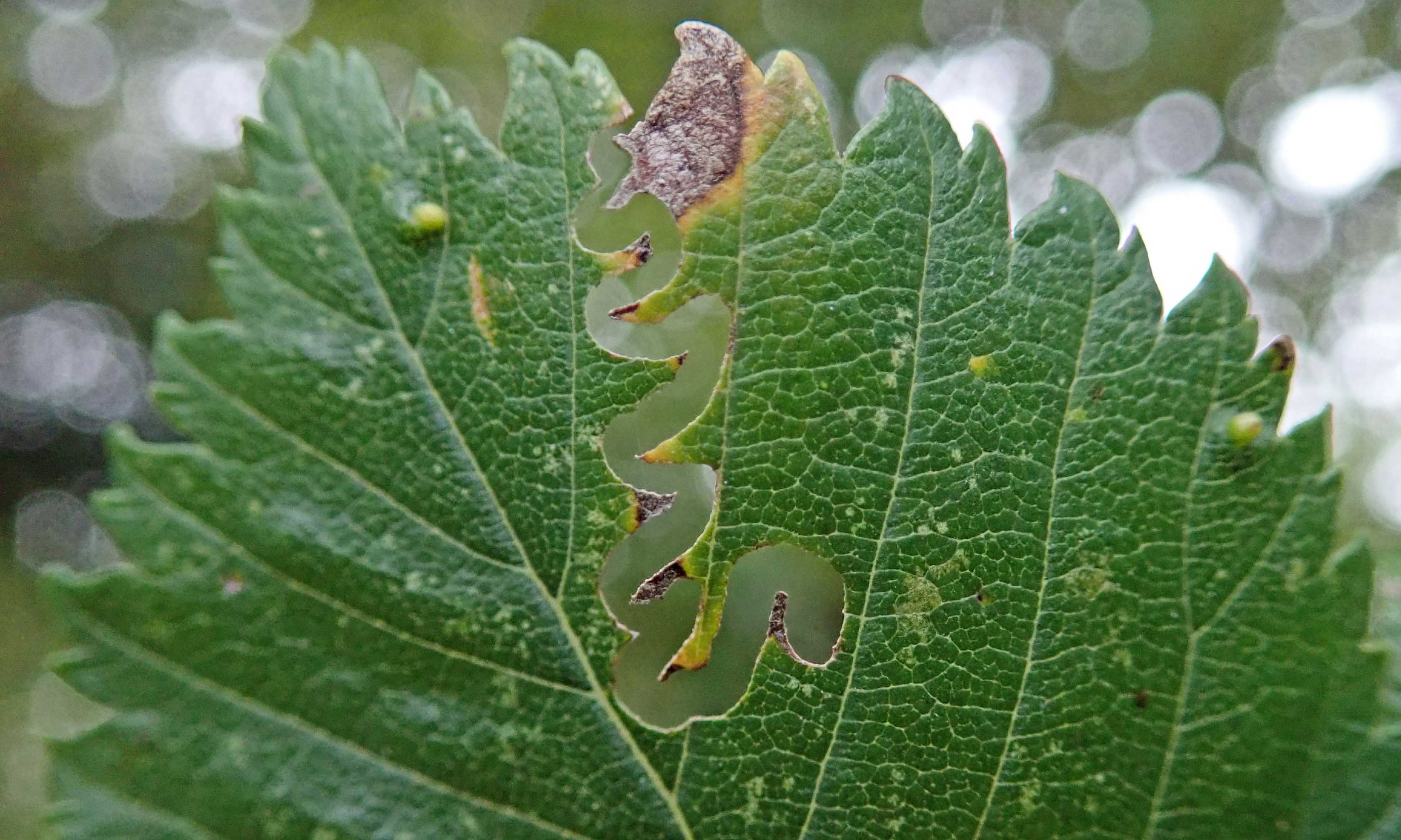
‘Yes it’s definitely Zorro’, confirmed Andy, a county sawfly recorder, when he took a look at these photos on Twitter on Tuesday. Andy was not, of course, referring to the legendary fictional character of book, television series and movie, but to the creature that created, in the leaves of Wych elm, these characteristic feeding marks that resemble the trademark ‘Z’ signature the big screen version of Zorro left at the scene of his adventures.

211021 elm zigzag sawfly (1)

Zorro, in this case, is the Elm zigzag sawfly (Aproceros leucopoda) and my photos are the first records for this species in Wales. The find is a double-edged sword (see what I did there?), as this sawfly is considered an invasive species, though I am assured by those who have been following its spread in England that the damage it does is not as considerable as first feared. I hope to spot the larvae that do this damage sometime next year.

211021 elm zigzag sawfly (2)
211021 elm zigzag sawfly (3)
211021 elm zigzag sawfly (4)

Like Loading...

A Moth fly

20 Wednesday Oct 2021

Posted by sconzani in insects

≈ 2 Comments

Tags

British flies, Drain fly, Moth fly, Owl fly, Owl midge, Psychodidae

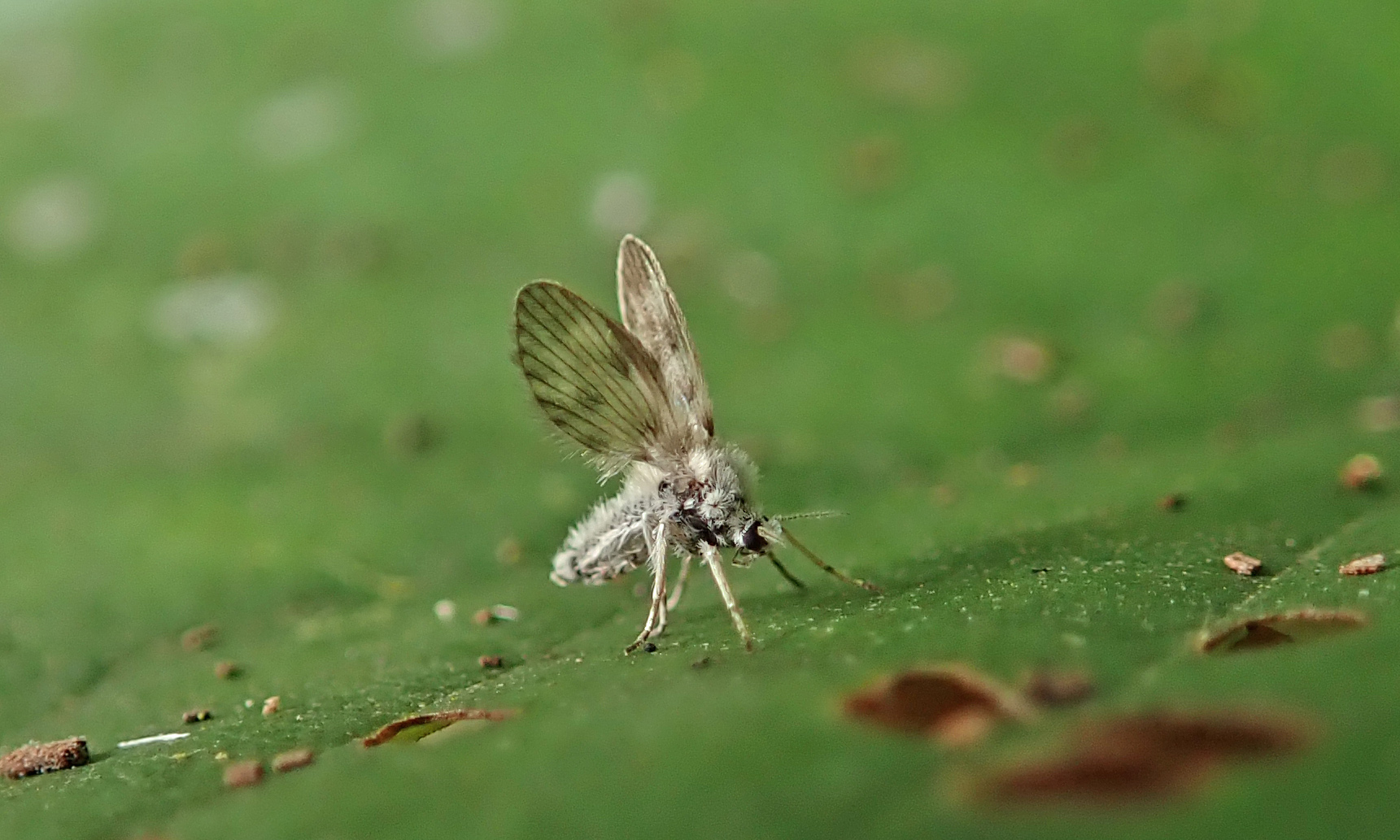
Meet a Moth fly, or an Owl midge, or a Drain fly, or an Owl fly, a tiny creature that has a multitude of common names but whose 99 British species are so difficult to identify that I can’t give you an exact scientific name for this particular one, except to say that it’s a member of the Psychodidae family.

211020 moth fly (1)

I was actually amazed that it stayed relatively still long enough for me to get so many photos – perhaps the cooler temperature this day had reduced its ability to flit actively about. Not so good for the fly, but a bonus for the photographer.

211020 moth fly (2)
211020 moth fly (3)
211020 moth fly (4)

Like Loading...
← Older posts
Newer posts →

About me

sconzani

sconzani

I'm a writer and photographer; researcher and blogger; birder and nature lover; countryside rambler and city strider; volunteer and biodiversity recorder.

View Full Profile →

Follow earthstar on WordPress.com

Enter your email address to follow this blog and receive notifications of new posts by email.

Recent blog posts

  • Alder flies April 9, 2026
  • Lily beetle April 8, 2026
  • First bee-flies April 7, 2026
  • Bloody-nosed beetle April 6, 2026
  • Gorse and its weevil April 5, 2026

From the archives

COPYRIGHT

Unless otherwise acknowledged, the text and photographs on this blog are my own and are subject to international copyright. Nothing may be downloaded or copied without my permission.

Fellow Earth Stars!

  • Unknown's avatar
  • Unknown's avatar
  • Unknown's avatar
  • Unknown's avatar
  • Unknown's avatar
  • Unknown's avatar
  • Unknown's avatar
  • Unknown's avatar
  • Unknown's avatar
  • Unknown's avatar
  • Unknown's avatar
  • Unknown's avatar
  • Unknown's avatar
  • Unknown's avatar
  • Unknown's avatar
  • Unknown's avatar
  • Unknown's avatar
  • Unknown's avatar
  • Unknown's avatar
  • Unknown's avatar
  • Unknown's avatar
  • Unknown's avatar
  • Unknown's avatar
  • Unknown's avatar
  • Unknown's avatar
  • Unknown's avatar
  • Unknown's avatar
  • Unknown's avatar
  • Unknown's avatar
  • Unknown's avatar
  • Unknown's avatar
  • Unknown's avatar
  • Unknown's avatar
  • Unknown's avatar
  • Unknown's avatar
  • Unknown's avatar
  • Unknown's avatar
  • Unknown's avatar
  • Unknown's avatar
  • Unknown's avatar
  • Unknown's avatar
  • Unknown's avatar
  • Unknown's avatar
  • Unknown's avatar
  • Unknown's avatar
  • Unknown's avatar
  • Unknown's avatar
  • Unknown's avatar
  • Unknown's avatar
  • Unknown's avatar

Blog at WordPress.com.

Privacy & Cookies: This site uses cookies. By continuing to use this website, you agree to their use.
To find out more, including how to control cookies, see here: Cookie Policy
  • Subscribe Subscribed
    • earthstar
    • Join 642 other subscribers
    • Already have a WordPress.com account? Log in now.
    • earthstar
    • Subscribe Subscribed
    • Sign up
    • Log in
    • Report this content
    • View site in Reader
    • Manage subscriptions
    • Collapse this bar
 

Loading Comments...
 

You must be logged in to post a comment.

    %d