• ABOUT
  • BIRDING 2018
  • Birding 2019
  • BLOG POSTS
  • Butterflies 2018
  • Resources

earthstar

~ a celebration of nature

earthstar

Category Archives: leaves

Wild words: chlorophilia

24 Wednesday Jan 2018

Posted by sconzani in leaves, nature, trees

≈ 1 Comment

Tags

#WildWords, chlorophilia, green leaves, loving all things green

Chlorophilia: from the Greek khlōros, meaning green, and philia, meaning loving; thus, loving all things green and growing.
Now, that sounds straightforward enough and many of us would willingly admit to having chlorophilia but a word of caution. I’ve just been reading on the Wiki Knowledge Dump blog (the place where rejected Wikipedia articles often get resurrected) that the word (which does not appear in standard dictionaries) was ‘invented’ in 2004 to describe a physical or sexual attraction to plants. Tree-huggers, take note!

180124 chlorophilia

Like Loading...

Leafmines 101

13 Saturday Jan 2018

Posted by sconzani in insects, leaves, nature, plants, trees

≈ 5 Comments

Tags

British insects, homes of insect larvae, insect larvae in leaves, leaf mine, leafmine, leafminer, mines on leaves

Leafmines and their miners are a subject I started to look at last summer but I quickly discovered that, in order to identify the miner, you had to know the plant they were mining, so I needed to improve my botanical knowledge before I could go much further. That effort has begun, and is ongoing, so I will start to look again at the miners in the coming months.

180113 leafmines (1)
180113 leafmines (2)

Firstly though, in case you don’t know, leafmines are made by the larvae of various insects. The mines are their homes and their larders – as well as providing them with some degree of protection from predators, the larvae eat the tissue of the leaves they live within, thus creating their mines. The larvae can be the immature stages of various species of flies, sawflies or moths, and, apparently, some beetles also mine leaves.

180113 leafmines (3)
180113 leafmines (4)

If you look at a mine, you will often see a tiny hole at one end, which means the creature that made it has left the premises, to pupate or to being life as an adult. Sometimes, you can still see the larva within, and you can often also see the pooh (known as frass) it has left behind as it eats and tunnels.

180113 leafmines (5)
180113 leafmines (6)

The shapes of the mines can vary considerably, from long meandering or straight lines to roundish blotches, and these shapes, plus the placement of the mine within the leaf (some occupy just the upper or lower surface, some go right through) and the identity of the plant, are the main ways to determine which creature has made the mine.

**p.s. Since posting this, I’ve been told what I thought was a leaf mine on ivy (the photo on the right in the middle) is actually caused by a fungus, possibly Phoma hedericola, the most common leaf spot of ivy. I can see these leafmines are going to be even more tricky than I anticipated!

Like Loading...

This crisp winter air

09 Tuesday Jan 2018

Posted by sconzani in leaves, nature, weather, winter

≈ 3 Comments

Tags

fire of the frost, frost, frosty leaves, ice, winter weather

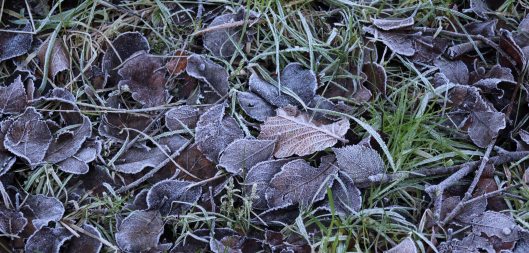
180109 frosty leaves (1)

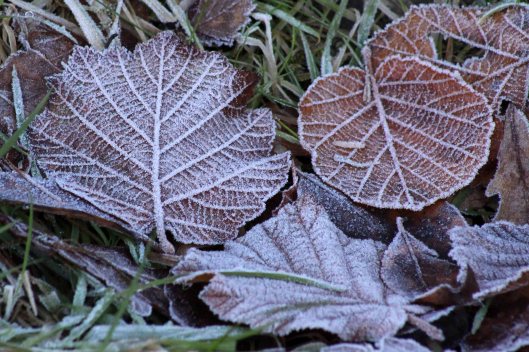
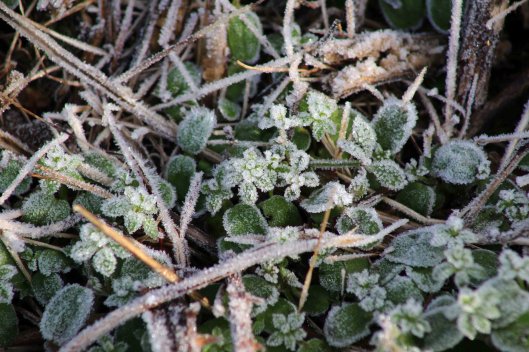
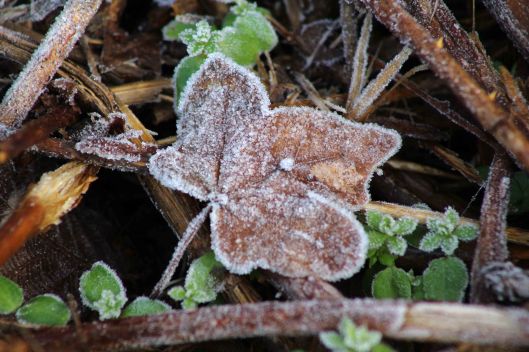
‘It is the life of the crystal, the architect of the flake, the fire of the frost, the soul of the sunbeam. This crisp winter air is full of it.’ ~ John Burroughs (1837-1921), Winter Sunshine, 1875

180109 frosty leaves (2)180109 frosty leaves (3)180109 frosty leaves (4)

Like Loading...

The living fossil fungus challenge

05 Friday Jan 2018

Posted by sconzani in fungi, leaves, nature, parks, trees

≈ Leave a comment

Tags

Bartheletia paradoxa, fungus on Ginkgo leaves, Ginkgo, Ginkgo biloba, living fossil fungus

My local fungus group has a new challenge going for the month of January, to find a ‘living fossil fungus’. Sounds weird? Well, the ‘living fossil’ is the Ginkgo tree (Ginkgo biloba), a tree that’s been around since the time of the dinosaurs (read more about this beautiful tree on my sconzani blog here), and the fungus is Bartheletia paradoxa, a basidiomycete that only grows on Ginkgo leaves and has characteristics that are unique amongst basidiomycetes (for the science geeks out there, here’s a link to an expert article).

180105 Ginkgo fungus (1)

The fungus was not formally recognised until 1932 and was first found in Britain, on the leaves of a Ginkgo at Kew Gardens, in 2008. There are still very few official records for it but, as members of our fungus group are now discovering, it seems to be on almost every Ginkgo tree we can find.

180105 Ginkgo fungus (3)
180105 Ginkgo fungus (2)

As you can see from the photos, the fungus looks like black spots on the fallen leaves. Of course, autumn is long gone and the winter winds that have been roaring across Britain this past week have blown away a lot of fallen leaf litter but it’s still worth looking look around any Ginkgo trees you know of in your local parks. I found these leaves on Wednesday around the magnificent Ginkgo avenue in Bute Park, behind Cardiff Castle, and I have another couple of places to go looking in the next few days. So, do see if you can find yourself a ‘living fossil fungus’ as well.

Like Loading...

Wild words: Psithurism

06 Wednesday Dec 2017

Posted by sconzani in autumn, leaves, nature, trees, winter

≈ Leave a comment

Tags

#WildWords, autumn leaves, Psithurism, rustling leaves, sound of rustling leaves, words about Nature

Here’s a word that’s not in the Oxford Dictionary because it’s now considered obsolete but, as Oxford University Press has a habit of somewhat arbitrarily removing words from its dictionaries (since 2007 it was deleted words like ‘buttercup’ and acorn’ from its Junior Dictionary) and replacing them with modern lingo (like ‘cut-and-paste’ and ‘analogue’), I’m doing my bit to revive words before they’re forgotten.

171203 Psithurism (1)

Psithurism, then, is a noun used to describe the sound of rustling leaves. It is, apparently, an adaptation of the Ancient Greek ψιθύρισµα (psithurisma) or ψιθυρισµός (psithurismos), which are derived from ψιθυρίζω (psithurizō, meaning ‘I whisper’) and from ψίθυρος (psithuros, meaning ‘whispering’ or ‘slanderous’). Can you hear them rustling? And, here’s a little test: what’s the word for leaves like these that wither but stay attached to the stem?

171203 Psithurism (2)

Like Loading...

Leaf skeletons

28 Tuesday Nov 2017

Posted by sconzani in autumn, leaves, nature, trees

≈ 2 Comments

Tags

autumn leaves, skeleton leaf, skeleton leaves, veins in leaves

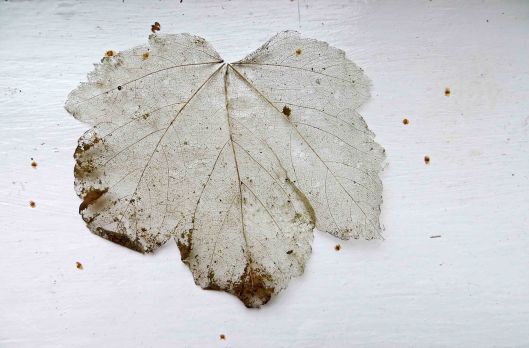
One of the things I love about this time of year is the way the substance of some leaves crumbles to reveal the complex structures of veins. Lacy, delicate, fragile.

171128 leaf skeletons (1)

Going, going, gone!

171128 leaf skeletons (2)
171128 leaf skeletons (3)
171128 leaf skeletons (4)
Like Loading...

Wild words: feuillemort

22 Wednesday Nov 2017

Posted by sconzani in autumn, leaves, nature, trees

≈ 2 Comments

Tags

#WildWords, autumn colour, autumn leaves, dyling leaf, Feuillemort

Feuillemort: adjective, meaning ‘having the colour of a dying leaf’, from the French feuille morte, meaning dead leaf.

171122 Feuillemort (1)
171122 Feuillemort (2)
171122 Feuillemort (3)
171122 Feuillemort (4)
171122 Feuillemort (5)
171122 Feuillemort (6)
171122 Feuillemort (7)
171122 Feuillemort (8)
171122 Feuillemort (9)
Like Loading...

Autumn leaves, 3

12 Sunday Nov 2017

Posted by sconzani in autumn, leaves, nature, seasons, trees

≈ 2 Comments

Tags

autumn, autumn colour, autumn leaves, Fall colour

There is so much to love about autumn: it’s as if Nature is an award-winning play, and all the trees are her actors. She’s coming to the end of another successful season, it’s the last grand finale, the players are dressed in magnificent richly coloured costumes ready to take their final bows before a rapturous audience amidst great critical acclaim … and then the curtain comes down for another year.

171112 autumn leaves (1)
171112 autumn leaves (2)
171112 autumn leaves (3)
171112 autumn leaves (4)
171112 autumn leaves (5)
171112 autumn leaves (6)
171112 autumn leaves (7)
171112 autumn leaves (8)
Like Loading...

Autumn leaves, 2

02 Thursday Nov 2017

Posted by sconzani in autumn, leaves, nature, seasons, trees

≈ Leave a comment

Tags

autumn, autumn colour, autumn leaves, autumn trees, Fall colour

‘I am rich today with autumn’s gold.’ ~ Gladys Harp

171102 autumn colour (1)
171102 autumn colour (2)
171102 autumn colour (3)
171102 autumn colour (3a)
171102 autumn colour (4)
171102 autumn colour (5)
171102 autumn colour (6)
171102 autumn colour (8)
Like Loading...

Wild words: marcescent

18 Wednesday Oct 2017

Posted by sconzani in autumn, fungi, leaves, nature, trees, winter

≈ 1 Comment

Tags

botanical words, marcescent, wild words

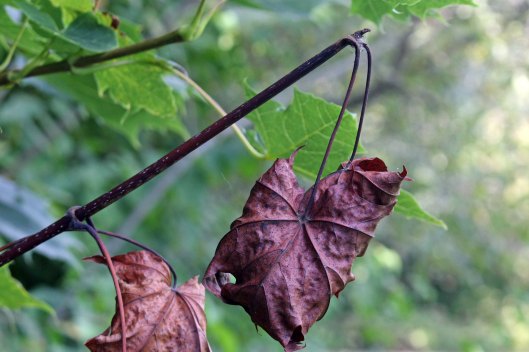
Thanks in part to following favourite author Robert Macfarlane (@RobGMacfarlane) on Twitter (he tweets a daily word) and in part to working through naturalist extraordinaire Dr Mary Gillham’s archives, I’ve been learning a lot of new words so I thought I would share the occasional one here. To start the stone rolling, we have marcescent, an adjective, which the Oxford Dictionary defines as ‘withering but remaining attached to the stem’. This is particularly noticeable during autumn and winter, as the leaves of some trees wilt and fade but remained attached to their branches. Some palms continuously retain a marcescent ‘skirt’ of dried fronds, and the term is, apparently, also used to refer to those species of fungi that can dry out but subsequently be rehydrated and continue to shed spores.

171018 marcescent

Like Loading...
← Older posts
Newer posts →

About me

sconzani

sconzani

I'm a writer and photographer; researcher and blogger; birder and nature lover; countryside rambler and city strider; volunteer and biodiversity recorder.

View Full Profile →

Follow earthstar on WordPress.com

Enter your email address to follow this blog and receive notifications of new posts by email.

Recent blog posts

  • Avocet February 21, 2026
  • First large spider February 20, 2026
  • Our celebrity Redshank February 19, 2026
  • My first moth of the year February 18, 2026
  • Three Common sandpipers February 17, 2026

From the archives

COPYRIGHT

Unless otherwise acknowledged, the text and photographs on this blog are my own and are subject to international copyright. Nothing may be downloaded or copied without my permission.

Fellow Earth Stars!

  • Unknown's avatar
  • Unknown's avatar
  • Unknown's avatar
  • Unknown's avatar
  • Unknown's avatar
  • Unknown's avatar
  • Unknown's avatar
  • Unknown's avatar
  • Unknown's avatar
  • Unknown's avatar
  • Unknown's avatar
  • Unknown's avatar
  • Unknown's avatar
  • Unknown's avatar
  • Unknown's avatar
  • Unknown's avatar
  • Unknown's avatar
  • Unknown's avatar
  • Unknown's avatar
  • Unknown's avatar
  • Unknown's avatar
  • Unknown's avatar
  • Unknown's avatar
  • Unknown's avatar
  • Unknown's avatar
  • Unknown's avatar
  • Unknown's avatar
  • Unknown's avatar
  • Unknown's avatar
  • Unknown's avatar
  • Unknown's avatar
  • Unknown's avatar
  • Unknown's avatar
  • Unknown's avatar
  • Unknown's avatar
  • Unknown's avatar
  • Unknown's avatar
  • Unknown's avatar
  • Unknown's avatar
  • Unknown's avatar
  • Unknown's avatar
  • Unknown's avatar
  • Unknown's avatar
  • Unknown's avatar
  • Unknown's avatar
  • Unknown's avatar
  • Unknown's avatar
  • Unknown's avatar
  • Unknown's avatar
  • Unknown's avatar

Blog at WordPress.com.

Privacy & Cookies: This site uses cookies. By continuing to use this website, you agree to their use.
To find out more, including how to control cookies, see here: Cookie Policy
  • Subscribe Subscribed
    • earthstar
    • Join 670 other subscribers
    • Already have a WordPress.com account? Log in now.
    • earthstar
    • Subscribe Subscribed
    • Sign up
    • Log in
    • Report this content
    • View site in Reader
    • Manage subscriptions
    • Collapse this bar
 

Loading Comments...
 

You must be logged in to post a comment.

    %d