• ABOUT
  • BIRDING 2018
  • Birding 2019
  • BLOG POSTS
  • Butterflies 2018
  • Resources

earthstar

~ a celebration of nature

earthstar

Category Archives: nature photography

‘It would puzzle a monkey to climb that tree’

16 Saturday Jan 2016

Posted by sconzani in leaves, nature, nature photography, trees

≈ 2 Comments

Tags

Argentinian tree, Chilean tree, Monkey puzzle

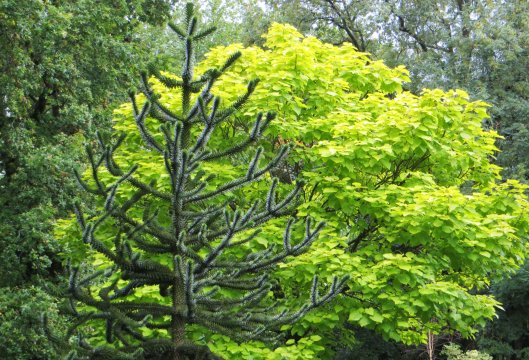
An 18th-century dignitary reputedly said that it would puzzle a monkey to climb this tree, hence its common name the Monkey puzzle (Araucaria araucana). Whether or not that’s true, it makes a good story, and the tree’s sharp branches and spiky leaves would certainly make its climbing by any creature almost impossible.
160116 monkeypuzzle

The Monkey puzzle’s shape stands out well against the vibrant Lime tree

An evergreen conifer that is native to Argentina and Chile, the Monkey puzzle was introduced to Britain in 1795 by Archibald Menzies, one of a generation of naval officers and plant collectors who brought back all manner of flora and fauna from their global voyages. One of Menzies’ Monkey puzzles survived at Kew for almost a hundred years, until it died in 1892, and the Monkey puzzle was a popular planting in Victorian parks and gardens because of its unique appearance.
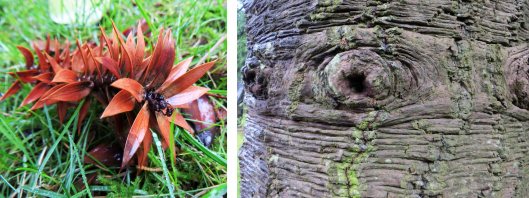
160116 monkeypuzzle (2)

The dead branch shows the spiny leaves, and the bark is also quite unique

In Chile, the tree is now a protected species, its population having been severely threatened by human activity, especially the burning of native forests for conversion to agricultural use. The Amerindian tribe, the Araucanos (from whom the tree gets its scientific name), consider the tree sacred, and their assistance and indigenous knowledge are helping to protect the tree for the future.
Like Loading...

A jay’s search for food

15 Friday Jan 2016

Posted by sconzani in birds, nature, nature photography

≈ 6 Comments

Tags

birding, birds, birdwatching, British birds, Eurasian jay, Jay

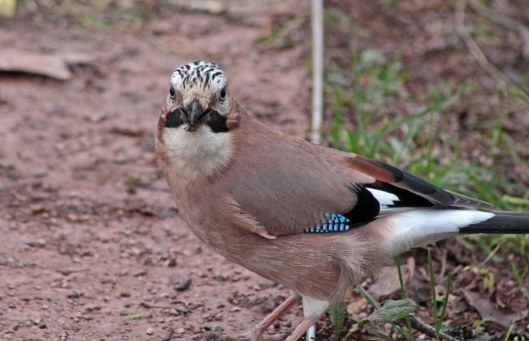
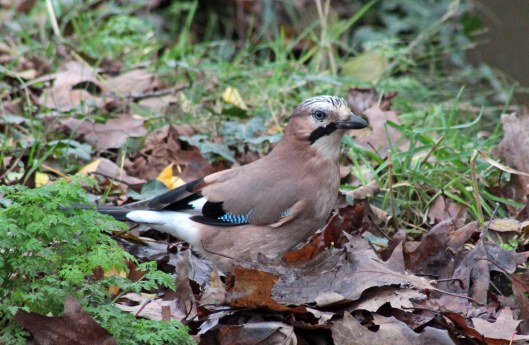
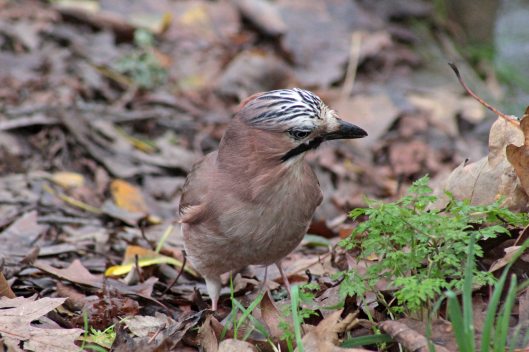
Though a shy bird by nature, the Eurasian Jay’s colouring is anything but. With a vivid blue patch on its wings, a body of dusky pink, pretty little black-and-white stripes atop its head and what looks remarkably like a black moustache, this bird is chic. No surprise then that ‘jay’ was once used, sneeringly, to describe a flashy dresser. Like most members of the crow family, the jay (Garrulus glandarius) can be loud and noisy, and an excellent mimic. As well as copying other birds, they’ve been known to imitate the sounds of cats, dogs and even telephones.

IMG_9302

One recent afternoon I spent the most delightful 10 minutes watching this jay search for food. Most thoroughly, it picked up leaves in its beak and flung them out of the way. It then turned its head first to one side then the other to see if it had unearthed anything interesting. And, finally, success! I’m not sure what it found – some kind of seed perhaps – but the triumphant jay gulped it down whole and then looked directly at me, with a very satisfied look on its face, before flying off, no doubt to repeat the same process all over again.

IMG_9321IMG_9334IMG_9350IMG_9353

Like Loading...

Split gill fungi

14 Thursday Jan 2016

Posted by sconzani in fungi, nature, nature photography

≈ Leave a comment

Tags

fungi, fungus, Schizophyllum commune, Split Gill

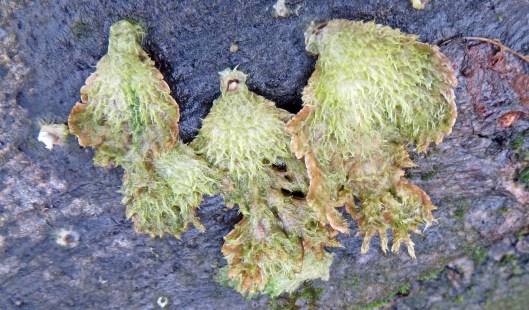
Ten days ago I was out on a fungi foray with friends when we came across this mysterious organism. Was it a lichen? Was it a fern? Was it some other kind of plant? Although we were searching for fungi, we had no idea this was one! Consultations with experts and two return visits later, I can confirm we had found the Split Gill fungus (also known as Schizophyllum commune), one of the most widely distributed mushrooms on earth. It can be found on every continent except Antarctica (no trees).

160114 Schizophyllum commune Split Gill (3)

Although its tough rubbery consistency looks totally unappetising, the Split Gill is a favourite food in many parts of the world, particularly in the tropics where the heat and humidity affect it less than more fleshy mushrooms. In the Congo it is eaten after much boiling and the addition of peanuts; in north-east India it’s a favourite ingredient in pancakes; and in Thailand, where the Split Gill is also valued for its medicinal properties, it’s used to make a hot spicy curry. If you do decide to cook up a feast, please be very careful as the Split Gill can cause disease in humans with immune deficiency issues.

160114 Schizophyllum commune Split Gill (2)

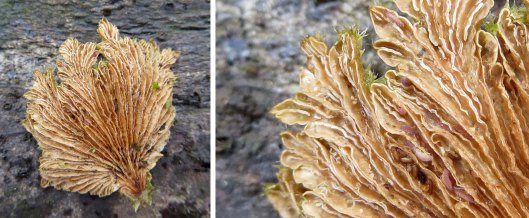
The underside, with a close up showing lots of tiny creatures amongst the gills

160114 Schizophyllum commune Split Gill

Like Loading...

Coot warfare

13 Wednesday Jan 2016

Posted by sconzani in birds, nature, nature photography

≈ 2 Comments

Tags

birding, birds, birdwatching, British birds, Coot, coots fighting

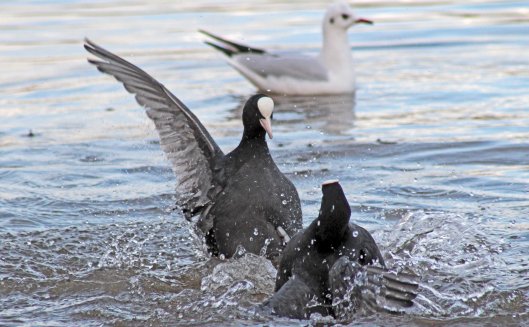
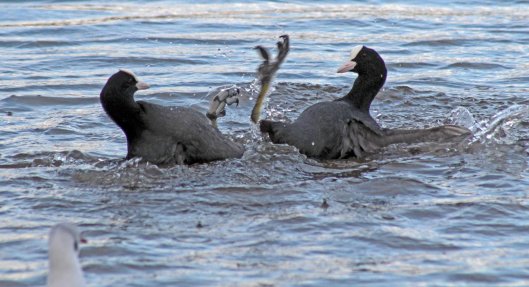
In yesterday’s blog I posted pretty photos of placid coots but these birds also have a dark side. They are ornery critters, constantly bickering and frequently aggressive for no apparent reason. Not only do they suddenly swim threateningly towards each other, they often fight quite violently.

This sequence of photos was taken a few days ago at my local lake. The fight began between two birds, then a third joined in, and then a fourth. The gull, it seems, was just enjoying the show!

160113 coot warfare (1)

160113 coot warfare (2)

160113 coot warfare (3)

160113 coot warfare (4)

160113 coot warfare (5)

Like Loading...

Silly as a coot

12 Tuesday Jan 2016

Posted by sconzani in birds, nature, nature photography

≈ Leave a comment

Tags

birding, birds, birdwatching, British birds, Coot

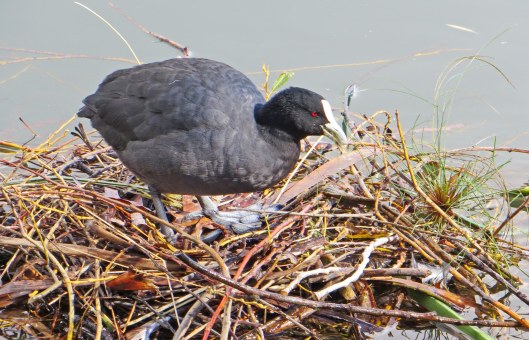
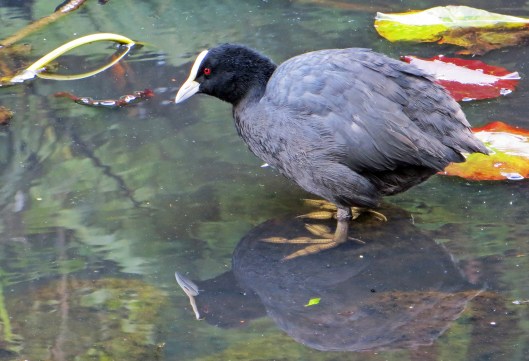
The Common coot (Fulica atra) is considered a game bird in Britain, with the same hunting season as the moorhen, though I would certainly never be tempted to kill one. Maybe it’s something to do with birds and water, but these are very entertaining to watch. The bird’s captivating silliness is probably where the idiom ‘silly coot’, used to describe a foolish person, originated. And the coot’s white head shield is the source of another common expression ‘to be as bald as a coot’, though bald here does not, in fact, mean hairless; an alternate definition of bald is ‘marked or streaked with white’.

160112 coot (1)

Although I’m a New Zealander, the coot is very familiar to me as it was introduced to New Zealand in 1958 and, like most immigrants, has made itself right at home. I am constantly fascinated by its bizarre lobed feet, a cross between the long toes of wading birds and the webbed feet of swimming birds like ducks. Coots are mostly vegetarians, though they do also consume snails and insect larvae, and will readily join the line up at the local lake when humans are dishing out food to the ducks, geese and swans.

160112 coot (2)

Like Loading...

Paper, bark or both?

11 Monday Jan 2016

Posted by sconzani in nature, nature photography, trees

≈ 3 Comments

Tags

bark, cemetery, Paper birch, parks

During a recent walk through the cemetery after a particularly stormy night, I noticed paper strewn around amongst the graves and was angrily muttering to myself about disgusting humans when I realised it wasn’t paper but bark. The Paper birch (Latin name: Betula papyrifera; other common names: white birch and canoe birch) has quite striking white, sometimes pinkish, bark that peels to reveal a pale orange bark underneath.

160111 paper birch bark (2)

The Paper birch was introduced to Europe in the mid 18th century and is still a popular ornamental addition to parklands and large gardens, but it is native to North America, where its oil-rich bark has been used by the indigenous peoples to make various items, from cartons and boxes to canoes and tepees. As the bark will even ignite well when wet, it is a useful fire starter, and it also has medicinal uses, as a poultice on wounds, as a cast for broken bones and for treating respiratory problems. More recently, it has been used to make ice-block sticks and toothpicks, and strips of bark are used to make handicrafts and to decorate floral arrangements. I think I’ll be picking up all that ‘paper’ and bringing it home next time!

160111 paper birch bark (1)

Like Loading...

Slater, woodlouse or chiggy pig?

10 Sunday Jan 2016

Posted by sconzani in insects, nature, nature photography

≈ Leave a comment

Tags

cemetery, crustaceans, insects, slater, woodlouse

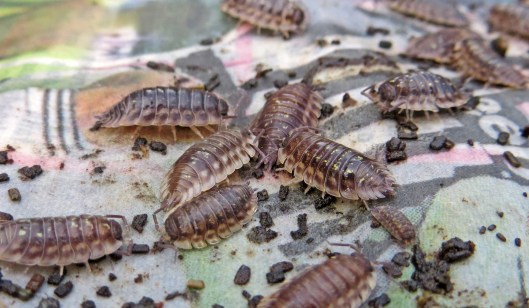
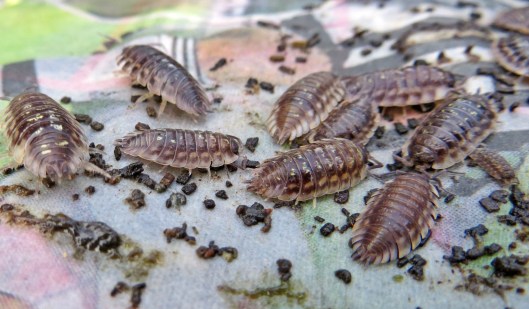
As I was walking through my local cemetery today, I spotted a very thick, very wet newspaper lying on a fallen tree and I simply couldn’t resist taking a peek underneath. These are what I found, Common shiny woodlice (Oniscus asellus), one of the 45 (yes, 45!) native or naturalised species of woodlice in Britain.

160110 woodlice (1)

Did you know:

  • A woodlouse has fourteen jointed limbs, and breathes using lungs in its rear legs.
  • Although it’s a crustacean (like the oh-so-tasty lobsters and crabs), a woodlouse tastes like strong urine. I wonder who the crazy person was who discovered that interesting fact!
  • Just like earthworms, woodlice are good for the garden because they produce compost, aerate the soil and help control pests.
  • Woodlice prefer damp places because they lose a lot of moisture through excretion (plenty of evidence of that to be seen in my photos!).
  • In New Zealand it’s called a slater; in Reading, England it’s a cheeselog; in Devon it’s a chiggy pig; and in Cornwall it goes by the name of gramersow. Do you have a special name for this little critter? Let me know in the comments below.

160110 woodlice (2)

Like Loading...

The cute little tufties

09 Saturday Jan 2016

Posted by sconzani in birds, nature, nature photography

≈ 1 Comment

Tags

birding, birds, birdwatching, British birds, Tufted duck

160109 tuffted duck (3)

Every time I walk around my local lake these charming little ducks delight me as they dive to feed on the roots, seeds and buds of aquatic plants, clams and snails, aquatic insects and sometimes amphibians and small fish. Until 150 years ago, they were only winter visitors but the resident population of the Tufted Duck (Aythya fuligula) expanded rapidly during the late 19th and early 20th centuries due to the colonisation of British waterways by the small freshwater bivalve, the Zebra Mussel.
 160109 tuffted duck (2)

I particularly love their floppy little top-knot and it’s easy to see how they got their common name but, like most British birds, they’ve gained a wide variety of other vernacular names: black curre, black poker, black topping duck, black wigeon, doucker, douver, crested diver and magpie diver. Those last two seem particularly appropriate given their tufts and colours. However, though the males may look black and white, when you see them in the sunlight you soon realise their plumage has a range of colours, from brown and green to purple. And, personally, I think there’s something slightly demonic about that bright yellow eye, particularly in the male, where the colour contrast is greater.

160109 tuffted duck (1)

Like Loading...

Old Man’s Beard

08 Friday Jan 2016

Posted by sconzani in nature, nature photography, plants

≈ Leave a comment

Tags

clematis vitalba, Old Man's Beard, seeds, Traveller's joy, winter garden

If I were still living in New Zealand, I would be horrified to see this plant, Clematis vitalba. It’s a British native that was introduced as a garden plant but it very quickly escaped into forest areas where, in the temperate climate, its vigorous growth quickly smothers native plants. Unsurprisingly, it has been outlawed and is listed on the National Pest Plant Accord.

160108 clematis vitalba old mans beard (1)

Here in Britain, though, I can enjoy the silky plumed seed heads that make such a pretty show at this time of year. It’s easy to see how they led to its common name of Old Man’s Beard, but this clematis has many other vernacular names, including traveller’s joy, virgin’s bower, ladies’ bower, love vine, and traveller’s ivy. In the south-east of England it is also known as Boy’s Bacca and Shepherd’s Delight because poorer country folk once used the dry stems as a tobacco substitute.

160108 clematis vitalba old mans beard (2)

In France, its common name is herbe aux gueux, the beggar’s herb because, in times past, beggars would make use of its toxic sap to purposefully irritate their skin in order to provoke sympathetic donations from passers by. All parts of this clematis are poisonous so look but don’t touch!

Like Loading...

The Jelly ear

07 Thursday Jan 2016

Posted by sconzani in fungi, nature, nature photography

≈ 1 Comment

Tags

fungi, fungus, Jelly ear

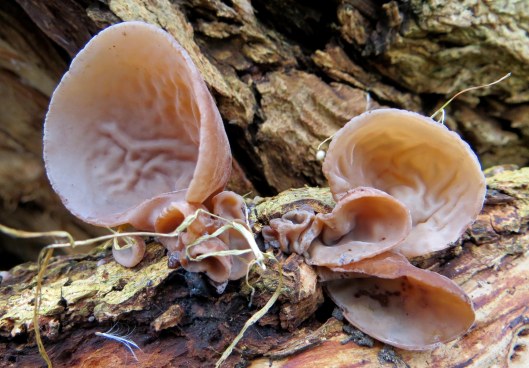
Who needs 3-D printers to produce replacement human body parts when you could use a fungus instead? Not exactly a practical solution to gaining a new ear I admit but, you have to agree, this fungus is definitely the right shape, if not the ideal colour or texture.

Auricularia auricula-judae Jelly Ear

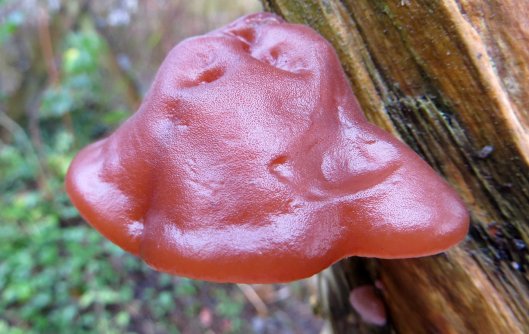
The Jelly ear (Latin name Auricularia auricular-judae) can be rather gelatinous, hence its common name. It is a very common and easily recognisable fungus that grows on standing and fallen dead broadleaf trees, in parks and gardens and forest areas. It can reach up to 100mm across, though its shape becomes more contorted and undulating as it ages. In my native New Zealand, the Jelly ear was of considerable economic importance around the turn of the 20th century when large quantities were exported to China for food.

Auricularia auricula-judae Jelly Ear (1)

Jelly ears can often be found growing on the elder tree and it seems the fungus got its original common name of Judas’s Ear from the belief that Judas Iscariot hung himself from an elder tree. Over time, the epithet Judas’s Ear changed to Jew’s Ear, though in these days of political correctness, that epithet is rarely used.

160107 jelly ear (2)

Like Loading...
← Older posts
Newer posts →

About me

sconzani

sconzani

I'm a writer and photographer; researcher and blogger; birder and nature lover; countryside rambler and city strider; volunteer and biodiversity recorder.

View Full Profile →

Follow earthstar on WordPress.com

Enter your email address to follow this blog and receive notifications of new posts by email.

Recent blog posts

  • Spring messengers February 1, 2026
  • Kestrel 2026 : 86 January 31, 2026
  • Birch polypore January 30, 2026
  • The Marl Med gull January 29, 2026
  • Recording Grey squirrels January 28, 2026

From the archives

COPYRIGHT

Unless otherwise acknowledged, the text and photographs on this blog are my own and are subject to international copyright. Nothing may be downloaded or copied without my permission.

Fellow Earth Stars!

  • Unknown's avatar
  • Unknown's avatar
  • Unknown's avatar
  • Unknown's avatar
  • Unknown's avatar
  • Unknown's avatar
  • Unknown's avatar
  • Unknown's avatar
  • Unknown's avatar
  • Unknown's avatar
  • Unknown's avatar
  • Unknown's avatar
  • Unknown's avatar
  • Unknown's avatar
  • Unknown's avatar
  • Unknown's avatar
  • Unknown's avatar
  • Unknown's avatar
  • Unknown's avatar
  • Unknown's avatar
  • Unknown's avatar
  • Unknown's avatar
  • Unknown's avatar
  • Unknown's avatar
  • Unknown's avatar
  • Unknown's avatar
  • Unknown's avatar
  • Unknown's avatar
  • Unknown's avatar
  • Unknown's avatar
  • Unknown's avatar
  • Unknown's avatar
  • Unknown's avatar
  • Unknown's avatar
  • Unknown's avatar
  • Unknown's avatar
  • Unknown's avatar
  • Unknown's avatar
  • Unknown's avatar
  • Unknown's avatar
  • Unknown's avatar
  • Unknown's avatar
  • Unknown's avatar
  • Unknown's avatar
  • Unknown's avatar
  • Unknown's avatar
  • Unknown's avatar
  • Unknown's avatar
  • Unknown's avatar
  • Unknown's avatar

Blog at WordPress.com.

Privacy & Cookies: This site uses cookies. By continuing to use this website, you agree to their use.
To find out more, including how to control cookies, see here: Cookie Policy
  • Subscribe Subscribed
    • earthstar
    • Join 670 other subscribers
    • Already have a WordPress.com account? Log in now.
    • earthstar
    • Subscribe Subscribed
    • Sign up
    • Log in
    • Report this content
    • View site in Reader
    • Manage subscriptions
    • Collapse this bar
 

Loading Comments...
 

You must be logged in to post a comment.

    %d