• ABOUT
  • BIRDING 2018
  • Birding 2019
  • BLOG POSTS
  • Butterflies 2018
  • Resources

earthstar

~ a celebration of nature

earthstar

Category Archives: nature

Ooooops!

13 Monday Feb 2017

Posted by sconzani in birds, nature

≈ 4 Comments

Tags

birding, birdwatching, British birds, fish for lunch, gull with fish, Herring gull

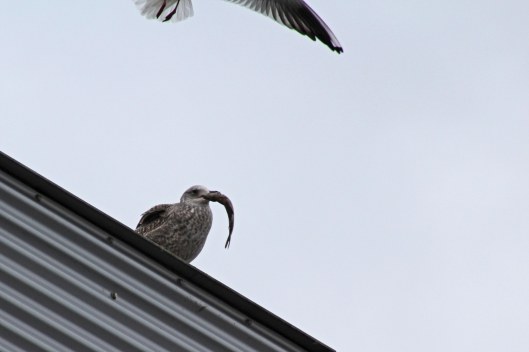
Lunch! Yum! Still twitching and a bit of a slippery treat but this will certainly fill a gap.

170213-herring-gull-with-fish-1

Intruder alert! Someone’s noticed the tasty snack and tries to grab it.

170213-herring-gull-with-fish-2

Oh no! It’s too slippery to hold. Going … going …

170213-herring-gull-with-fish-3

This young Herring gull did well to catch itself such a substantial fish for its lunch but, unfortunately, couldn’t hold on when bullied by another gull. I’m fairly sure the fish fell on to the metal surface about 20 feet below and this youngster did fly down there to look but couldn’t find its fish and soon flew off to try again.

I apologise for the poor quality of these images. Sometimes I find my desire to show the story outweighs my desire to get perfect photos.

Like Loading...

The Pontcanna 100

12 Sunday Feb 2017

Posted by sconzani in nature, parks, trees

≈ Leave a comment

Tags

avenue of trees, Cardiff parks, disease-resistant elm, Elm tree, Pontcanna Fields, tree avenue, Ulmus New Horizon

170212-pontcanna-elm-avenue

I’ve admired this young avenue of trees since I moved to Cardiff in August 2015, and I posted some photos of how it looked through the seasons back in November 2016, when I blogged about National Tree Week. I’d always been puzzled by what type of tree these were, but no longer. Thanks to the wonderfully informative blog by Pat at The Squirrelbasket and a look at the excellent Cardiff Council Horticultural Database website, I now know the avenue is made up of 100 disease-resistant elms of the variety Ulmus ‘New Horizon’. The trees were planted in November 2004 to mark 2005 as the centenary of Cardiff becoming a city and the city’s 25th jubilee as capital of Wales. Pat will be blogging about these trees each month for the next year so, if you’re a tree lover like me, I suggest you follow her blog to read more about this glorious elm avenue.

Like Loading...

Nuthatch seedy limits

11 Saturday Feb 2017

Posted by sconzani in birds, nature, parks

≈ 8 Comments

Tags

birding, birdwatching, Cosmeston Lakes Country Park, nuthatch

170211-nuthatch

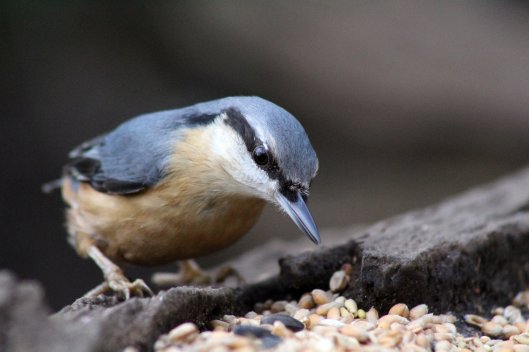
Twenty-five was the seed limit
Other birds not allowed in it
Buy more seed on Friday
Go to Cosmeston on Sunday
They call it Nuthatch
Oh, Nuthatch
They call it Nuthatch seedy limits

(with apologies to Tina Turner)

Like Loading...

Golden ears and Yellow brains

10 Friday Feb 2017

Posted by sconzani in fungi, nature

≈ 8 Comments

Tags

fungus, Golden ear fungus, jelly fungus, Tremella aurantia, Tremella mesenterica, Yellow Brain Fungus

170210-tremella-mesenterica-yellow-brain-3
170210-tremella-mesenterica-yellow-brain-1

These two fungi may look different but they may actually be exactly the same – in theory, it should be possible to tell without resorting to a microscope. There are two possibilities: Tremella aurantia (known to the Americans as Golden ears; the British Mycological Society hasn’t assigned it a common name), which is parasitic on the fruit bodies of the Hairy curtain crust fungus (Stereum hirsutum), and Tremella mesenterica (Yellow brain), which is parasitic on the mycellium of the Peniophora species of fungi. However, those Peniophora fungi are not always easy to spot as the Tremella may have smothered the lot, so identification can still be tricky.

I’ve only knowingly seen Golden ears the once and, if you take a look at the top right corner of my image (below), you can just spot the brackets of Hairy curtain crust that helped me confirm what it was. (So, the two photos above and the very bottom photo probably all show Yellow brain but I can’t be 100% certain.)

170210-tremella-aurantia-golden-ear-1

The word Tremella means trembling, a reference to the jelly-like constituency of these fungi; aurantia means orange coloured or golden; and mesenterica joins two Ancient Greek words together: meso means middle and enteron means intestine, so maybe the title of this post should really be Golden ears and Yellow intestines. Ew!

170210-tremella-mesenterica-yellow-brain-2

Like Loading...

Shoreditch Bobby vs the Kingsland Roarer

09 Thursday Feb 2017

Posted by sconzani in birds, nature, parks

≈ 2 Comments

Tags

Avicultural Magazine, bird singing competition, bird singing contest, birding, birdwatching, British birds, chaffinch, Cosmeston Lakes Country Park, Fringilla coelebs

Though I found these Chaffinches (Fringilla coelebs) in a woodland setting in Cosmeston Lakes Country Park, they are equally at home in urban gardens, as long as there are trees around. Mr Chaffinch’s multi-hued plumage is particularly dapper, and is the reason why the expression ‘as gay as a chaffinch’ was used for a well-dressed and vivacious person, in the days before ‘gay’ acquired a rather different meaning. I think Mrs Chaffinch looks every inch the stylish tweed-wearing countrywoman as well.

170209-chaffinch-male-1170209-chaffinch-female-1

Chaffinches are prolific singers, so much so that Brits used to hold contests to determine which bird could sing best and longest. The Avicultural Magazine of 1896 (vol.2, pp.115-17) has a wonderful story about the contest between ‘Shoreditch Bobby’ of Bricklane and the ‘Kingsland Roarer’, organised by the landlord of the ‘Cock and Bottle’ pub in London and, though it makes for a rather long post, I have reproduced most of the article here for those who, as I do, love a good story:

In the parlour all the gas-jets are lighted, but have some trouble to penetrate the fumes of tobacco, beer, etc. At last the contesting parties enter, each dressed in his Sunday best. …The two markers take their places, and as the clock strikes the two cages are uncovered and hung up. The battlers look around for a moment, shake their plumage, whet their beaks and one may take a grain of seed, but before it is cracked he hears a familiar sound uttered by his opponent. Immediately he replies by a full strophe of his song, to which the other answers with fuller power. Before each marker is already a stroke of his chalk, and now the combat is fairly ‘started’. The chalks are busily employed to mark each properly delivered strophe, and keep pace with each other for a time, until ‘Bobby’ takes it into his head to betake himself to the food trough.

Meanwhile, the ‘Roarer’ continues steadily to pour out his heart, and gains considerably in chalk marks. ‘Costermonger Joe’ is getting very uneasy and cannot understand this ‘trick’ of his much-renowned bird. Never before did he think of food while in the presence of an opponent. In order to draw his bird’s attention upon himself and from the food trough, he moves uneasily in his seat and ventures at last to cough aloud.

It must be understood, that while a match is proceeding no words of encouragement are allowed; no whistling or other means may be resorted to, to recall a truant to his duty. Fair play is rigorously enforced. Coughing cannot be stopped.

At last, Joe can stand it no longer: accidentally his beer glass gets knocked over and falls on the floor with much clatter. Bobby peers across the room to ascertain the cause of the unusual disturbance and catches sight of his master, and immediately he resumes his battle-cry. The ruse has succeeded, although there is a tumbler to pay for.

The chalk marks on the tables are getting very numerous. The Roarer has challenged without a fault for thirteen minutes and is forty points ahead of Bobby, but now he feels rather ‘dry’. He stops working, takes a drink of water and hops to the food box. But ‘Kingsland Bill’ does not give his bird time to lose ground by feeding like the other. In a moment he whips out the brightly-coloured handkerchief the Roarer knows so well, and pretends to wipe the perspiration from his anxious brow. His finch takes the hint, and gallops through the remaining two minutes of the appointed fifteen in grand style. Bobby also had tried hard to make up for the precious time he had lost so wantonly, but could not recover all of it. Although credited with 212 marks, the Roarer beat him by 28 strokes.

Immediately protest is entered by Costermonger Joe, fair play having been violated by the use of the coloured cloth. Bill retorts by calling into question the fairness of the beer glass episode. One word leads to another, the spectators mingle in the strife, expressions of opinion and sympathy with either party are getting more and more select, and battle of another kind seems imminent. Joseph declares he has won, but William insists on ‘fighting’ him for the stakes. This mode of settling the question being declined by Joe, the landlord is called upon to exercise his functions of umpire. With characteristic disinterestedness he declares the whole match null and void, and orders a fresh match to be sung for the same stakes that day week and on the same spot.

170209-chaffinch-male-2
170209-chaffinch-female-2
Like Loading...

My first microscope success!

08 Wednesday Feb 2017

Posted by sconzani in fungi, nature

≈ 7 Comments

Tags

fungal microscopy, Ruby elfcup, Sarcoscypha austriaca, Sarcoscypha coccinea, Scarlet elfcup

I’ve blogged about Scarlet elfcups before (here and here) but this post is a little different. A few days ago I talked about dipping my toes into the waters of fungal microscopy (and thanks to those of you who were concerned that I might end up with Athlete’s foot in the process!). Yesterday, I made my first fungus identification on my own … small steps but I’m chuffed!

170208-sarcoscypha-austriaca-scarlet-elfcup

As I’m sure I’ve mentioned before, there are two red elfcups, Scarlet (Sarcoscypha austriaca) and Ruby (Sarcoscypha coccinea), and it’s impossible to tell them apart without microscopic examination. There are two distinguishing features: the spore shape and the shape of the hairs that cover the outer surface of the cups. In Scarlet elfcups, the ends of the spores are flattened, almost square and the hairs are curly (as shown below left) whereas, in Ruby elfcups, the spores are more elliptical and the hairs are straight – sorry, no photos of those as Ruby elfcups are not that common and the specimen I examined today turned out to be a Scarlet.

170208-sarcoscypha-austriaca-scarlet-elfcup-1
170208-sarcoscypha-austriaca-scarlet-elfcup-2

Many thanks to SEWBReC for letting me use their microscope and gear for this identification and to Amy Hicks for taking the photos. Also, thanks to Mary Gillham Archives Project Officer Al and volunteer John for bringing me the elfcup present back from a local nature reserve.

Like Loading...

Bring out the Bunting!

07 Tuesday Feb 2017

Posted by sconzani in birds, nature, parks

≈ 6 Comments

Tags

birding, birdwatching, bodkin, bog sparrow, British birds, chink, Cosmeston Lakes Country Park, Emberiza schoeniclus, pit sparrow, Reed bunting

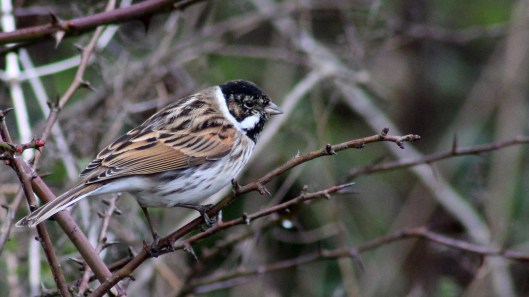
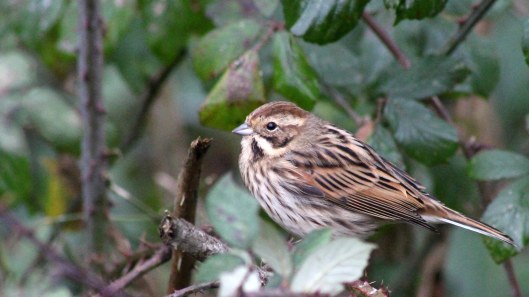
As its name implies, the Reed Bunting (Emberiza schoeniclus) is most at home in the reed beds and rush-filled pastures that surround many of Britain’s freshwater lakes and ponds, though it has been encroaching on farmlands and into woodlands during the last 80-odd years, perhaps in response to a reduction in its preferred wetland habitats. Luckily, it’s flourishing in the expanses of reed beds that fringe the conservation lake at Cosmeston Lakes Country Park, which is where I photographed these little beauties last Sunday.

170207-reed-bunting-2

170207-reed-bunting-1

I particularly like some of their common names (as supplied by Buczacki’s Fauna Britannica): black bonnet, coaly hood, bog sparrow and chink (Scotland); bodkin (Lancashire); pit sparrow (Cheshire; Colin blackhead (Renfrewshire); seave cap and toad snatcher (Yorkshire); ring bird and ring fowl (Aberdeenshire). I also particularly like the male bird’s large white and very stylish moustache.

170207-reed-bunting-4
170207-reed-bunting-3
Like Loading...

Incoming

06 Monday Feb 2017

Posted by sconzani in birds, nature

≈ 3 Comments

Tags

birding, birds landing on lake, birdwatching, British birds, Cosmeston Lakes Country Park, Tufted duck

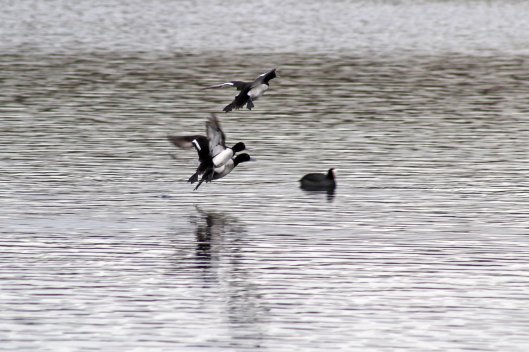
170206-tufted-ducks-landing-on-lake-1170206-tufted-ducks-landing-on-lake-2170206-tufted-ducks-landing-on-lake-3
‘Cosmeston Lakes West Lake is pleased to announce the safe arrival of Tufted duck flight 0502 from Cosmeston Lakes East Lake.’

Like Loading...

Introduction to fungal microscopy

05 Sunday Feb 2017

Posted by sconzani in fungi, nature

≈ 1 Comment

Tags

fungal microscopy, fungus, learning to use a microscope, SEWBReC, spores

Yesterday I dipped my toes into the fungal microscopy waters and it was good! In fact, it was more than good. Funded by the Wales Biodiversity Partnership, hosted and organised by SEWBReC, and led by Mr Glamorgan Fungi Mike Bright, ably assisted by SEWBReC’s fungi whizz Amy Hicks, the whole day was simply excellent!

170205-microscopy-course

One of the most frustrating things about fungi can be trying to identify them and/or differentiate between visually similar species. Now I have the basic skills needed to do this. I’m under no illusions, though – I do realise that IDing my finds will still be difficult: I might not have collected a good specimen, I might not be able to find what I need under the microscope, I might not be able to find the information in books or online to compare with what I’m seeing, and, something that I hadn’t expected, the floaters I have in my right eye (a problem that comes from the vitreous gel in my eye hardening with age) interfere with what I see down the microscope.

170205-fungi-spores-1
170205-fungi-spores-2

So, I’m not rushing out to spend hundreds of pounds on a good ’scope just yet. Luckily, as a regular biodiversity recorder, I’m able to borrow the equipment they hold at SEWBReC, my local biodiversity records centre. Now I just need to find my first sample to identify!

Many thanks to my friend Graham Watkeys for the photo of me studiously peering down the ’scope, and sorry for the poor quality of my ’scope images – I now know photos of microscope camera photos shown on a laptop screen don’t reproduce very well.

Like Loading...

‘Little Trotty Wagtail’

04 Saturday Feb 2017

Posted by sconzani in birds, nature

≈ 4 Comments

Tags

birding, birdwatching, British birds, John Clare, Motacilla alba, Pied wagtail, poem about pied wagtail

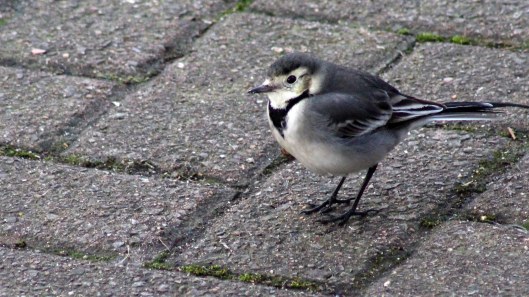
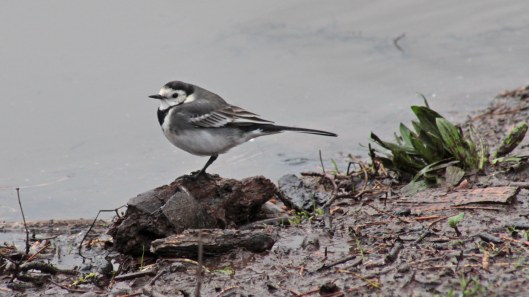
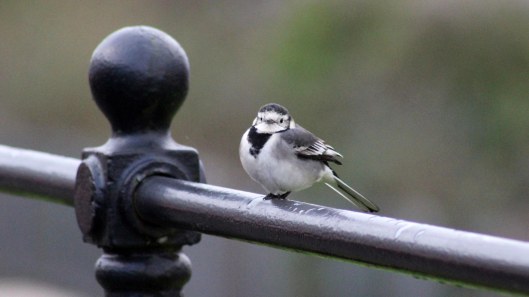
Little trotty wagtail, he went in the rain
And, tittering tottering sideways, he ne’er got straight again.
He stooped to get a worm and look’d up to catch a fly
And then he flew away ere his feathers they were dry.

170204-pied-wagtail-3

Little trotty wagtail, he waddled in the mud
And left his little foot marks, trample where he would.
He waddled in the water pudge and waggle went his tail
And chirrupt up his wings to dry upon the garden rail.

170204-pied-wagtail-1

Little trotty wagtail, you nimble all about
And in the dimpling water pudge you waddle in and out.
Your home is nigh at hand and in the warm pigsty,
So little Master Wagtail I’ll bid you a ‘Good bye’.

170204-pied-wagtail-2

~ John Clare (1793 – 1864), the ‘Northamptonshire Peasant Poet’ who is often regarded as one of the most important poets of the natural world.

Like Loading...
← Older posts
Newer posts →

About me

sconzani

sconzani

I'm a writer and photographer; researcher and blogger; birder and nature lover; countryside rambler and city strider; volunteer and biodiversity recorder.

View Full Profile →

Follow earthstar on WordPress.com

Enter your email address to follow this blog and receive notifications of new posts by email.

Recent blog posts

  • Lifer: Box bug April 27, 2026
  • Peak Wild garlic April 26, 2026
  • First damsels of 2026 April 25, 2026
  • NFY: Green-veined white April 24, 2026
  • The return of the Willow warblers April 23, 2026

From the archives

COPYRIGHT

Unless otherwise acknowledged, the text and photographs on this blog are my own and are subject to international copyright. Nothing may be downloaded or copied without my permission.

Fellow Earth Stars!

  • Unknown's avatar
  • Unknown's avatar
  • Unknown's avatar
  • Unknown's avatar
  • Unknown's avatar
  • Unknown's avatar
  • Unknown's avatar
  • Unknown's avatar
  • Unknown's avatar
  • Unknown's avatar
  • Unknown's avatar
  • Unknown's avatar
  • Unknown's avatar
  • Unknown's avatar
  • Unknown's avatar
  • Unknown's avatar
  • Unknown's avatar
  • Unknown's avatar
  • Unknown's avatar
  • Unknown's avatar
  • Unknown's avatar
  • Unknown's avatar
  • Unknown's avatar
  • Unknown's avatar
  • Unknown's avatar
  • Unknown's avatar
  • Unknown's avatar
  • Unknown's avatar
  • Unknown's avatar
  • Unknown's avatar
  • Unknown's avatar
  • Unknown's avatar
  • Unknown's avatar
  • Unknown's avatar
  • Unknown's avatar
  • Unknown's avatar
  • Unknown's avatar
  • Unknown's avatar
  • Unknown's avatar
  • Unknown's avatar
  • Unknown's avatar
  • Unknown's avatar
  • Unknown's avatar
  • Unknown's avatar
  • Unknown's avatar
  • Unknown's avatar
  • Unknown's avatar
  • Unknown's avatar
  • Unknown's avatar
  • Unknown's avatar

Blog at WordPress.com.

Privacy & Cookies: This site uses cookies. By continuing to use this website, you agree to their use.
To find out more, including how to control cookies, see here: Cookie Policy
  • Subscribe Subscribed
    • earthstar
    • Join 642 other subscribers
    • Already have a WordPress.com account? Log in now.
    • earthstar
    • Subscribe Subscribed
    • Sign up
    • Log in
    • Report this content
    • View site in Reader
    • Manage subscriptions
    • Collapse this bar
 

Loading Comments...
 

You must be logged in to post a comment.

    %d