• ABOUT
  • BIRDING 2018
  • Birding 2019
  • BLOG POSTS
  • Butterflies 2018
  • Resources

earthstar

~ a celebration of nature

earthstar

Category Archives: nature

Fungi Friday: The black fuzz

03 Friday Feb 2017

Posted by sconzani in fungi, nature

≈ 6 Comments

Tags

ascospores, asexual reproduction in fungi, Chaetosphaerella phaeostroma, conidia, fungus, mycelium, sexual reproduction in fungi

When I first found this fungus a month ago, I thought the wee grey orbs might be a type of slime mould but I was puzzled by the black fuzz that surrounded them. Turns out it was not a slime mould at all but rather the fungus Chaetosphaerella phaeostroma. The fuzz (more correctly, the subiculum) is a dense mat of hyphae (the branching filaments that make up the mycelium, the vegetative part of the fungus that is usually hidden below the ground) and the grey orbs are the fruiting bodies (a mushroom is the more usual form of fungal fruiting body).
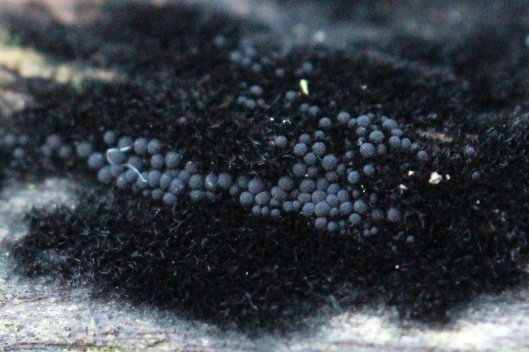
170203-chaetosphaerella-phaeostroma

If you think that’s confusing, it gets even more tricky! This particular fungus has two methods of reproducing as it’s capable of producing both sexual and asexual spores – it’s not surprising that this led scientists in the past to believe it was two separate fungi. The hyphae (the fuzzy stuff) can produce conidia (below left), which are asexual (so they can create new fungi but these would be exactly the same as the parent), and the spherical fruiting bodies (called perithecia) produce ascospores (below right), which are sexual (so they need to interact with another fungus in order to produce a new organism which would then have characteristics of both parents).

170203-chaetosphaerella-phaeostroma-conidia-x-400
170203-chaetosphaerella-phaeostroma-asci-with-ascospores

I am exceedingly grateful to my friend from the Glamorgan Fungus Group, Mark Evans, who examined the sample I gave him and produced not only the identification of this fungus but also the wonderful microscopic images. His detailed explanations also helped me understand what was going on with Chaetosphaerella phaeostroma, and if I’ve got any of this wrong, it’s entirely my own fault!

Like Loading...

Cardiff Bay birds

02 Thursday Feb 2017

Posted by sconzani in birds, nature

≈ 5 Comments

Tags

Anthus petrosus, Arenaria interpres, birding, birdwatching, British birds, Cardiff Bay, Common redshank, Rock pipit, Tringa totanus, Turnstone

My move closer to the seaside is already paying off with more and different bird sightings. Meet large, the Common redshank (Tringa totanus); medium, the Turnstone (Arenaria interpres); and small, the Rock pipit (Anthus petrosus). (Apologies for the poor images – it’s been a very grey week in Cardiff!)

170202-common-redshank
170202-turnstone
170202-rock-pipit

As they enjoy very similar diets of insects, crustaceans and molluscs, these birds were all foraging together, hipping and hopping, stalking and walking, stumbling and grumbling their way along the water’s edge of the artificial stony seawall where the River Ely now flows into the equally artificial Cardiff Bay. Though some of these birds may be residents, many also come from foreign parts to over-winter in Britain: up to half the winter population of Redshanks comes from Iceland; Turnstones can come from such countries as Canada and Greenland; and some Rock pipits come from Norway. I guess the British winters aren’t so bad after all.

170202-turnstones
170202-redshanks
Like Loading...

‘Dedicated Naturalist’: Mary’s shells

01 Wednesday Feb 2017

Posted by sconzani in nature

≈ 6 Comments

Tags

Dr Mary Gillham, Mary Gillham Archive Project, scallop shells, sea shells, shell collection, shells, univalve shells

A snippet from my volunteer work on the ‘Dedicated Naturalist’ Project, helping to decipher and digitise, record and publicise the life’s work of naturalist extraordinaire, Dr Mary Gillham.

170201-mary-gillhams-shell-collections-3

I have two weeks away from the project to move house and, when I get back, this is what I find. The table top is piled high with boxes of beautiful shells, from countries as far apart as Zanzibar and the Bahamas. These were Mary’s teaching collections, garnered from her many trips around the world from the 1950s right through to the late 1980s. When Mary retired from her position as a lecturer in Cardiff University’s Extramural Department, she left her collections for those who followed in her footsteps to use but, once the university’s focus shifted away from this type of lifelong learning, Mary’s shells were tucked away in cupboards, left to gather dust.

170201-mary-gillhams-shell-collections-2
170201-mary-gillhams-shell-collections-1

Now they’ve been rediscovered and gifted to the project. Project manager Al contacted the National Museum of Wales to see if any of the collection would be useful to them and their staff have since visited and taken some specimens but the rest can be used for displays and exhibits to help celebrate Mary’s incredible life and achievements. I was delighted to find some New Zealand shells amongst the boxes – a box full of scallops, large and small, and an equally diverse box of univalve shells, some with beautiful markings. I swear I could hear the waves thundering on my favourite Kiwi beaches when I held one up to my ear!

For the full story about the Mary Gillham Archive Project, check out our website, and follow our progress on Facebook and on Twitter.

Like Loading...

Rusts: resplendent yet ruthless

31 Tuesday Jan 2017

Posted by sconzani in nature

≈ 2 Comments

Tags

Puccinia acetosae, Puccinia circaeae, Puccinia coronata, Puccinia magnusiana, Puccinia phragmitis, Puccinia poarum, Puccinia sessilis, Puccinia species, rust, rust fungus, rust on plants

If you think rust only happens to metal, think again. These are rusts – actually fungi – that cause diseases in plants; anything from trees and shrubs in the local park to the fruit and vegetables you lovingly tend in your home garden can be affected by rusts, sometimes fatally. There are around 7000 species of rust but they are more readily identifiable than you might think as many are specific to particular plants – often it’s a case of name the plant, name the rust.

170131-puccinia-acetosae-on-dock

Rusts are most visible when they form disfiguring spots on the upper surfaces of leaves, and pustules on their undersides, as well as on the stalks and sometimes the flowers and fruit of plants. Just like most other fungi, rusts produce spores, in this case in their millions from within the pustules. Though they are the bane of most gardeners, rusts can be interesting and attractive fungi to examine and study. The photos shown here are: Puccinia acetosae on Dock (Rumex sp.) (above), Puccinia circaeae on Enchanter’s-nightshade (Circaea lutetiana), Puccinia coronata on Creeping soft-grass (Holcus mollis), Puccinia magnusiana on Buttercup (Ranunculus sp.), Puccinia phragmitis on Dock (Rumex sp.), Puccinia poarum on Coltsfoot (Tussilago farfara), and Puccinia sessilis on Lords-and-Ladies (Arum maculatum).

170131-puccinia-circeae-on-enchanters-nightshade
170131-puccinia-coronata-on-holcus-mollis
170131-puccinia-magnusiana-on-buttercup
170131-puccinia-phragmitis-on-dock
170131-puccinia-poarum-on-coltsfoot
170131-puccinia-sessilis-on-arum
Like Loading...

Sassy Squirrels

30 Monday Jan 2017

Posted by sconzani in animals, nature

≈ 10 Comments

Tags

grey squirrel, red squirrel, Sciurus carolinensis, Sciurus vulgaris

Grey squirrels (Sciurus carolinensis) are constantly vilified for their adverse effect on the local environment here in Britain because they are not native creatures. Their ancestors were North American immigrants, first introduced to the British Isles in the late 1870s by local landowners who considered them ‘exotic’ (what were they thinking?). Not only did the Greys bring with them the squirrelpox virus (SQPV), which doesn’t harm them but kills the native Red squirrels (Sciurus vulgaris), the Greys also compete with the Reds for food. And as the Greys have a broader food range – they’re able to eat nuts with high tannin contents, like acorns, which the Reds cannot digest – they have a better chance of survival when winters are hard and food resources scarce.

170130-grey-squirrel-4
170130-grey-squirrel-3

Luckily, there are plenty of folks out there trying to save the Reds – and you can too, by supporting organisations like the Red Squirrel Survival Trust http://rsst.org.uk/ Let’s hope they’re successful in their efforts as I’d hate to see the locals overcome by the brash interlopers from across the Atlantic.

170130-grey-squirrel-1
170130-grey-squirrel-2

All that being said, there is something incredibly cute about Grey squirrels, about the way they sit back on their hind legs, nibbling on the nuts they’re clutching in their front paws. There’s something about those big doe eyes, and the way they quiver and shake their bushy tails. Though I understand all the arguments against them I can’t help but enjoy their antics.

Like Loading...

Spore prints

29 Sunday Jan 2017

Posted by sconzani in fungi, nature

≈ 3 Comments

Tags

fungus, mushroom, spore print, spores, ways to identify fungi

One of the things that helps identify types of fungi is their spore colour so, though I try to avoid collecting fungi – preferring instead to leave them for everyone to enjoy, for the fungi themselves to release their spores and thus multiply, and for insects to feast upon – I do occasionally collect a specimen to bring home to spore print. For the uninitiated, this is usually a simple matter of turning the mushroom upside down on a white or coloured piece of paper (or a glass slide, if you’re also planning microscopic examination), covering it with something like a glass jar, and waiting several hours. (If your fungus is not mushroom-shaped, the process can vary but let’s keep it simple today.)

170129-spore-print-cortinarius-cinnamomeus
170129-spore-print-tricholoma-fulvum

The reward after those several hours have elapsed is not only discovering what spore colour your mushroom has produced but also, if you’re lucky, getting the added benefit of a very pretty spore print. Spores are like tiny spots of dust so can easily be disturbed by the slightest waft of air but it is possible to preserve your print by spraying it with a very light sealant. I’m still experimenting with this process – I’ve tried hairspray but the spray droplets contained too much moisture which ruined the print. If you’ve ever tried this and have some ideas to share, please do add a comment below, and PLEASE DO NOT go out and pick every mushroom you see just to try this. Fungi are not like blackberries or apples, they need to be left where they are to send out their spores!

170129-spore-print-lepista-sordida
170129-spore-print-boletus-impolitus
Like Loading...

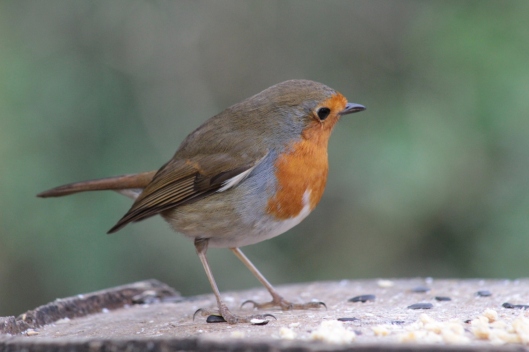
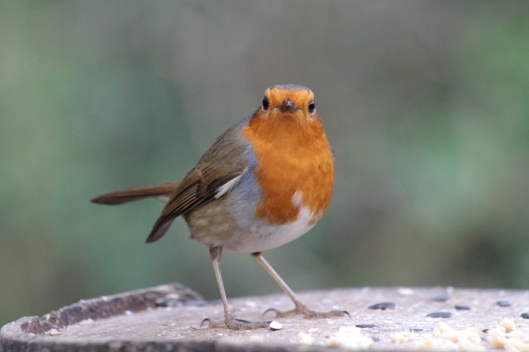
Conversations with robins: 6

28 Saturday Jan 2017

Posted by sconzani in birds, nature

≈ 13 Comments

Tags

birding, birdwatching, British birds, British robin, conversations with robins, robin

170128-conversations-with-robins-56-1

Robin: ‘The food table’s looking a bit empty!’

170128-conversations-with-robins-56-2

Me: ‘Well, hello to you, too, Robin.’
Robin: ‘Oh, okay. Hello, lady.’

170128-conversations-with-robins-56-3

Me: ‘Nice to see you today.’
Robin: ‘Never mind the small talk. It’s cold and I’m hungry!’

170128-conversations-with-robins-56-4

Me: ‘So, what else is new?’
Robin: ‘I’m still not seeing any food here. Suet is my favourite, y’ know.’

170128-conversations-with-robins-56-5

Me: ‘Yes, I know. And you’ll glare at me until I give you some, won’t you?’
Robin: ‘Darn right!’

Like Loading...

Fungi Friday: The Cobalt crust challenge

27 Friday Jan 2017

Posted by sconzani in fungi, nature

≈ 14 Comments

Tags

Cobalt crust, crust fungus, fungus, Glamorgan Fungus Group, Terana caerulea

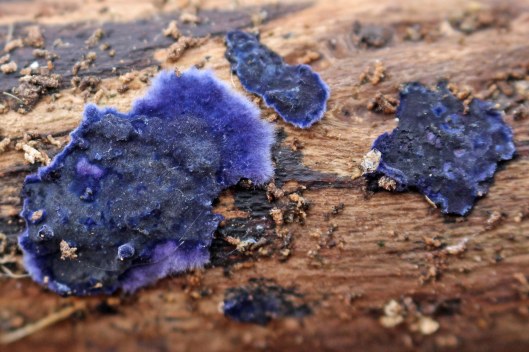
My fellow Glamorgan Fungus Group members and I are taking part in another challenge this month, hunting far and wide within the county to see how many specimens we can find of the supposedly rare Cobalt crust fungus (Terana caerulea). You may remember that I blogged about this special, once-seen-never-forgotten fungus back in February. It’s generally classified as rare but, here in Glamorgan, it most certainly isn’t.

170127-cobalt-crust-terana-caerulea-1

Here are the latest stats: for the 14 days from 13 to 26 January inclusive, 14 of our group had made a total of 45 separate finds on 16 different host plants, ranging from elder, bramble and buddleja to hazel, oak, ivy and even Japanese knotweed. Our results just go to show that this fungus is not actually rare but rather rarely recorded, and our participation in challenges like these also highlights the benefits of ordinary folk like you and I making the effort to record the biodiversity we see around us every day. We’re helping to rewrite science!

170127-cobalt-crust-terana-caerulea-2

Like Loading...

The curious case of the case-bearer

26 Thursday Jan 2017

Posted by sconzani in insects, nature

≈ 7 Comments

Tags

case-bearing caterpillar, case-bearing larva, Case-bearing moth, moth larva, Tinea pellionella, Tineola bisselliella

This afternoon I realised I was not living alone in my new flat – this tiny creature very stupidly decided to climb one of the walls, thus bringing upon itself a level of attention that would ultimately lead to its demise. It’s the larva of one of the Case-bearing moths (possibly Tinea pellionella or Tineola bisselliella, or maybe something else entirely) that likes to chew your carpets threadbare or devour the fibres in your favourite woollen jumper.

170126-case-bearing-moth-1
170126-case-bearing-moth-2

As you can see it’s constructed itself a cosy little home which it can very easily move around. The case is open-ended so, as I discovered when waiting for it to poke its head out one end, it can actually turn around inside and poke its head out the other end if danger (or a gigantic human with a camera lens) threatens.

170126-case-bearing-moth-4

I actually had the carpet professionally cleaned before I moved in here so this little fellow must’ve been hiding somewhere, or it came along for the ride from my old abode. Sweet as that may sound, I do not want to be its friend, and it has now left the building!

170126-case-bearing-moth-3

Like Loading...

Penarth: Fog, 1

25 Wednesday Jan 2017

Posted by sconzani in nature, weather, winter

≈ 8 Comments

Tags

Bristol Channel, fog, fog horns, freezing fog, Penarth, Severn Estuary, winter weather

For those who don’t know Wales, the town I’ve just moved to, Penarth, sits on the northern shores of the Severn Estuary, which eventually becomes the Bristol Channel, which eventually becomes the Celtic Sea, which eventually becomes the North Atlantic Ocean, which is all to explain that Penarth is, essentially, a seaside town and therefore gets seaside-type weather.

170125-penarth-fog-1

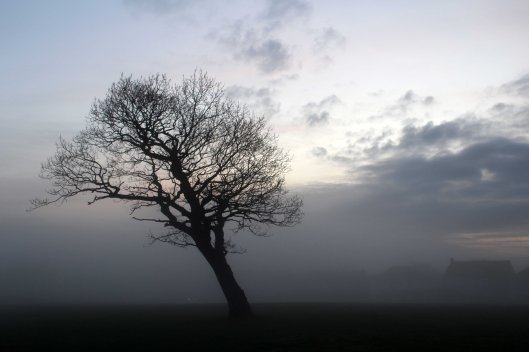
Yesterday the whole area was shrouded in heavy, freezing fog and, as my flat is only about one kilometre from the water, as the seagull flies, I could hear the fog horns blasting all day. It may have been cold but it was actually quite wonderful and brought back happy memories of my years living near the harbour in Auckland, New Zealand, when I would also hear the horns on foggy wintery days. I was stuck indoors waiting on a delivery most of the day but, when that finally came late afternoon, I headed out for a quick wander. As I stood in the centre of this field, on the clifftops, the fog swirled eerily back and forth, sometimes blotting out this lone tree and the houses beyond, sometimes almost clearing. The fog was like a living entity dancing around me – it was just magical! I’m already looking forward to the next fog to come rolling in from the ocean.

170125-penarth-fog-2

Like Loading...
← Older posts
Newer posts →

About me

sconzani

sconzani

I'm a writer and photographer; researcher and blogger; birder and nature lover; countryside rambler and city strider; volunteer and biodiversity recorder.

View Full Profile →

Follow earthstar on WordPress.com

Enter your email address to follow this blog and receive notifications of new posts by email.

Recent blog posts

  • Lifer: Box bug April 27, 2026
  • Peak Wild garlic April 26, 2026
  • First damsels of 2026 April 25, 2026
  • NFY: Green-veined white April 24, 2026
  • The return of the Willow warblers April 23, 2026

From the archives

COPYRIGHT

Unless otherwise acknowledged, the text and photographs on this blog are my own and are subject to international copyright. Nothing may be downloaded or copied without my permission.

Fellow Earth Stars!

  • Unknown's avatar
  • Unknown's avatar
  • Unknown's avatar
  • Unknown's avatar
  • Unknown's avatar
  • Unknown's avatar
  • Unknown's avatar
  • Unknown's avatar
  • Unknown's avatar
  • Unknown's avatar
  • Unknown's avatar
  • Unknown's avatar
  • Unknown's avatar
  • Unknown's avatar
  • Unknown's avatar
  • Unknown's avatar
  • Unknown's avatar
  • Unknown's avatar
  • Unknown's avatar
  • Unknown's avatar
  • Unknown's avatar
  • Unknown's avatar
  • Unknown's avatar
  • Unknown's avatar
  • Unknown's avatar
  • Unknown's avatar
  • Unknown's avatar
  • Unknown's avatar
  • Unknown's avatar
  • Unknown's avatar
  • Unknown's avatar
  • Unknown's avatar
  • Unknown's avatar
  • Unknown's avatar
  • Unknown's avatar
  • Unknown's avatar
  • Unknown's avatar
  • Unknown's avatar
  • Unknown's avatar
  • Unknown's avatar
  • Unknown's avatar
  • Unknown's avatar
  • Unknown's avatar
  • Unknown's avatar
  • Unknown's avatar
  • Unknown's avatar
  • Unknown's avatar
  • Unknown's avatar
  • Unknown's avatar
  • Unknown's avatar

Blog at WordPress.com.

Privacy & Cookies: This site uses cookies. By continuing to use this website, you agree to their use.
To find out more, including how to control cookies, see here: Cookie Policy
  • Subscribe Subscribed
    • earthstar
    • Join 642 other subscribers
    • Already have a WordPress.com account? Log in now.
    • earthstar
    • Subscribe Subscribed
    • Sign up
    • Log in
    • Report this content
    • View site in Reader
    • Manage subscriptions
    • Collapse this bar
 

Loading Comments...
 

You must be logged in to post a comment.

    %d