Of winter’s lifeless world each tree
Now seems a perfect part;
Yet each one holds summer’s secret
Deep down within its heart.
~ Charles G. Stater
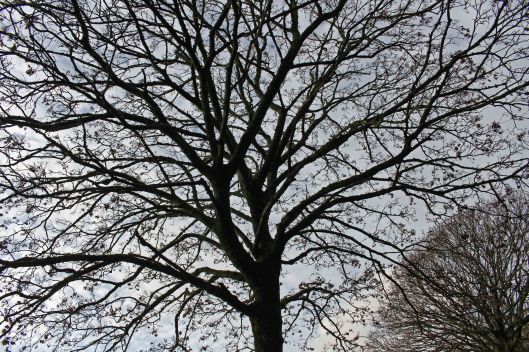

14 Saturday Jan 2017
Of winter’s lifeless world each tree
Now seems a perfect part;
Yet each one holds summer’s secret
Deep down within its heart.
~ Charles G. Stater
13 Friday Jan 2017
There are 22 species of fungi called disco, according to the British Mycological Society’s list of English Names for Fungi 2016, and they have some delightful names, mostly referring to what they grow on, I think: Larch, Conifer, Larch canker, Rush, Heath sedge, Mast, Juniper, Fir and, my personal favourite, Hairy Nuts Disco!
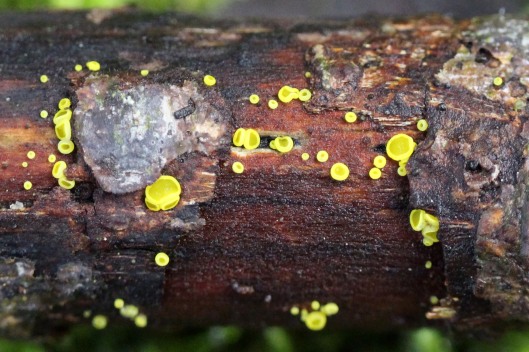
So far I’ve only found two. My excuse is that they’re tiny, only a few millimetres across, so they’re difficult to spot, and many are quite rare. This first one is probably Lemon Disco (Bisporella citrina), and is actually one of the more common discos. It’s a wood-rotter that can be found growing – often in the thousands – on decaying deciduous trees, particularly oak.


This second fungus may be Snowy disco (Lachnum virgineum) – like so many fungi, it requires microscopic examination for a definite ID, and I haven’t reached that level in my mycological evolution … yet! Snowy disco also grows on dead and decaying wood, and is said to be frequent, though I’ve only found it once in 18 months of foraying.
12 Thursday Jan 2017
Posted in coastal fauna, nature
As there are more than 1200 species of barnacles and my knowledge of coastal flora and fauna is virtually non-existent, I’m afraid I have no idea which barnacle species this is.

It is, however, one of the 25% of species that occupy the intertidal zone, that area of the coast line that is covered by water at high tide but out of the water at low tide, and this means it has to be able to protect itself from dehydration. To this end, the barnacle has developed an impermeable shell and a system of secure plates to effectively seal its top opening.


Although they are active swimmers in their larval stages, once they clamp on to their particular piece of coastal rock in adulthood and secrete the calcium mix that becomes their shell, barnacles never move again. When the tide comes in and covers them, they feed on minute organisms suspended in the water, using their hairy legs as filters and gatherers.


11 Wednesday Jan 2017
Wherever we went in Cornwall there were gulls: perching on rooftops, balancing on railings, sitting atop vans (especially seafood vans!), roosting on harbour walls, feigning nonchalance, affecting disinterest, calling the bluff of the unwary tourist. But we were wise.

With our first purchase of Cornish pasties we’d been warned: ‘The gulls here are vicious. One will distract you while the others swoop down from behind, so be careful where you sit and, whatever you do, don’t feed them!’ Forewarned is forearmed, as they say, so we were smart. We found benches with our backs to building walls, where no artful marauders could surprise with their cunning manoeuvres, and so we weren’t bothered at all by the scavenging gulls … though I’m sure the scouts on the rooftops were watching our every mouthful!


10 Tuesday Jan 2017
Tags
autumn colours, bridge, brook, reflections, reflections in water, Roath Brook, Roath Park, stream
I’m moving house in a couple of weeks so I’ve started saying goodbye to some of my favourite local spots – not that I won’t ever see them again, as Roath Park will still be a short 30-minute train ride away, but now it’s just a 5-minute walk.

6 January 2017
I’ve taken lots of photographs of Roath Brook in the 17 months I’ve lived in this area, mostly from a similar angle, standing on one bridge and looking towards the other, ’cause it’s just such a lovely scene. Here are just a few of those shots, mostly taken in autumn and winter as the leaves obscure the scene in spring and summer.
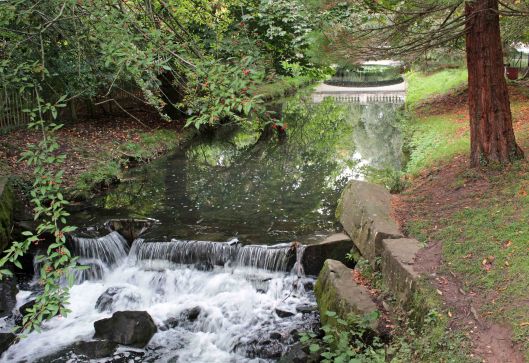
24 September 2015
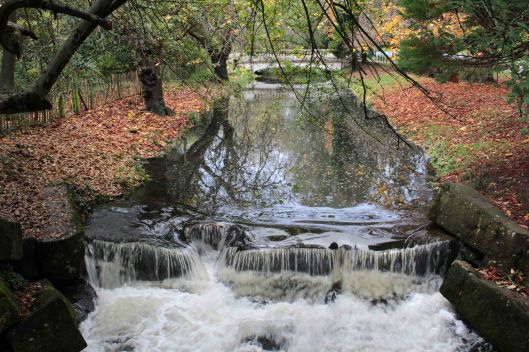
7 November 2015
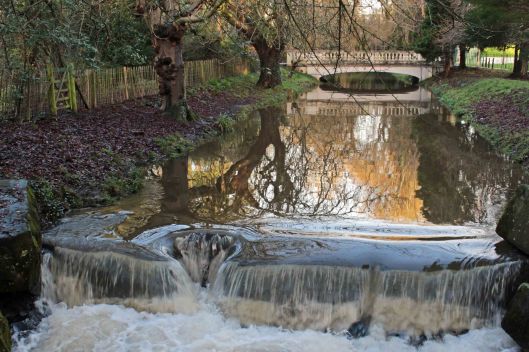
31 December 2015, after heavy rain
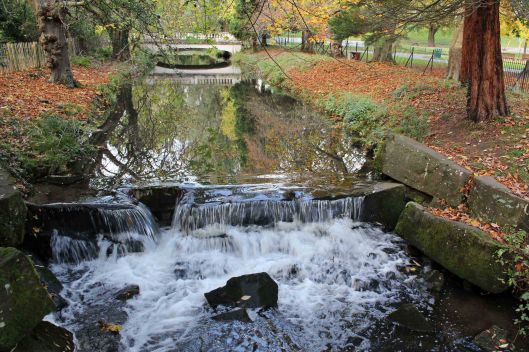
9 November 2016
09 Monday Jan 2017
Tags
Arenaria interpres, birding, birdwatching, British birds, Turnstone, turnstones as scavengers, turnstones in Cardiff, turnstones in Cornwall
I’d only seen these delightful little birds, the Turnstones (Arenaria interpres), once before I went to Cornwall and they were doing as their name suggests, turning over stones around Cardiff Bay, looking for the tiny insects, molluscs and crustaceans they like to eat.

the Cardiff Turnstones
However, though they looked exactly the same, the Cornish Turnstones were different birds entirely. No turning over muddy wet stones for these cute creatures – instead, they’ve followed the example of the gulls (and the occasional Starling) and learnt that scavenging from humans is a much easier way to obtain food, with crumbs of Cornish pasty their morsels of choice!


Turnstones were present in all the little harbour towns we visited and, though their habit is to scurry very quickly to and fro, they appeared very comfortable around people. They are adorable little birds and a pleasure to watch.

08 Sunday Jan 2017
Tags
dead fish, fishermen dumping fish, gulls feeding on dead fish, Marazion Beach, sardines, St Michael's Mount
Our first stop on day two of ‘Christmas in Cornwall’ was at Marazion beach for a wander and some photographs of the sublime silhouette that was St Michael’s Mount. But there was a surprise in store for us, and rather a smelly surprise at that.

On this and preceeding days, thousands of dead fish had washed up at various Cornish beaches, and here the high-tide line was awash with them, mostly sardines but some mackerel and herring as well. I read later, on the BBC website, that the problem was caused by fishing boats catching so many fish in their nets that they were at risk of capsizing or sinking so were having to release part of their catch. Unfortunately the fish rarely survive this catch-and-release process.


Though this was obviously a horror story for the fish, it was a dream come true for the seabirds, and, as we watched, a huge flock of gulls and the occasional cormorant were feasting on the fish in the waves just offshore. It was sensational to watch them, constantly dipping down to wave level and rarely coming up without a fish in their beaks. Hundreds more birds were bobbing about on the sea just beyond the breakers, probably too full to move. And, on the beach, too, the crows were enjoying this plentiful pre-Christmas bounty. It was both a macabre and marvellous introduction to St Michael’s Mount.
07 Saturday Jan 2017

‘Hey, lady. I saw you talking to that robin just now. Why don’t you ever talk to me?
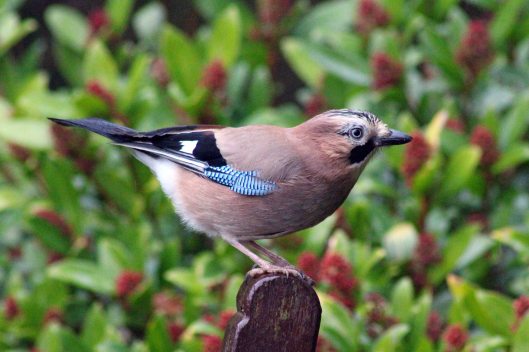
‘I get hungry in the wintertime too, y’know, and I’m just as handsome as that robin!’
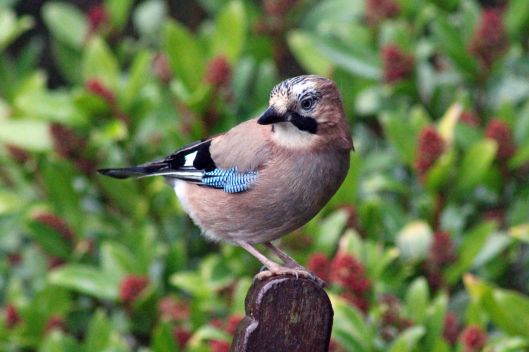
‘I have sharp eyesight so I can see that you’ve still got some seed in that little tub you’re holding.’

‘So, how about throwing a cold wet hungry but gorgeous jay a handful of seeds …. please.’

I’m sure you’ll be pleased to know the cold wet but gorgeous jay is no longer hungry!
06 Friday Jan 2017
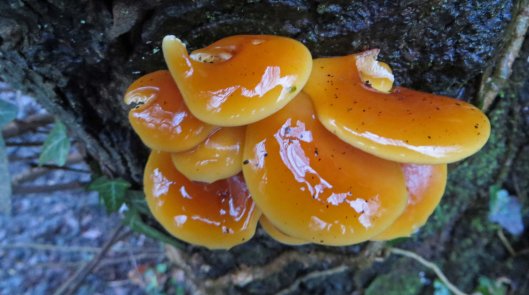
Starting as I mean to continue, I braved the chill wind and annoying drizzle on New Year’s Day for a walk around one of my local parks and was rewarded with the sight of these lovely fungi Flammulina velutipes, otherwise known as Velvet shanks (due to their velvety lower stems).
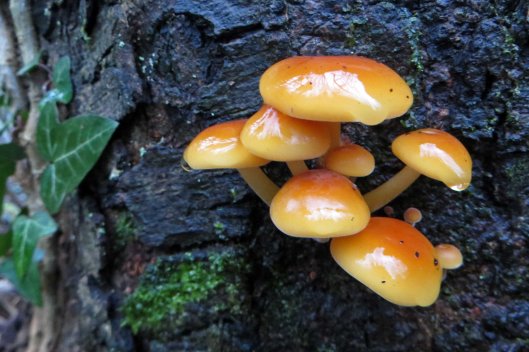
They’re wood rotters, and it might surprise you to know that these are exactly the same fungi as the white Enoki (or Enokitake), much favoured by the Japanese and occasionally available in supermarkets in Britain and other countries. As they’re commercially grown in a dark environment Enoki are longer, smaller and very pale but the natural colour of the Velvet shank is the vibrant golden orange shown in my photos (flammulina means little flame).
05 Thursday Jan 2017
Tags
churchyard lichens, lichen on gravestones, old gravestones, St Just's Churchyard, St Just-in-Roseland
My Christmas holiday was spent exploring Cornwall with a friend, so I thought I’d share a few of the natural delights I saw along the way. On our first day we visited a charming old church at St Just-in-Roseland, an ancient place where St Just the Martyr has been honoured since around 550AD.


The present church, dating from the 1260s, is surrounded by a large graveyard set in a semi-tropical garden. I was particularly taken with the quantity and colours of the magnificent mosses and luxuriant lichens, and with this lovely verse about aging gracefully.

 earthstar
You must be logged in to post a comment.