• ABOUT
  • BIRDING 2018
  • Birding 2019
  • BLOG POSTS
  • Butterflies 2018
  • Resources

earthstar

~ a celebration of nature

earthstar

Category Archives: seaside

Birding along Rumney Great Wharf

07 Tuesday Aug 2018

Posted by sconzani in birds, coastal fauna, nature, seaside, walks

≈ Leave a comment

Tags

birding, birdwatching, British birds, Glamorgan Bird Club, Rumney Great Wharf

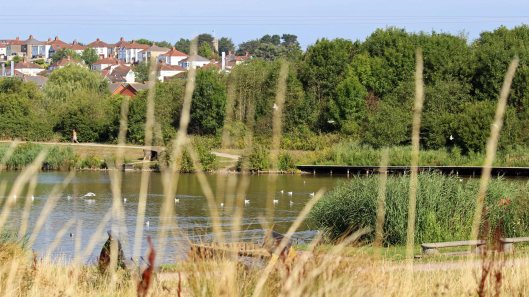
It was hot! In fact, it was not just hot, it was scorching but, along with 15 other brave souls, I joined the Glamorgan Bird Club’s outing last Sunday to walk part of the coastal path along Rumney Great Wharf. We started at Parc Trederlerch, where fishermen were trundling their mountains of gear to favourite sites for a day’s fishing, and Swans, Coots, Tufted ducks and Moorhens flocked to be fed by strolling families.

180807a Parc Tredelerch

From there we walked down towards the sea alongside Cors Crychydd Reen. Despite being choked with weed, the reen was home to Little grebes, Coots and Moorhens, all with young, as well as countless, though elusive Reed warblers.

180807b Cors Crychydd Reen

A Buzzard was hunting from a post overlooking the adjacent landfill site, where gulls, Swifts and assorted hirundines were diving and swooping for food.

180807c buzzard

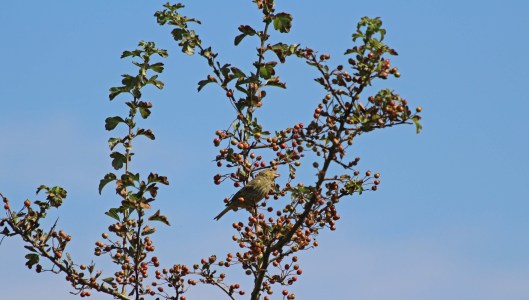
Tucking in to the blackberries as we walked, we were charmed by the sounds of Willow warblers and House sparrows, Goldfinches and Greenfinches, like this one perched high in a tree.

180807d greenfinch.jpg

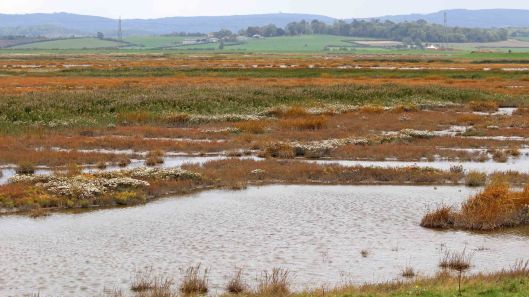
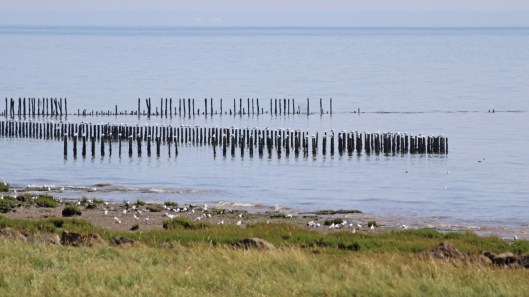
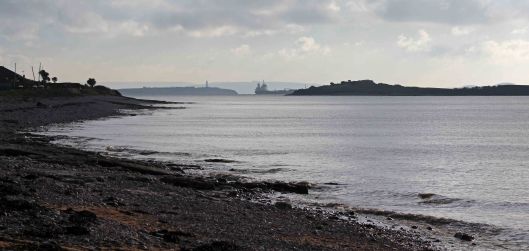
When we reached the sea wall, we turned left towards Newport. Here’s the view in both directions, firstly looking west over Cardiff Bay towards Penarth Head and then west across the very dry foreshore. The heat shimmer didn’t make bird-spotting easy.

180807e view west twds Penarth180807f view east

Linnets entertained us as they bounced around the bushes and reeds.

180807g linnet

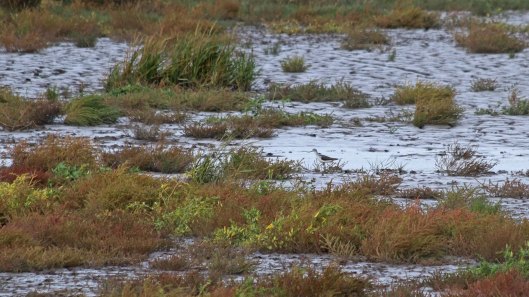
We didn’t see a huge number of waders – maybe it was too hot even for them. A large mixed flock of Redshanks and Dunlins flew east, we had good ’scope views of Ringed plovers and Dunlins at the water’s edge, and gulls abounded. There was one Common gull amongst this lot perched on the posts and a Little egret further along doing the same.

180807h gulls

There were also a ton of dragonflies and hoverflies, bees and butterflies – I’ll post more on two of those lovelies in tomorrow’s blog.

And for those who like the nitty-gritty details – I saw 42 bird species: Black-headed Gull, Carrion Crow, Buzzard, Chiffchaff, Common Gull, Redshank, Swift, Common Whitethroat, Coot, Dunlin, Goldfinch, Great Black-backed Gull, Green Woodpecker, Greenfinch, Grey Heron, Herring Gull, House Martin, House Sparrow, Jackdaw, Kestrel, Lesser Black-backed Gull, Linnet, Little Egret, Little Grebe, Magpie, Mallard, Moorhen, Mute Swan, Lapwing, Oystercatcher, Reed Bunting, Reed Warbler, Ringed Plover, Feral Pigeon, Rock Pipit, Shelduck, Starling, Swallow, Tufted Duck, Willow Warbler, Woodpigeon, and Wren. Also seen by trip participants were Blackbird, Blackcap, Blue tit, Canada goose, Collared dove, Cormorant, Curlew, Great crested grebe, Pied wagtail, Skylark, Robin, Stonechat and Whimbrel, bringing the total club list to a very respectable 55 species.

Like Loading...

Rye birds

27 Tuesday Feb 2018

Posted by sconzani in birds, nature, seaside, weather

≈ Leave a comment

Tags

birding, birdwatching, British birds, Cormorant, Great black-backed gull, Lapwing, Redshank, Rye Harbour Nature Reserve, shoveler, Wigeon

My original title for this blog was ‘A mad Kiwi and an Englishwoman go birding in a howling gale’. I decided that was a trifle long but it was certainly an accurate reflection of our day at Rye Harbour Nature Reserve. Nevertheless, we persevered, though we did put off walking the beach-top path – I think we would’ve been blown all the way back to Rye township if we’d tried that.

180227 Rye Harbour birds (4)

As you might expect, the birds were mostly hunkered down, sheltering where possible behind clumps of grass or huddled alongside sandy banks. Still, with brief stops here and there to scan the shingle and reeds with constantly watering eyes through fogging-up binoculars and short pops into hides (as much to warm up as to look out), we managed to clock up a total of 35 species. They were: Kestrel, House sparrow, Herring gull, Lesser black-backed gull, Black-headed gull, Mallard, Shelduck …

180227 Rye Harbour birds (3)

Shoveler (above, seen through a netting fence), Brent goose …

180227 Rye Harbour birds (5)

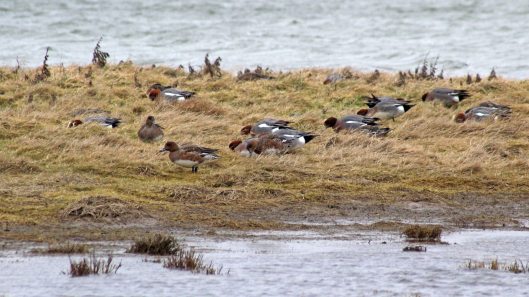
Wigeon (those handsome birds above), Oystercatcher, Carrion crow, Tufted duck …

180227 Rye Harbour birds (1)

Redshank (always a favourite of mine), Coot …

180227 Rye Harbour birds (6)

Cormorant (already beginning to nest in trees near Castle Water) …

180227 Rye Harbour birds (2)

Great black-backed gull and Lapwing (both above), Little grebe, Mute swan, Teal, Little egret, Goldfinch, Woodpigeon, Blackbird, Green woodpecker, Great tit, Coal tit, Magpie, Mistle thrush, Pied wagtail, Greylag goose, Egyptian goose, Pheasant, and Starling.

Like Loading...

Wild words: chalk

21 Wednesday Feb 2018

Posted by sconzani in geology, nature, seaside

≈ Leave a comment

Tags

#WildWords, Birling Gap, chalk, chalk cliffs, Cuckmere Haven, limestone cliffs, Seven Sisters Country Park

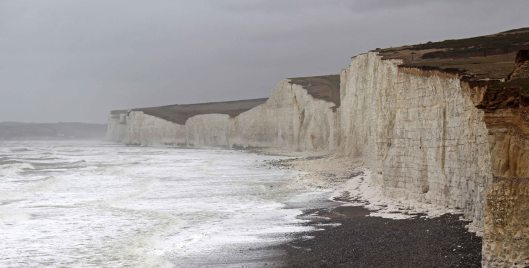
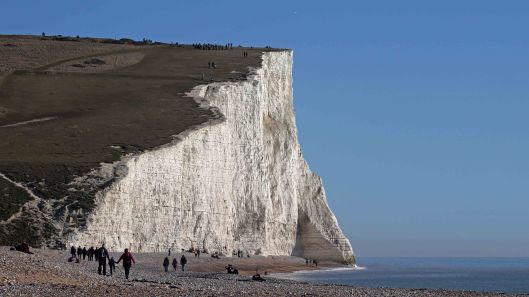
Chalk: noun; ‘a white soft earthy limestone (calcium carbonate) formed from the skeletal remains of sea creatures’, according to the Oxford Dictionary, though that seems a relatively simplistic explanation to me. I chose chalk as this week’s word as I was in East Sussex last week and had occasion twice to see the magnificent chalk cliffs known as the Seven Sisters, once at Birling Gap in a howling gale and again, at Cuckmere Haven, on a day that felt like summer had come early to southern England.

180221 chalk (1)

The Discovering Fossils website has this to say about the chalk at the Seven Sisters:

The Chalk at Seven Sisters belongs to the Upper Chalk, and was deposited during the Coniacian and Santonian stages of the Late Cretaceous epoch between 87-84 million years ago (mya). At this time Seven Sisters and much of Great Britain, along with Europe, lay beneath a relatively shallow sea around 40°N of the equator, on an equivalent latitude to the Mediterranean Sea today.

And you can read more about the fascinating process of chalk formation here.

180221 chalk (2)

Like Loading...

Birding at Ogmore and Kenfig

10 Saturday Feb 2018

Posted by sconzani in birds, nature, seaside, walks

≈ 2 Comments

Tags

birding, birdwatching, Glamorgan Bird Club, Goldeneye, Greenfinch, Kenfig National Nature Reserve, Kenfig Pool, Ogmore, Slavonian grebe, Stonechat

Wednesday dawned clear and frosty so on went the layers of clothing, scarf, hat, gloves and boots, in the backpack went the camera, binoculars, a spot of lunch and rain jacket (this is Wales and I was once a Girl Guide so I was prepared!). I’d scanned tweets, posts and blogs so knew vaguely what to expect and left the house hopeful.

180211 Birding at Ogmore & Kenfig (10)

And I did not despair, nor was I disappointed. On my first Glamorgan Bird Club trip of the year, to Ogmore – both the river and the beach – and then on to Kenfig National Nature Reserve, I added ten new birds to my 2018 list, including two lifetime firsts in the Slavonian grebe and Short-eared owls.

180211 Birding at Ogmore & Kenfig (3)

At Ogmore, the weather was glorious – blue skies, and heat in the sun, if you managed to shelter from the chilly breeze. There were gulls galore, mostly Herring and Black-headed, a sprinkling of Common and a single Med, as well as, further down river, a Great black-backed gull – what beasts they are!

180211 Birding at Ogmore & Kenfig (2)

180211 Birding at Ogmore & Kenfig (1)

A Kingfisher added its flash of turquoise, to the mostly white, grey and brown colours of the other birds (Little egret, Cormorant, Mallard, Redshank, Canada goose, Mute swan). But I don’t mean to imply the other avian species were boring – just look at these dazzling Goldeneyes!

180211 Birding at Ogmore & Kenfig (4)

As we wandered further towards the river mouth, a Stonechat popped up to survey the humans adorned with bins, scopes and cameras, all staring in the opposite direction, to peep briefly, ‘Look at me!’. So I did.

180211 Birding at Ogmore & Kenfig (9)

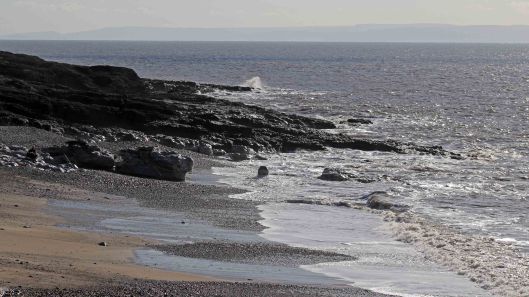
At Ogmore beach, we were hoping for Purple sandpipers but, even with 21 pairs of eyes surveying every nook and rock cranny, we lucked out. Turns out the birds were spending the day across the bay at Newton and Porthcawl. But hey, the scenery was glorious, with glimpses of the recent dumps of snow across the water on Exmoor.

180211 Birding at Ogmore & Kenfig (5)180211 Birding at Ogmore & Kenfig (6)

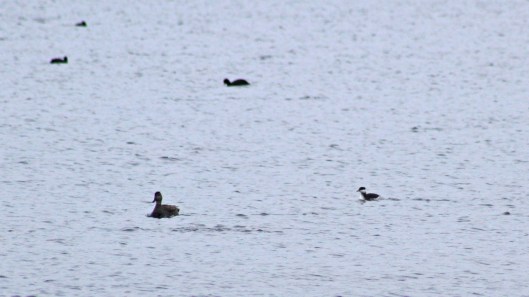
Sandwiches devoured, we headed to Kenfig and stomped down to the pool, where I almost immediately got on to my first lifer of the day, the little black-and-white Slavonian grebe that’s been overwintering there. It’s small, a frequent diver, and was distant but was plainly see-able through bins and scopes, if not such a great subject for my camera.

180211 Birding at Ogmore & Kenfig (7)

By this time, the sun had clouded over, and even a stroll through boggy fields, over wonky stiles, around the lake’s edge in search of White-fronted geese failed to keep the chill from my bones – and we didn’t see those geese. But, a small stalwart seven of us – the others peeling off to heated cars and homes – decided to head for a high point to survey the dunes for the Short-eared owls that have recently been sighted hunting at dawn and dusk. Another lifer! Two birds were seen, one flying low, back and forth amongst the dunes, the other gliding high, with a Kestrel for company.

180211 Birding at Ogmore & Kenfig (11)

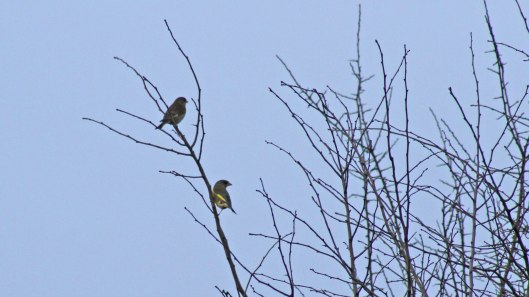
And to finish off a wonderful day’s birding, we got the call that tea, coffee and cake awaited us at the Kenfig office, and spotted these two Greenfinch amongst trees along the way. Just perfect!

180211 Birding at Ogmore & Kenfig (8)

We saw 62 species in total: the full list can be seen on the Glamorgan Bird Club’s website here.

Like Loading...

A stroll at Sully

06 Tuesday Feb 2018

Posted by sconzani in birds, coastal fauna, nature, seaside, walks

≈ Leave a comment

Tags

birding, birdwatching, British birds, Curlew, Grey plover, Little ringed plover, Oystercatchers, Rock pipit, Sully, Turnstone, Wales Coastal Path

At 9:20am yesterday I was on the bus to Sully, looking forward to seeing what seabirds might be scavenging along the shore at the 10:16 high tide. A bonus was seeing my first pheasant of the year in a passing field.

180206 Sully stroll (1)

Walking down the long narrow path to the beach, I was immediately rewarded with the sight of Black-headed gulls and Oystercatchers looking for worms in the neighbouring field, and a Rock pipit flew up from the shore to join them in their foraging.

180206 Sully stroll (2)
180206 Sully stroll (3)

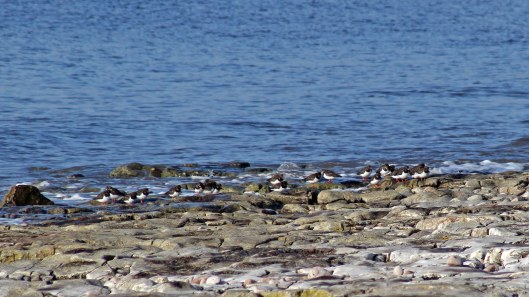
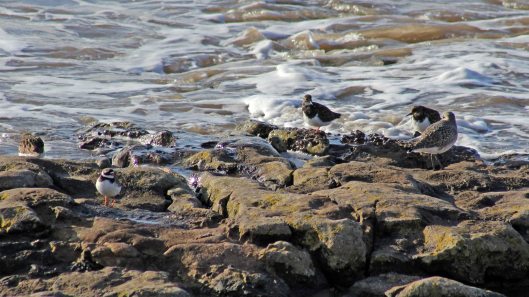
The beach looked empty as I strolled along the ‘coastal path’ – really just a line of rocks and mud here – but a flurry of loud peeping made me turn my head and bring the camera up in time to catch this flock of Turnstones flying in.

180206 Sully stroll (4)180206 Sully stroll (5)

Further east, scanning the water’s edge with my binoculars, I finally spotted an interesting little group of 3 Turnstones, a Little ringed plover and a Grey plover, the latter two year ticks for me, and I’d not seen a Grey plover so close before (I’m still talking a couple of hundred metres away but see-able with bins and long lens). I watched them for perhaps 10 minutes before two loud women and their dog scared the birds off.

180206 Sully stroll (6)

180206 Sully stroll (7)
180206 Sully stroll (8)

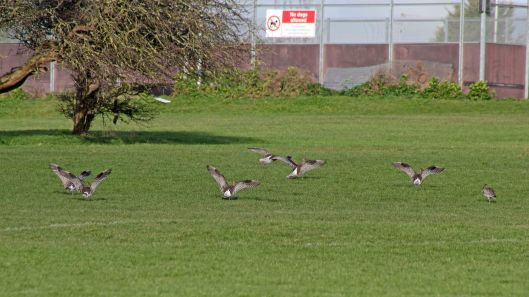
Last, but mostly certainly not least, as these beautiful birds are endangered in Britain, 28 handsome Curlews were using their long curving beaks to probe the playing fields that abut the coastal path in search of worms. After 15 minutes’ watching I left them to their feast, with a silent ‘thanks for being the icing on the cake of my lovely morning at Sully’, and strolled on …

180206 Sully stroll (9)180206 Sully stroll (10)

Like Loading...

Fossils from the Jurassic Coast

06 Saturday Jan 2018

Posted by sconzani in geology, nature, seaside

≈ 2 Comments

Tags

ammonite, beachcombing, belemnite, Charmouth, fossil hunting, fossils, Jurassic Coast, pyrite ammonite

Yesterday a living fossil fungus, today fossicking for fossils on Dorset’s Jurassic Coast – I’m on a roll with the old stuff!

180106 Charmouth fossils (1)

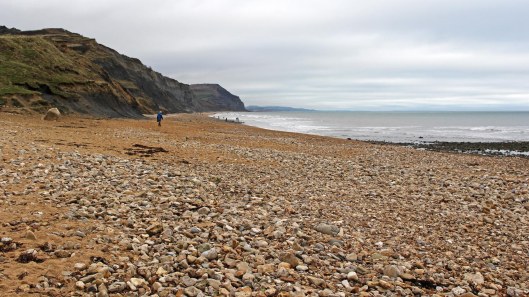
Part of one of my Christmas break days was spent at Charmouth, on England’s south coast, where my friend Sarah and I enjoyed a wonderful long beach walk, much of the time with our eyes down, searching the rocks and pebbles for fossils. Though you’re not allowed to chip away at the cliff face – and you’d be foolish to try, as it can be rather unstable and is subject to frequent mud slips, you are allowed to take fossils from the beach itself.

180106 Charmouth fossils (2)
180106 Charmouth fossils (3)

Sarah spotted one enormous fossil in a big boulder, but that was rather too big to pop in my pocket and bring home.

180106 Charmouth fossils (4)
180106 Charmouth fossils (5)

And, though it took a while to get my eye in, I did eventually find two small pieces of pyrite ammonite and another small rod-shaped rock, which looked very like the belemnite fossils being sold in the local shop. Result!

Like Loading...

Birding on Gower

10 Tuesday Oct 2017

Posted by sconzani in birds, coastal fauna, nature, seaside, walks

≈ 4 Comments

Tags

birding, birdwatching, British birds, coastal cliffs, dramatic coastline, Glamorgan Bird Club, Gower, Mewslade, Rhossili Beach, Worm's Head

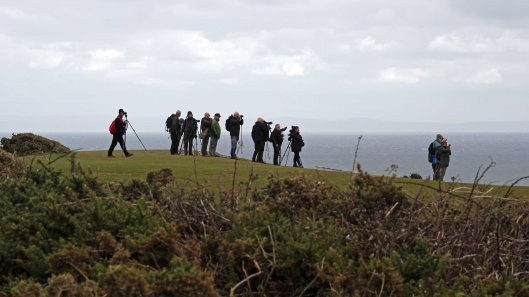
It was a wild and windy but not wet day last week when I ventured for the first time to the incredible Gower peninsula, on a birding trip with my Glamorgan Bird Club friends.

171010 Glamorgan bird clubbers

We parked near Mewslade Beach, then walked a circuit from there along the cliff-top coastal path, across the medieval field system of The Vile, through the little village of Rhossili and then back to the car park. Most of the birds were best viewed through binoculars or ’scopes so I don’t have many images of them to share but the scenery was just stunning! High stone cliffs honed in places to a razor edge by millennia of wind and rain, secret little coves nestled between tall protective hills, the long stretch of golden-sand beach at Rhossili that was recently named the best beach in Britain and one of the world’s top ten – Gower really does deserve the adjective ‘awesome’!

171010 Gower (1)
171010 Gower (2)
171010 Gower (4)
171010 Gower (3)
171010 Gower (5)
171010 Gower (6)

Oh, and getting back to the birds – I saw a total of 34 species: Cormorant, Sparrowhawk, Common Buzzard, Kestrel, Peregrine, Oystercatcher, Lesser Black-backed Gull, Herring Gull, Woodpigeon, Collared Dove, Pheasant, Magpie, Jackdaw, Carrion Crow, Raven, Blue Tit, Great Tit, Coal Tit, Long-tailed Tit, Chiffchaff, Goldcrest, Wren, Blackbird, Robin, Stonechat, Dunnock, House Sparrow, Pied Wagtail, Meadow Pipit, Chaffinch, Goldfinch, Linnet, and the two highlights for me, Common Scoter (a group of perhaps 20 floating together on the sea – seen through a ’scope) and several Gannets, flying low to the waves not far offshore, plus a bonus sighting of at least one Grey seal lolling about in the waves in one of the bays.

171010 Linnets
171010 Meadow pipits
171010 Goldfinches

The group total was 46 species as I was too busy admiring the scenery to notice these: Shag, Kittiwake, Guillemot, Razorbill, Green Woodpecker, Great Spotted Woodpecker, Chough, Rook, Bullfinch, Song Thrush, Common Gull, and Great Black-backed Gull. Thanks to John and Glamorgan Bird Club members for yet another fantastic day out!

171010 Rhossili beach

Like Loading...

Humming-bird hawk-moth

25 Monday Sep 2017

Posted by sconzani in insects, nature, seaside, wildflowers

≈ 8 Comments

Tags

British moths, Humming-bird hawk-moth, Macroglossum stellatarum, moth, moth like hummingbird, Red valerian

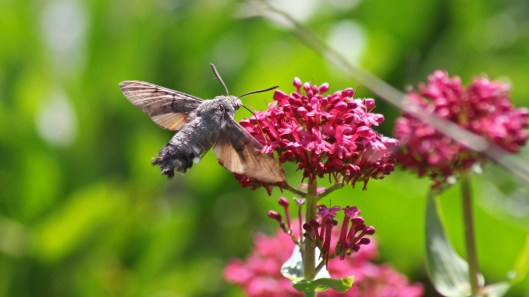
Remember how I wrote yesterday about some days being magical: first I was mobbed by Red admirals, next I discovered the Ivy bee colony and marvelled at its mating antics, and then, la pièce de résistance, I saw my very first Humming-bird hawk-moth.

170925 Humming-bird Hawk-moth (4)

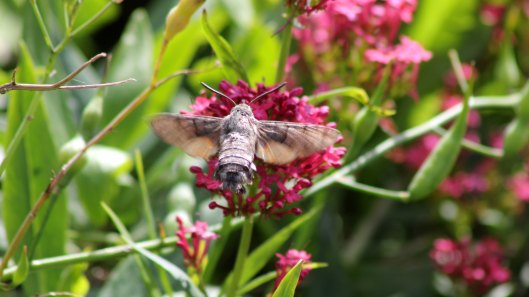
And, by golly, it was difficult to photograph. I took around 70 pictures but most are a blur because, like the bird it’s named after, this moth just does not keep still. Macroglossum stellatarum is its formal name, and it came to Britain originally from Africa and southern Europe. The adult moths can be seen flying any time from April to late November, at which time they start looking for a crevice in a building, a hole in a wall, or a handy crack in a tree to while away the winter months.

170925 Humming-bird Hawk-moth (2)
170925 Humming-bird Hawk-moth (1)

That super-long tongue allows them to specialise in feeding from tube-shaped flowers like the Echiums, though this one was enjoying the nectar of Red valerian plants growing along the high-tide line at a local beach, humming (its wings) as it hovered from one flower to the next. Incredibly, studies have shown that Humming-bird hawk-moths often return to the same flowers at the same time every day. So, it’s a moth that looks like a bird but has the memory of an elephant – simply amazing!

170925 Humming-bird Hawk-moth (3)

Like Loading...

National Meadows Day

01 Saturday Jul 2017

Posted by sconzani in flowers, insects, nature, parks, seaside, walks, wildflowers

≈ Leave a comment

Tags

Lavernock Point, Lavernock Reserve, National Meadows Day, Wildlife Trust for South & West Wales

170701 Lavernock Reserve (3)

Happy National Meadows Day!

170701 Lavernock Reserve (2)

I had a slightly premature celebration by joining a Wildlife Trust walk around Lavernock Reserve on the south Wales coast yesterday. It’s an interesting place that has only become a reserve relatively recently. Due to its prime coastal position, a gun battery was built here back in 1860s and added to during the Second World War – these now form a scheduled ancient monument.

170701 Lavernock Reserve (1)

The meadows sit upon a substrate of clay over Jurassic limestone and, thanks to the tremendous efforts of dedicated volunteers who work constantly to contain the invading scrub, the grasslands are home to many lovely plant, insect and animal species, as well as a succession of migrating birds in spring and autumn.

170701 7-spot ladybird
170701 Centaury
170701 Common red soldier beetle
170701 Common spotted orchid & Selfheal
170701 Large skipper
170701 Marmalade hoverfly
170701 Orange-spot piercer
170701 Plume moth
170701 Restharrow
170701 Ringlet
170701 Snipe fly
170701 Swollen-thighed beetle
Like Loading...

Botany 101: Status = scarce

07 Sunday May 2017

Posted by sconzani in nature, plants, seaside

≈ Leave a comment

Tags

Bota, British clovers, British coastal plants, British flora, British grasses, Bulbous Meadow-grass, Poa bulbosa, Scarce British flora, Suffocated clover, Trifolium suffocatum

I would normally walk right over these tiny plants but, after my outing with my botany mentor on Thursday, I now know to look more closely at what’s growing under my feet. These two plants may not look like much but they are nationally scarce and just as fascinating as the more colourful and showy flowering plants that most easily catch our eye.

170507 Trifolium suffocatum Suffocated clover (1)

Trifolium suffocatum Suffocated clover
Suffocated seems an apt name for this little beauty, surrounded and almost overpowered as it was by the species-rich grassland in which it was living. Luckily, it seems to thrive on a good stomping by humans, in places like picnic sites and car parks, as this was growing in a much-trampled area of the south Wales coastline. Luckily, too, we visited at the right time, as this little clover does not hang around long: its seeds usually germinate in the autumn, it flowers between March and May, and then ‘disintegrates’, according to the Online Atlas of British and Irish Flora. The flowers, which are white and tiny, are contained in the burr-like clusters you can see in the photo above.

Poa bulbosa Bulbous Meadow-grass
The exceedingly dry April weather meant we didn’t get to see this second scarce plant at its best: though we counted 27 flower heads, the plants themselves had mostly dried up, though you can still see the bulbous bases that give it its name. Though it’s called a meadow grass, it actually seems to prefer rather infertile sandy soils, living, according to the Atlas, in ‘open sparse grassland’ and even ‘on bare sand in dune systems’. We found ours in a car park adjacent to a beach and dune systems but it wasn’t actually growing in those dunes.

170507 Poa bulbosa Bulbous Meadow-grass (1)
170507 Poa bulbosa Bulbous Meadow-grass (2)

Though this grass can spread through the wind blowing the bulbs around, the plants that live in south Wales are also all viviparous: the flowers are ‘replaced by tiny plantlets which are capable of rooting and becoming established as individual plants’. I thought the flower heads (inflorescences) were particularly lovely with their shades of purple, green and cream.

Like Loading...
← Older posts
Newer posts →

About me

sconzani

sconzani

I'm a writer and photographer; researcher and blogger; birder and nature lover; countryside rambler and city strider; volunteer and biodiversity recorder.

View Full Profile →

Follow earthstar on WordPress.com

Enter your email address to follow this blog and receive notifications of new posts by email.

Recent blog posts

  • The Marl Med gull January 29, 2026
  • Recording Grey squirrels January 28, 2026
  • Jimmy Wren January 27, 2026
  • Millipede: Nanogona polydesmoides January 26, 2026
  • Mid-winter 10 January 25, 2026

From the archives

COPYRIGHT

Unless otherwise acknowledged, the text and photographs on this blog are my own and are subject to international copyright. Nothing may be downloaded or copied without my permission.

Fellow Earth Stars!

  • Unknown's avatar
  • Unknown's avatar
  • Unknown's avatar
  • Unknown's avatar
  • Unknown's avatar
  • Unknown's avatar
  • Unknown's avatar
  • Unknown's avatar
  • Unknown's avatar
  • Unknown's avatar
  • Unknown's avatar
  • Unknown's avatar
  • Unknown's avatar
  • Unknown's avatar
  • Unknown's avatar
  • Unknown's avatar
  • Unknown's avatar
  • Unknown's avatar
  • Unknown's avatar
  • Unknown's avatar
  • Unknown's avatar
  • Unknown's avatar
  • Unknown's avatar
  • Unknown's avatar
  • Unknown's avatar
  • Unknown's avatar
  • Unknown's avatar
  • Unknown's avatar
  • Unknown's avatar
  • Unknown's avatar
  • Unknown's avatar
  • Unknown's avatar
  • Unknown's avatar
  • Unknown's avatar
  • Unknown's avatar
  • Unknown's avatar
  • Unknown's avatar
  • Unknown's avatar
  • Unknown's avatar
  • Unknown's avatar
  • Unknown's avatar
  • Unknown's avatar
  • Unknown's avatar
  • Unknown's avatar
  • Unknown's avatar
  • Unknown's avatar
  • Unknown's avatar
  • Unknown's avatar
  • Unknown's avatar
  • Unknown's avatar

Blog at WordPress.com.

Privacy & Cookies: This site uses cookies. By continuing to use this website, you agree to their use.
To find out more, including how to control cookies, see here: Cookie Policy
  • Subscribe Subscribed
    • earthstar
    • Join 670 other subscribers
    • Already have a WordPress.com account? Log in now.
    • earthstar
    • Subscribe Subscribed
    • Sign up
    • Log in
    • Report this content
    • View site in Reader
    • Manage subscriptions
    • Collapse this bar
 

Loading Comments...
 

You must be logged in to post a comment.

    %d