This Garden spider (Araneus diadematus) was doing a spot of web maintenance as I passed by and I – rather fancifully, I admit – thought it looked just like it was playing a game of peek-a-boo.



29 Thursday Nov 2018
This Garden spider (Araneus diadematus) was doing a spot of web maintenance as I passed by and I – rather fancifully, I admit – thought it looked just like it was playing a game of peek-a-boo.
08 Sunday Apr 2018
Tags
Abraxas grossulariata, Andrena flavipes, Magpie moth caterpillar, Red Admiral, Red velvet mite, Trombidiidae, Vanessa atalanta, Yellow-legged mining bee
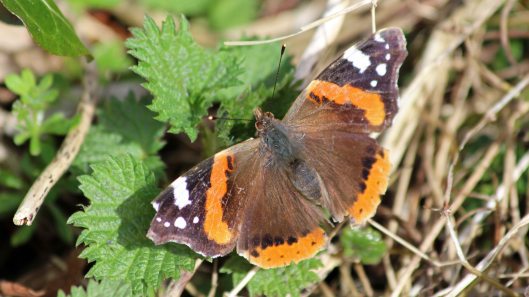
I mentioned yesterday that I saw my first butterflies of 2018 this week. The first was a Peacock but my camera was in my backpack and, by the time I extracted it, the butterfly had flown off. I was still cursing that fact when another butterfly appeared, this lovely Red admiral (Vanessa atalanta). Snap!
On Wednesday’s walk, as well as the bee-flies I blogged about yesterday, I also saw several varieties of bee. I’m hopeless at identifying bees – I will focus on them one year to try to improve my skills, but that won’t be this year. Luckily, there’s a good Facebook group where the folks are very helpful, and they’ve IDed these as Yellow-legged mining bees (Andrena flavipes). They’re spring-flying solitary bees that make individual nests but often in large groups (the experts call them aggregations). This lot, of perhaps 20, were digging in to a sandy bank by the seaside. (Here’s a link to more information from BWARS.)



This next little critter was tiny, as you can see by comparison with my hand behind (and I have small hands). Once again, I needed help on the ID but the folks from my local Butterfly Conservation Facebook group are experts. This is a caterpillar of the Magpie moth (Abraxas grossulariata), a stunning-looking moth that I have not yet seen. Its caterpillar is quite lovely too, don’t you think?

Though only 3 to 5mm long, these little Red Velvet Mites are hard to miss, simply because of their unusual colour. This is one of the Trombidiidae family but I don’t know which one. It’s really an arachnid (note the eight legs) rather than an insect but I’m including it here anyway. It’s carnivorous but no need to worry – it only eats creatures smaller than itself!


And, finally, a bee that I haven’t tried to put a name to – I just liked it for the way it’s positively luxuriating in the pollen of this Lesser celandine flower.

13 Monday Nov 2017
I know a lot of people freak out about spiders but these are not dangerous in any way and they’re incredibly beautiful. They’re Garden spiders (Araneus diadematus), and are also known as Crowned orb weavers, Garden cross spiders and Diadem spiders because of the intricate crown-like patterns on their backs. And it’s those patterns that I want to focus on here.
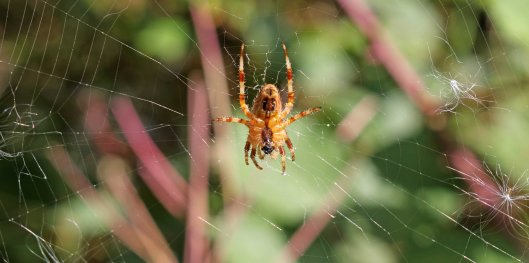
As you can see below, the designs vary from spider to spider, a little like fingerprints and retina patterns in humans. As you can also see, their colours are quite varied, ranging from an orangey brown right through to very dark brown, verging on black. So, next time you spot one of their large webs strung across the plants in your garden, take a closer look … and be amazed.


 earthstar
You must be logged in to post a comment.