Some of the splendid trees at Cardiff’s Cathays Cemetery displaying their glorious autumn colours. Better in person, obviously, but I hope you enjoy these magnificent trees as much as I did.

07 Sunday Nov 2021
Some of the splendid trees at Cardiff’s Cathays Cemetery displaying their glorious autumn colours. Better in person, obviously, but I hope you enjoy these magnificent trees as much as I did.
06 Saturday Nov 2021
Tags
British hoverflies, hoverfly larva, hoverfly larva on Sycamore, insects on Sycamore, sycamore, Syrphus sp larvae, Syrphus species
We’ve seen the Godzilla of hoverfly larvae, one of the Dasysyrphus species, and, back in February 2020, I featured my very first hoverfly larva, one of the Platycheirus family, and then in September we saw the larva and adult of Scaeva pyrastri. However, I haven’t yet shown you the larvae I see most often, those of the Syrphus species of hoverfly.
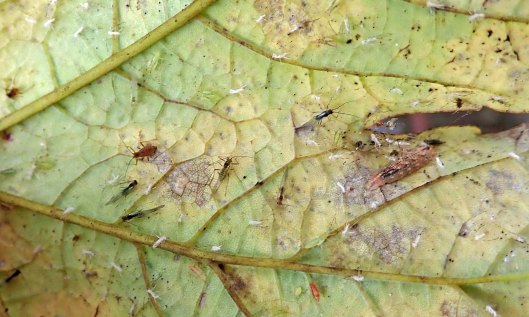
I usually find these on Sycamore leaves, the undersides of which are home to thriving families of aphids, the hoverfly larvae’s favourite food. Occasionally, I’ve found larvae on the tops of leaves or on branches, perhaps on the move to a new leaf. And yesterday, on Twitter, I saw a short video by my go-to hoverfly larvae expert on the various species of hoverfly larvae he had found on gravestones under Sycamore trees in his local cemetery. I’ll be checking out that idea during one of next week’s nature walks. Meantime, try turning over some Sycamore leaves – you never know what might be lurking underneath.


03 Wednesday Nov 2021
Tags
Ash tree galls, Dasineura fraxini, gall causing midge, gall midges, galls, galls made by midges, galls on Ash leaves, midge gall
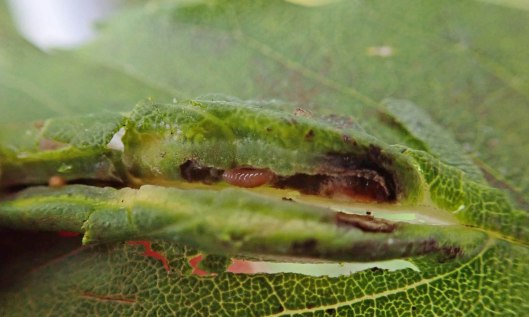
One of the benefits of checking the leaves of various trees, and other plants, for leafmines is that, even when I don’t find them, I do find other things just as interesting, and this is one of those. I didn’t know what it was, of course, until I got home and checked my Field Studies Council Guide to plant galls in Britain fold-out guide. (If you’re not familiar with these, check the FSC online shop here. I have a few of these and find them really useful.)


My guide informed me that these galls on the leaves of Ash trees were created by the larvae of Dasineura fraxini, a species of tiny midge. Few people have ever seen the adult midge but I did have a look at one of the galls that was partly open and spotted one of the miniscule orange larvae. These galls can be found from May through to October, at which time the leaves will fall to the ground, where the larvae will pupate and over-winter until emerging as adult midges in the springtime.
01 Monday Nov 2021
Tags
British leafmines, leaf mines, leaf-mining moth, leaf-mining moth larvae, leafmines on Plane trees, Phyllonorycter platani, Plane trees
Another #LeafmineMonday, another new leafmine discovery – new to me, that is, not to science or Wales.

This is another mine that’s created by the larva of a moth, the rather handsome micro moth Phyllonorycter platani, whose larvae feed on the leaves of Plane trees. This moth only appeared in Britain 30 years ago – as it can be found in many countries around the globe, it’s not possible to say where it came from or how it got to London but, since 1989, it has colonised much of southern Britain. Of course, no one knows how it’s managed that either, though I did read some speculation on Twitter that, as the first Cardiff records were noted very near the main car and coach parks, the moths could well have hitched a ride on passing vehicles. As I’ve sometimes seen small moths on trains, I can quite believe that possibility.


29 Friday Oct 2021
Fungi come in an amazing variety of forms and colours. Here’s one I found for the first time a week or so ago.
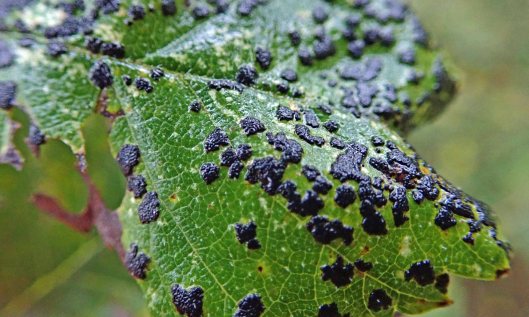
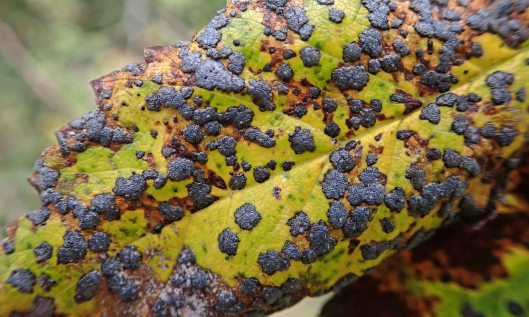
You’re probably familiar with Sycamore tarspot (Rhytisma acerinum), which makes black spots on the leaves of Sycamore trees. Well, this is superficially similar, though not as widely recorded in Britain: it’s Dothidella ulmi, a fungus that develops under the epidermis of leaves on Elm trees, in this case Wych elm, then erupts in a mass of grey blisters.
26 Tuesday Oct 2021
Tags
British hoverflies, Dasysyrphus larva, hoverfly larva, hoverfly larva eating an aphid, hoverfly larva on Sycamore
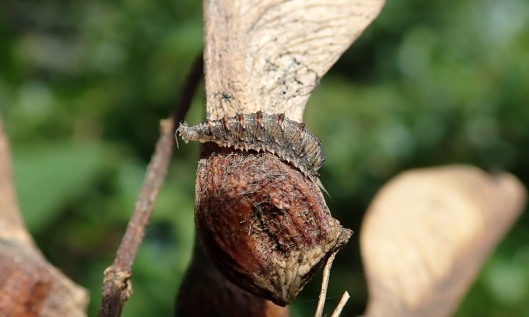
The highlight of Friday’s walk was marvelling at this hoverfly larva catch an aphid. The larva sat, perfectly camouflaged on its Sycamore seed, waiting for an unsuspecting aphid to tootle past. Though these larvae are blind, they can obviously sense movement, as this one rapidly twisted its body towards any approaching larvae. As I watched, it missed the first one but the next larva to chance its luck was grabbed and was in the process of having its life juices sucked out when I moved on.
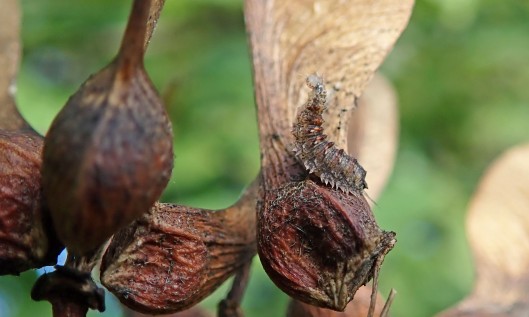
Geoff, a hoverfly larvae expert I consulted on Twitter, was able to confirm a species but not a precise identification: ‘The Godzilla of hoverfly larvae! Certainly Dasysyrphus sp. probably albostriatus. Need a dorsal view of the rear breathing tube to be certain.’ Yes, you read that right – not only is the larva blind but it also breathes through tubes in its rear end!
25 Monday Oct 2021
Tags
Case-bearing moth, Coleophora badiipennella, leaf-mining moth, leafminer, leafmines on Wych elm, Pale elm case-bearer
This might not look like much but I’ve been looking for one of these for perhaps a year, at least during the months when it was around to be found. And if I hadn’t been looking closely at the leaves of this Wych elm, I could so easily have missed it. These are the leafmine and the case of Coleophora badiipennella, the Pale Elm Case-bearer (click on the link here to see the adult moth on the UK Moths website).


According to the British Leafminers website, the larva:
initially forms a gallery along the midrib, which then goes out along a vein (see photo). The end of this gallery is then excised to construct the first case. It then feeds close to this and makes several small mines …
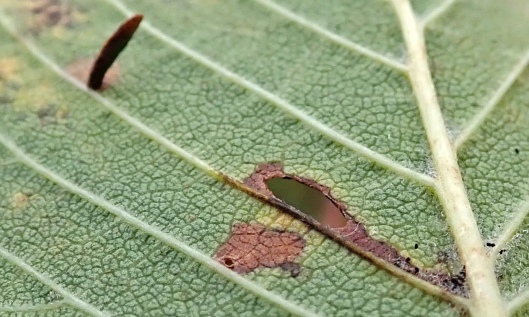
If you look at my photo above, you can see where the larva has made a second mine below the first – you can see the tiny hole where it would have attached itself – before moving to the third mine where it was then feeding. I haven’t been able to find much information about pupation but I presume the larva remains in its case, falls to the ground either still attached to its leaf when the leaf falls or after detaching itself, and over-winters on the ground. It seems many of these leafminers are not very well studied … yet.
21 Thursday Oct 2021
Tags
Aproceros leucopoda, British sawflies, Elm zigzag sawfly, sawfly feeding marks on elm leaves, sawfly on Wych elm
‘Yes it’s definitely Zorro’, confirmed Andy, a county sawfly recorder, when he took a look at these photos on Twitter on Tuesday. Andy was not, of course, referring to the legendary fictional character of book, television series and movie, but to the creature that created, in the leaves of Wych elm, these characteristic feeding marks that resemble the trademark ‘Z’ signature the big screen version of Zorro left at the scene of his adventures.

Zorro, in this case, is the Elm zigzag sawfly (Aproceros leucopoda) and my photos are the first records for this species in Wales. The find is a double-edged sword (see what I did there?), as this sawfly is considered an invasive species, though I am assured by those who have been following its spread in England that the damage it does is not as considerable as first feared. I hope to spot the larvae that do this damage sometime next year.


15 Friday Oct 2021
Tags
British slime moulds, Ceratiomyxa fruticulosa, Coral slime, slime mould, slime mould on dead tree
While out walking on Wednesday I spotted this large expanse of something white on the side of a huge old fallen tree and, of course, I had to investigate.
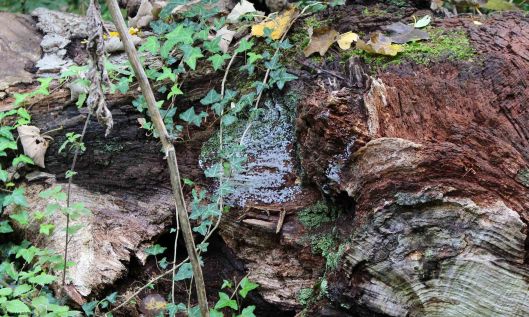
As I got closer, I realised it was the slime mould Ceratiomyxa fruticulosa, a mass of tiny translucent white tubes, often branched, clustered together like terrestrial coral or sea anemones.
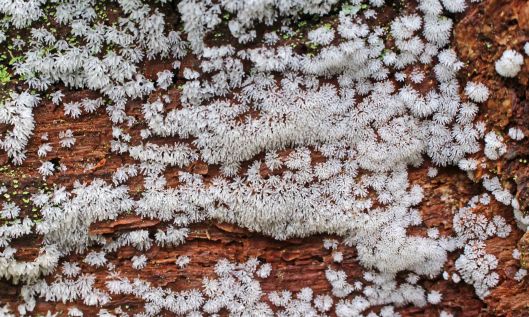
As this plasmodium stage of a slime mould often only lasts a day or two, the timing of my walk was very lucky indeed.

12 Tuesday Oct 2021
Tags
British moths, Moth larvae in Sycamore seeds, moth mines in Sycamore seeds, Pammene aurita larva, Pammene regiana larva, Sycamore seeds
This is the sequel to yesterday’s post …
30 September: While I was searching for the larval mines of the moth Ectoedemia decentella on the few Sycamore seeds I could reach, I found one seed with a hole in it. Thinking it might be relevant, I brought it home and later posted a photo and query on Twitter. Butterfly Conservation senior moth ecologist George replied that this is ‘the exit hole made by a tortrix [moth] larva – likely Pammene aurita, though Pammene regiana also feeds on Sycamore seeds’. Then followed a discussion, prompted by George, between he and 3 other moth-ers about whether Pammene regiana makes an exit hole like this. No one knew for sure.

1 October: The next morning, when I picked up the little group of three joined seeds, I noticed what looked like frass sitting below. I mentioned this on Twitter and was advised to put the seeds on tissue in a jar in case the larva was still inside.

2 October: My tweet: ‘Exciting news: we have a larva! Not from the original hole. I put that seed, with 2 attached, in a jar, and a larva has emerged from one of the other seeds. It’s currently doing a circuit of the tissue – hoping it will pupate.’ It wasn’t until later, when I was looking at the photos I had taken, that I realised the photo above shows where that larva had begun to eat its way out of the seed (indicated by the yellow arrow).


3 October: The larva pupated. I haven’t been able to get a good image as it’s under the tissue and seems partly stuck to the glass jar. And I realised that I’ll now need to wait until at least next May, maybe later to see which moth emerges. What’s that about patience being a virtue?!

 earthstar
You must be logged in to post a comment.