The Cherry tree outside my window has chosen these weather-beaten, wind-blown days of Storms Dudley, Eunice and now Franklin to open its first blossoms of the year. It’s incredibly cheering on a dull grey wet day.


20 Sunday Feb 2022
The Cherry tree outside my window has chosen these weather-beaten, wind-blown days of Storms Dudley, Eunice and now Franklin to open its first blossoms of the year. It’s incredibly cheering on a dull grey wet day.
09 Wednesday Feb 2022
Tags
Aceria ilicis, British galls, gall mites, galls, galls on oak trees, Holm oak, mite galls, mite galls on Holm oak
During yesterday’s walk, when checking for leaf mines on the leaves of Holm oak (large numbers of Ectoedemia heringella present – you can see one in the photo below), I noticed a huge abundance of small bumps covering many of the leaves.
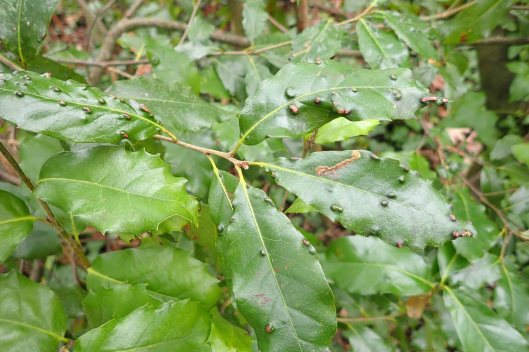
These are the galls caused by the miniscule mite Aceria ilicis. On the underside (though sometimes also on top), the depression in the leaf is filled with tiny brown hairs (an erineum) where the mites make their home. The galls can be seen throughout the year, so next time you spot a Holm oak, check out its leaves.


30 Sunday Jan 2022
Posted in trees
Tags
Alder, Alder catkins, British trees, catkins, female Alder flowers, female Hazel flowers, Hazel, Hazel catkins
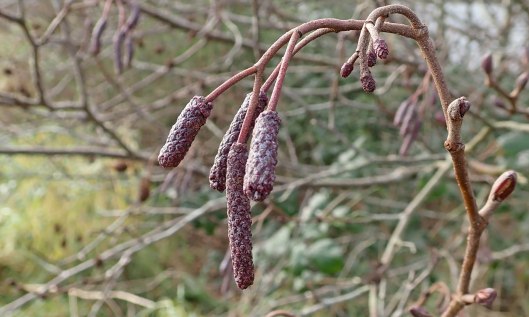
The catkins of Hazel (left) and Alder (right) are now swinging from their respective tree branches like furry pussycats’ tails – the male catkins, that is.


The female flowers are rather different, the Hazel females (left) totally different, that startlingly hot pink, and the Alder flowers (right) a little catkin-ish but much smaller (my last photo shows both male and female Alder to show the size comparison).


09 Sunday Jan 2022
Posted in trees
I read this recently on Twitter and liked the idea so much that I just had to share:
‘The Welsh phrase “dod yn ôl at fy nghoed”, meaning “to return to a balanced state of mind”, literally translates as “to return to my trees”.’ Works for me!

31 Friday Dec 2021
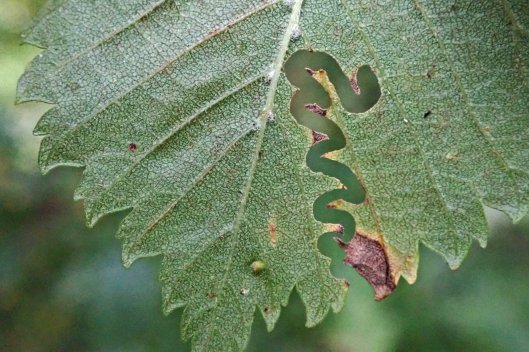
And so we come to the end of my A-to-Z showcase of some of the highlights of my ‘wild life’ in 2021. There was only ever one contender for the letter Z, Zorro, my find of Elm zigzag sawfly larval feeding tracks on a Wych elm leaf, a first record for this species in Wales.
Thanks, everyone, for following along on my journey through the wildlife of south Wales again this year. I truly appreciate all your likes and comments that inspire me to continue seeking and learning. And I hope these posts encourage you to look more closely at and appreciate the amazing natural world around us.
I hope to continue my daily posts in 2022, though I already know there will be some changes to my personal circumstances in the coming year, which may affect my ability to post or, quite possibly, the location I post from. I’ll write more about this when things become clearer.
One immediate change takes effect today – to save money I’ve cancelled my personalised domain name. I’m assured this should automatically revert to a generic wordpress domain – fingers crossed! – but I don’t know how this will affect, amongst other things, links in prior posts. I’ll be checking.
24 Friday Dec 2021
Tags
leaf-mining moth larvae, leaf-mining moths, leafmines, leafmines on Field maple, leafmines on Norway maple, Stigmella aceris
As the leafmine season draws to a close (though I do still have a couple of finds to share early in 2022), I thought I’d post an update on our progress of monitoring the spread of the moth Stigmella aceris in the wider Cardiff area, a moth that was first recorded in Wales in 2019.

The map on the left below shows 1km squares where the moth’s larval leafmines were present as at 11 November 2020; the map on the right as at 29 November 2021. The red-coloured squares represent new finds during that year; the mustard-coloured squares are finds from previous years, i.e. in the left map, the mustard squares were finds made in 2019; in the map on the right, the mustard squares show the finds at the end of 2020. I am just one of several enthusiastic local members of Team leafmine who have been helping with this surveying, walking many miles to check each 1km square and, as the maps show, we have been able to confirm that Stigmella aceris has spread quite extensively in 2021.
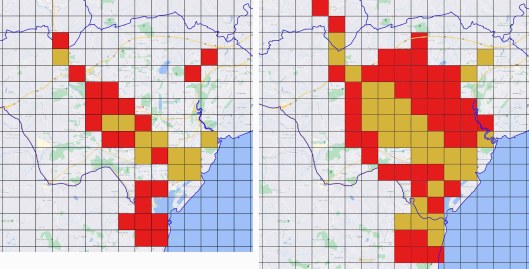
The moth’s presence, of course, does depend on the presence of its larval food plants, the trees Field maple and Norway maple, so blank squares can indicate an absence of trees, rather than a failure to find any mines. Where the moth has been present for more than a year, it can be prolific, with several mines on each leaf of Field or Norway maple, whereas in newly colonised places, I’ve often found just one or two mines from a whole tree load of fallen leaves. It will be fascinating to check this tiny moth’s progress again in 2022.

22 Wednesday Dec 2021
When I began this alphabetical countdown, I thought I might struggle with some of the letters but Q was easy: Quercus, the Latin for Oak tree. The mighty Oak features often in this blog: its leaves for their autumn colours, for the galls they support, for the insect larvae they feed, for the birds that nest in the Oak’s branches, for the fungi that grow beneath this amazing tree … and so much more. This year, amongst other topics, we’ve had Oak leaf burst; a new gall I was lucky enough to find; and some mothy goodness. I’m sure the Oak will provide further wonders in the future.

29 Monday Nov 2021
Tags
British leafminers, Hornbeam, leaf-mining moths, leafmines on Hornbeam, leafmining moth larvae, Stigmella microtheriella
Hornbeam is a tree that’s somehow escaped my attention but, at this time of year, when its leaves turn gorgeous and vibrant shades of yellow, I can’t help but notice how widespread it is and, while admiring its autumn colour, I’ve also spotted some leafmines on its leaves.
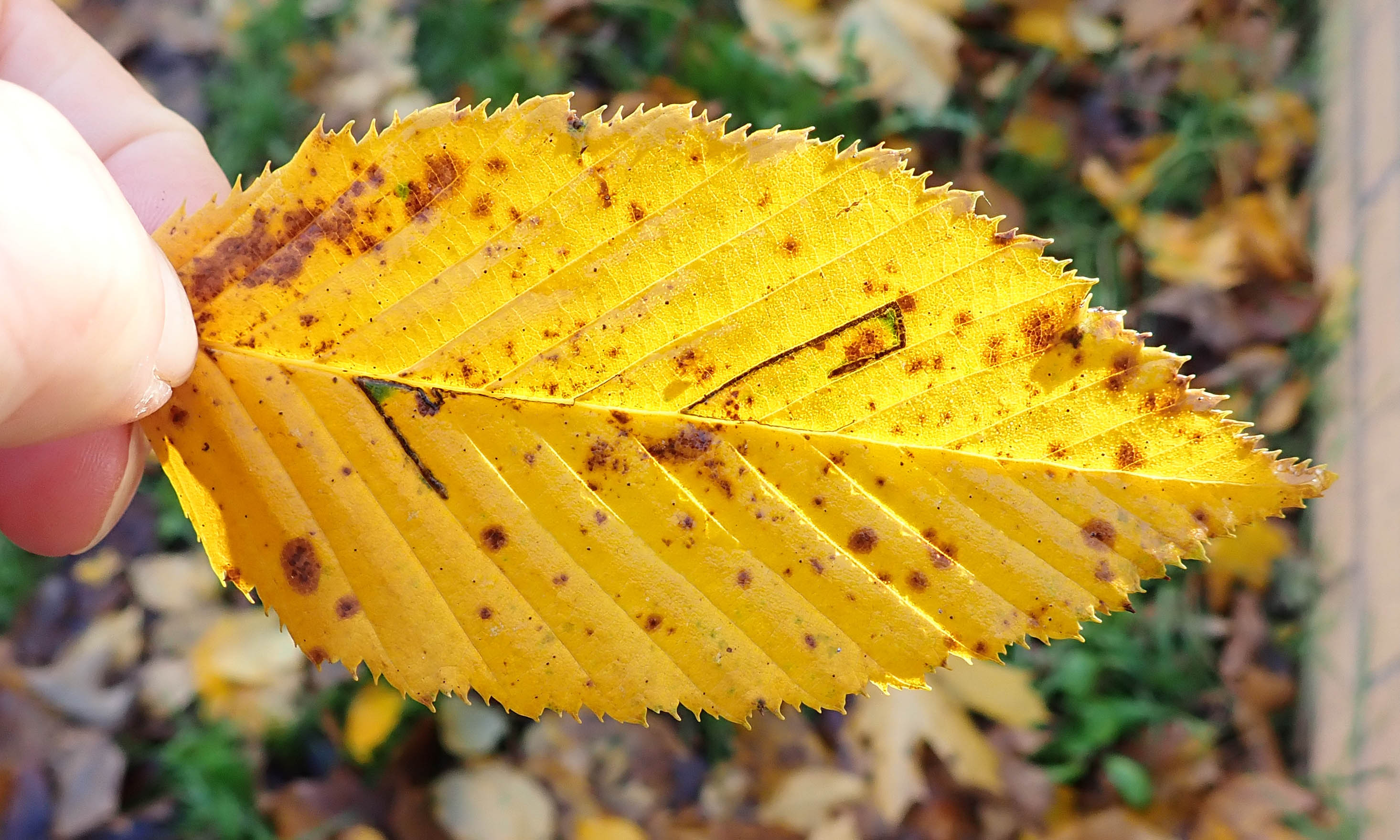
Reading the mine description on the British Leafminers website, I thought I had found Stigmella microtheriella (egg laid, so mine starting, on or near a vein but not in the axil) but, as there was potential confusion with another moth, Stigmella floslactella, I checked with the experts. Rob, one of those behind the British Leafminers website, kindly confirmed that my identification was correct and also commented that ‘Although S floslactella is said to mine Hornbeam I don’t know anyone who has found it on that host. It’s a very doubtful record.’ Now I – and you, if you see mines like these – can record them as Stigmella microtheriella with confidence!


28 Sunday Nov 2021

I simply can’t resist it – the gorgeous golden glow of Ginkgos in the autumn. Such magnificent ancient trees!


14 Sunday Nov 2021
‘And all the lives we ever lived and all the lives to be are full of trees and changing leaves….’ ~ Virginia Woolf, To the lighthouse

 earthstar
You must be logged in to post a comment.