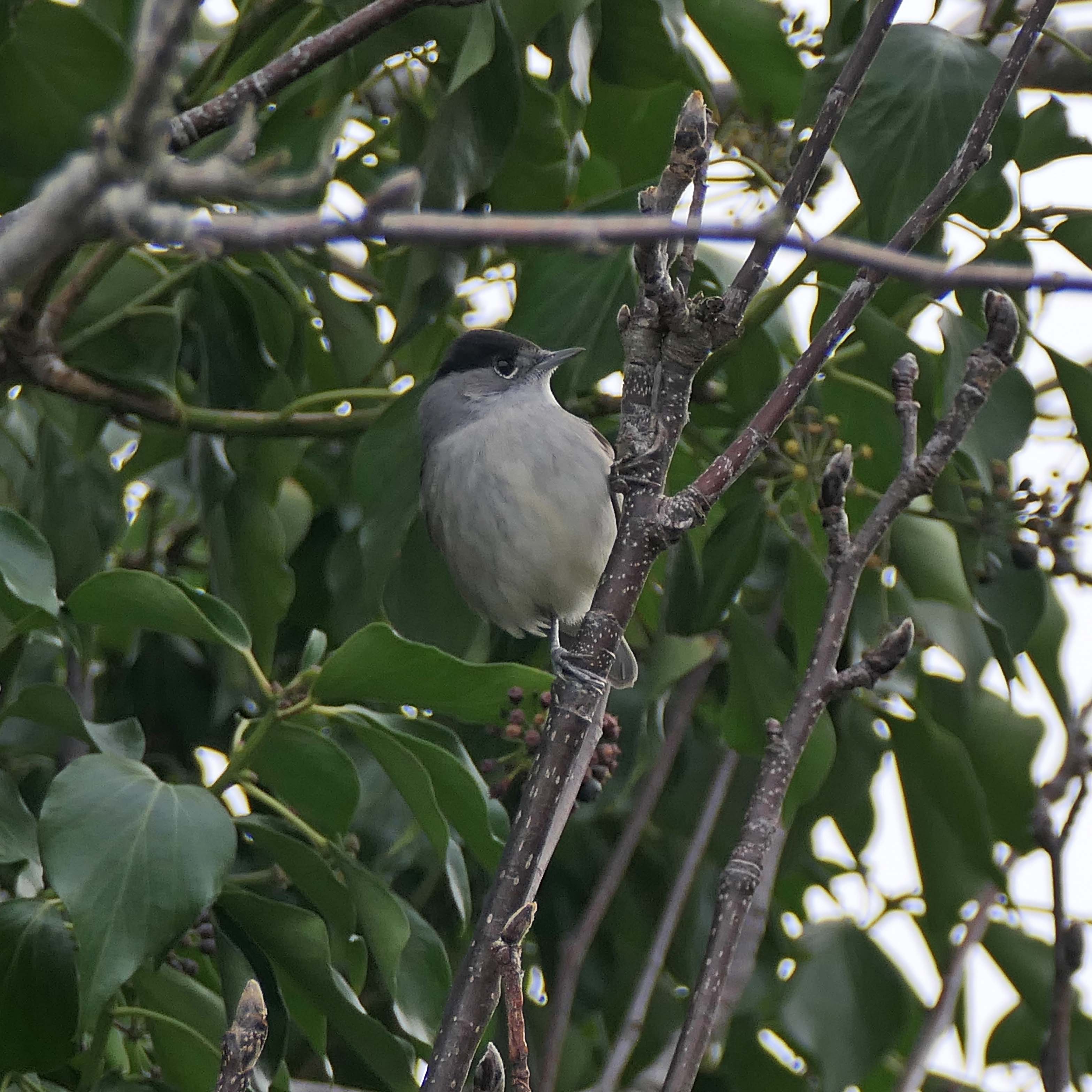
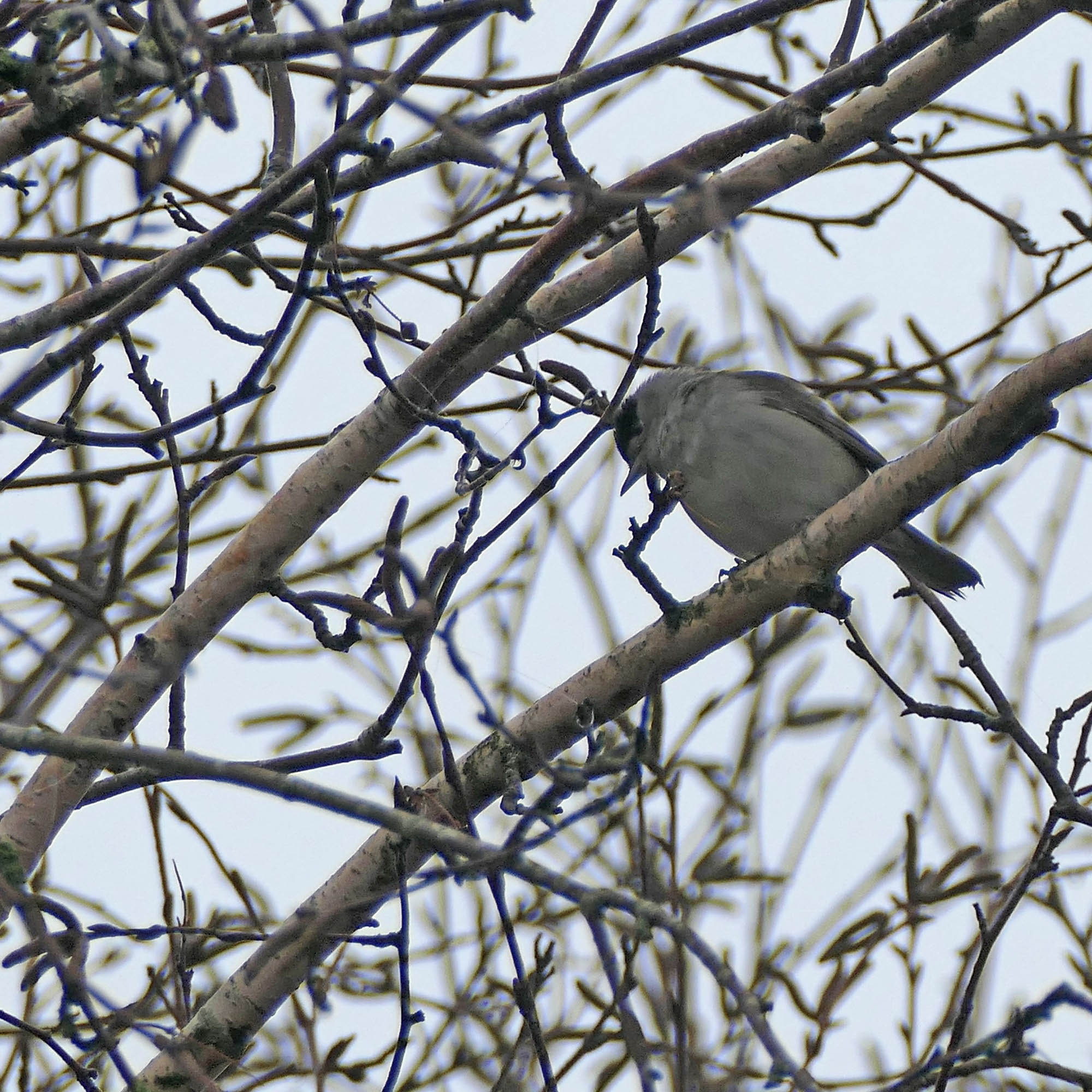
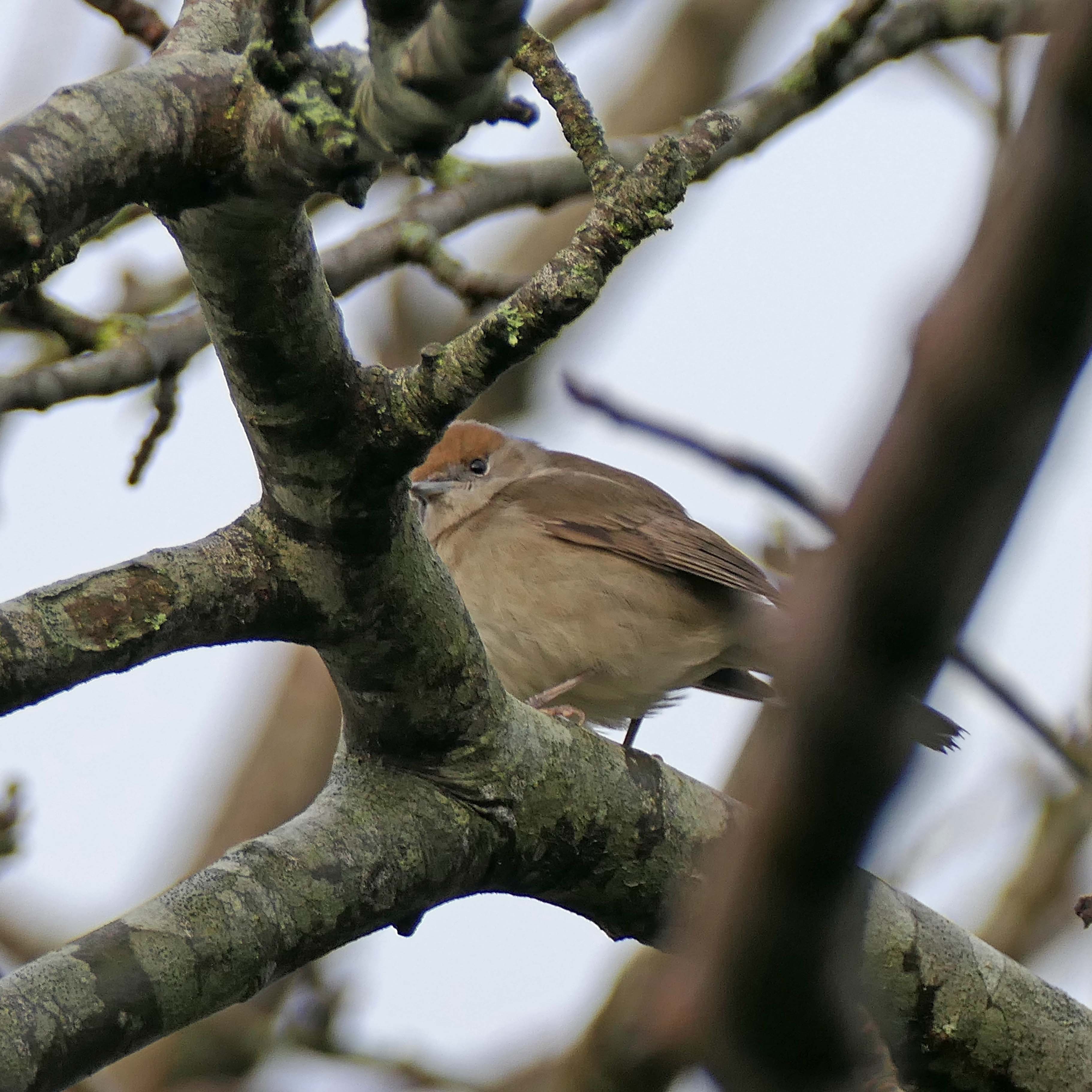
Am I watching the Sparrowhawk or is the Sparrowhawk watching me?
I was checking the rather boggy area near these trees and shrubs for any lurking Snipe (none seen) when I was distracted by a rustling in the branches. A bird flew out and away up the field, and I quickly realised it was a Sparrowhawk from its flight pattern (flap, flap, glide). Then, I got the feeling I was being watched and turned to find this second Sparrowhawk still sitting in the trees.
Deep-diving in leaf litter has become a favourite pastime when the days are short, the birds aren’t showing themselves, and the insects are few … except in the wet muddy depths of the decaying leaves where so many spend their winters as larvae, and where adult springtails abound. This springtail, Orchesella cincta, which had crawled from the leaf litter on to a metal fence, was a new find for me in December.
The local berry trees and shrubs – Hawthorn, Blackthorn, Buckthorn and, in parks and gardens, also Cotoneaster and Firethorn – have an abundance of fruit this winter, which means we have a corresponding abundance of thrushes feasting on those berries.
I find our winter visitors, the beautiful Redwings (Turdus iliacus), quite skittish birds, often difficult to get close to. And even when I do manage to sneak up on them, their bodies are frequently obscured, at least in part, by the branches and twigs of the trees in which they’re perched.
So, I was particularly pleased to spot this bird, which was so intent on the delicious Hawthorn berries it was devouring that it didn’t initially notice my approach so I was able to get several reasonably sharp images before a nearby Blackbird suddenly raised the alarm and the whole tree erupted with panicking birds.
p.s. As I’ve been writing this, I’ve just noticed 2 Redwings in the trees opposite my flat, a new bird for the house list.
As one of the people I follow on social media so aptly wrote: ‘Birdy folk do love a list. Especially a list that can be wiped clean and started afresh’. And, though I’m not by any means one of those obsessive listers who drive all over the country just to add a bird to their list, I do enjoy the challenge of walking around my local patch seeing what I can find for my new year’s list of bird species.
In recent years, when the weather has allowed, I’ve started the year with a circuit of Cardiff Bay, and that’s exactly how I began 2026. A bitterly cold wind was blowing out of the north west, which probably accounts for some missed birds – I think the resident Raven pair were probably huddled near their perch and the Linnets had found somewhere more sheltered to forage, but my total by the end of an eight-and-a-half-mile walk was a very respectable 43 species.
The highlights for me were, firstly, a Treecreeper (my first photo above) that I spotted on a street tree just a block from home – they can be quite difficult to find locally, but that was the second one I’d seen on local street trees in the past week.
Redshanks are one of my favourite bird species and, though I’ve seen several foraging for food on the mudflats outside Cardiff Bay Barrage this winter, the three birds that were stationed along the Ely River embankment on New Year’s Eve and again on New Year’s morning were the first I’d seen within the Bay itself. They tend only to come in during very cold weather.
Black redstarts have been absent from the Bay so far this winter, so local birders were very pleased when this female was located on 30 December, and very relieved that she decided to stay in to the new year. The same could be said of the Goldeneye pair that have been in the Bay on and off for a couple of weeks; fortunately for those of us birders who do love a list, they appeared together on New Year’s day. And so it began …
I went looking for Fly agaric, the mushroom everyone recognises but which is surprisingly uncommon where I live; I found none but, almost immediately on arrival at north Cardiff’s Cefn Onn Park, I did spot this large log covered in small black button-like fungi.
These are the fruit of the fungus Black bulgar (Bulgaria inquinans), also known as Rubber buttons and Bachelor’s buttons. According to the First Nature website, they are known as Black Jelly Drops or Poor Man’s Licorice in the United States, though the site also cautions readers not to be fooled by those names – these fungi are not edible and may, indeed, be toxic.
As you can see in the photo above, the fruit bodies look a bit like short tacks; they start out flat on top but come to resemble little cups. The outer surface is, initially, brown and scaly looking but, as they age, they become black, blobby when wet, but tougher and rubbery when dry. Black bulgar is described as common, and can be seen, mostly on fallen Oaks but also on a few other tree species, from autumn through to spring.
According to a research report* published on the British Trust for Ornithology’s website, the Shelduck (Tadorna tadorna) was ‘one of the most common waterbird species at Cardiff Bay prior to barrage-closure’. When the report was written, in 2003, Shelduck were still using the Bay as a roosting site between tides, albeit in small numbers. Twenty-two years later, the Bay has become so overwhelmed by human water traffic (jetboats, speedboats, water taxis, yachts, kayakers, paddleboarders) that it is rare to see Shelduck within the Bay itself.
Fortunately, there are still reasonably untouched areas of mudflat along the coast between Cardiff and Newport, and Bridgwater Bay, a National Nature Reserve renowned for its population of Shelducks, is a relatively short flight across the Bristol Channel from Cardiff Bay. So, the birds can often be seen, at a distance, feeding on the tidal mudflats outside the Barrage at low tide. And, occasionally, as happened one day last week, a pair will arrive early and wait for the lowering tide along the beach below Penarth Heads or, in this case, in the Barrage basin. This is the only time I get to see these beautiful birds up close so I sat on a rock and watched and, as the mud was exposed, took this short video of them hoovering and filtering the mud for tiny invertebrates.
As poet Robbie Burns wrote ‘The best laid schemes … gang aft agley’, and such was my experience this week. I’d planned to go for a long walk today to search out as many wildflowers in bloom as I could but the weather has intervened, with forecast strong wind and heavy rain warnings. So, here are nine flowers I grabbed in a short walk yesterday, though I didn’t photograph all I saw. I know, for example, that Petty spurge, Groundsel, one of the bittercresses, Snow drops and Three-cornered leek, as well as Ivy-leaved toadflax, were among those I missed. Still, it was nice to see my first Sweet violets of the year and a little Red dead-nettle, and there’s always next Sunday …
For me the male Bullfinch, with his glorious apricot breast feathers, is the most exotic-looking of Britain’s birds. He looks like he belongs in a tropical rain forest, not in the sub-zero temperatures of a British winter. These two particularly handsome chaps were busily nibbling the new buds from the trees at Forest Farm Nature Reserve earlier this week, which is why these birds are never much liked by orchardists.
There were female Bullfinches about as well, though, for some reason, they tended to be skulking in the furthest reaches of the branches, out of this photographer’s lens range. Perhaps it’s just that male birds in general like to advertise their presence more as we approach spring and the breeding season.
I googled ‘leaf skeletons’ and found links to blogs and videos on how to make leaf skeletons, and advertisements for various websites selling skeletons, from locations as distant as Thailand, to be used in art projects and journals.
I found this depressing! Where are the expressions of joy at finding a skeleton when you’re out for a walk, a skeleton that has been produced by natural methods, a combination of weather, perhaps a muddy surface, insect feeding, the natural process of rotting and deterioration? I liken leaf skeletons to feathers, small natural gifts that brighten a walk in dull grey winter weather and always bring a smile.
I admit to feeling a few pangs of envy when, a couple of days ago, one of the entomologists I follow on social media posted photos of the eleventh species of ladybird they’d sighted this year. I’ve never seen 11 ladybird species in my entire life (my total is 8), let alone in the middle of winter. [Note to self: must try harder!]
Meanwhile, in the local park (and, yes, many are on the railings), apart from a single 7-spot ladybird, the population seems overwhelmingly to be comprised of Harlequin ladybirds, those invasive interlopers that originally lived in Asia but have become one of the most invasive insect species in the world, according to the Buglife website.
You must be logged in to post a comment.