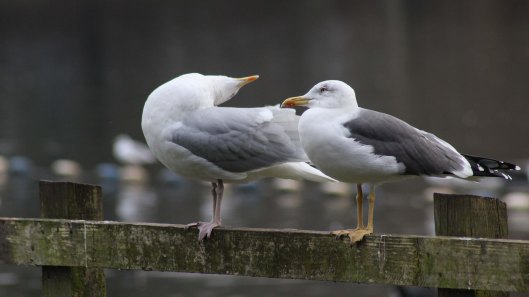
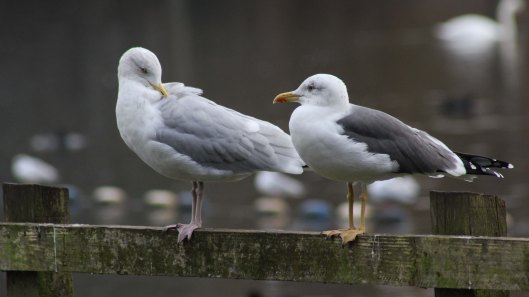
As the Herring gull said to the Lesser Black-backed …

Tags

, , , , ,

171116 gull chat (1)

Herb: “Don’t look now but there’s a human over there with one of those black pointy thingies covering one eye, looking in our direction.”
Alby: “Do you think it’s going to hurt us, Herb? What should we do?”
Herb: “Those things don’t usually hurt. Maybe if we just keep perfectly still, it’ll go away.”

171116 gull chat (2)

Alby: “I think it’s still there. Can you take a look, Herb?”

171116 gull chat (3)

Herb: “Yep, still there. It’s making a clicking noise.”
Alby: “What should we do?”
Herb: “Let’s do something really weird. That might scare it off.”

171116 gull chat (4)

Wild words: Crown shyness

Tags

, , , , ,

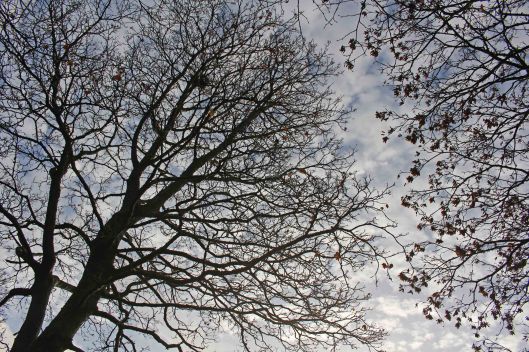
Who would’ve thought that trees value their personal space? Well, they do … or, at least, some trees, particularly those of the same species, do.

Next time you go walking amongst trees, look up and you may notice gaps in the tree canopy, where trees appear to be avoiding touching each other. This phenomenon is known as crown shyness (sometimes also called canopy shyness, intercrown spacing and canopy disengagement). There have been various hypotheses to explain crown shyness: these include ‘reciprocal pruning’ caused by the trees rubbing together in windy conditions; ‘photoreceptor-mediated shade avoidance response’, a long-winded term for trees adapting to the shade caused by their neighbours; and the idea that trees are actively limiting the spread of insects by not touching each other (though, presumably, insects could simply crawl down one tree, across the ground and up the next!). Whatever the true reason, crown shyness can create some lovely patterns in the canopy and I’ll be looking up more often from now on.

171115 crown shyness

Wearing a diadem

Tags

, , , ,

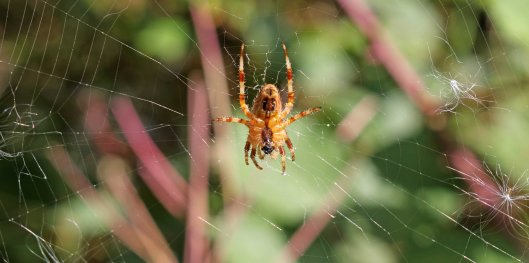
I know a lot of people freak out about spiders but these are not dangerous in any way and they’re incredibly beautiful. They’re Garden spiders (Araneus diadematus), and are also known as Crowned orb weavers, Garden cross spiders and Diadem spiders because of the intricate crown-like patterns on their backs. And it’s those patterns that I want to focus on here.

171113 Araneus diadematus Garden spider (7)

As you can see below, the designs vary from spider to spider, a little like fingerprints and retina patterns in humans. As you can also see, their colours are quite varied, ranging from an orangey brown right through to very dark brown, verging on black. So, next time you spot one of their large webs strung across the plants in your garden, take a closer look … and be amazed.

Autumn leaves, 3

Tags

, , ,

There is so much to love about autumn: it’s as if Nature is an award-winning play, and all the trees are her actors. She’s coming to the end of another successful season, it’s the last grand finale, the players are dressed in magnificent richly coloured costumes ready to take their final bows before a rapturous audience amidst great critical acclaim … and then the curtain comes down for another year.

Gulls are tricksy

Tags

, , , , ,

Gulls were doing my head in earlier this week. A Yellow-legged gull (Larus michahellis) had been reported by local birdwatchers and, as I’d never seen one and the location was on a lovely walking route along the River Taff, I thought I’d go for a look-see. “It was the only large gull on the river so that might help”, said one who had spotted it the previous day. Well, wouldn’t you know it – when I arrived at the site, there were two large gulls there and, to my gull-uneducated eye, they looked very alike.

171111 Yellow-legged gull (2)

The grey back of the Yellow-legged gull is supposed to be somewhere between that of a Herring gull and a Lesser black-backed gull but, when you have neither of those gulls sitting right next to yours to do a comparison and when one of my possibilities was standing in deep shade and the other in full sun, it was almost impossible to see any difference. So, I followed the other advice I’d been given: “Take lots of photos and hope the experts can help you out.” Thanks to those experts, in the South Wales Birding group on Facebook, I can here present to you my first-ever Yellow-legged gull … and I wish you the very best of luck if you’re ever trying to ID one of these for yourself.

171111 Yellow-legged gull (1)

’Tis the time of the thrushes

Tags

, , , , , , , , , ,

Officially, in Britain, the resident true thrushes are the Ring ouzel, Fieldfare, Blackbird, Song thrush, Mistle thrush and Redwing, while other thrush species are occasional, sometimes rare visitors.

171109 Redwing (2)

The thrushes I’ve been noticing most in recent weeks have been the Song thrush, Mistle thrush and Redwing, partly due to their seasonal migration southwards to our ever so slightly milder south Wales climate and partly due to this being prime berry-eating time.

Song thrushes (Turdus philomelos) are resident here all year round, though there is some movement through Britain from Scandinavian birds heading south for the winter.

171109 Mistle thrush (1)

It can sometimes be difficult to distinguish Song from Mistle thrushes (Turdus viscivorus), though the Mistles have a tendency to perch high in the tree tops (or, I discovered, on TV aerials, in urban areas!) and to stand with heads held high when foraging on the ground, and their football-rattle song is unmistakeable. I saw my first Mistle thrushes of the season on 9 October and there are now quite large numbers in local parks and reserves.

171109 Redwing (1)

Redwings (Turdus iliacus) were reported locally in early October but it was the 30th before I caught up with a small flock at Cathays Cemetery in Cardiff, and I’ve since spent several hours following them around the berry trees at Cosmeston, trying to get close enough for photos. They’re easily spooked though so my shots so far have not been that great – I’ll keep trying, and I’ll need to try to find Ring ouzels and Fieldfare as well.

Wild words: Inquiline

Tags

, , , , , , ,

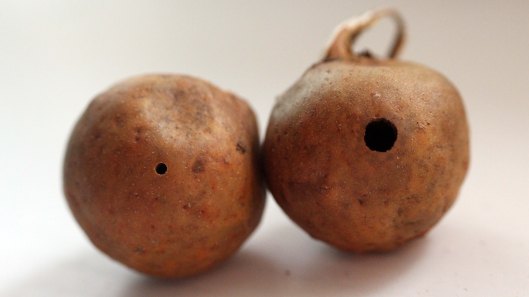
I learnt this word the day a mystery wasp hatched out of an Oak Marble gall I’d brought home. Though I thought it must be the gall-causing wasp, it turned out that it was not and could, in fact, have been any one of 29 other species of hymenoptera that can, potentially, make their home in a Marble gall. According to an article I found on the Natural History Museum website (‘Oak-galls in Britain’ by Robin Williams), 21 of those other gall inhabitants are parasitoid (their larvae consume the original gall wasp’s larvae) and 8 are inquiline, which is to say that they are simply ‘exploiting the living space of another’ creature. And the Oxford Dictionary online actually gives the instance of ‘an insect that lays its eggs in a gall produced by another’.

171108 Oak marble gall inhabitants (1)

Of course, if I’d been smart and compared the size of the holes in other Marble galls I have to that of the newly emerged creature, I would’ve twigged that they must be quite different. I’m afraid my curiosity then got the better of me and I sliced in half one of the Marble galls I had, which means that the little creatures I exposed will not survive. The larva (and large hole) in the centre is the gall wasp Andricus kollari, and the little larvae and holes are representatives of the other 29 possibilities.

Lesson – and new word – learnt, I have now returned to the wild the other various galls, of several kinds, that I’d brought home thinking they were empty, in case they also have little creatures growing inside them!