The tree outside my living room window has been alive with birds lately, and I’ve been hugely entertained watching and listening to them all, but my particular favourite has been this very cute Coal tit fledgling.


12 Saturday Jun 2021
Posted in birds
The tree outside my living room window has been alive with birds lately, and I’ve been hugely entertained watching and listening to them all, but my particular favourite has been this very cute Coal tit fledgling.
05 Saturday Jun 2021
Posted in birds
Tags
birding, birdwatching, British birds, gull chicks, Lesser black-backed gull, Lesser black-backed gull chicks, urban gull chicks
My nearest Lesser black-backed gulls (the ones who’ve featured in many previous blogs, see here and here) were late getting started this year and are still sitting tight.

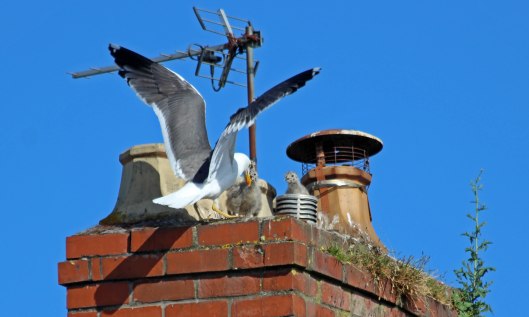
But, down at the end of the lane, in amongst the chimney pots, another regular pair of Lesser black-backed gulls is once again raising a family.

And, when I passed by yesterday, these three youngsters were cheeping up a storm, especially when mum – or dad – returned to feed them.
22 Saturday May 2021
Posted in birds
Dippers are birds I don’t see very often. They’re primarily birds of fast-flowing rivers and, although there are two rivers, the Ely and the Taff, within walking distance of my home, where they flow in to Cardiff Bay neither river has the boulders or rocks Dippers like to use to launch themselves into the water.

So, it was a delight to hear a Dipper calling in the River Rhymney during Wednesday’s walk in the Welsh valleys and then, on peering down into the river, to see not only an adult bird, which flew off upstream, but also to spot and then watch this adorable fledgling, which was already practising the bobbing motion these birds are known for.


20 Thursday May 2021
These three juvenile Carrion crows were keeping incredibly quiet – in fact, two were mostly snoozing – so it was just good luck that I happened to look up into their tree and spot them.

Their parents were in a neighbouring area of wasteland, foraging for food – a full-time job with three hungry beaks to fill. The juveniles look close to fledging so I’m picking they’ll have moved out by the time I next walk this way.

13 Thursday May 2021
Tags
bird migration, birding, birdwatching, British birds, Cardiff Bay birding, Cardiff Bay birds, Dunlin, spring migration
Though I live near the sea, I don’t get to see Dunlin very often as the coastline near me is mostly cliffs and rocks, not the stretches of mud or sand these little waders can easily feed on.

So, it was a real treat during Monday’s walk around Cardiff Bay to see this single Dunlin foraging on the edge of the Barrage.

Flocks of Dunlin, and other waders, pass along our shoreline at this time of year on their way to their breeding grounds and, very occasionally, drop in briefly to feed, as this one was. And to have a good scratch …

After taking several photos, I left the bird in peace to forage further, grateful for the birding treat!

10 Monday May 2021
Tags
baby birds, birding, birdwatching, British birds, cygnets, Mute swan, swan with cygnets, Ugly duckling fairytale
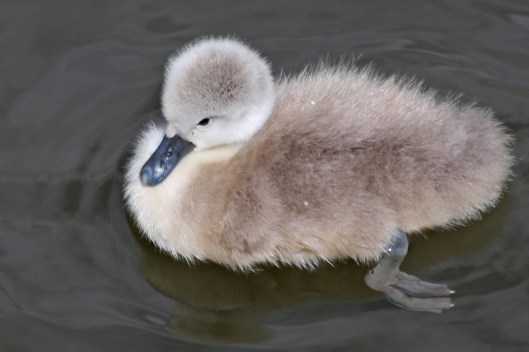
Seeing these gorgeous little balls of fluff made my day! I’d been watching these Mute swans for several weeks, building their nest, then sitting on eggs, so it was a real delight to see the proud parents gently shepherding their newly hatched brood around a local river inlet on Thursday.


08 Saturday May 2021
Posted in birds
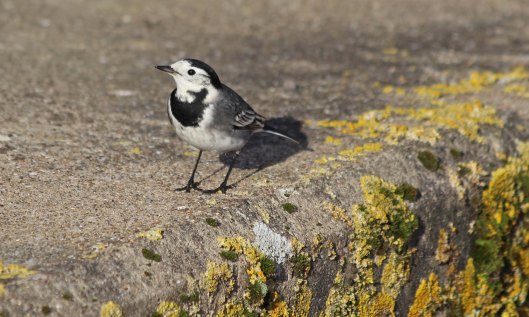
When I read Skomer Island’s Twitter post giving the Welsh name for the Pied wagtail, I just had to share it and, of course, some of the many photos I’ve been accumulating of these little cuties. And that Welsh name? Sigl-di-gwt which, apparently, means ‘Shake-yer-bum’. Just perfect!



05 Wednesday May 2021
Tags
bird migration, birding, birdwatching, British birds, Cardiff Bay birding, spring migration, Yellow wagtail
I’ve only seen Yellow wagtails a couple of times and never locally so, when they were reported flitting about Cardiff Bay, I went walking that way. On my first walk past where they’d been reported, I couldn’t find any – I dipped as they say in birder speak, and I’ve been dipping a bit lately so didn’t bother trying again the next day.
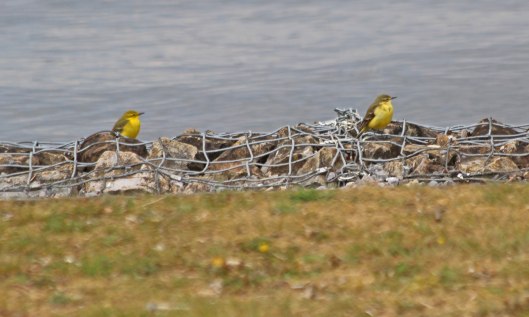
Then, last Friday, I thought I’d pop over to the wetlands reserve to see if I could find any Sedge warblers to photograph. Those birds were being very vocal though visually elusive but then I spotted a couple of birders I know who were obviously looking at something interesting. Turns out, it was a Whinchat, my first of the year – good news! – and then both chaps said they’d seen more Yellow wags that morning, dotting around the grassy areas on the Barrage.

So, a quick change of plan saw me strolling in that direction and, remarkably, the birds were still there. Four gorgeous little bursts of vibrant yellow, easily disturbed by walkers and dogs, but I managed to get some quality watching time and a few distant photos before they headed off over the water. Magic!
03 Monday May 2021
Last Thursday’s walk was very similar to walks I’ve written about previously (a Superb Sully stroll, 23 April 2019, and The Whimbrel and the Barwit, 30 April 2017), and the reason I repeat the walk, sometimes several times, at this time of year is hopefully to catch sight of migrating Whimbrel (and Bar-tailed godwit).
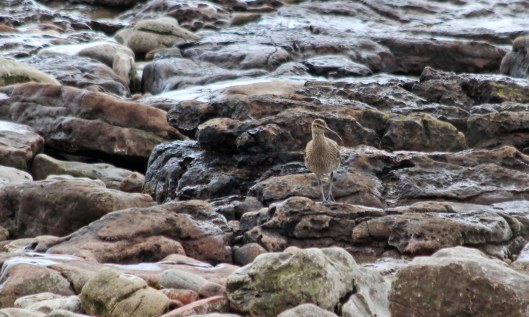
A local birding friend had reported sightings, and the tide was right – as the Bristol Channel has the second highest tidal range in the world, it’s best to look over high tide so the birds are relatively close to the coastal path.
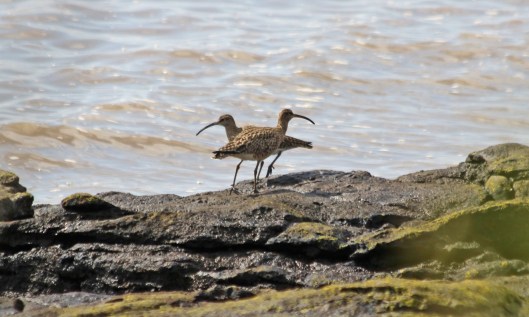
And I was lucky to see several Whimbrel. There were perhaps six or seven birds but I’m not sure of the exact number, as they were quite flighty, and would head off along the beach when disturbed by people and their dogs walking along the path and the rocks.
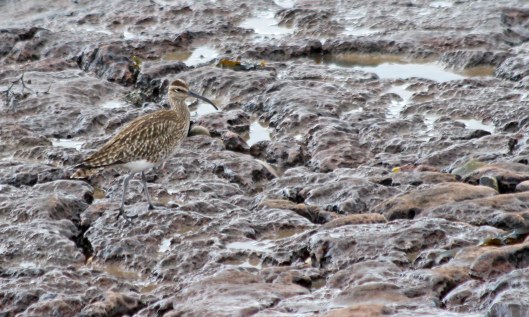
These birds are part of the annual migration, seen locally during April and May, when Whimbrel that over-winter in West Africa move through to their breeding grounds in more northerly latitudes (according to the Bird Guides website, Iceland, Scandinavia, the Faroes and Shetland are their likely breeding locations.)
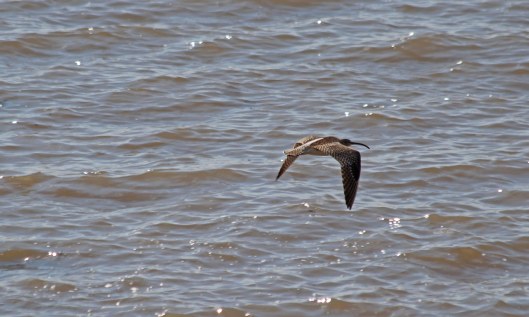
29 Thursday Apr 2021
I love the wonderful variety of vernacular names that have been given to the Whitethroat (Sylvia communis), local references to the bird’s love of hedgerows and bramble patches and farm fields, and its rasping singing style, and its plumage.

Flora Britannica lists the following, amongst many others: Beardie (Scotland) and Wheetie whey beard (Angus); Blethering tam (Scotland); Charlie muftie (Northamptonshire) and Muffit (Stirlingshire); Nettle creeper (North Yorkshire); Hay jack (Norfolk) and Haysucker (Devon) and Hedge chicken (Shropshire).

Flora Britannica also notes how fragile British bird populations can be: ‘There was a dramatic fall in numbers of Whitethroats after 1968, which was traced to severe drought in the southern Sahara and the death of large numbers of migrating birds which used up their fat reserves on their journey from further south in Africa’. Judging by the volume of ‘blethering’ I’m hearing in local parks and fields, the Whitethroat population has recovered well from that setback in the ‘60s but, given the global climate emergency, the future of all our beautiful birds is uncertain.

 earthstar
You must be logged in to post a comment.