• ABOUT
  • BIRDING 2018
  • Birding 2019
  • BLOG POSTS
  • Butterflies 2018
  • Resources

earthstar

~ a celebration of nature

earthstar

Tag Archives: birding

Birding in Barry

12 Monday Mar 2018

Posted by sconzani in birds, nature

≈ 2 Comments

Tags

Barry, Barry Docks, Barry Old Harbour, birding, birdwatching, British birds, Curlew, Great Crested Grebe, Med gull, Mediterranean gull, Oystercatcher, Redhsank, Shelduck

The south Wales town of Barry is not exactly what you’d call a prime birding destination but, due to its coastal location, it does turn up regular wader sightings and the occasional rarity. On this visit, I dipped on my target species, the Great northern diver that’s been overwintering in Barry Docks – I saw the bird last year but want to add it to this year’s list – but I still had an enjoyable day’s birding, with a few nice surprises.
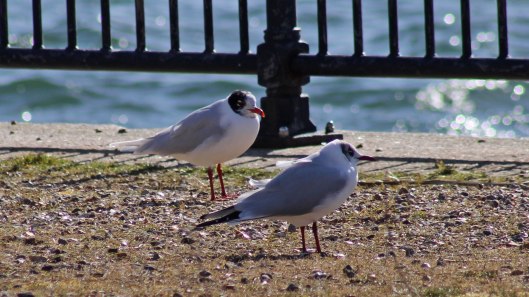
180312 Med & black-headed gulls

First up at Barry Docks was the local Mediterranean gull. For those unfamiliar with this bird, you can see some of the differences between it and Black-headed gulls in this photo – in breeding season, the hood on the head of the Med gull covers its entire head and is a true black (not a chocolate brown hood on just the front half of the head), its beak and legs are different, and it has white wing tips.
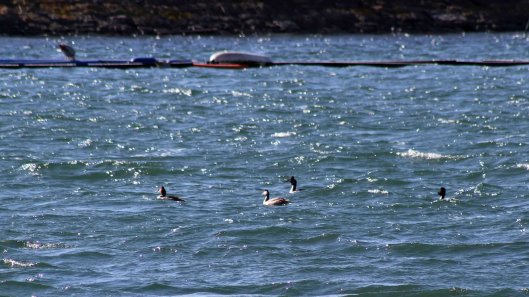
180312 Great crested grebes

Four Great crested grebes were braving the choppy waves being whipped up by the strong sou’westerly wind.
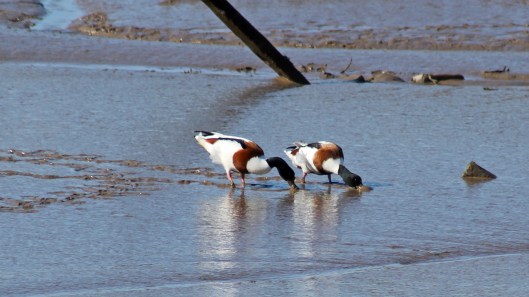
180312 Shelducks

In Barry Old Harbour, two Shelducks were hoovering the mud for small shellfish and aquatic snails.

180312 Redshanks

At least eight Redshanks were prospecting amongst the salt marsh and along the silty rivulets.
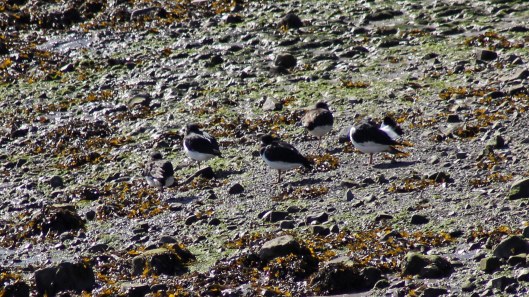
180312 Oystercatchers

Sitting down, five Oystercatchers were so well camouflaged as to be almost invisible, until they got up and one set them all off singing out their characteristic call.
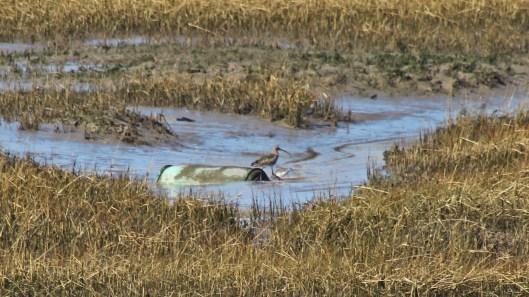
180312 Curlew (1)

The day’s pièce de résistance was the sight of two Curlews prospecting for a late lunch amongst reeds and under rocks. At first, I thought I had the two Black-tailed godwits reported earlier in the week but no, those bills were definitely curved. A nice sighting just the same!

180312 Curlew (2)

Like Loading...

Birding in the Forest of Dean

10 Saturday Mar 2018

Posted by sconzani in birds, nature, walks, winter

≈ 2 Comments

Tags

birding, birdwatching, Cannop Ponds, Forest of Dean, Glamorgan Bird Club, Great grey shrike, Hawfinch, Mandarin duck, snow

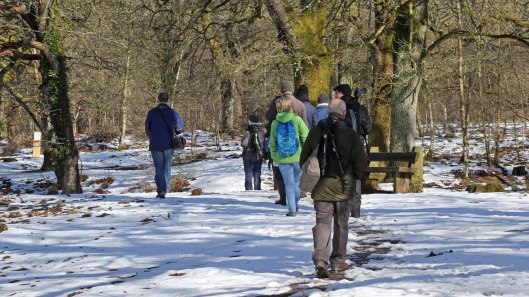
For my latest birding adventure, I joined 21 other members of the Glamorgan Bird Club and ventured across the border to England, to explore birding sites in the beautiful Forest of Dean, where the glorious tree-clad countryside was made even more lovely by the covering of snow that still lingered from the previous weekend’s weather bomb.

180310 snowy landscape (2)

The snow also meant two of the car parks we tried were closed and necessitated a long stomp along the forest trails to the viewpoint where we could search the skies for Goshawk – unfortunately, the birds weren’t seen, but what a wonderful walk it was! There’s just something about that snow-white coating that makes a landscape look magical.

180310 Cannop Ponds (1)180310 Cannop Ponds (2)

But I’m getting ahead of myself. We started off at Cannop Ponds, where I got my first sight of Mandarin ducks in the wild. These stunning birds are native to Asia – and I had first seen them in a bird park in Kuala Lumpur – but escapees from parklands and zoos have established breeding populations in Britain and, in 1971, the bird was added to the official British bird list, under category C1 (although introduced, the birds now derive from the resulting self-sustaining populations).

180310 Mandarin & other ducks (1)180310 Mandarin & other ducks (3)

At the ponds we also enjoyed good views of a resident Marsh tit before heading off along the forest trails. In a large clearing, one of our eagle-eyed younger members spotted another of our target birds for this trip, the Great grey shrike. Using bins and ’scopes we were able to watch the bird catch a tiny lizard and, its trademark action, impale its prey on a sharp twig.

180310 snowy landscape (1)180310 Great grey shrike

After our Goshawk-less stomp to New Fancy viewpoint, we returned to the cars and drove on to Parkend, where the local Hawfinches proved more cooperative, obliging with distant but dark views under the conifers by the cricket ground. They were the icing on the cake of another thoroughly enjoyable outing with my bird club buddies.

180310 Hawfinch

My list of species sighted is as follows: Mute Swan, Greylag Goose, Mandarin Duck, Gadwall, Teal, Mallard, Tufted Duck, Little Grebe, Cormorant, Buzzard, Moorhen, Coot, Lesser Black-backed Gull, Woodpigeon, Great Spotted Woodpecker, Great Grey Shrike, Magpie, Jay, Carrion Crow, Raven, Blue Tit, Great Tit, Coal Tit, Marsh Tit, Long-tailed Tit, Goldcrest, Nuthatch, Treecreeper, Blackbird, Robin, Dunnock, Chaffinch, Goldfinch, Siskin, and Hawfinch. And I was obviously not paying attention when others in the group saw (or heard) the Grey Heron, Stock Dove, Jackdaw, Mistle Thrush, Grey Wagtail, Greenfinch, and Bullfinch.

180310 Mandarin & other ducks (2)180310 Mandarin & other ducks (4)

Like Loading...

Fieldfares and Redwings

08 Thursday Mar 2018

Posted by sconzani in birds, nature, weather, winter

≈ 6 Comments

Tags

#StormEmma, #TheBeastfromtheEast, birding, birdwatching, British birds, cold weather effect on birds, Fieldfare, Green woodpecker, Redwing, Song thrush, thrushes

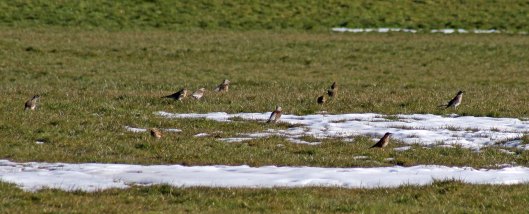
Nature’s cold weather events may be lovely to look at – and I freely admit that, as a Kiwi unused to snow, I absolutely loved the heavy snow we had last week as a result of ‘The Beast from the East’ and Storm Emma – but such events come at a high cost, particularly to wildlife. The extreme cold and gale-force easterlies blew across from Europe thousands of Fieldfares and Redwings, and displaced a myriad of other birds: Golden plovers and Lapwing, Woodcocks and Snipe were all reported in parklands and farmers’ fields, all desperately looking for food.

180308 Fieldfare & Redwing

180308 Redwing (1)
180308 Redwing (2)

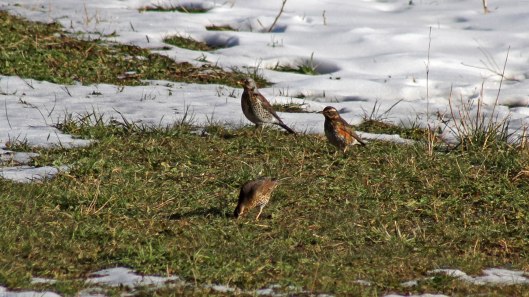
I’d not seen many Fieldfares before this storm hit but a walk around local parks and Cardiff Bay on Sunday and Monday gave me the opportunity to see large numbers of them and Redwings.

180308 Fieldfare Redwing Green woodpecker

In Penarth Marina Park, I spotted five of Britain’s six thrush species grazing (Song thrush, Mistle thrush, Blackbird, Redwing and Fieldfare) (accompanied by a Green woodpecker), and in trees alongside the River Taff, I got my closest views yet of Fieldfare – such beautiful markings.

180308 Fieldfare Redwing Song thrush180308 Fieldfare

Let’s hope they now have the strength to head back to where they came from and that the cold blast won’t have any long-term effects on their populations.

Like Loading...

Wild words: preen

07 Wednesday Mar 2018

Posted by sconzani in birds, nature

≈ 2 Comments

Tags

#WildWords, birding, birdwatching, British birds, preen, preening, wild words

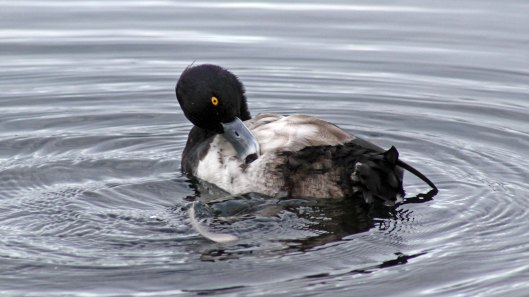
Preen: verb; (of birds) to maintain (feathers) in a healthy condition by arrangement, cleaning and other contact with the bill (Collins Concise Dictionary).
Interestingly, one dictionary said it also related to animals tidying and cleaning their fur with their tongue, but I’ve never heard the word used that way. Information as to the word’s origins varies according to which dictionary you consult – the Collins says it first appeared around the 14th century and probably comes from prunen, thence preinen, meaning to stab, pierce or prick, referring to the action of the bird’s bill when preening.

180307 preen (1)

Preening is an extremely important action for birds, to keep their feathers in the correct position for flight and for the preservation of body heat; to clear away dirt and parasites; to assist with the process of moulting; and, in those birds that have a uropygial gland, to maintain their waterproofing by spreading oil from the gland over and through their feathers.

180307 preen (2)180307 preen (3)

180307 preen (4)

‘Who’s preening?’

Like Loading...

Glamorgan swift champions

05 Monday Mar 2018

Posted by sconzani in birds, nature

≈ 2 Comments

Tags

birding, birdwatching, British birds, Glamorgan Swift Project, nest boxes for swifts, Penarth swift champions, Swift, Swift nest boxes, Trinity Church Penarth, Trinity Methodist Church

As you all know, I’m a very keen birder and member of the Glamorgan Bird Club. A couple of months after I moved here to Penarth, I was delighted to hear Swifts screaming almost daily in the sky above my flat, and to see them practising their aerial acrobatics when I was out walking in the local area. I was aware that Swifts are an endangered species – in the last 30 years, numbers in Glamorgan have declined by 50% – and wondered what I might do to help. Here’s what happened:

11 June 2017 While on a club outing, I got chatting to Alan Rosney, the bird club’s committee member who co-ordinates the Glamorgan Swift Project. I mentioned that I heard the birds screaming overhead a lot and that there was a church across the road from me (the Trinity Methodist Church), with a tower that might be a possibility for some nest boxes. The next day I emailed Alan the church’s details so he could check it out and follow up if he thought it a possibility.

180305 Swifts Trinity (1)

19 July 2017 Alan paid a visit to the folks at Trinity Church, to discuss the plan.

7 August 2017 A positive response from the church – the boxes could go ahead, ready for the following year’s return of the Swifts.

180305 Swifts Trinity (2)
180305 Swifts Trinity (3)

29 September 2017 Alan and other project members visited the church to check where the nest boxes might be located and for Howard, the box builder and installer, to measure up.

180305 Swifts Trinity (4)
180305 Swifts Trinity (5)
180305 Swifts Trinity (6)

23 February 2018 Installation day, and Alan invited me along to see the result of my original suggestion. I had a lovely chat with Julia and Ian, other keen birders involved in the project, and with Chris, the church’s representative, and got to see inside the church tower but there was no way I was venturing up that ladder.

180305 Swifts Trinity (7)

So the boxes are in, but there was an issue with the speaker system so that will be installed in late April / early May, ready to call the Swifts to come a’nesting. The speakers are set on a timer system to play the sound of screaming Swifts, in the mornings and evenings, to try to entice the birds to use the boxes. Of course, the birds might not oblige – we can but keep our fingers crossed that they’ll take a fancy to their new accommodation. The day they traditionally return to Britain is May the 4th so, little Swifts, I’ll be looking out for you from my living room window, and may the fourth be with you!

180305 Swifts Trinity (8)

Like Loading...

February at Cosmeston

04 Sunday Mar 2018

Posted by sconzani in birds, nature, parks, walks, winter

≈ 2 Comments

Tags

birding, birdwatching, British birds, Buzzard, chaffinch, Cosmeston, Cosmeston Lakes Country Park, Great tit, Lesser redpolls, Malard, nuthatch, Redpoll, Redwing, Reed bunting, treecreeper, Tufted duck

180304 180202 (1) nuthatch

2 February A stride was required so I passed through Cosmeston as part of a longer walk. I did, as always, keep an eye out for unusual birds, though the only bird that fitted that category was a Buzzard in a tree by the dipping pond, exactly where a friend had reported it the previous day.

180304 180202 (2) buzzard

I scattered some seed around for my small and hungry feathered friends, and I did linger a while by the lake to take some photos of gulls. (I’m attempting to learn to recognise gulls of different ages but I’ll post separately about that when I’ve got more photos and information.)

180304 180202 (3) great tit

4 February There are various routes I can take when I walk to Cosmeston; on this day I approached from the north, which produced a couple of Bullfinches near Old Cogan Farm and, further down Mile Road, a couple of Redwing feasting on ivy berries.

180304 180204 redpoll (1)
180304 180204 redpoll (2)
180304 180204 redpoll (3)
180304 180204 redpoll (4)
180304 180204 redpoll (5)
180304 180204 redpoll (6)

To escape the Sunday crowds, I headed off piste and almost immediately spotted a Green woodpecker and, seeing it fly to the ground, started stalking it. It flew off but then a mixed flock of tits and finches flew in, amongst which, to my very great delight, were 3 Lesser redpolls, a bird I’ve only seen once before and which is not often seen in these parts. They were feeding in an alder tree, moving often, doing acrobatics while suspended from cones, flitting from branch to branch, all of which made them difficult to photograph. But what a delightful 30 minutes I spent watching their antics.

180304 180209 redwing
180304 180209 reed bunting

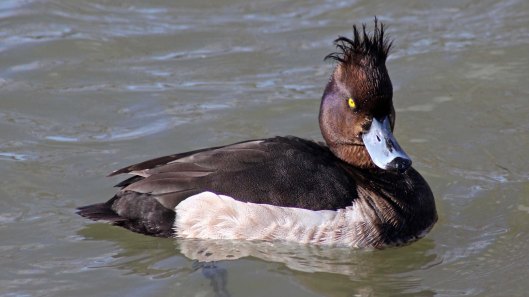
9 February I was hoping to spot the Redpolls again today but lucked out, though I did spot a flock of perhaps 8 Redwings in the trees nearby. A handsome male Reed bunting was enjoying the seed a kind passerby had left on a fence post by the west lake, and it wasn’t just me who was finding the winds strong and gusty – this Tufted duck was having a bad hair day.

180304 180209 tufted duck

21 February This was school half-term holiday week in Wales, not a particularly pleasant time to visit a country park to enjoy the delights of nature as the parks are usually full of screaming children and frazzled parents at such times. I managed to avoid most of that by taking the paths less travelled but still found much of the wildlife was being scared away by the noise.

180304 180221 fleeing the noise (1)
180304 180221 fleeing the noise (2)

Still, I thought I’d make a list of what I did see: Great tit, Blackbird, Dunnock, Robin, Magpie, Goldfinch, Redwing, Carrion crow, Jay, Wren, Blue tit, Buzzard, Jackdaw, Long-tailed tit, Woodpigeon, Mistle thrush, Chaffinch, House sparrow, Starling, Green woodpecker, Reed bunting, Nuthatch, Coal tit, Coot, Cormorant, Mute swan, Black-headed gull, Lesser black-backed gull, Herring gull, Mallard, Tufted duck, Great crested grebe, Canada goose, Greylag goose and Pochard – not a bad list, with 35 bird species, and just one mammal, the ubiquitous Grey squirrel.

180304 180228 treecreeper

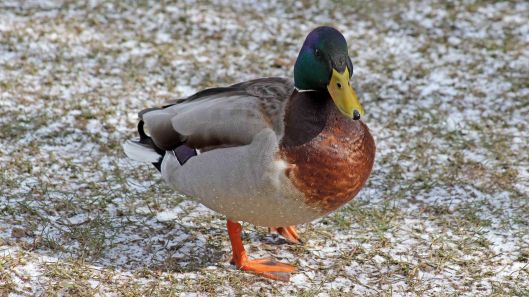
28 February South Wales was feeling the brunt of the ‘Beast from the East’, a freezing weather bomb from Siberia, when I paid my last February visit to Cosmeston so it was a short visit, partly for the exercise and I also bought a couple of bags of seed from the Rangers’ Office to feed the birds. You know they’re finding foraging tough when you see a Treecreeper come to the bird feeder – most unusual! And it was also unusual to have the sparse remnants of the previous day’s snow on the ground, so I had to get a few photos of birds (Chaffinch and Mallard) in snow as well. Let’s hope spring (re)appears soon.

180304 180228 chaffinch180304 180228 mallard

Like Loading...

February on the Ely embankment

03 Saturday Mar 2018

Posted by sconzani in birds, nature, walks, winter

≈ Leave a comment

Tags

birding, birdwatching, British birds, Coot, Ely embankment, Grey wagtail, Redshank, Rock pipit, Turnstone

My first February wander alongside the River Ely was in the late afternoon of Saturday the 3rd. It was quiet – were the birds all watching Wales thump Scotland in the 6 Nations rugby, I asked myself? A faint peep alerted me to a Rock pipit tootling along the embankment path towards me. It had been minding its own business, looking for a lunchtime snack, when it suddenly realised there was a stonking great human standing on the path in front of it … at which point it flew off to the relative safety of the water’s edge.

180303 180203 rock pipit (1)180303 180203 rock pipit (2)180303 180203 rock pipit (3)

Shortly afterwards, I could see a roundish form that might’ve been a rock but was, in fact, a Turnstone, the only one seen that day. And, as well as those two birds, one Pied wagtail and two Grey wagtails were in residence. One of the Greys had an interesting plumage aberration, as you can see below.

180303 180203 Grey wagtail (1)
180303 180203 Grey wagtail (2)

I was away for a week mid February so my next visit to the embankment was on Tuesday 20 February. A strong cold wind was blowing small waves on to the stony shore and, initially, there were no birds to be seen. But, about half way along the embankment path, I spotted a huddle of seven Turnstones, looking sleepy, enjoying a little bit of warmth from a shaft of sunlight that had reached their roosting spot from between the nearby houses. And, a minute or two later, I noticed one further Turnstone who was already meandering along, turning stones as it searched for breakfast bugs. Two Grey wagtails, hardy creatures, were also dotting about.

180303 180220 turnstones

The twenty-seventh of February was a bitterly cold day, as Britain was in the grip of a severe blast of polar weather, blown across Europe from Siberia, and even Cardiff had a few snow showers that day (quite unusual in recent years). Hopefully, the birds had found somewhere more sheltered than the embankment, as the stiff easterly was so cold that icicles were forming on branches that littered the shoreline and there was a slab of ice at least a foot wide coating the rocks along the water’s edge.

180303 180227 (3) turnstone180303 180227 (2) coot

In spite of those bitter conditions, I spied one Grey wagtail, one Turnstone, a pair of Coots, and a solitary Redshank. It made me feel cold just looking at that lovely bird standing in the icy water!

180303 180227 (1) redshank

Like Loading...

Birding at Dryslwyn, Cilsan Bridge and Tregaron Bog

02 Friday Mar 2018

Posted by sconzani in birds, nature, walks, winter

≈ 3 Comments

Tags

birding, birdwatching, British birds, Cors Caron, Dryslwyn Castle, Glamorgan Bird Club, Green sandpiper, Lapwing, Red kite, Tregaron Bog, Tywi Valley, Whooper swan

Up at 6, collected at 7 and off we headed, west along the M4 for a 9 o’clock meet up with our other Glamorgan Bird Club buddies at the foot of Dryslwyn Castle in mid Wales. This was unexplored territory for me and the scenery of the Tywi (or Towy) Valley was simply stunning, with castles and monuments seemingly on every hill top and the beautiful River Tywi meandering through the valley below them. It was clear but cold, with a bitter wind, and heavy frost and thick ice still blanketing those spots the sun could not reach. Later, we moved on to Tregaron Bog, also known as Cors Caron National Nature Reserve, a fabulous area of marsh and wetland. And what a superb day’s birding we had!

180302 Tywi Valley (1)

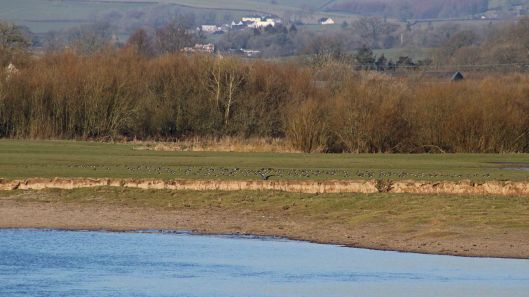
A large flock of Lapwing on the fields next to the River Tywi, and a Grey heron flying in.

180302 Tywi Valley (2)

Ducks, geese and Little grebes in the river.

180302 Tywi Valley (3)

A Red kite looks for lunch from its perch on this big old dead tree.

180302 Tywi Valley (4)

Looking towards Dinefwr Castle, with two swans flying off (possibly Mute but we also saw Whooper).

180302 Tywi Valley (5)

A thrush checks through a mole hill for potential food.

180302 Tregaron Bog (1)

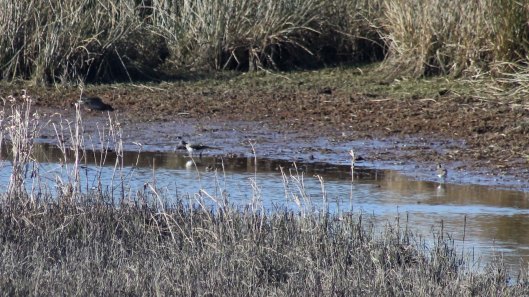
Too distant for clear shots, two Green sandpipers (and a Teal), from one of the hides at Tregaron Bog.

180302 Tregaron Bog (2)

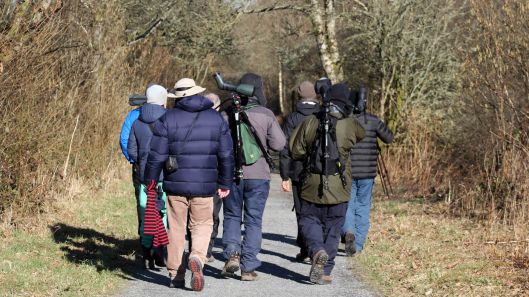
Intrepid birders, well rugged up against the chill.

180302 Tregaron Bog (3)

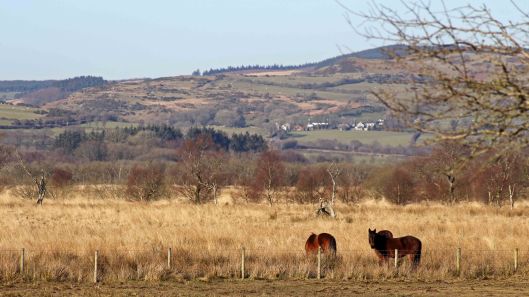
Beautiful countryside around Tregaron Bog, where grazing ponies help to manage the wetland environment.

180302 Tregaron Bog (4)

A Red kite; one of several seen this day and spectacular birds to watch.

My species list for the day was: Mute Swan, Whooper Swan, Pink-footed Goose, Greylag Goose, Canada Goose, Wigeon, Teal, Mallard, Goosander, Little Grebe, Grey Heron, Great White Egret, Little Egret, Cormorant, Red Kite, Hen Harrier, Buzzard, Lapwing, Snipe, Curlew, Green Sandpiper, Black-headed Gull, Herring Gull, Lesser Black-backed Gull, Woodpigeon, Great Spotted Woodpecker, Magpie, Jackdaw, Carrion Crow, Raven, Blue Tit, Great Tit, Coal Tit, Wren, Treecreeper, Starling, Blackbird, Fieldfare, Song Thrush, Redwing, Mistle Thrush, Robin, Stonechat, Dunnock, House Sparrow, Tree Sparrow, Pied Wagtail, Chaffinch, Goldfinch and Bullfinch. A further 7 species were seen by other members of our group but not by me: Peregrine, Common Gull, Rook, Long-tailed Tit, Goldcrest, Nuthatch, and Greenfinch.

Like Loading...

Rye birds

27 Tuesday Feb 2018

Posted by sconzani in birds, nature, seaside, weather

≈ Leave a comment

Tags

birding, birdwatching, British birds, Cormorant, Great black-backed gull, Lapwing, Redshank, Rye Harbour Nature Reserve, shoveler, Wigeon

My original title for this blog was ‘A mad Kiwi and an Englishwoman go birding in a howling gale’. I decided that was a trifle long but it was certainly an accurate reflection of our day at Rye Harbour Nature Reserve. Nevertheless, we persevered, though we did put off walking the beach-top path – I think we would’ve been blown all the way back to Rye township if we’d tried that.

180227 Rye Harbour birds (4)

As you might expect, the birds were mostly hunkered down, sheltering where possible behind clumps of grass or huddled alongside sandy banks. Still, with brief stops here and there to scan the shingle and reeds with constantly watering eyes through fogging-up binoculars and short pops into hides (as much to warm up as to look out), we managed to clock up a total of 35 species. They were: Kestrel, House sparrow, Herring gull, Lesser black-backed gull, Black-headed gull, Mallard, Shelduck …

180227 Rye Harbour birds (3)

Shoveler (above, seen through a netting fence), Brent goose …

180227 Rye Harbour birds (5)

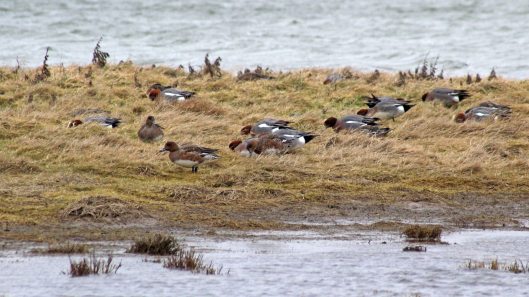
Wigeon (those handsome birds above), Oystercatcher, Carrion crow, Tufted duck …

180227 Rye Harbour birds (1)

Redshank (always a favourite of mine), Coot …

180227 Rye Harbour birds (6)

Cormorant (already beginning to nest in trees near Castle Water) …

180227 Rye Harbour birds (2)

Great black-backed gull and Lapwing (both above), Little grebe, Mute swan, Teal, Little egret, Goldfinch, Woodpigeon, Blackbird, Green woodpecker, Great tit, Coal tit, Magpie, Mistle thrush, Pied wagtail, Greylag goose, Egyptian goose, Pheasant, and Starling.

Like Loading...

The 18-buzzard bus

26 Monday Feb 2018

Posted by sconzani in animals, birds, nature

≈ 4 Comments

Tags

birding, birdwatching, British birds, Buteo buteo, Buzzard, killing time on bus journeys

What do you do to help pass the time on a long bus journey? Read, sleep, listen to music, do crosswords or puzzles? I had taken along my knitting for the three-and-a-half-hour bus ride from Cardiff to London, but I didn’t knit a single stitch.

180226 buzzards (1)
180226 buzzards (2)

I spent the 15 minutes waiting for the bus watching the earth of a molehill moving as the little mole tidied up its tunnel (and, of course, I was hoping it might poke its head out, but no such luck). And, once we were underway, we hadn’t cleared Cardiff’s suburbs before I spotted my first buzzard hovering over a park so, after that, I decided to abandon my knitting and keep my eyes on the countryside that was whizzing past outside the window.

180226 buzzards (5)

And what did I see? My list reads as follows: Lesser black-backed gulls, Herring gulls and Black-headed gulls, Carrion crows, Robins, Jackdaws, Pied wagtails, Feral and Woodpigeons, Magpies, Starlings, Mallards and Mute swans, Mistle thrushes and Blackbirds, a Rookery, lots of rabbits and Pheasants, and two small groups of deer, plus, of course, the 18 Buzzards alluded to in the title of this blog. I was very impressed to see so many of them.

180226 buzzards (3)
180226 buzzards (4)
Like Loading...
← Older posts
Newer posts →

About me

sconzani

sconzani

I'm a writer and photographer; researcher and blogger; birder and nature lover; countryside rambler and city strider; volunteer and biodiversity recorder.

View Full Profile →

Follow earthstar on WordPress.com

Enter your email address to follow this blog and receive notifications of new posts by email.

Recent blog posts

  • A female Tawny April 21, 2026
  • NFY: Orange-tip April 20, 2026
  • All the yellows April 19, 2026
  • Spider: Dysdera crocata April 18, 2026
  • Recent Reed buntings April 17, 2026

From the archives

COPYRIGHT

Unless otherwise acknowledged, the text and photographs on this blog are my own and are subject to international copyright. Nothing may be downloaded or copied without my permission.

Fellow Earth Stars!

  • Unknown's avatar
  • Unknown's avatar
  • Unknown's avatar
  • Unknown's avatar
  • Unknown's avatar
  • Unknown's avatar
  • Unknown's avatar
  • Unknown's avatar
  • Unknown's avatar
  • Unknown's avatar
  • Unknown's avatar
  • Unknown's avatar
  • Unknown's avatar
  • Unknown's avatar
  • Unknown's avatar
  • Unknown's avatar
  • Unknown's avatar
  • Unknown's avatar
  • Unknown's avatar
  • Unknown's avatar
  • Unknown's avatar
  • Unknown's avatar
  • Unknown's avatar
  • Unknown's avatar
  • Unknown's avatar
  • Unknown's avatar
  • Unknown's avatar
  • Unknown's avatar
  • Unknown's avatar
  • Unknown's avatar
  • Unknown's avatar
  • Unknown's avatar
  • Unknown's avatar
  • Unknown's avatar
  • Unknown's avatar
  • Unknown's avatar
  • Unknown's avatar
  • Unknown's avatar
  • Unknown's avatar
  • Unknown's avatar
  • Unknown's avatar
  • Unknown's avatar
  • Unknown's avatar
  • Unknown's avatar
  • Unknown's avatar
  • Unknown's avatar
  • Unknown's avatar
  • Unknown's avatar
  • Unknown's avatar
  • Unknown's avatar

Blog at WordPress.com.

Privacy & Cookies: This site uses cookies. By continuing to use this website, you agree to their use.
To find out more, including how to control cookies, see here: Cookie Policy
  • Subscribe Subscribed
    • earthstar
    • Join 642 other subscribers
    • Already have a WordPress.com account? Log in now.
    • earthstar
    • Subscribe Subscribed
    • Sign up
    • Log in
    • Report this content
    • View site in Reader
    • Manage subscriptions
    • Collapse this bar
 

Loading Comments...
 

You must be logged in to post a comment.

    %d