• ABOUT
  • BIRDING 2018
  • Birding 2019
  • BLOG POSTS
  • Butterflies 2018
  • Resources

earthstar

~ a celebration of nature

earthstar

Tag Archives: British aphids

Aphid: Eriosoma lanigerum

01 Monday Dec 2025

Posted by sconzani in insects, plants, trees

≈ 2 Comments

Tags

American blight, aphid, aphids on Apple trees, aphids on Firethorn, aphids on Pyracantha, British aphids, Eriosoma lanigerum, galls on Firethorn, galls on Pyracantha, Woolly apple aphid

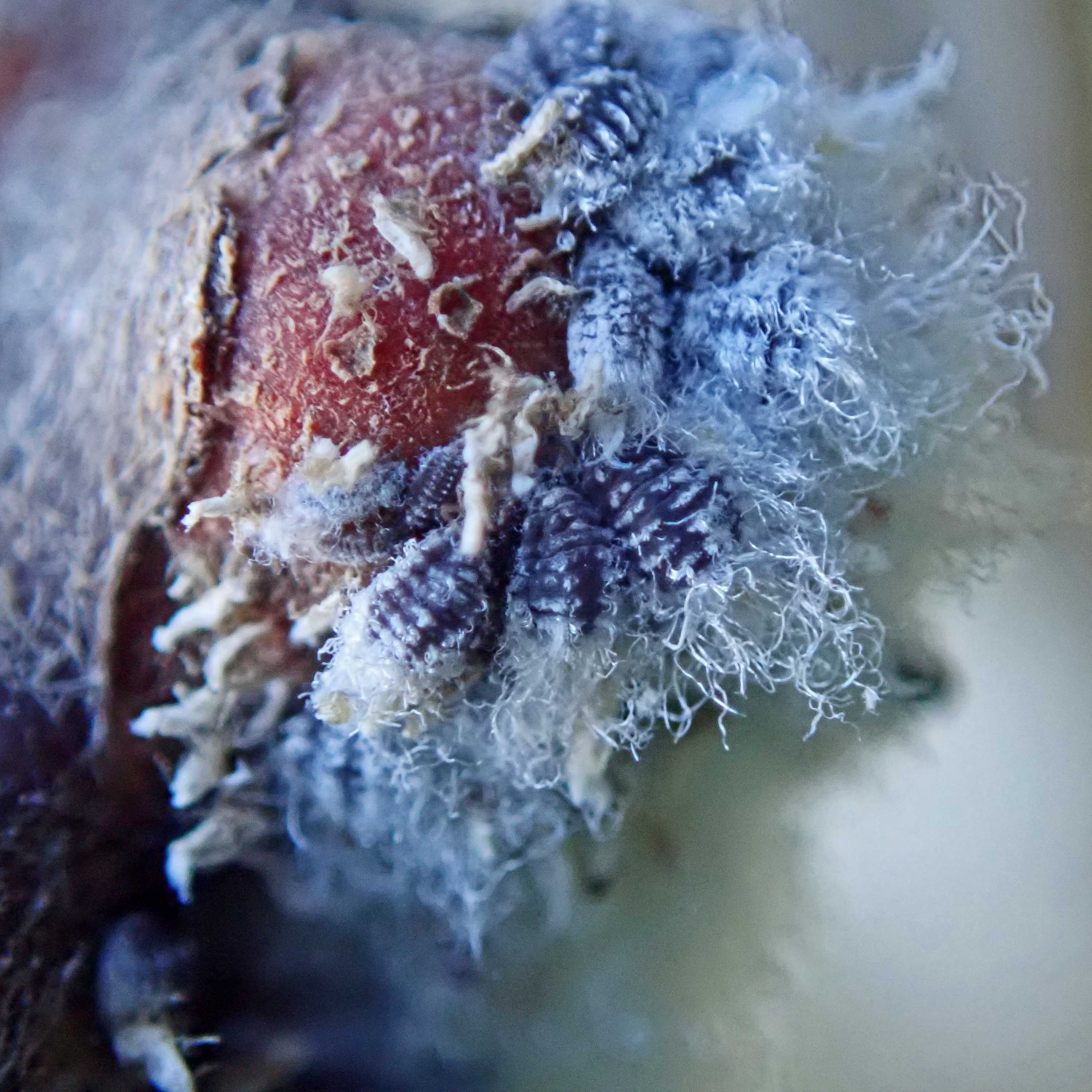
When I set out on my walk last Saturday, I wasn’t intentionally targeting aphids but up they popped. At this first location I wasn’t completely certain that what I saw was caused by aphids but, as soon as I poked one of the fuzzy white lumps on this Firethorn (Pyracantha species) and my finger came away stained red, I knew I’d just inadvertently squashed an aphid (this has happened to me before when I grabbed a willow branch without noticing the aphids perched on it).
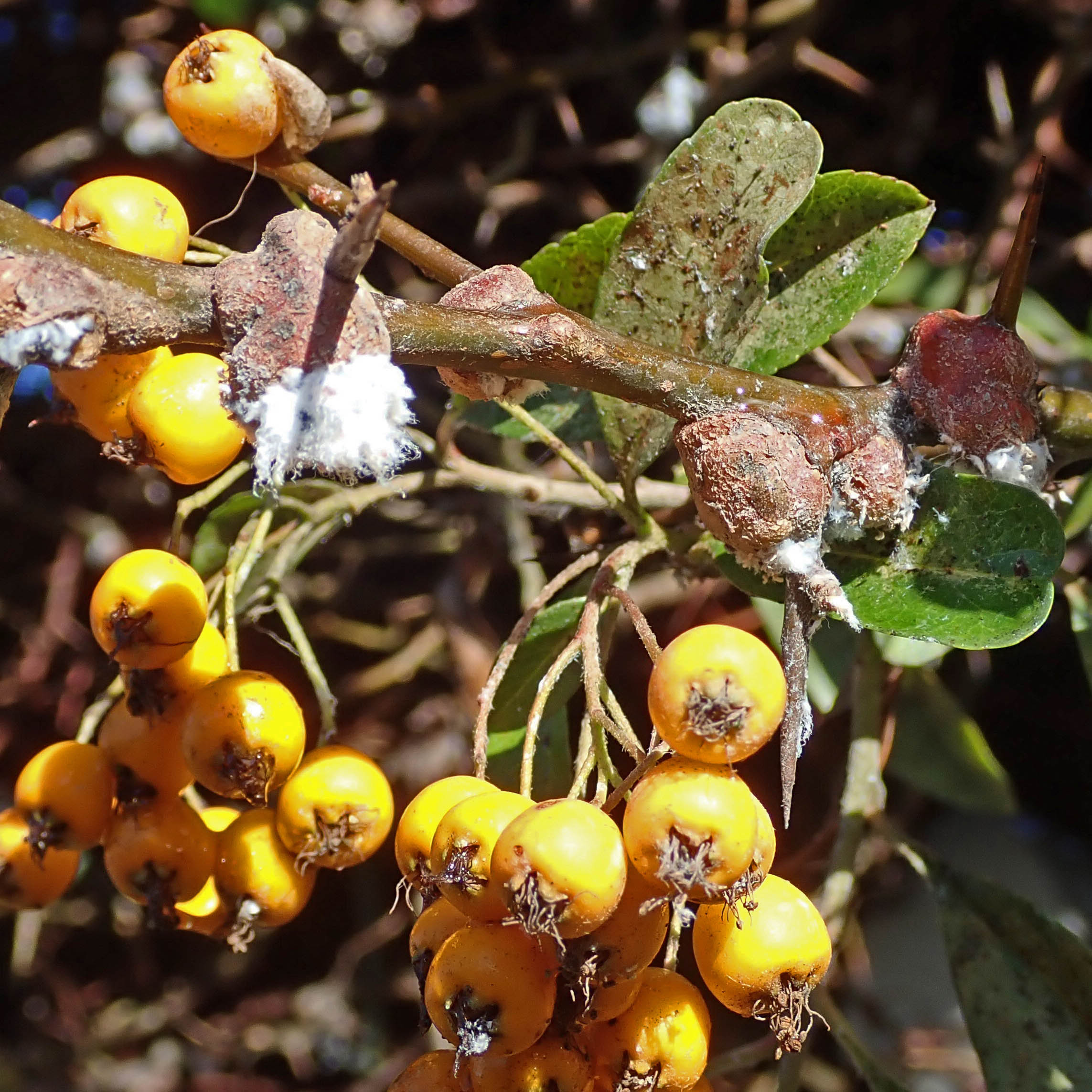
After a little research when I got home, it quickly became apparent that these were Eriosoma lanigerum, also known as Woolly apple aphids and American blight. The sap-sucking feeding of Eriosoma lanigerum causes deformation and swellings on the branches, trunks and roots of their host plants, as you can see from the lumpy growths on the branches of this Firethorn bush.
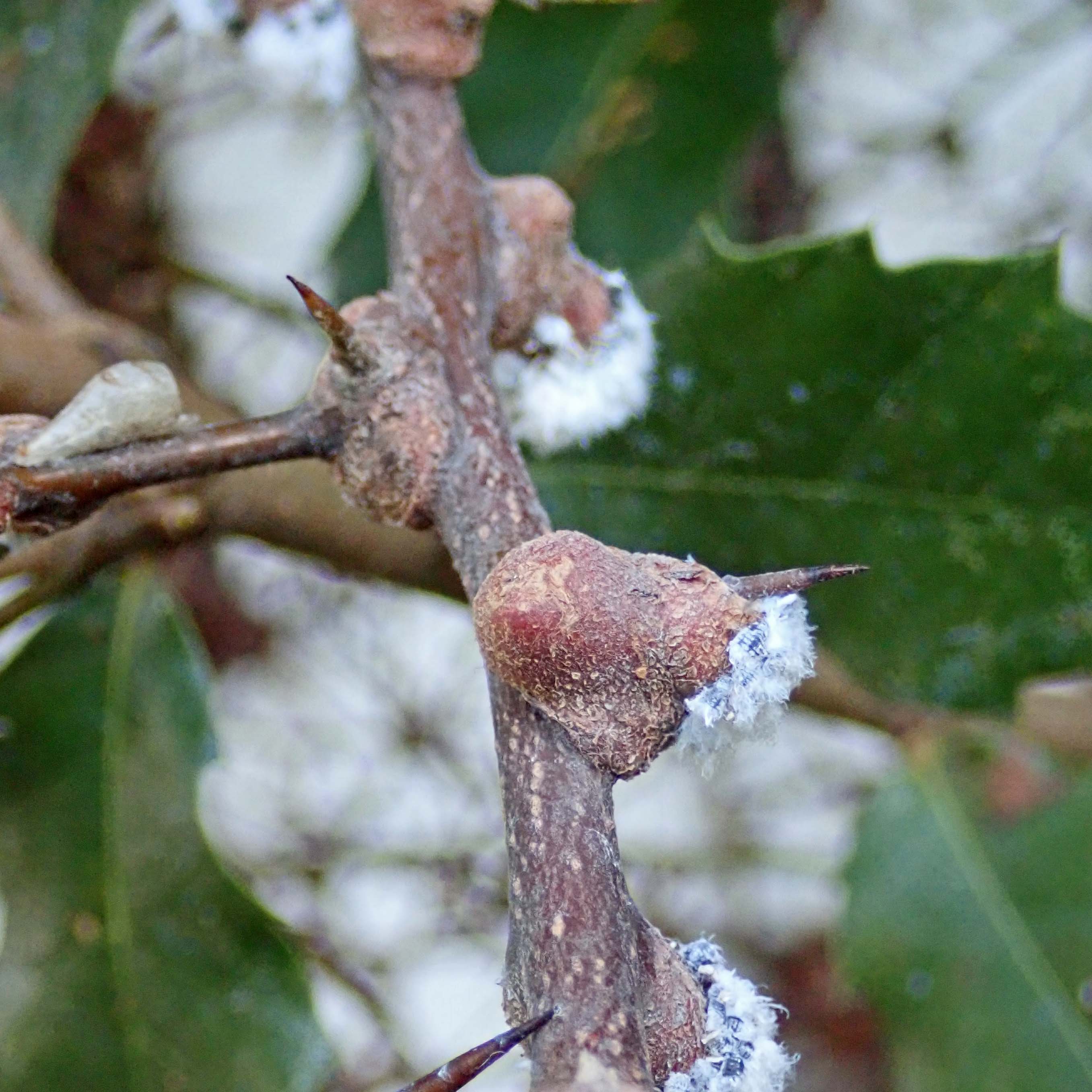
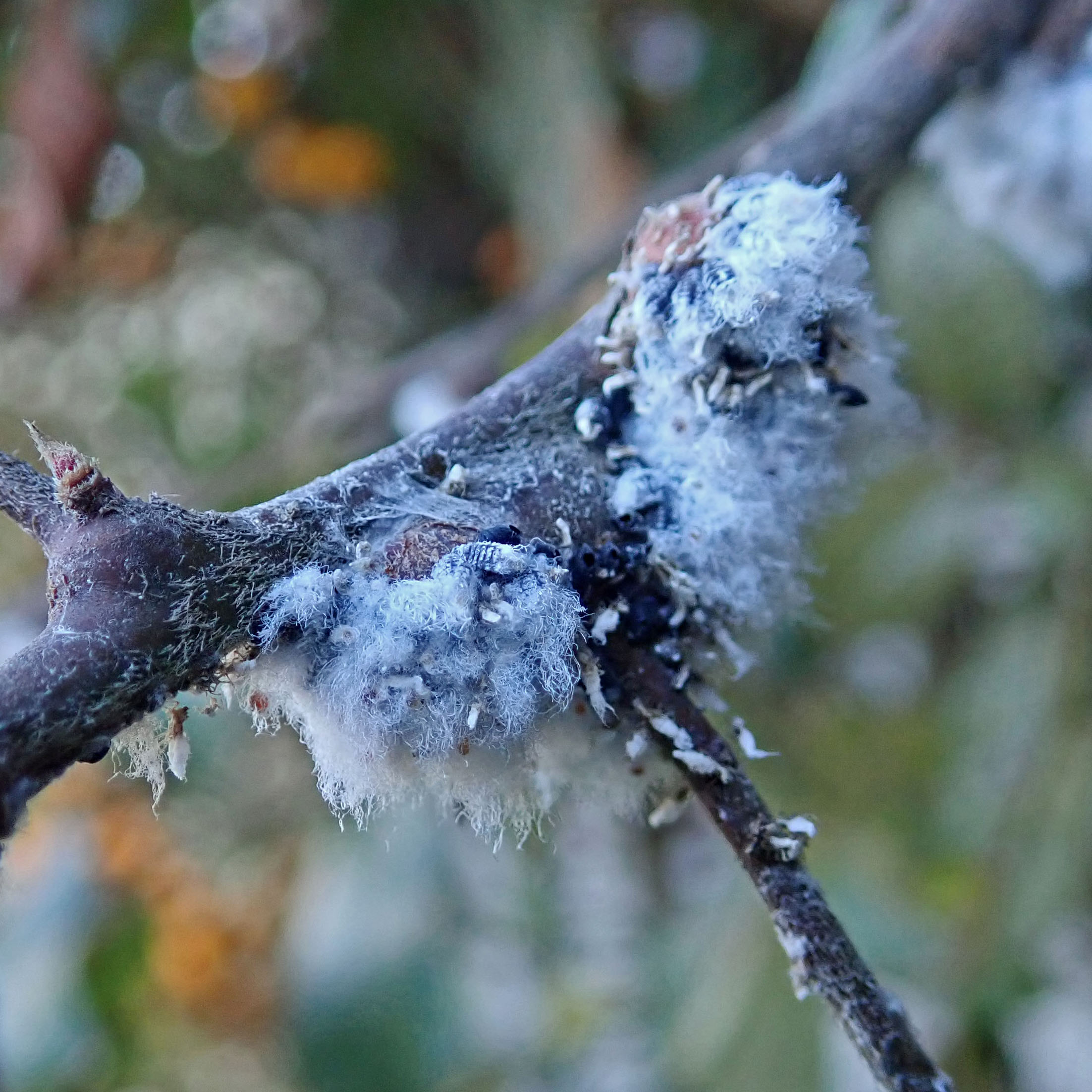
The white ‘wooliness’ is a wax substance the aphids produce in specialised glands and excrete as filaments from various parts of their bodies. The Influential Points website, which is an excellent resource for information about aphids, summarises the various reasons scientists have reached for this wax secretion:

Smith suggests that the primary role of the secreted wax is to prevent the aphids becoming contaminated by their own honeydew … and that of other members of the colony…. Other secondary roles of wax may include individual microclimate isolation, protection from fungi, parasites and predators plus waterproofing and frost protection.
Though their primary plant hosts are Pyracantha and Cotoneaster species, as the Woolly apple aphid name suggests, their secondary host is Apple and, on the various species of Apple trees, they are considered a major pest, often having a severe economic impact on Apple crops. If you’re interested in reading more about this, the Influential Points website has a long list of various scientific research papers from around the globe on the subject of these aphids, their reproduction habits, their seasonal movements, their genetics and population dynamics, as well as ways to control their infestations.
Like Loading...

Lime aphids

19 Monday Aug 2024

Posted by sconzani in insects, trees

≈ Leave a comment

Tags

aphids on Lime trees, British aphids, Eucallipterus tiliae, insects on Lime trees, Lime aphid, Lime trees

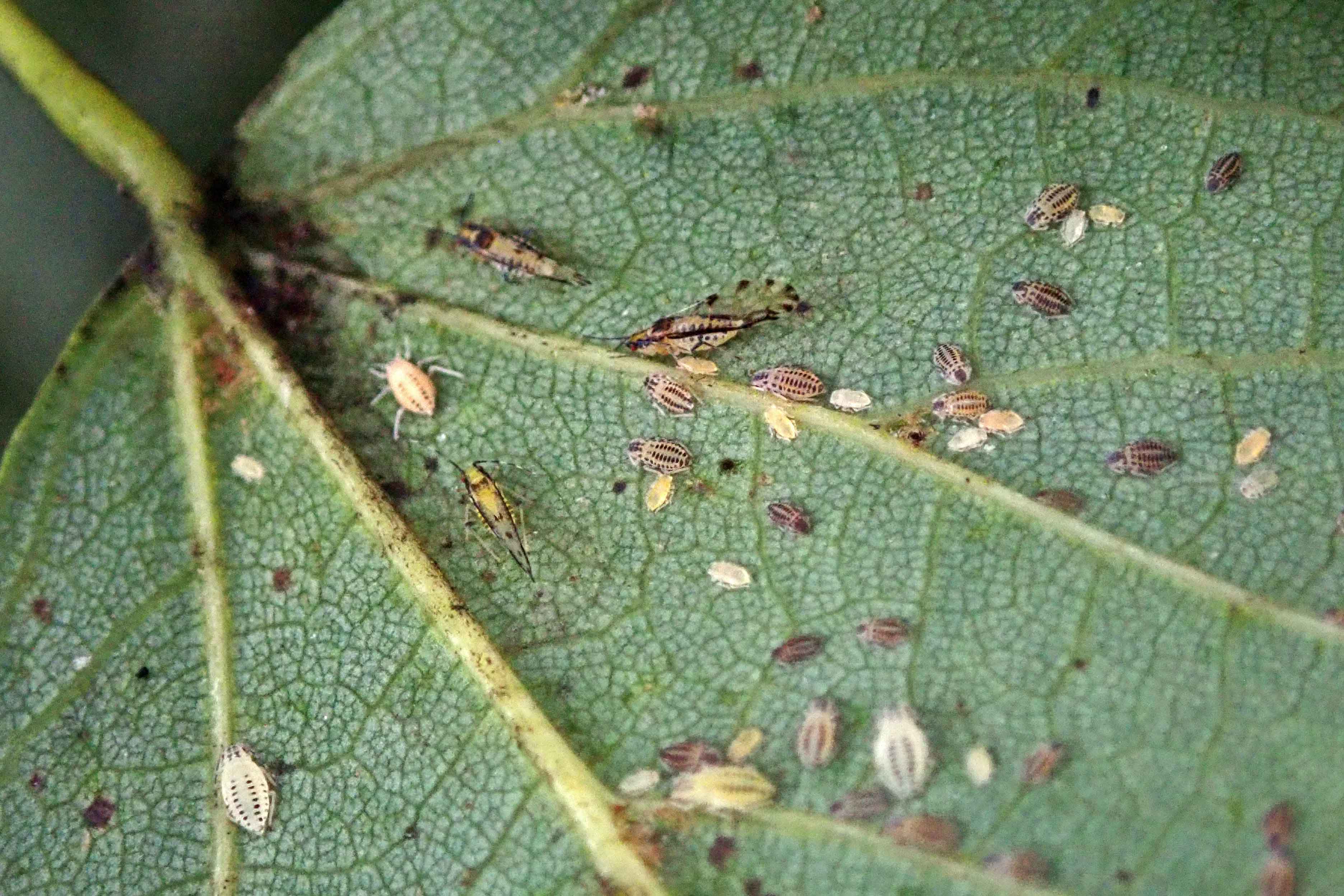
Last Tuesday, on my way home from exploring a local park, I stopped to investigate the leaves of a Lime tree (Tilia species, not sure which one) as I’ve never really found anything of much interest on Limes. Well, that soon changed because the undersides of these leaves were awash with aphids, unsurprisingly Lime aphids (Eucallipterus tiliae), a species I’d never seen before.

240819 eucallipterus tiliae (1)

And when I checked on the Welsh biodiversity database later in the day, I was surprised to find only five previous Welsh records. As is the way with many small creatures though, I now believe these aphids are under-recorded as the following day, walking in the opposite direction, I found two more colonies. It seems more people need to become leaf-turners and leaf-botherers so we can get a clearer, more accurate picture of our insect populations.

240819 Eucallipterus tiliae (2)

If you’re interested in learning more about these aphids and their life cycle, the Influential Points website has an excellent page, with very clear images though slightly technical scientific information.

Like Loading...

A is for aphid

06 Wednesday Dec 2023

Posted by sconzani in insects

≈ 6 Comments

Tags

aphid, British aphids

As I did two years ago, I’m going to use my last 26 posts to count down alphabetically to the end of the year, sometimes celebrating special finds, often highlighting particular species or families, occasionally indicating the flora and fauna I want to learn more about. That countdown also began with A is for aphids and with my announcement that I intended to look at their various species more closely in 2022. That didn’t really happen; in fact, my fascination with aphids didn’t really kick in until 2023 was half over.

231206 aphids (1)

Initially, aphids were the victims, food for hoverfly larvae (Yummy aphids, 21 June). Next, I found some new galls that were caused by aphids (Galls: Pemphigus spyrothecae, 17 July). Then began my slide down the slippery (and often confusing) slope towards aphids and their parasites, with A parasitised aphid on 19 September; Aphid mummies on 26 September; the 10 October post: A confusion of pie crusts; and more mummies, this time black in colour, Black mummies on 19 October. I finished my 2023 aphid obsession with a chance sighting on 25 October Aphids: Tuberolachnus salignus, and I’m already excited about what I might find next year.

231206 aphids (2)

Like Loading...

Aphids: Tuberolachnus salignus

25 Wednesday Oct 2023

Posted by sconzani in insects, trees

≈ Leave a comment

Tags

aphids on willow, British aphids, Giant willow aphid, Tuberolachnus salignus

I know, I know. I said there’d probably be no more aphids during the winter months but they overwinter as adults, and I just happened to be looking at the leaves of a willow while waiting for a train when I spotted these and couldn’t resist a few photos. These are Giant willow aphids (Tuberolachnus salignus), and I happened to catch them in various sizes and forms: the winged aphid is an adult (the scientific term is alate).

231026 Tuberolachnus salignus on willow (1)

The Influential Points website gives some fascinating information about these aphids:

Tuberolachnus salignus is anholocyclic and no males have ever been found, so all reproduction is assumed to be parthenogenetic. The females produce live young which are all genetically identical (clones) … [and]
One part of the giant willow aphid’s life cycle remains shrouded in mystery. Tuberolachnus salignus have only been found on willow trees from July through to early March. Numbers tend to peak in October, but by February few are left on the trees and none has been seen from April to July. [So, where do they go?]

231026 Tuberolachnus salignus on willow (2)

Though I didn’t catch it on camera as my train was pulling in to the station, the aphids got annoyed with my lens being so close to them and started waving their legs at me, apparently something they do to frighten off potential predators.

Like Loading...

Black mummies

19 Thursday Oct 2023

Posted by sconzani in insects

≈ Leave a comment

Tags

Aphelinus species, aphid, aphid mummies, aphid parasitised by wasp, British aphids, Drepanosiphum platanoidis, parasitic wasp, parasitised aphids

Unless I find something particularly noteworthy, this might be my last venture into the confusing world of aphids and their parasites, at least for the winter months. You might remember my post about Aphid mummies on 26 September. Well, the tiny creature pictured below is also an aphid mummy and, thanks to my local expert, I can identify this as a nymph of the aphid Drepanosiphum platanoidis that has been parasitised by one of the Aphelinus species of parasitic wasps. Within its now-blackened body, a wasp larva has been eating its host, will pupate and eventually emerge as an adult wasp. (Perhaps I should have saved this post until 31 October as it has something of the Halloween / zombie / walking dead feel to it.)

Like Loading...

Aphid mummies

26 Tuesday Sep 2023

Posted by sconzani in insects

≈ 4 Comments

Tags

aphid mummy, aphids, British aphids, parasitised aphids

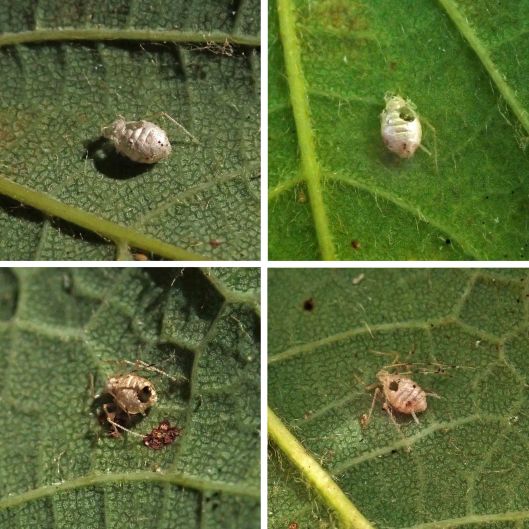
I feel as if I’m standing at the top of a very slippery slope, at the bottom of which is a chasm filled with aphids and their parasites! I say this because I’m finding that these are creatures that have been little studied, are very tricky to identify, and thus could easily become a bottomless pit of specimens I’m frustratingly unable to put a name to. (I already have two jars on my windowsill with parasitised aphids inside, waiting to see what emerges.) I really really should back away from the edge of that slippery slope right now but, before I do, here are some photos I’ve already taken, of what are known as ‘aphid mummies’. The aphids have had eggs laid in them by parasitic wasps, whose larvae have slowly eaten their host while it was still alive, then pupated and emerged as adult wasps – you can see the tiny holes where they’ve left their mummies.

230926 aphid mummies

Like Loading...

Galls: Pemphigus spyrothecae

17 Monday Jul 2023

Posted by sconzani in insects, trees

≈ Leave a comment

Tags

aphids on Poplar, British aphids, gall, gall-causing aphid, galls on Poplar, Pemphigus spyrothecae, Poplar

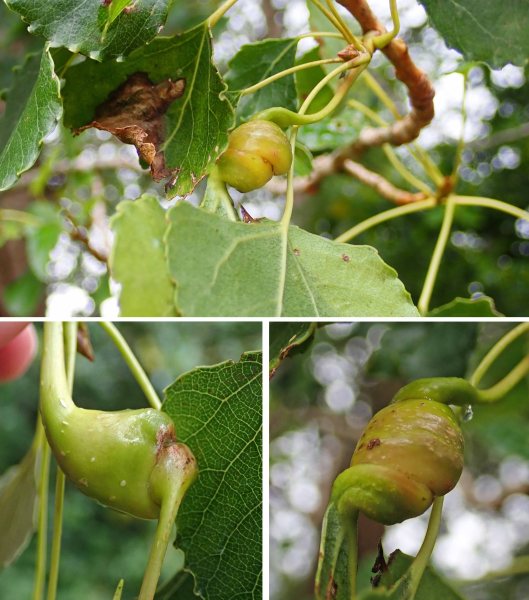
During our recent wet and windy weather I’ve taken to leaving my good camera at home, going out in wet weather gear with just my point-and-shoot camera tucked in a jacket pocket. As that camera is really only good for macro shots, I’ve been forced to look at things more closely – no bad thing, and, given the frequent heavy showers, I’ve been spending more time than usual sheltering under trees. And that, of course, means I’ve been looking at trunks and branches and leaves, which is how I came to notice these odd swellings on a Poplar tree in a local park. The aphid Pemphigus spyrothecae causes the leaf petiole to twist two or three times, forming a chamber in which the aphid’s larvae can develop. I didn’t open any of the galls but, if you want to see images of what’s inside, and read more about the life cycle of these aphids, the Influential Points website is the place to go.

230717 Pemphigus spyrothecae galls

Like Loading...

Yummy Aphids

21 Wednesday Jun 2023

Posted by sconzani in insects

≈ Leave a comment

Tags

aphid, aphids on Elder, aphids on willow, British aphids, hoverfly, hoverfly larvae

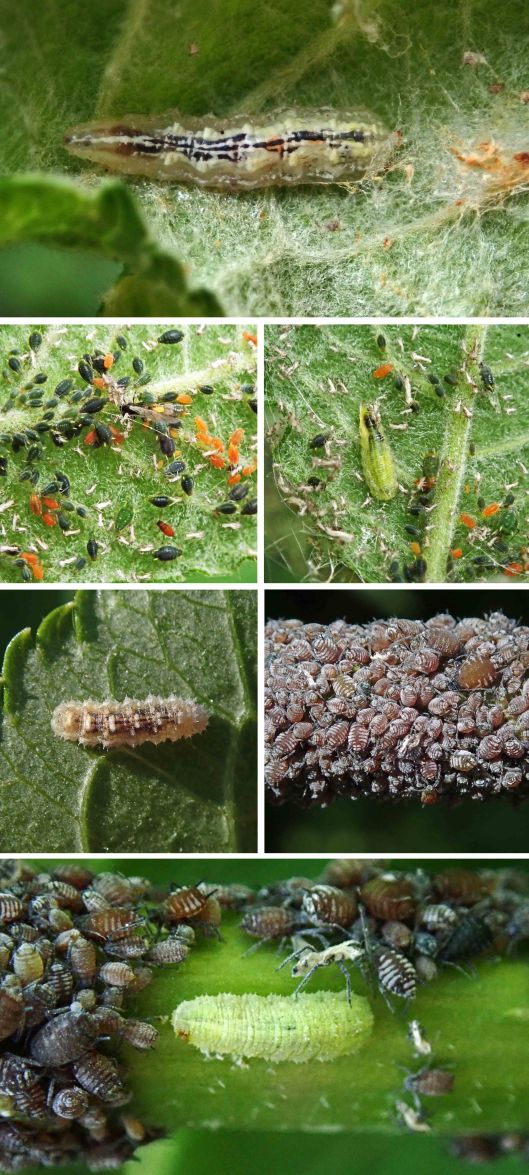
Whenever you see aphids (those shown below were on a willow species and on Elder), it’s always worth a look to see what other insects are nearby, particularly those that find aphids delicious! There’s usually a ladybird or two in the vicinity, and, as I’ve been finding, plenty of hoverfly larvae of various species. Their appetite for aphids is yet another reason to love hoverflies, if one were needed.

230621 aphids and hoverfly larvae

Like Loading...

A is for aphids

06 Monday Dec 2021

Posted by sconzani in insects

≈ 4 Comments

Tags

aphids, aphids on salix species, British aphids, Giant willow aphid, Tuberolachnus salignus

This year I thought I’d finish 2021 with something different, an A-to-Z 26-day countdown to the end of the year. So, first up, A is for aphids, a family I intend to look closer at in the coming year. Many species look very similar to each other and so are hard to identify, like these.

211206 aphids (1)
211206 aphids (2)
211206 aphids (3)

But there are other species that are specific to particular plants, like the one shown below. Though my finds haven’t yet been confirmed, from their relatively large size, the fact that I’ve found them twice now on Grey willow, and their markings and the distinctive horny bumps on their rear ends, I’m fairly sure these are Giant willow aphids (Tuberolachnus salignus).

211206 aphids (4)

Like Loading...

About me

sconzani

sconzani

I'm a writer and photographer; researcher and blogger; birder and nature lover; countryside rambler and city strider; volunteer and biodiversity recorder.

View Full Profile →

Follow earthstar on WordPress.com

Enter your email address to follow this blog and receive notifications of new posts by email.

Recent blog posts

  • M is for mite December 18, 2025
  • L is for lepidopteran lifers December 17, 2025
  • K is for Keeled skimmers December 16, 2025
  • J is for Jersey tiger December 15, 2025
  • I is for Ichneumon December 14, 2025

From the archives

COPYRIGHT

Unless otherwise acknowledged, the text and photographs on this blog are my own and are subject to international copyright. Nothing may be downloaded or copied without my permission.

Fellow Earth Stars!

  • Unknown's avatar
  • Unknown's avatar
  • Unknown's avatar
  • Unknown's avatar
  • Unknown's avatar
  • Unknown's avatar
  • Unknown's avatar
  • Unknown's avatar
  • Unknown's avatar
  • Unknown's avatar
  • Unknown's avatar
  • Unknown's avatar
  • Unknown's avatar
  • Unknown's avatar
  • Unknown's avatar
  • Unknown's avatar
  • Unknown's avatar
  • Unknown's avatar
  • Unknown's avatar
  • Unknown's avatar
  • Unknown's avatar
  • Unknown's avatar
  • Unknown's avatar
  • Unknown's avatar
  • Unknown's avatar
  • Unknown's avatar
  • Unknown's avatar
  • Unknown's avatar
  • Unknown's avatar
  • Unknown's avatar
  • Unknown's avatar
  • Unknown's avatar
  • Unknown's avatar
  • Unknown's avatar
  • Unknown's avatar
  • Unknown's avatar
  • Unknown's avatar
  • Unknown's avatar
  • Unknown's avatar
  • Unknown's avatar
  • Unknown's avatar
  • Unknown's avatar
  • Unknown's avatar
  • Unknown's avatar
  • Unknown's avatar
  • Unknown's avatar
  • Unknown's avatar
  • Unknown's avatar
  • Unknown's avatar
  • Unknown's avatar

Blog at WordPress.com.

Privacy & Cookies: This site uses cookies. By continuing to use this website, you agree to their use.
To find out more, including how to control cookies, see here: Cookie Policy
  • Subscribe Subscribed
    • earthstar
    • Join 667 other subscribers
    • Already have a WordPress.com account? Log in now.
    • earthstar
    • Subscribe Subscribed
    • Sign up
    • Log in
    • Report this content
    • View site in Reader
    • Manage subscriptions
    • Collapse this bar
 

Loading Comments...
 

You must be logged in to post a comment.

    %d