• ABOUT
  • BIRDING 2018
  • Birding 2019
  • BLOG POSTS
  • Butterflies 2018
  • Resources

earthstar

~ a celebration of nature

earthstar

Tag Archives: British bees

Mining bees

08 Tuesday Apr 2025

Posted by sconzani in insects, spring

≈ 4 Comments

Tags

Andrena species, Andrenidae, bees, British bees, mining bees, solitary bees

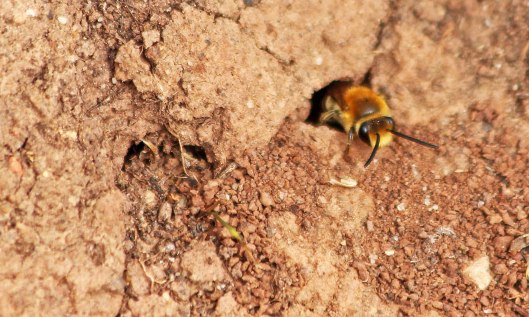
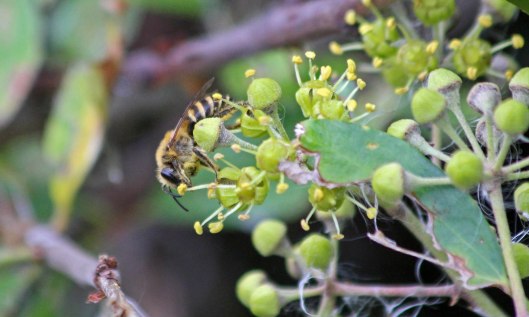
Mining bees, the Adrenidae, are notoriously difficult to identify I find, and, as my brain is already swimming with factors to consider when identifying spiders (and other life stuff that is happening in the background), I don’t have the mental capacity to tackle bees at the moment. Maybe they can be next year’s project.

In the meantime though, I can still appreciate how exceedingly cute they are, especially when they sit still for a few moments (which isn’t often) and allow me to get some close up photos (also not often).

Like Loading...

Andrena haemorrhoa

17 Wednesday May 2023

Posted by sconzani in insects

≈ Leave a comment

Tags

Andrena bees, Andrena haemorrhoa, British bees, Early mining bee, mining bees, Orange-tailed mining bee

Bee-cause I hardly ever manage to identify bees to species, I just had to share this one that was a first for me and has been identified. My local go-to guy for bee identification, Liam from Buglife Cymru, says this is a ‘nice distinctive one with the orange thorax and black abdomen with bright orange tail. Also orange hind legs beneath the pollen brush’. Meet Andrena haemorrhoa, in this case a female specimen. When I recorded it, the common name came up as Orange-tailed mining bee, though the Naturespot website calls it the Early mining bee. Same same, but different.

230517 Andrena haemorrhoa

Like Loading...

Mapping Ivy bees

29 Thursday Sep 2022

Posted by sconzani in insects

≈ Leave a comment

Tags

British bees, Colletes hederae, Ivy bee, Ivy bee colonisation, mapping of Ivy bee, spread of Ivy bee

From its first sighting in Dorset the Ivy bee (Colletes hederae) has spread to cover much of England south of a rough line from Nottingham to Norfolk, with scattered sightings in the north of England and just one verified record in Scotland thus far. There have also been verified sightings around most of coastal Wales, though the rugged Welsh hinterlands remain unconquered by this handsome little bee, as do large parts of inland Devon. Considering the first confirmed record of Colletes hederae in Britain came just 21 years ago, it’s an impressive colonisation effort. You can see the latest map on the NBN Atlas website here, and you can contribute to the BWARS mapping project here.

220929 ivy bees

Like Loading...

Companions

31 Wednesday Aug 2022

Posted by sconzani in insects

≈ Leave a comment

Tags

Bombus lapidarius, Bombus pascuorum, British bees, British bumblebees, Common carder bee, male Red-tailed bumblebee, Red-tailed bumblebee

As our hot dry summer draws to a close, flowers are in short supply so, sometimes, hungry critters just have to share. Here, a male Red-tailed bumblebee (Bombus lapidarius), left, shares with a Common carder bee (Bombus pascuorum). (Yes, I know the Red-tailed doesn’t actually have a red tail and it certainly doesn’t look like the images I had been searching through when trying to put a name to it, but my friendly local Twitter expert tells me ‘males get sun bleached rather quickly’ and assures me this identification is correct. This is precisely why I don’t really ‘do’ bees!)

220831 Bombus lapidarius MALE n Bombus pascuorum

Like Loading...

Even more piles of dirt

02 Monday May 2022

Posted by sconzani in insects

≈ Leave a comment

Tags

British bees, kleptoparasitism, mining bee, nomad bee

Bottoms up! A mining bee heads into its burrow covered in pollen, food for its eggs when they hatch.

220502 (1) mining bee

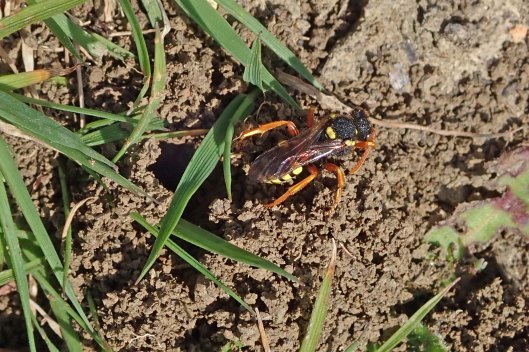
But, lurking nearby, is its kleptoparasite, a nomad bee that will lay its eggs in the burrow so its larvae can eat the mining bee’s food store. Sneaky!

220502 (2) Nomad bee

Like Loading...

Bee volcanoes

06 Wednesday Apr 2022

Posted by sconzani in insects

≈ 2 Comments

Tags

British bees, mining bee nests, mining bees, solitary bee nests, solitary bees, tiny piles of dirt

I can’t take the credit for the title of today’s post: by sheer coincidence, after returning from a walk with photos of these tiny dirt mountains, I spotted a tweet about the mini volcanoes of the bee Andrena fulva, and it seemed a very appropriate description. Mine may not be the work of that same bee species but they do indicate where solitary bees have dug out nest burrows for their young. I’m not sure whether these bee volcanoes are from newly hatched bees emerging from their winter nests or these volcanoes have only recently been excavated for the adult bees to lay this year’s eggs.

220406 solitary bee nest (1)
220406 solitary bee nest (2)
220406 solitary bee nest (3)
Like Loading...

Another percher

14 Monday Mar 2022

Posted by sconzani in insects

≈ Leave a comment

Tags

Andrena flavipes, bee on finger, British bees, mining bees

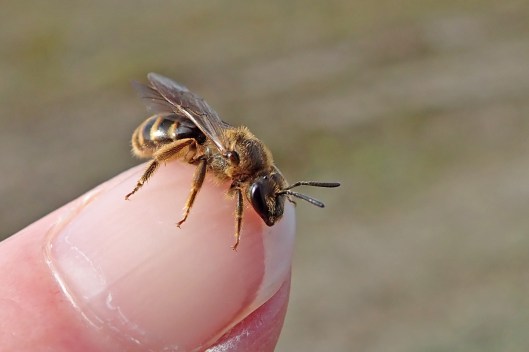
How lucky am I? After blogging last week about my delight at having a hoverfly sit on my hand, I’ve had another tiny percher. This time it was a bee, possibly a Yellow-legged mining-bee (Andrena flavipes), but don’t quote me on that. It was reluctant to fly off, as it was a cool day, so I carried it along with me until I got to a willow with open catkins, which my little flying friend was happy to move on to.

220314 bee on finger

Like Loading...

Flying critters

28 Monday Feb 2022

Posted by sconzani in insects

≈ Leave a comment

Tags

Andrena flavipes, British bees, British wasps, Lasioglossum species, Vespula vulgaris

Though a cool breeze blew from the south east, yesterday was wonderfully sunny, so I planned my walk to check the more sheltered spots in the local landscape where I hoped I might find newly emerged flying critters. And I got lucky. As well as my first two butterflies of the year (Small tortoiseshell and Brimstone, both too distant for photos with the camera I had with me), I also found some solitary bees and a wasp.

220228 lasioglossum (1)
220228 lasioglossum (2)

Thanks to Liam Olds, of the Colliery Spoil Biodiversity Initiative, I can tell you the two bees above are both ‘female Lasioglossum sp. [species] (morio group but not possible to ID from pics)’ and the bee below is a ‘male Andrena flavipes by the looks’.

220228 andrena flavipes

And the wasp I found basking on a tree trunk is a Vespula vulgaris.

220228 vespula vulgaris

Like Loading...

Busy buzzing

14 Thursday Oct 2021

Posted by sconzani in autumn, insects

≈ Leave a comment

Tags

bees on Ivy flowers, British bees, Colletes hederae, Ivy bee

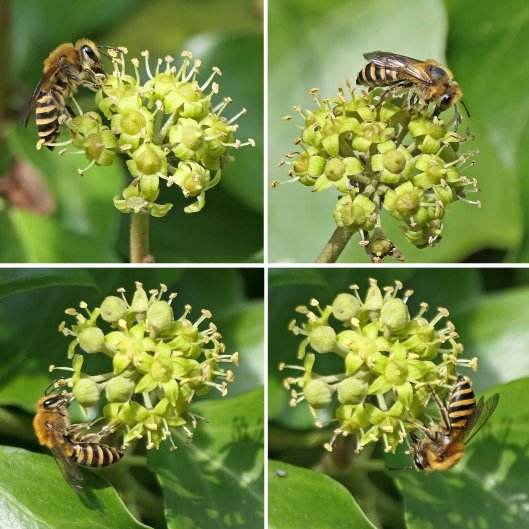
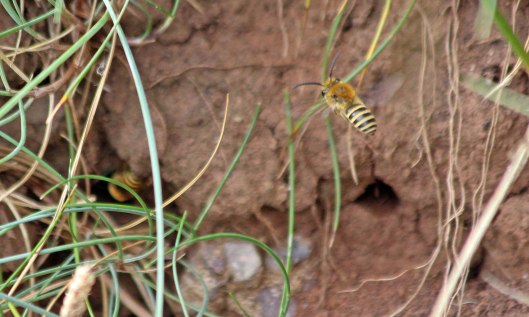
Every year I look out for them. Every year I share photos of them, and 2021 is no exception. Here, then, are some of this year’s cohort of Ivy bees, at their burrows and feasting on Ivy flowers.

211014 ivy bees (1)211014 ivy bees (2)211014 ivy bees (3)211014 ivy bees (4)

Like Loading...

Humongous Hornet

29 Tuesday Jun 2021

Posted by sconzani in insects

≈ Leave a comment

Tags

British bees, European hornet, Hornet, Vespa crabro

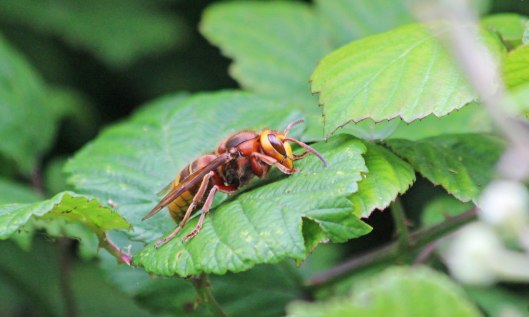
There’s no doubt about it – the European hornet (Vespa crabro) is an imposing, awe-inspiring creature, a giant of the apian world.

210629 european hornet (2)

I spotted this one resting on a bramble bush during a woodland walk on Saturday and, as I rarely see them stationary, couldn’t resist getting some close-up photos. But not too close: these shots were taken using my 300mm zoom lens, so I was about two metres away. And I admit that, when the hornet became aware of me and turned to check me out, I did back off a little further. They rarely sting – only when stressed or threatened; it’s their sheer size (between 25-35mm) that I find a little intimidating.

210629 european hornet (1)

But this beautiful creature obviously didn’t see me as a threat and proceeded to clean its wings and eyes while I looked on in awe. A special encounter!

Like Loading...
← Older posts

About me

sconzani

sconzani

I'm a writer and photographer; researcher and blogger; birder and nature lover; countryside rambler and city strider; volunteer and biodiversity recorder.

View Full Profile →

Follow earthstar on WordPress.com

Enter your email address to follow this blog and receive notifications of new posts by email.

Recent blog posts

  • M is for mite December 18, 2025
  • L is for lepidopteran lifers December 17, 2025
  • K is for Keeled skimmers December 16, 2025
  • J is for Jersey tiger December 15, 2025
  • I is for Ichneumon December 14, 2025

From the archives

COPYRIGHT

Unless otherwise acknowledged, the text and photographs on this blog are my own and are subject to international copyright. Nothing may be downloaded or copied without my permission.

Fellow Earth Stars!

  • Unknown's avatar
  • Unknown's avatar
  • Unknown's avatar
  • Unknown's avatar
  • Unknown's avatar
  • Unknown's avatar
  • Unknown's avatar
  • Unknown's avatar
  • Unknown's avatar
  • Unknown's avatar
  • Unknown's avatar
  • Unknown's avatar
  • Unknown's avatar
  • Unknown's avatar
  • Unknown's avatar
  • Unknown's avatar
  • Unknown's avatar
  • Unknown's avatar
  • Unknown's avatar
  • Unknown's avatar
  • Unknown's avatar
  • Unknown's avatar
  • Unknown's avatar
  • Unknown's avatar
  • Unknown's avatar
  • Unknown's avatar
  • Unknown's avatar
  • Unknown's avatar
  • Unknown's avatar
  • Unknown's avatar
  • Unknown's avatar
  • Unknown's avatar
  • Unknown's avatar
  • Unknown's avatar
  • Unknown's avatar
  • Unknown's avatar
  • Unknown's avatar
  • Unknown's avatar
  • Unknown's avatar
  • Unknown's avatar
  • Unknown's avatar
  • Unknown's avatar
  • Unknown's avatar
  • Unknown's avatar
  • Unknown's avatar
  • Unknown's avatar
  • Unknown's avatar
  • Unknown's avatar
  • Unknown's avatar
  • Unknown's avatar

Blog at WordPress.com.

Privacy & Cookies: This site uses cookies. By continuing to use this website, you agree to their use.
To find out more, including how to control cookies, see here: Cookie Policy
  • Subscribe Subscribed
    • earthstar
    • Join 667 other subscribers
    • Already have a WordPress.com account? Log in now.
    • earthstar
    • Subscribe Subscribed
    • Sign up
    • Log in
    • Report this content
    • View site in Reader
    • Manage subscriptions
    • Collapse this bar
 

Loading Comments...
 

You must be logged in to post a comment.

    %d