• ABOUT
  • BIRDING 2018
  • Birding 2019
  • BLOG POSTS
  • Butterflies 2018
  • Resources

earthstar

~ a celebration of nature

earthstar

Tag Archives: British dragonflies

Lifer: Scarce chaser

19 Thursday Jun 2025

Posted by sconzani in insects

≈ Leave a comment

Tags

Blue chaser, British chasers, British dragonflies, dragonflies at Radipole, dragonfly, Libellula fulva, RSPB Radipole, Scarce chaser

Here they are, the extremely confiding dragonflies mentioned in yesterday’s blog, the Scarce chasers (Libellula fulva) (also known as the Blue chaser). They were everything you could want in a photographer’s model, perching this way and that to show their best sides; not flying off at the slightest hint of movement behind the camera; the consummate professionals!
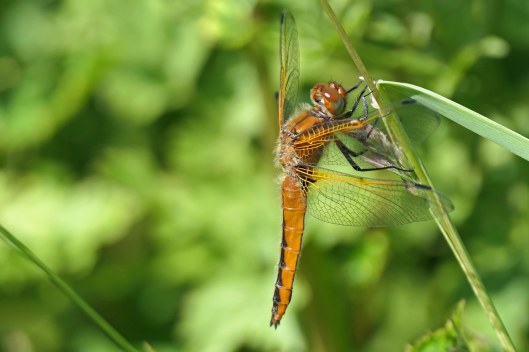
So, I managed to get photos of a male, female and the two together in cop. The female (above) is described in my guide book as having an olive-brown thorax and ochre-brown abdomen but, as you can see, she was much more vibrant than those descriptions suggest.
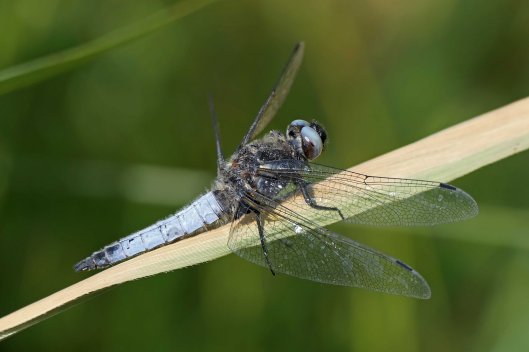
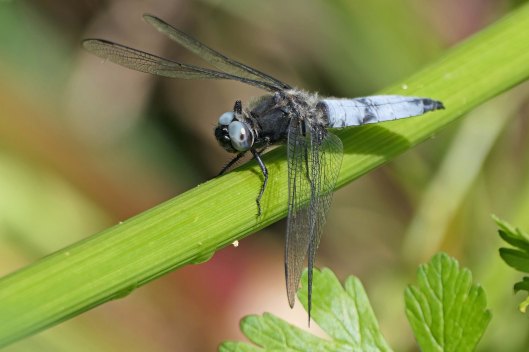
The males have a black thorax and blue abdomen with a dark tip. At a glance, with those colours, they could be mistaken for other dragonflies with similar colouration, until you see their eyes, which are the most amazing shade of blue. (In fact, I’ve just decided to add in a second photo of the male so you can get a better look at those eyes.)
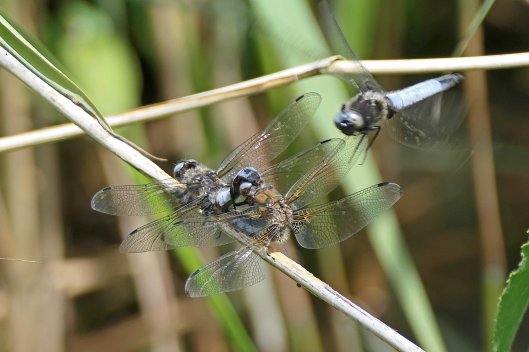
I saw several of these dragons at RSPB Radipole Lakes in Weymouth, which left me wondering why they are called ‘Scarce’ chasers. It seems that, where they are found (in isolated spots in the east and south of England) their populations are relatively small, so they are officially designated as rare. Indeed, in the 2008 British Odonata Red List they were officially listed as ‘near threatened’, so I feel very privileged to have enjoyed such excellent views of these stunning creatures.
Like Loading...

Lifer: Norfolk hawker

18 Wednesday Jun 2025

Posted by sconzani in insects

≈ Leave a comment

Tags

Aeshna isoceles, British dragonflies, British hawkers, Dorset dragonflies, dragonflies at Radipole, dragonfly, hawker, Norfolk hawker, RSPB Radipole

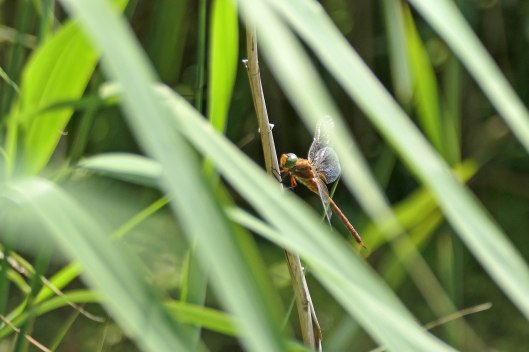
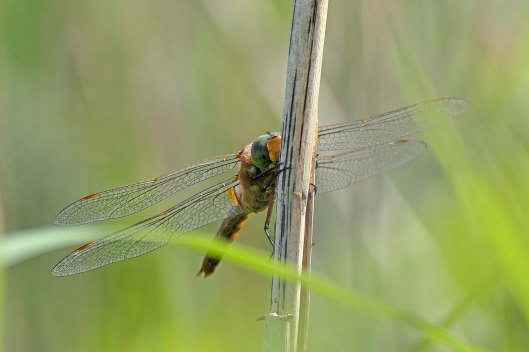
My wildlife-watching hopes for my short break in Weymouth centred on butterflies and, perhaps, a few birds that I might not see locally, so it was a wonderful surprise to see two new dragonfly species, one extremely confiding (it’ll feature in tomorrow’s blog), one elusive to the point of frustration.

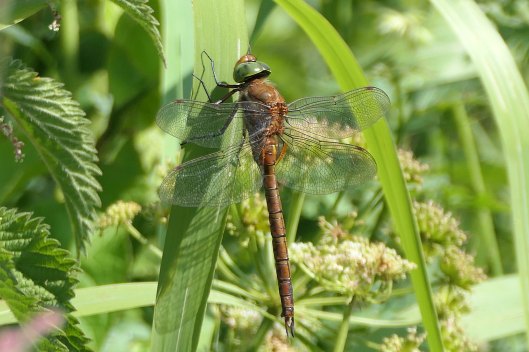
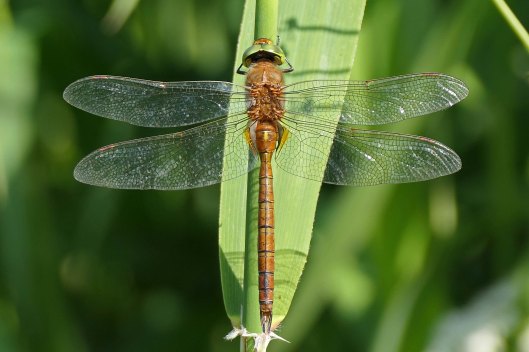
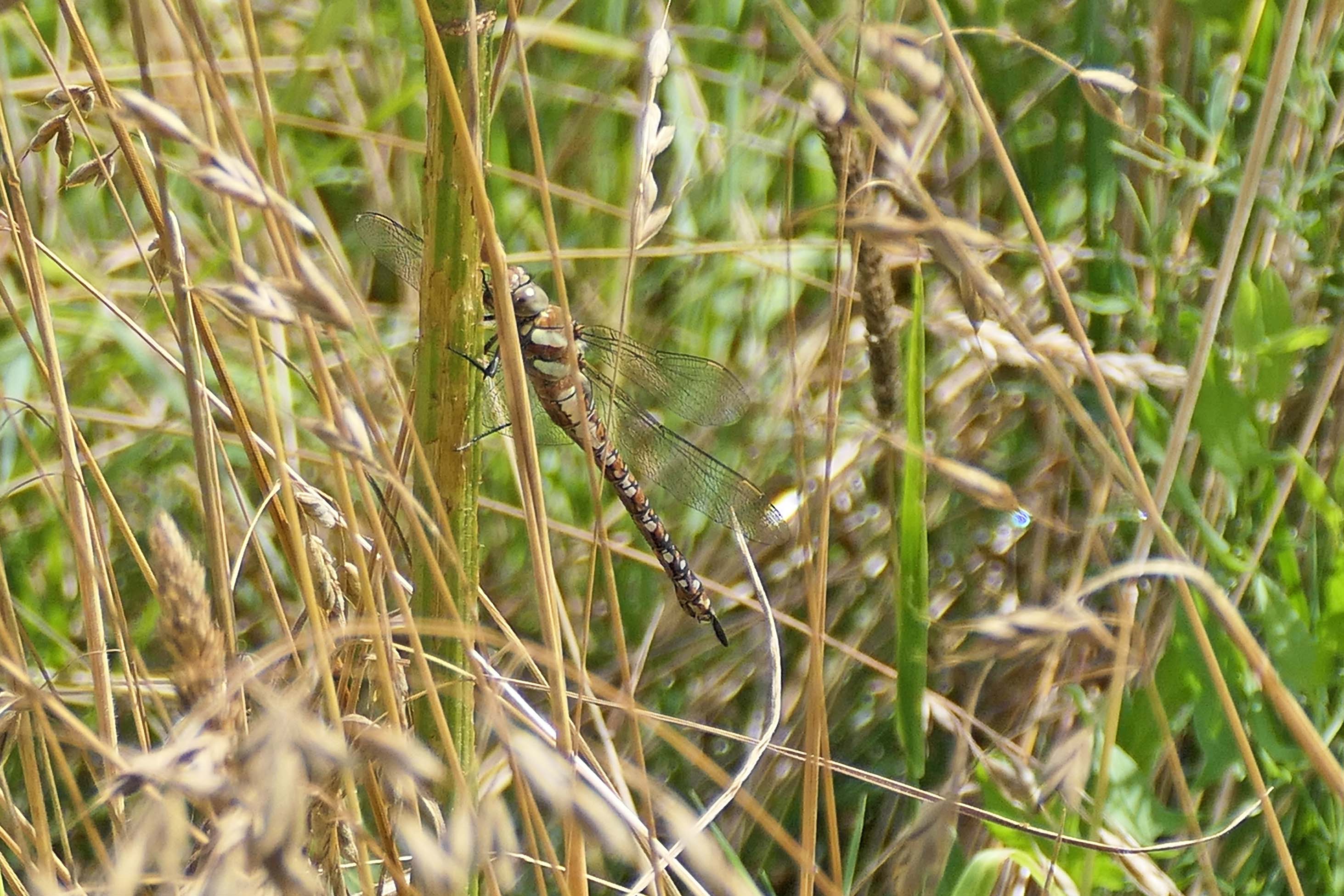
The Norfolk hawker (Aeshna isoceles) was the latter and, on my first visit to the RSPB Radipole reserve, the few times I spotted these dragonflies (easily recognisable by their brown colouring and green eyes), they stayed mostly hidden, perching – when they did actually stop flying – in obscure locations, as you can see from the photos above and below.

Finally, on my last afternoon, when there were fewer people out walking after a morning’s heavy rain and I was battling my way through the extremely overgrown vegetation along the path to the northern bird hide, one of these stunning dragons posed perfectly for me.

Although called Norfolk hawkers, these medium-sized dragonflies have been expanding their range beyond the English county of Norfolk. Their preference for reed beds in swamps and ponds, along streams and ditches, means Radipole provides the perfect location for them to thrive.

Like Loading...

Two dragons

28 Wednesday May 2025

Posted by sconzani in insects

≈ Leave a comment

Tags

British dragonflies, Broad-bodied Chaser, dragonfly, Four-spotted Chaser, Libellula depressa, Libellula quadrimaculata, Odonata

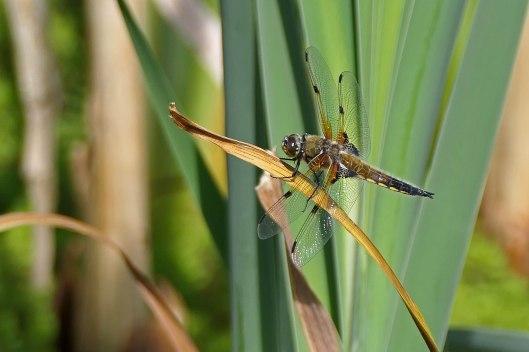
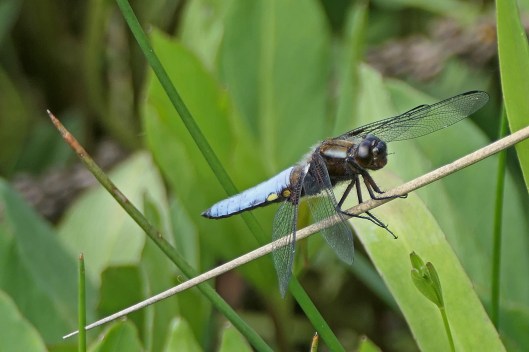
For me, the larger dragonflies have been few and far between this Spring. I’ve seen the odd one but fleetingly and its flown off before I could get a good view. Or I’ve heard one, that distinctive sound of the small wings rustling together as it takes flight. So, finally to have found two dragons that stayed still long enough for me to admire their colours and get some photographs has been very welcome indeed. Below are a Four-spotted chaser (Libellula quadrimaculata) and a Broad-bodied chaser (Libellula depressa). Fingers crossed for more sightings to come.

Like Loading...

Demoiselles

24 Saturday May 2025

Posted by sconzani in insects

≈ Leave a comment

Tags

Banded Demoiselle, Beautiful Demoiselle, British dragonflies, Calopteryx splendens, Calopteryx Virgo, demoiselles, Odonata

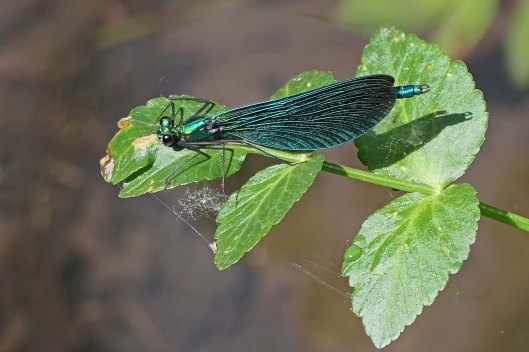
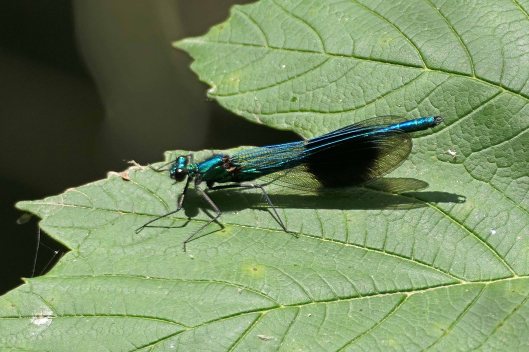
Thursday was a good day for demoiselles. As I strolled along the old Glamorgan canal at Forest Farm Nature Reserve, I was almost constantly entertained by both the Beautiful (Calopteryx virgo) and the Banded demoiselles (Calopteryx splendens), though there were definitely many more of the former than the latter.

 ~ male Beautiful demoiselle

While the females mostly perched quietly on leaves somewhat removed from the males – the only way to escape their attention, the males seldom kept still. They flashed their wings, displaying their metallic blue hues to impress any female that did venture past, and competed with other males for the best territories, those with sun, and shelter, and perches, and suitable places for egg-laying. What was serious breeding business for these stunning creatures was enchanting and magical for me.

~ male Banded demoiselle

Like Loading...

Hunting the Migrant hawker

23 Friday Aug 2024

Posted by sconzani in insects

≈ Leave a comment

Tags

Aeshna mixta, British dragonflies, British odonata, Migrant hawker, Odonata

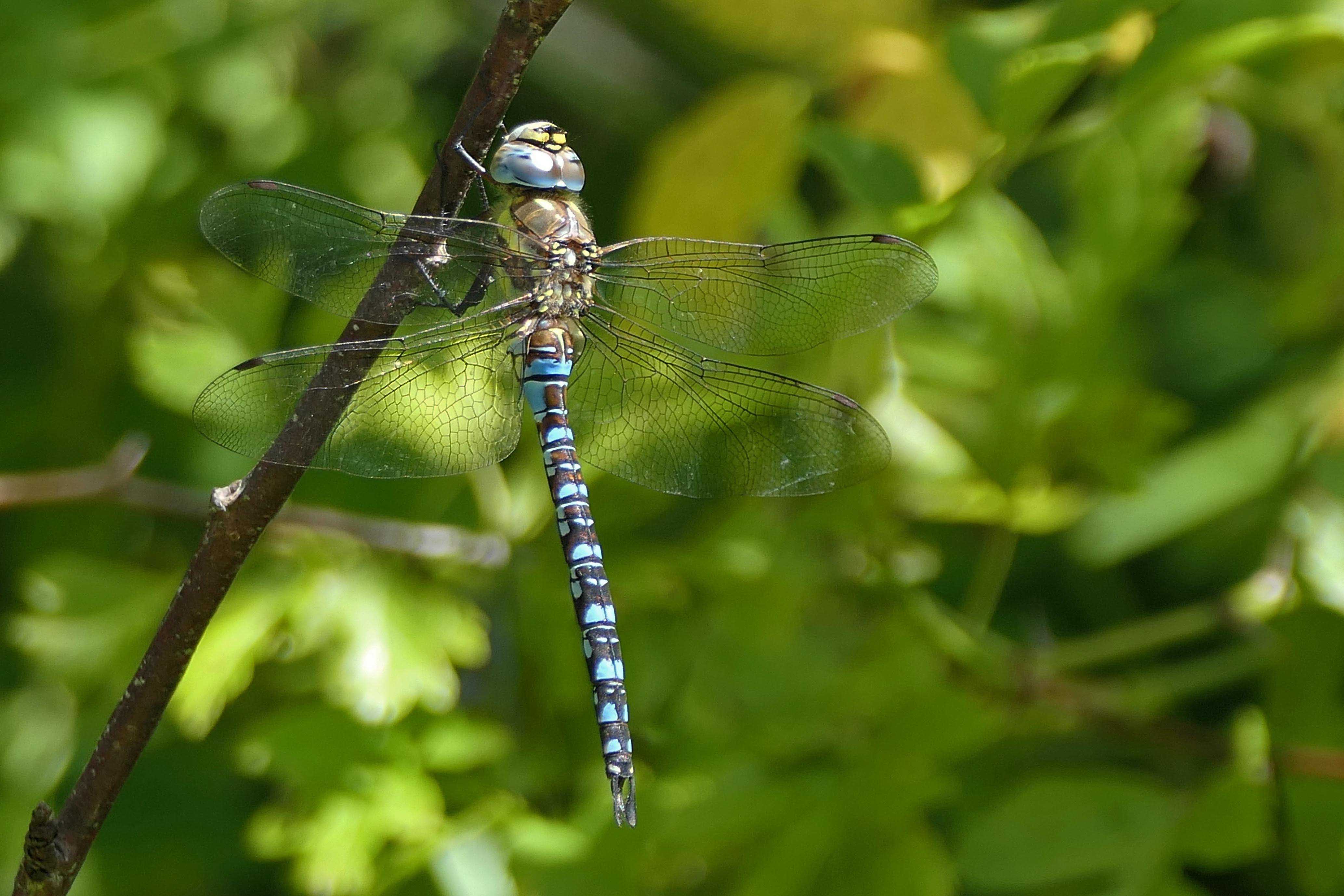
The first Migrant hawker (Aeshna mixta) I spotted this year, on 3 August, flew up into the tree tops almost immediately after I noticed it, and stayed there – I took some photos for recording purposes but they barely showed this dragonfly’s distinguishing features. So, when I spotted my next Migrant hawker, on 9 August, I spent 30 minutes watching and hoping for it to settle. This was all I got before it flew off, disappearing over a hedge, and I moved on.

240823 migrant hawker (1)

Then, finally, a week later, on the 16th, after another 30-minute session watching this beauty hawking back and forth along a tree line, expertly weaving in amongst the branches when it spotted potential prey, occasionally fighting with another of its kind hawking a little further along the ride, it perched very obligingly right in front of me and I managed slowly to approach for some reasonable photos. Dragonflies are amazing to watch, but it is also very satisfying to actually get good photographs of them.

240823 migrant hawker (2)

Like Loading...

Red and yellow and brown

09 Friday Aug 2024

Posted by sconzani in insects

≈ Leave a comment

Tags

British dragonflies, Common Darter, dragonfly, Sympetrum striolatum

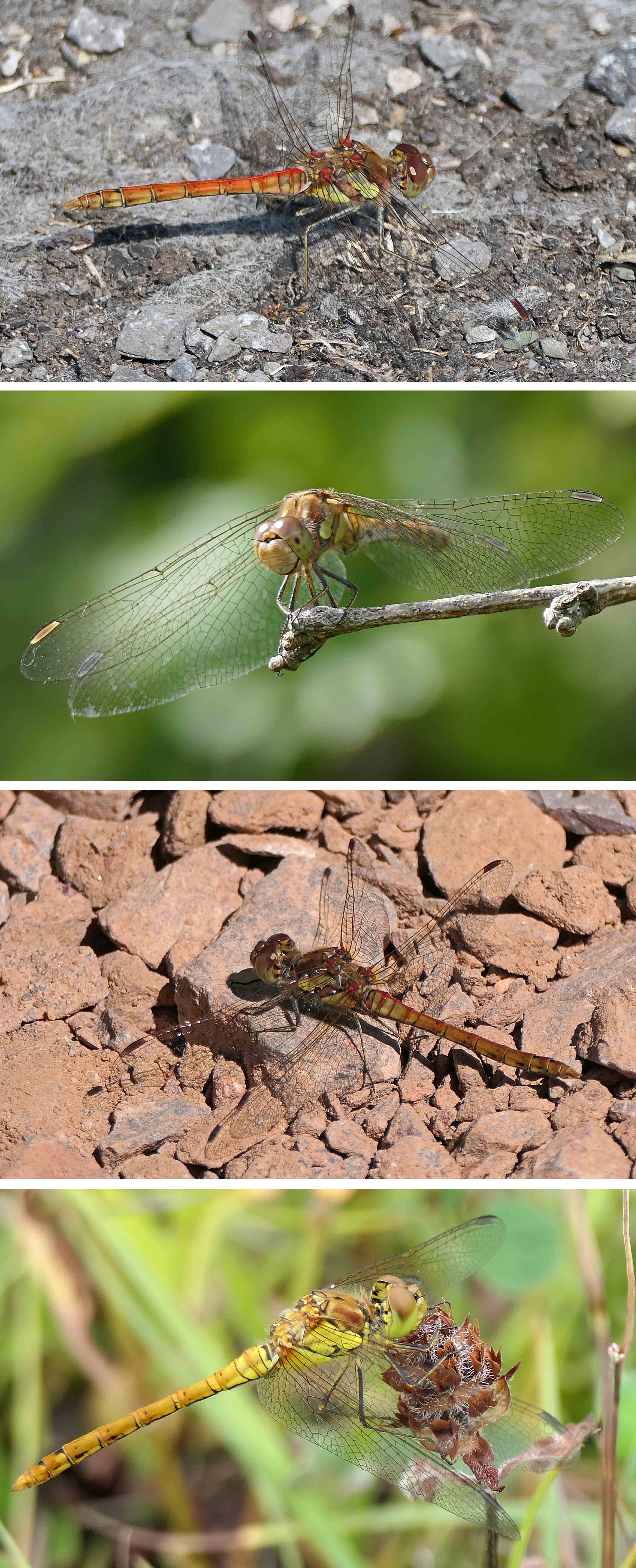
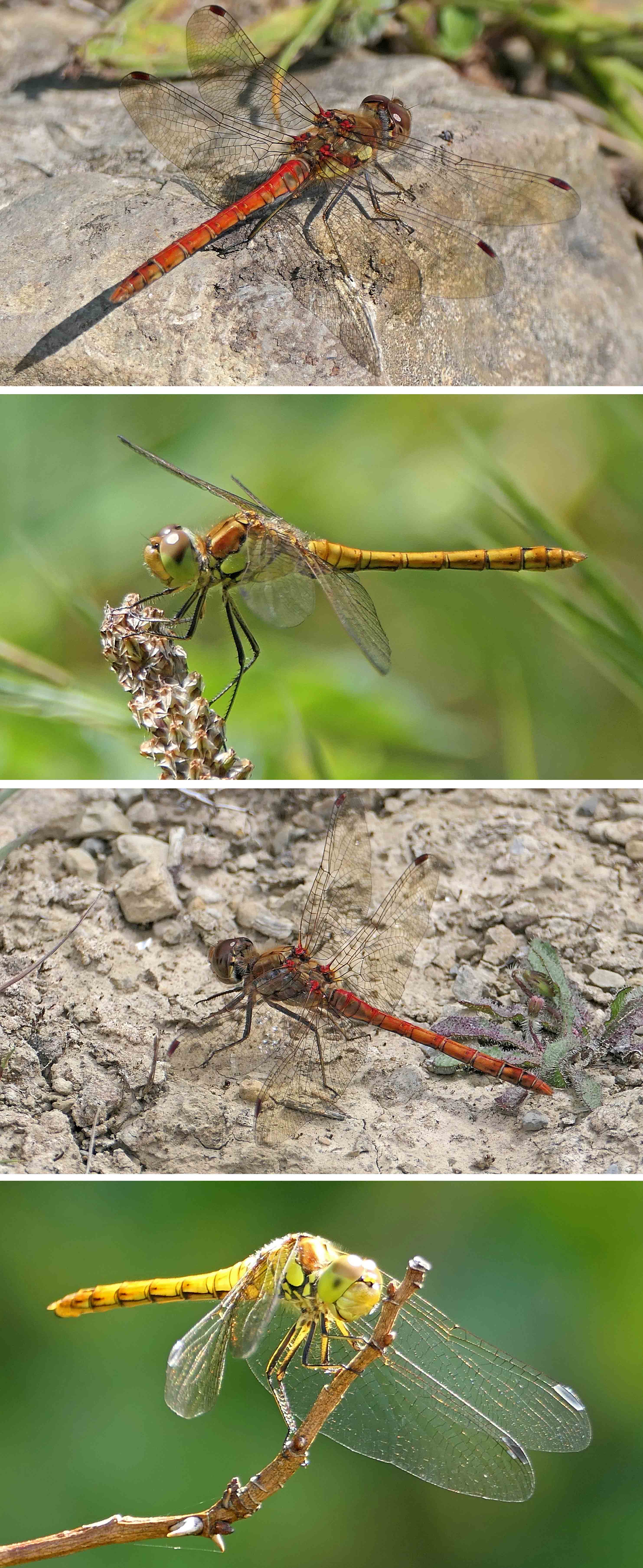
Generally speaking, female Common darters (Sympetrum striolatum) are yellow and males are red. However, as with so many things, the reality is not so black and white – or, rather, yellow and red.

240809 common darters (1)

Immature Common darters are usually yellow in colour, regardless of sex; and, as they age, the colours of both sexes often become dull, the males losing their vibrancy and looking quite brownish, the females turning reddish so they resemble males.

240809 common darters (2)

Like Loading...

First Southern hawker for 2024

11 Thursday Jul 2024

Posted by sconzani in insects

≈ Leave a comment

Tags

Aeshna cyanea, British dragonflies, dragonfly, Hawker dragonflies, Odonata, Southern hawker

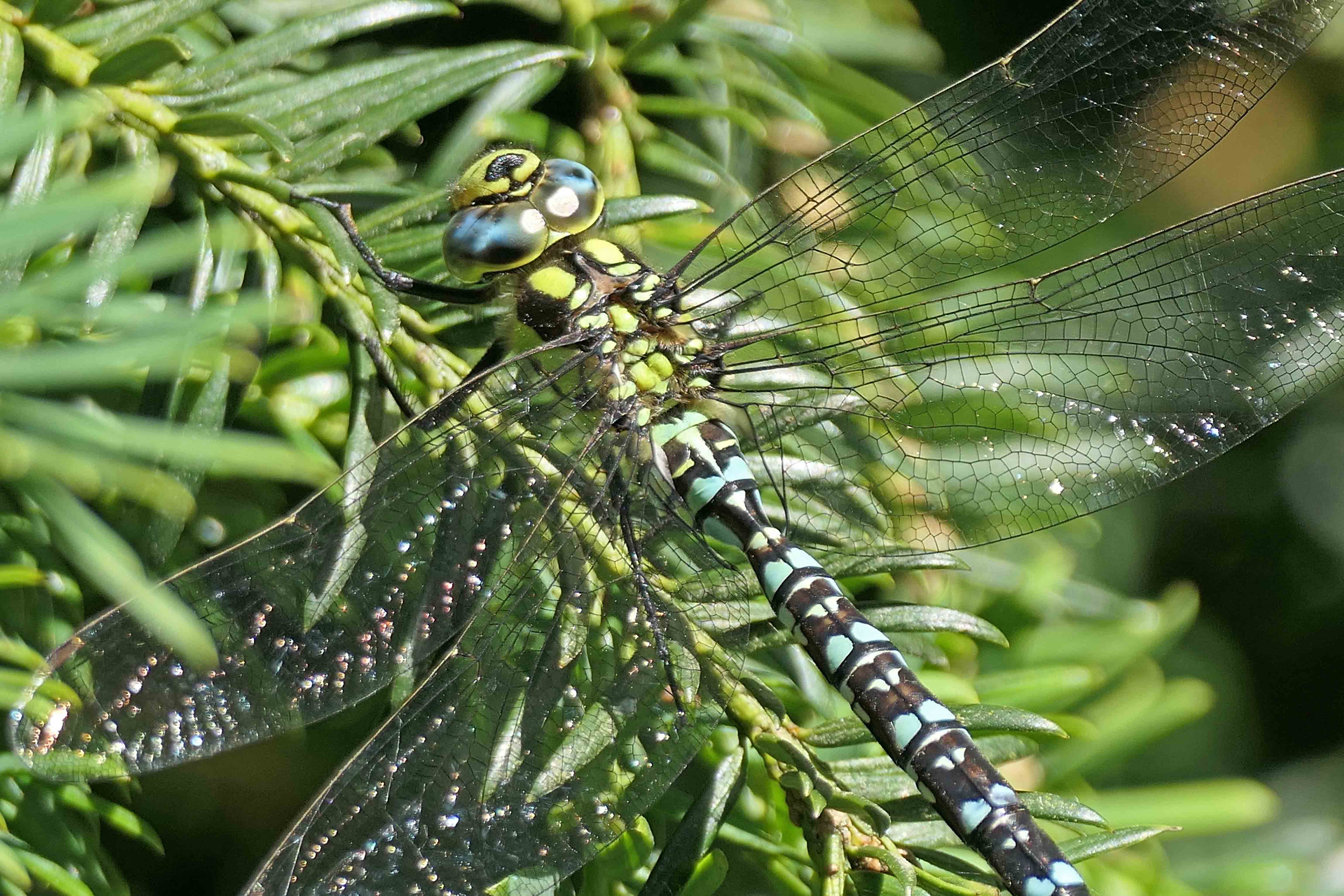
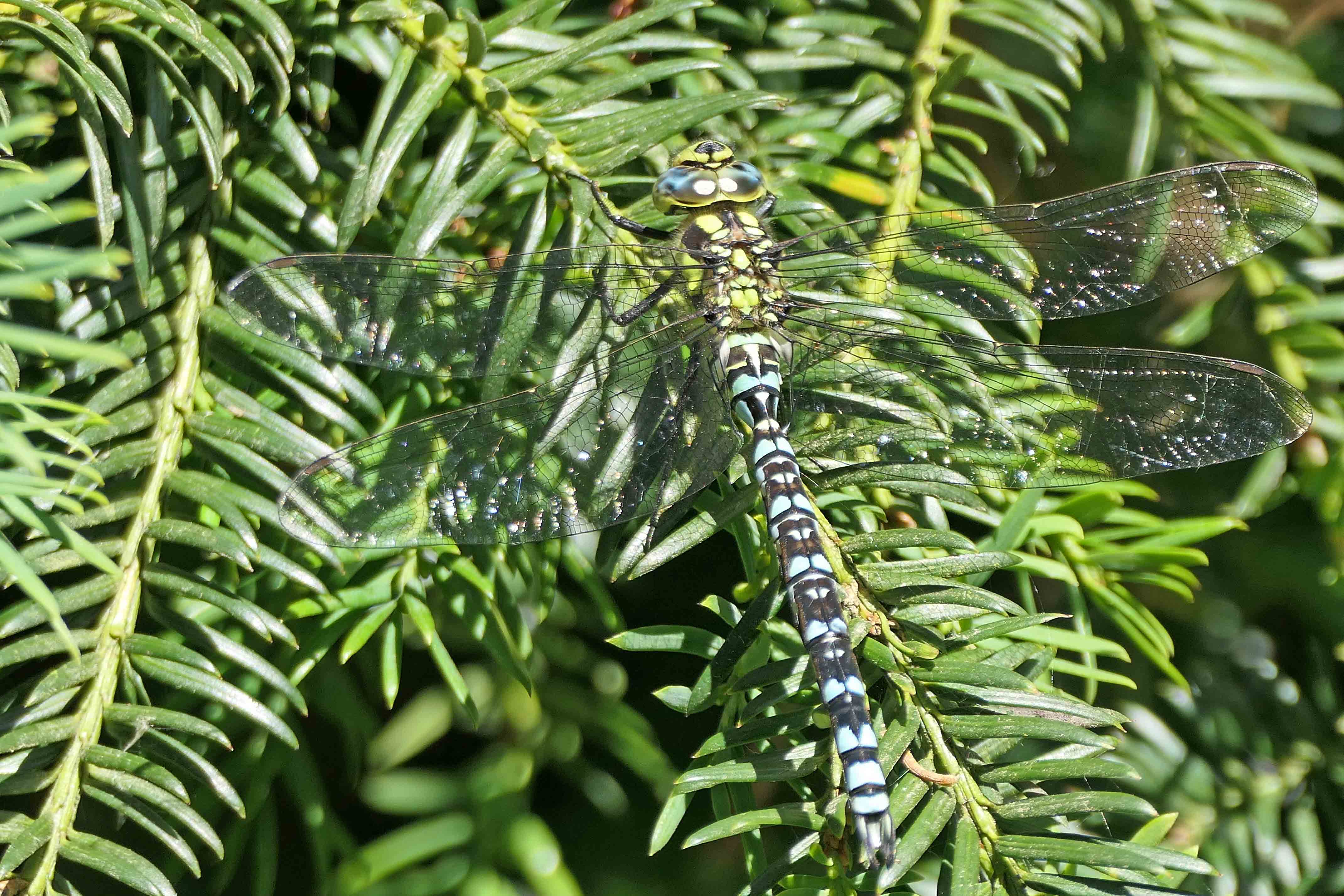
This handsome beastie was another wonderful find from my recent trip to Slade Wood in Gwent. The Southern hawker, also known as the Blue hawker (Aeshna cyanea), though quite similar to the Migrant hawker, can be identified by the broad yellow stripes on the top of its thorax, and, with a flight period running from the beginning of July to the end of September, is seen flying a month or so earlier than the Migrant.

240711 southern hawker (2)

Woodland rides like those at Slade Wood provide the ideal environment for its hawking of insects and, when it finds an ideal location, the Southern hawker will often defend its territory quite aggressively from other dragonfly intruders.

240711 southern hawker (1)

Like Loading...

A day of golden dragons

19 Wednesday Jun 2024

Posted by sconzani in insects

≈ Leave a comment

Tags

Black-tailed skimmer, British dragonflies, Broad-bodied Chaser, dragonfly, Four-spotted Chaser, Libellula depressa, Libellula quadrimaculata, Odonata, Orthetrum cancellatum

Last Saturday was a day of golden dragons …

240619 black-tailed skimmer

my first Black-tailed skimmers (Orthetrum cancellatum) of the year (unfortunately, the male didn’t stop for a photo),

240619 broad-bodied chaser

a female Broad-bodied chaser (Libellula depressa), and …

240619 four-spotted chaser

a Four-spotted chaser (Libellula quadrimaculata).

Like Loading...

Chasing a dragon

06 Thursday Jun 2024

Posted by sconzani in insects

≈ Leave a comment

Tags

British dragonflies, dragonfly, Four-spotted Chaser, Libellula quadrimaculata

This beauty wasn’t my first Four-spotted chaser (Libellula quadrimaculata) of the season but it was the first to pose long enough for me to get a decent photo.

240606 four spotted chaser

Like Loading...

Hello, Hairy!

21 Tuesday May 2024

Posted by sconzani in insects

≈ Leave a comment

Tags

Brachytron pratense, British dragonflies, Cardiff Bay Wetlands Reserve, dragonfly, Hairy dragonfly, Hairy hawker

Finally, my first dragonfly of the year appeared during last Thursday’s circuit of Cardiff Bay. This stunning Hairy dragonfly (also known as Hairy hawker) (Brachytron pratense) flew a circuit of the reeds near the boardwalk at the wetlands reserve before settling on a clump close to where I was standing. It was a little obscured by stalks blowing in the gentle breeze but I managed to get a few reasonable photos of this handsome-looking dragon.

240521 hairy dragonfly

Like Loading...
← Older posts
Newer posts →

About me

sconzani

sconzani

I'm a writer and photographer; researcher and blogger; birder and nature lover; countryside rambler and city strider; volunteer and biodiversity recorder.

View Full Profile →

Follow earthstar on WordPress.com

Enter your email address to follow this blog and receive notifications of new posts by email.

Recent blog posts

  • Red in beak and claw January 9, 2026
  • Who’s watching who? January 8, 2026
  • Springtail: Orchesella cincta January 7, 2026
  • A good year for Redwings January 6, 2026
  • Bug: Anthocoris nemorum January 5, 2026

From the archives

COPYRIGHT

Unless otherwise acknowledged, the text and photographs on this blog are my own and are subject to international copyright. Nothing may be downloaded or copied without my permission.

Fellow Earth Stars!

  • Unknown's avatar
  • Unknown's avatar
  • Unknown's avatar
  • Unknown's avatar
  • Unknown's avatar
  • Unknown's avatar
  • Unknown's avatar
  • Unknown's avatar
  • Unknown's avatar
  • Unknown's avatar
  • Unknown's avatar
  • Unknown's avatar
  • Unknown's avatar
  • Unknown's avatar
  • Unknown's avatar
  • Unknown's avatar
  • Unknown's avatar
  • Unknown's avatar
  • Unknown's avatar
  • Unknown's avatar
  • Unknown's avatar
  • Unknown's avatar
  • Unknown's avatar
  • Unknown's avatar
  • Unknown's avatar
  • Unknown's avatar
  • Unknown's avatar
  • Unknown's avatar
  • Unknown's avatar
  • Unknown's avatar
  • Unknown's avatar
  • Unknown's avatar
  • Unknown's avatar
  • Unknown's avatar
  • Unknown's avatar
  • Unknown's avatar
  • Unknown's avatar
  • Unknown's avatar
  • Unknown's avatar
  • Unknown's avatar
  • Unknown's avatar
  • Unknown's avatar
  • Unknown's avatar
  • Unknown's avatar
  • Unknown's avatar
  • Unknown's avatar
  • Unknown's avatar
  • Unknown's avatar
  • Unknown's avatar
  • Unknown's avatar

Blog at WordPress.com.

Privacy & Cookies: This site uses cookies. By continuing to use this website, you agree to their use.
To find out more, including how to control cookies, see here: Cookie Policy
  • Subscribe Subscribed
    • earthstar
    • Join 669 other subscribers
    • Already have a WordPress.com account? Log in now.
    • earthstar
    • Subscribe Subscribed
    • Sign up
    • Log in
    • Report this content
    • View site in Reader
    • Manage subscriptions
    • Collapse this bar
 

Loading Comments...
 

You must be logged in to post a comment.

    %d