• ABOUT
  • BIRDING 2018
  • Birding 2019
  • BLOG POSTS
  • Butterflies 2018
  • Resources

earthstar

~ a celebration of nature

earthstar

Tag Archives: British fungi

10/366 In my cups

10 Friday Jan 2020

Posted by sconzani in fungi, nature, winter

≈ 3 Comments

Tags

#FungiFriday, British fungi, Elfcups, Scarlet elfcup

It seems appropriate that I should be ‘in my cups’ on a Friday night, the traditional night at the end of the working week for downing an alcoholic beverage or three. But, in my case, I neither work nor drink, and my ‘cups’ are fungi, Scarlet elfcups to be precise. As these are one of my favourite species of fungi I’ve blogged about them several times before and explained, in a blog back in 2017, how I know these are Scarlet, not the less common Ruby elfcups. They are always a joy to find, and they recur at this particular site every year.

200110 scarlet elfcups (1)
200110 scarlet elfcups (2)
200110 scarlet elfcups (3)
200110 scarlet elfcups (4)

(Though, as you’ll see in that previous blog, I was excited to learn how to identify fungi using microscopy, I didn’t continue with it. SEWBReC moved to an out-of-town location so it would now be a two-bus ninety-minute journey to their office, and I didn’t want the expense of buying my own microscope.)

Like Loading...

361/365 Soggy shanks

27 Friday Dec 2019

Posted by sconzani in fungi, nature

≈ 2 Comments

Tags

British fungi, Flammulina velutipes, fungus, Velvet shanks, winter fungi

It was so misty and soggy out today that I could hear more than I could see, particularly as my specs were alternately splattered with raindrops or steamed up.

191227 velvet shanks (1)

Yet, these gorgeous fungi were impossible to miss, a burst of golden orange amongst the drab browns and greys and greens.

191227 velvet shanks (2)

These are very slippery, soggy examples of Velvet shanks (Flammulina velutipes).

191227 velvet shanks (3)

Like Loading...

353/365 Oak curtain crust

19 Thursday Dec 2019

Posted by sconzani in fungi, nature, winter

≈ 1 Comment

Tags

British fungi, crust fungi, Grangemoor Park, Hymenochaete rubiginosa, Oak curtain crust

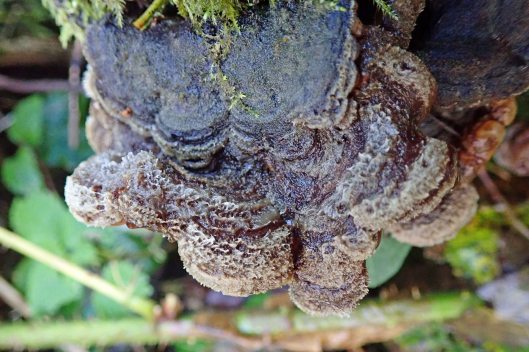
‘Nearly always associated with dead oak trees, this easily-overlooked crust fungus varies considerably in its appearance, sometimes mainly resupinate beneath fallen logs but usually in bracket form when on dead stumps,’ writes Pat O’Reilly on his First Nature website. The specimens of Oak curtain crust fungi I found yesterday, in Cardiff’s Grangemoor Park, were definitely growing on oak but, in this case, they were on thick, solid oak logs that have been used to construct benches and signposts.

191219 Oak Curtain Crust (2)

I always enjoy reading the etymology entries on O’Reilly’s website. Oak curtain crust’s binomial name is Hymenochaete rubiginosa, which is explained as follows:

Hymenochaete, the genus name, comes from hymen – a prefix referring to the fertile membrane (the crust surface), and -chaete perhaps from the Greek noun chaite meaning long hair and perhaps referring to the fine hairs (settae) on the upper surfaces of fungi in this generic group.
The specific epithet rubiginosa means rusty and refers to the reddish-brown colour of the hymenial (fertile) surface of this crust fungus.

191219 Oak Curtain Crust (1)

Like Loading...

340/365 Plums and custard

06 Friday Dec 2019

Posted by sconzani in fungi, nature, trees, winter

≈ Leave a comment

Tags

British fungi, fungi on conifers, Plums and custard, Tricholomopsis rutilans, winter fungi

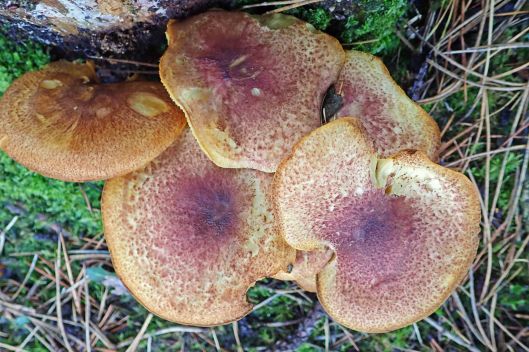
In this case, Plums and custard does not refer to a tasty Friday night dessert, sadly, but rather to a deliciously named fungus with the scientific name Tricholomopsis rutilans, which certainly does not roll off the tongue.

191206 plums and custard (1)

The Plums and custard name (and the alternate, Strawberry fungus) don’t refer to taste or edibility, however – at its most vibrant, this fungus displays rich shades of a plum-like colour on its cap and its gills are a lovely custard yellow.

191206 plums and custard (2)
191206 plums and custard (3)
191206 plums and custard (4)
191206 plums and custard (5)

These wood-rotting fungi are usually found growing on decaying conifers, and you can read more about them, their habitats, and their identification features on the First Nature website.

191206 plums and custard (6)

Like Loading...

331/365 Groovy bonnets

27 Wednesday Nov 2019

Posted by sconzani in autumn, fungi, nature

≈ 3 Comments

Tags

autumn fungi, Bonnet fungi, British fungi, Grooved bonnet, Mycena fungi, Mycena polygramma

Finally some fungi I can identify with confidence because, as Pat O’Reilly explains on the First Nature website,

Cap colour is rarely of much help when you are struggling to identify a Mycena, as they vary so much with age, location, humidity and growing substrate. If you look closely at the stem of a Grooved Bonnet you will see that it has longitudinal striations, whereas other common bonnet mushrooms have smooth stems.

So, the striated stems you can, hopefully, see in my second photo below prove that these lovely little bonnets I found growing in a tree in the grounds of a local church are … taaa daaa! … Grooved bonnets (Mycena polygramma).

191127 grooved bonnets (4)
191127 grooved bonnets (2)
191127 grooved bonnets (1)
191127 grooved bonnets (3)
Like Loading...

322/365 Tripe

18 Monday Nov 2019

Posted by sconzani in fungi, nature, trees

≈ 5 Comments

Tags

Auricularia mesenterica, British fungi, fungi on Elm trees, Tripe, Tripe fungi, Tripe fungus

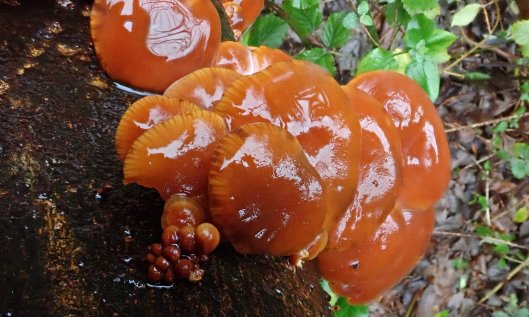
I’m sure you’ll be relieved to read that, despite its title, this blog has nothing to do with cow intestines. Rather, this is about a fungus, Tripe fungus (Auricularia mesenterica), not the loveliest of fungi but still an interesting find as it’s usually found growing on Elm trees. And Elms are few and far between following their devastation by Dutch Elm disease.

191118 tripe fungus (1)

I found these Tripe on a dead tree in Cogan Wood at Cosmeston Lakes Country Park this morning, in an area where I’ve previously found other fungi specific to Elm trees, so there were obviously several growing there in past days.

191118 tripe fungus (2)191118 tripe fungus (3)

Like Loading...

314/365 Toothed and crusty

10 Sunday Nov 2019

Posted by sconzani in autumn, fungi, nature

≈ 3 Comments

Tags

British fungi, crust fungi, fungus, Toothed crust, toothed fungi, toothed fungus

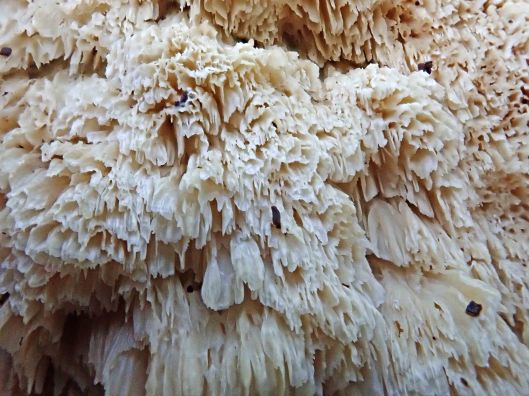
Crust fungi are notoriously difficult to identify and I’m not at all sure which this is, though one possibility is Toothed crust (Basidioradulum radula). Despite my uncertainty I thought I would share some photos as its shape and form are wonderfully sculptural and more than a little beautiful, I feel.

Toothed crust Forest Farm 191108 (1)
Toothed crust Forest Farm 191108 (2)

Toothed crust Forest Farm 191108 (3)

Toothed crust Forest Farm 191108 (4)
Toothed crust Forest Farm 191108 (5)
Like Loading...

287/365 Hygrocybe, but which

14 Monday Oct 2019

Posted by sconzani in autumn, fungi, nature

≈ 6 Comments

Tags

autumn colour, autumn fungi, British fungi, fungus, Hygrocybe, waxcap fungi, waxcaps

191014 hygrocybe (1)

Waxcaps are my favourite fungi but they can be difficult to identify. Sometimes the colour helps, but there are several species of a reddish-orange hue. As these have quite a coarse upper surface on the caps, I thought at first that they might be Fibrous waxcaps (Hygrocybe intermedia) but, as these were at Cosmeston Lakes Country Park, I’m wondering if they might be Hygrocybe calciphilia, which are smaller and grow on calcareous grassland. I really need to check their features more thoroughly in future. What I do know for sure is how lovely they are!

191014 hygrocybe (3)
191014 hygrocybe (4)

191014 hygrocybe (2)

Like Loading...

285/365 Mousepee pinkgill

12 Saturday Oct 2019

Posted by sconzani in autumn, fungi, nature

≈ Leave a comment

Tags

autumn fungi, British fungi, Cosmeston Lakes Country Park, Entoloma incanum, fungus, Mousepee pinkgill

What’s in a name? That which we call a Mousepee pinkgill
By any other name would still smell like mouse pee!
(with apologies to William Shakespeare)

191012 mousepee pinkgill (2)

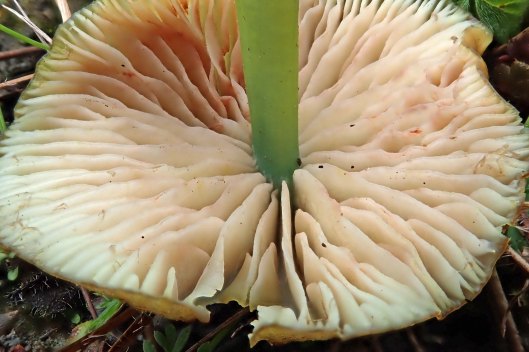
Truth be known, I have no idea what mouse pee smells like (and these fungi had been rained on for several days so the smell may well have dissipated) but I’m fairly sure that is what these fungi are. The greenish stem is a bit of a giveaway, and these are definitely not Parrot waxcaps, which are the only other green-stemmed fungi I know (though that, in itself, doesn’t mean there aren’t others).

191012 mousepee pinkgill (3)
191012 mousepee pinkgill (4)

191012 mousepee pinkgill (1)

You can read up on the Mousepee pinkgill (Entoloma incanum) on the most excellent First Nature website here.

191012 mousepee pinkgill (5)

Like Loading...

278/365 Happy National Fungi Day!

05 Saturday Oct 2019

Posted by sconzani in autumn, fungi, nature

≈ 2 Comments

Tags

#NationalFungiDay, bracket fungi, British fungi, Candlesnuff, fungus, National Fungi Day, oysterling fungi, Stump puffballs, Sulphur tuft, waxcaps

As today was National Fungi Day in Britain and we’ve had good quantities of the rain needed to stimulate fungal growth, I caught the train in to Cardiff today for a fungi foray around Heath Park and the new part of Cathays Cemetery. Here are some of the fungi I found …

191005 fungi (13)
191005 fungi (5)
191005 fungi (10)
191005 fungi (14)
191005 fungi (3)
191005 fungi (6)
191005 fungi (2)
191005 fungi (15)
191005 fungi (16)
191005 fungi (19)
191005 fungi (1)
191005 fungi (18)
191005 fungi (9)
191005 fungi (20)
191005 fungi (4)
191005 fungi (12)
191005 fungi (11)
191005 fungi (8)
191005 fungi (22)
191005 fungi (7)
191005 fungi (17)
191005 fungi (21)
Like Loading...
← Older posts
Newer posts →

About me

sconzani

sconzani

I'm a writer and photographer; researcher and blogger; birder and nature lover; countryside rambler and city strider; volunteer and biodiversity recorder.

View Full Profile →

Follow earthstar on WordPress.com

Enter your email address to follow this blog and receive notifications of new posts by email.

Recent blog posts

  • First large spider February 20, 2026
  • Our celebrity Redshank February 19, 2026
  • My first moth of the year February 18, 2026
  • Three Common sandpipers February 17, 2026
  • Beetle: Athous bicolor February 16, 2026

From the archives

COPYRIGHT

Unless otherwise acknowledged, the text and photographs on this blog are my own and are subject to international copyright. Nothing may be downloaded or copied without my permission.

Fellow Earth Stars!

  • Unknown's avatar
  • Unknown's avatar
  • Unknown's avatar
  • Unknown's avatar
  • Unknown's avatar
  • Unknown's avatar
  • Unknown's avatar
  • Unknown's avatar
  • Unknown's avatar
  • Unknown's avatar
  • Unknown's avatar
  • Unknown's avatar
  • Unknown's avatar
  • Unknown's avatar
  • Unknown's avatar
  • Unknown's avatar
  • Unknown's avatar
  • Unknown's avatar
  • Unknown's avatar
  • Unknown's avatar
  • Unknown's avatar
  • Unknown's avatar
  • Unknown's avatar
  • Unknown's avatar
  • Unknown's avatar
  • Unknown's avatar
  • Unknown's avatar
  • Unknown's avatar
  • Unknown's avatar
  • Unknown's avatar
  • Unknown's avatar
  • Unknown's avatar
  • Unknown's avatar
  • Unknown's avatar
  • Unknown's avatar
  • Unknown's avatar
  • Unknown's avatar
  • Unknown's avatar
  • Unknown's avatar
  • Unknown's avatar
  • Unknown's avatar
  • Unknown's avatar
  • Unknown's avatar
  • Unknown's avatar
  • Unknown's avatar
  • Unknown's avatar
  • Unknown's avatar
  • Unknown's avatar
  • Unknown's avatar
  • Unknown's avatar

Blog at WordPress.com.

Privacy & Cookies: This site uses cookies. By continuing to use this website, you agree to their use.
To find out more, including how to control cookies, see here: Cookie Policy
  • Subscribe Subscribed
    • earthstar
    • Join 670 other subscribers
    • Already have a WordPress.com account? Log in now.
    • earthstar
    • Subscribe Subscribed
    • Sign up
    • Log in
    • Report this content
    • View site in Reader
    • Manage subscriptions
    • Collapse this bar
 

Loading Comments...
 

You must be logged in to post a comment.

    %d