• ABOUT
  • BIRDING 2018
  • Birding 2019
  • BLOG POSTS
  • Butterflies 2018
  • Resources

earthstar

~ a celebration of nature

earthstar

Tag Archives: British fungi

Shooting stars

14 Friday Jan 2022

Posted by sconzani in fungi

≈ Leave a comment

Tags

Artillery fungus, British fungi, Cannonball fungus, Shooting star fungus, Shotgun fungus, Sphaerobolus stellatus

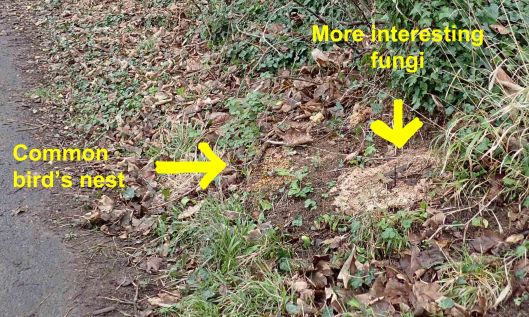
This was a first for me, an amazing cluster of fungi within inches of the Common bird’s nest fungi I blogged about yesterday. Variously named ‘Shooting star’, ‘Shotgun’, Artillery’ and ‘Cannonball’ fungus, Sphaerobolus stellatus gets its name from the way it shoots out its spores, apparently with a popping sound that you can actually hear and at a force that sends them flying up to 6 metres.

220114 shooting star (1)

I haven’t been able to find a lot of information about this fungus except for the Wikipedia entry on the genus Sphaerobolus, which looks reliable and includes some of the more technical details of its eruptive system, if you’re interested in the nitty gritty. I’m planning to return when it’s drier for another look and to get better photos.

220114 shooting star (2)
220114 shooting star (3)
Like Loading...

Common bird’s nests

13 Thursday Jan 2022

Posted by sconzani in fungi

≈ Leave a comment

Tags

Bird's nest fungi, British fungi, Common bird's-nest fungus, Crucibulum laeve

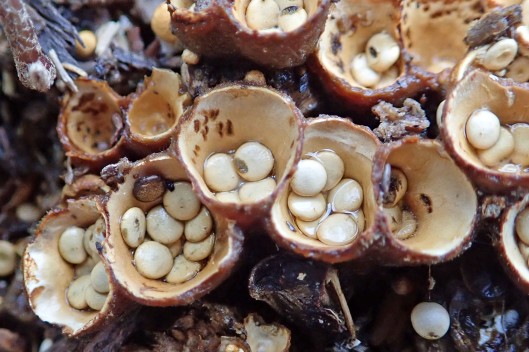
I had planned a long walk along a local beach but unforecast hail and almost constant showers sent me stomping homeward sooner than expected, a little disappointed at not seeing many waterfowl. And then a splash of yellow on the ground caught my eye, a blob of Witch’s butter (Tremella mesenterica) on a small fallen branch. But, even better than the butter, my eye was drawn to this fabulous cluster of Common bird’s nest fungi (Crucibulum laeve), a species that’s more common than you might think but very easily overlooked because of its small size.

I’ve blogged about these fungi before (Bird’s-nests with eggs!, August 2017) – click on the link to see better photos, taken in dry weather, when the details of the nests and their eggs can be more clearly seen. And check out tomorrow’s post for some even more amazing fungi, lurking right next to these bird’s nests.

Like Loading...

It’s Tripe time

07 Friday Jan 2022

Posted by sconzani in fungi

≈ Leave a comment

Tags

Auricularia mesenterica, British fungi, fungi on Elm trees, Tripe, Tripe fungus

At first glance, I thought this was Turkey tail, a common bracket fungus that I’m sure most people are aware of.

220107 tripe (1)

But, when I looked more closely, particularly at the newest growth – those fat, juicy looking little buttons, and also at how furry some of the growth was, I knew my initial impression was wrong. This is Tripe fungus (Auricularia mesenterica).

220107 tripe (2)
220107 tripe (3)
220107 tripe (4)

I couldn’t tell what the wood was as the tree had been sawn off very close to the ground and only a very short section of trunk and some sections of exposed root remained (all of which were covered in fungal growth). But, Tripe fungus grows most commonly on Elm trees so I assume this was an English elm that had succumbed to Dutch elm disease.

Like Loading...

I is for inkcap

14 Tuesday Dec 2021

Posted by sconzani in fungi

≈ Leave a comment

Tags

British fungi, inkcap fungi, inkcaps, mushrooms

Time to add some fungi to this countdown. Earthstars would be too predictable so I’ve chosen instead to focus on some of the more common fungi that we all see when we’re out on our wanders: the inkcaps. They come in many shapes and sizes, grow in grass and dense woodland, are not always easy to identify, and are often to be found in a state of deliquescence (dissolving into black mush). Here’s a selection of this year’s finds.

211214 inkcaps (1)
211214 inkcaps (2)
211214 inkcaps (3)
211214 inkcaps (4)
211214 inkcaps (5)
211214 inkcaps (6)
Like Loading...

Grey knights

03 Friday Dec 2021

Posted by sconzani in fungi

≈ Leave a comment

Tags

British fungi, Grey knight, Tricholoma species, Tricholoma terreum

Happy Fungi Friday!

211203 grey knight (1)

I’m fairly sure these are Grey knights (Tricholoma terreum), though, as with many fungi, I’m not exactly sure of my identification and it can be difficult to separate the grey Tricholoma species. According to the First Nature website, Grey Knights are usually found in coniferous forests – mine were in a cemetery but there were several conifers growing nearby, and I know these fungi have been found at this cemetery previously.

211203 grey knight (2)
211203 grey knight (3)
Like Loading...

Oozing brackets

26 Friday Nov 2021

Posted by sconzani in fungi, insects

≈ Leave a comment

Tags

Alder bracket, bracket fungi, British fungi, Fungus gnat larvae, Inonotus radiatus

It was the weak sunlight filtering through the almost-leafless overhead branches that drew my eyes to these fungi, their droplets of oozing liquid glinting as the light fell on them.
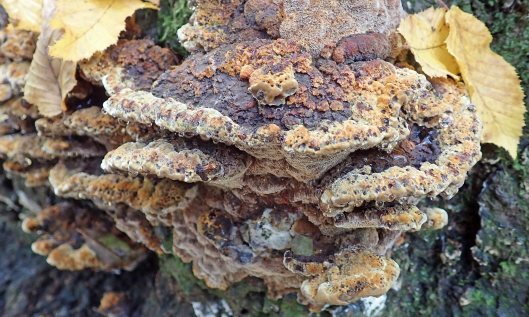
211126 alder brackets (1)

These are Alder brackets, Inonotus radiatus, a common species which, as you might expect from the name, is most often found on dead and dying Alder trees, though it does also grow on other species of hardwood trees.
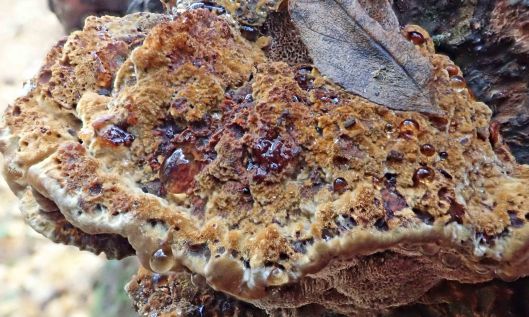
211126 alder brackets (2)

According to the First Nature website, ‘Inonotus, the genus name of the Alder Bracket fungus, comes from ino– a prefix meaning fibrous, and ot which means an ear; the ending –us merely turns it into the form of a Latinised noun. The specific name radiatus comes from the Latin radi– meaning a ray, spoke or plate, and it is probably a reference to the radial wrinkles that are often evident on the upper surfaces of mature Alder Brackets.’

211126 alder brackets (3)

As you can see from my last photograph, these particular brackets were also home to several tiny larvae, perhaps of fungus gnats, though I can’t be sure of that.
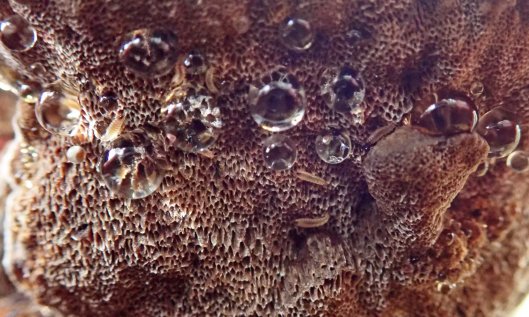

211126 alder brackets (4)

Like Loading...

Clubs and stagshorns

19 Friday Nov 2021

Posted by sconzani in autumn, fungi

≈ 2 Comments

Tags

British fungi, club fungi, Handsome club, Small stagshorn, Yellow club

The one in which we look at yellow stick-like fungi, poking up out of the ground, or wood.

211119 handsome club (1)
211119 handsome club (2)

Club fungi can be difficult to identify positively so I can’t be completely sure of my names here, though I have had some help from an expert. So, this first fungus, found in local deciduous woodland, is probably Handsome club (Clavulinopsis laeticolor).

211119 yellow club

This next club fungus looks superficially similar to the last but this one had sprouted in mossy grassland, meaning it is likely Yellow club (Clavulinopsis helvola).

211119 small stagshorn

And this third yellow stick-like fungus is paler, almost translucent and jelly-like, and was flourishing on decaying wood. I’m fairly sure this is Small stagshorn (Calocera cornea).

Like Loading...

Cemetery fungi

12 Friday Nov 2021

Posted by sconzani in autumn, fungi

≈ 2 Comments

Tags

boletes, British fungi, cemetery fungi, Cortinarius, earthtongues, entoloma fungi, fungi at the cemetery, waxcaps

In recent weeks I’ve paid several visits to Cardiff’s Cathays Cemetery so today I thought I’d share a selection of some of the glorious fungi I’ve seen, including various species of bolete, entoloma and cortinarius, as well as waxcaps and earthtongues.

Like Loading...

Helvella crispa

09 Tuesday Nov 2021

Posted by sconzani in fungi

≈ 4 Comments

Tags

British fungi, fungi under Beech, Helvella crispa, White saddle, woodland fungi

I think I’m developing an obsession with these beautiful fungi, Helvella crispa, commonly known as White saddles.

211109 helvella crispa (1)

These photos were taken during last week’s cemetery meander but I’ve also found a large group of these fungi recently in the woodland at Cosmeston Lakes Country Park.

211109 helvella crispa (2)

Perhaps it’s my imagination, but I fancy I can make out forms, spooky, ghostly creatures that have emerged from the earth.

211109 helvella crispa (3)

Like Loading...

Ears on the ground

05 Friday Nov 2021

Posted by sconzani in autumn, fungi

≈ Leave a comment

Tags

British fungi, ear fungi, Hare's ears, Otidea fungi, Otidea onotica

Growing on the ground under a large old beech tree is not where I’d usually expect to see ‘ears’ but there they were. Admittedly, I did initially think these were a species of cup fungus, and it wasn’t until I was looking more closely at my photos that I realised the cups had a split down the side, which indicates they are not cups but ‘ears’, one of the Otidea species.

211105 otidea species (1)

There are several species of Otidea growing in Britain: the two most common in Wales are Hare’s ear (Otidea onotica) and Tan ear (Otidea alutacea) but neither have been recorded in the Cardiff area. Though my finds look a little different from the usual Hare’s ear fungi, I suspect that, as mine were growing under Beech, they probably are Hare’s ears but they really need microscopic analysis to be certain.

211105 otidea species (2)

Despite not being able to positively identify these ‘ears’, I was absolutely delighted to have my first sighting of them, though it did make me wish my knees were younger and I was better able to get down on the ground to properly enjoy and photograph them!

211105 otidea species (3)

Like Loading...
← Older posts
Newer posts →

About me

sconzani

sconzani

I'm a writer and photographer; researcher and blogger; birder and nature lover; countryside rambler and city strider; volunteer and biodiversity recorder.

View Full Profile →

Follow earthstar on WordPress.com

Enter your email address to follow this blog and receive notifications of new posts by email.

Recent blog posts

  • Q is for Quercus December 22, 2025
  • P is for Phalarope December 21, 2025
  • O is for Odonata December 20, 2025
  • N is for nest December 19, 2025
  • M is for mite December 18, 2025

From the archives

COPYRIGHT

Unless otherwise acknowledged, the text and photographs on this blog are my own and are subject to international copyright. Nothing may be downloaded or copied without my permission.

Fellow Earth Stars!

  • Unknown's avatar
  • Unknown's avatar
  • Unknown's avatar
  • Unknown's avatar
  • Unknown's avatar
  • Unknown's avatar
  • Unknown's avatar
  • Unknown's avatar
  • Unknown's avatar
  • Unknown's avatar
  • Unknown's avatar
  • Unknown's avatar
  • Unknown's avatar
  • Unknown's avatar
  • Unknown's avatar
  • Unknown's avatar
  • Unknown's avatar
  • Unknown's avatar
  • Unknown's avatar
  • Unknown's avatar
  • Unknown's avatar
  • Unknown's avatar
  • Unknown's avatar
  • Unknown's avatar
  • Unknown's avatar
  • Unknown's avatar
  • Unknown's avatar
  • Unknown's avatar
  • Unknown's avatar
  • Unknown's avatar
  • Unknown's avatar
  • Unknown's avatar
  • Unknown's avatar
  • Unknown's avatar
  • Unknown's avatar
  • Unknown's avatar
  • Unknown's avatar
  • Unknown's avatar
  • Unknown's avatar
  • Unknown's avatar
  • Unknown's avatar
  • Unknown's avatar
  • Unknown's avatar
  • Unknown's avatar
  • Unknown's avatar
  • Unknown's avatar
  • Unknown's avatar
  • Unknown's avatar
  • Unknown's avatar
  • Unknown's avatar

Blog at WordPress.com.

Privacy & Cookies: This site uses cookies. By continuing to use this website, you agree to their use.
To find out more, including how to control cookies, see here: Cookie Policy
  • Subscribe Subscribed
    • earthstar
    • Join 667 other subscribers
    • Already have a WordPress.com account? Log in now.
    • earthstar
    • Subscribe Subscribed
    • Sign up
    • Log in
    • Report this content
    • View site in Reader
    • Manage subscriptions
    • Collapse this bar
 

Loading Comments...
 

You must be logged in to post a comment.

    %d