• ABOUT
  • BIRDING 2018
  • Birding 2019
  • BLOG POSTS
  • Butterflies 2018
  • Resources

earthstar

~ a celebration of nature

earthstar

Tag Archives: British hoverflies

240/366 Helophilus trivittatus

27 Thursday Aug 2020

Posted by sconzani in insects, nature

≈ 1 Comment

Tags

British hoverflies, Helophilus trivittatus, hoverfly

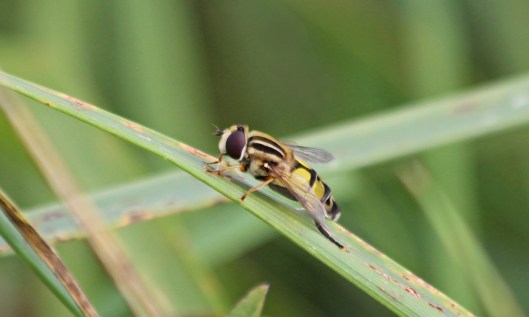
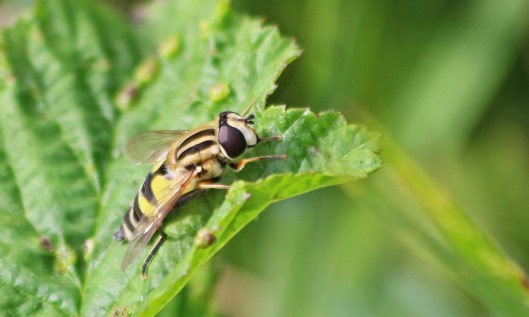
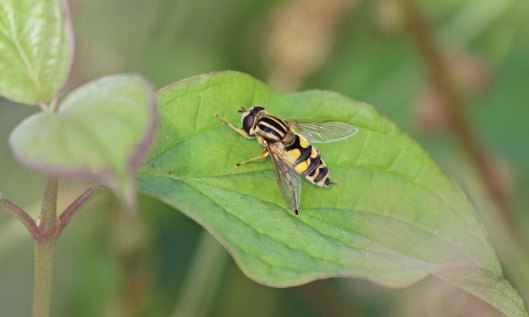
Somehow this splendid hoverfly had passed me by, probably many times, without my noticing its presence in my landscape. It wasn’t until one of my Twitter pals (thank you, Tate) posted a photo of his recent sighting at Cosmeston Lakes that I thought ‘Hang on a minute. Why haven’t I seen that?’, and duly set out to find one.

200827 helophilus trivittatus (1)

And, like buses, once one comes along, a whole fleet is soon whizzing past.

200827 helophilus trivittatus (2)

One of the possible reasons I hadn’t noticed it before is because it’s a migratory species so perhaps there haven’t been as many around in previous years.

200827 helophilus trivittatus (3)

Also, Helophilus trivittatus looks a lot like its close relative Helophilus pendulus, but H. trivittatus is actually much more lemon-yellow in colour, and it’s a little longer in the body (which is noticeable once you get your eye in), and it doesn’t have the black stripe down the centre of its face that the other Helophilus species have.

200827 helophilus trivittatus (4)

This handsome hoverfly tends to be found in coastal areas or, as it prefers a damp habitat, along the routes of Britain’s main river systems in the southern half of Britain.

Like Loading...

170/366 Misc hoverflies

18 Thursday Jun 2020

Posted by sconzani in insects, nature

≈ 4 Comments

Tags

British hoverflies, Cheilosia illustrata, Chrysotoxum bicinctum, Episyrphus balteatus, Eupeodes corollae, Helophilus pendulus, hoverfly, Sphaerophoria scripta, Volucella pellucens, Xanthogramma pedissequum, Xylota species

Hoverflies seem particularly numerous this year … or maybe it’s just that I’ve been keeping more of an eye out for them. Here are some of the species I’ve clocked in the past couple of weeks. Looking through my photos again now, I’m struck by how diverse these lovely creatures are.

OLYMPUS DIGITAL CAMERA

Volucella bombylans: One of the bumblebee-mimicking hoverflies. This one was snoozing on a cool day, which is how I managed to get a nice close shot.

200618 chrysotoxum bicinctum

Chrysotoxum bicinctum: Its distinctive yellow bars make this hoverfly reasonably easy to identify.

OLYMPUS DIGITAL CAMERA

Episyrphus balteatus: Also known as the Marmalade hoverfly. Despite its small size, this species is known some years to migrate en masse to Britain from continental Europe.
OLYMPUS DIGITAL CAMERA

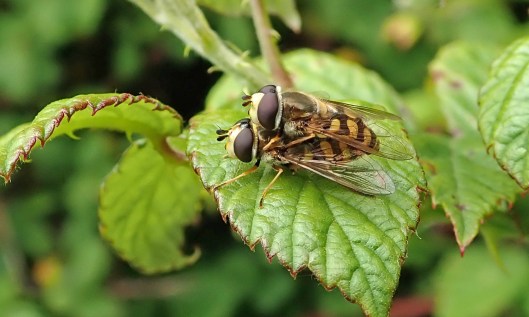
Eupeodes corollae: These two were otherwise occupied, which allowed me to get quite close to them.

OLYMPUS DIGITAL CAMERA

Helophilus pendulus: The ‘footballer’, because of the striped ‘footballers’ kit’ markings on its abdomen.

OLYMPUS DIGITAL CAMERA

Sphaerophoria scripta: Apparently, the yellow colouration is influenced by the temperature at which the larvae develop, so Spring-born individuals can be darker than those hatching later in the year.

OLYMPUS DIGITAL CAMERA

Volucella pellucens: One of Britain’s larger hoverflies; also known as the Great Pied hoverfly and the Pellucid fly.
200618 xanthogramma pedissequum

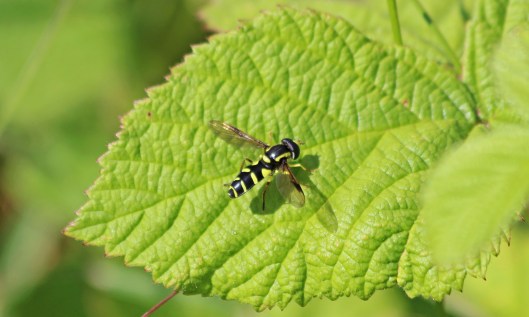
Xanthogramma pedissequum: This used to be easy to identify from its distinctive markings but, in 2012, the very similar Xanthogramma stackelbergi was added to the British list so now the thoracic markings need to be carefully checked to ensure the correct identification.

OLYMPUS DIGITAL CAMERA

Xylota species: I didn’t get good enough photos of this one to be able to work out whether this was X. segnis or X. sylvarum – you need very clear views of its hind tibia to work out which is which.

 

Like Loading...

155/366 A new hoverfly

03 Wednesday Jun 2020

Posted by sconzani in insects, nature

≈ 9 Comments

Tags

British hoverflies, Casehill Woods, hoverfly, Volucella inflata

Yesterday’s walk saw me exploring new trails – always exciting as I never know what I might find. I’d walked through part of Casehill Woods a couple of times before but in the winter months, when the ground was sodden and heavy with slippery mud, so it was nice to return for a summer visit – the first of many, I think. I particularly wanted to check out the woodland rides, for butterflies and other beasties – and a beastie is what I found there, a new-to-me and new-to-my-local-10km-recording-square hoverfly, Volucella inflata.

200603 volucella inflata

This gorgeous golden creature favours woodlands, and feeds on the flowers of Bramble and shrubs like Wild privet and Dogwood, so the habitat at Casehill Woods is perfect for it. These hoverflies should be on the wing for a few more weeks yet so I’ll be keeping an eye out for more when next I walk these paths.

Like Loading...

141/366 A Buff-tailed bear

20 Wednesday May 2020

Posted by sconzani in insects, nature

≈ 4 Comments

Tags

British hoverflies, Buff-tailed bear hoverfly, bumblebee mimic, Cogan Wood, Cosmeston Lakes Country Park, Criorhina floccose, hoverfly

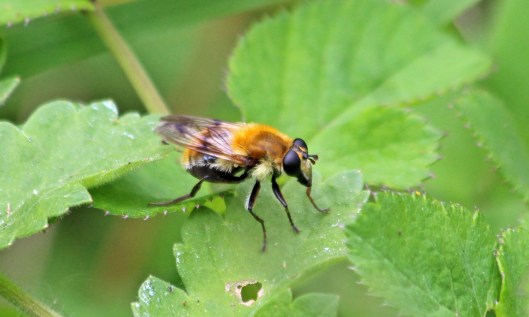
Bear? There are bears in south Wales? No, don’t worry, this Buff-tailed bear is a hoverfly (Criorhina floccose), a new find for me, from my first visit to Cosmeston Lakes Country Park in weeks (due to the Corona virus, the park was closed from 23 March until last Saturday 16 May). I initially thought this hoverfly was a variation of one of the other bumblebee-mimicking hoverflies, Merodon equestris, as they can be found in a wide variety of colours. But my record has been corrected by Mr UK Hoverflies himself, Roger Morris, and I now know the tufts of pale hairs at the sides of its abdomen are one of the main diagnostic features.

200520 Criorhina floccose (1)

These hoverflies are fashioned to mimic Common carder bees – see comparison photos below, hoverfly on the left, Common carder bee on the right. I think the hoverfly deserves an A for effort!

200520 Criorhina floccose (2)
200520 Common carder

Criorhina floccose is usually found in woodland – I found this one in a sheltered clearing in Cosmeston’s Cogan Wood, and there’s only been one previous record in my local 10-kilometre square. Now I know what to look for, I’ll be keeping an eye out for more.

Like Loading...

37/366 My first hoverfly larva

06 Thursday Feb 2020

Posted by sconzani in insects, nature

≈ 5 Comments

Tags

British hoverflies, dormant hoverfly larvae, hoverfly, hoverfly larva, Platycheirus larva, Platycheirus species

When I first saw this creature, I thought it might be a butterfly or moth larva but I was wrong – nothing new there!

OLYMPUS DIGITAL CAMERA

Thanks to a Twitter pal, I now know it’s a hoverfly larva and, with some excellent help from an entomologist who specialises in flies, I also now know it’s one of the Platycheirus family of hoverflies but not which of their 25 British species.

OLYMPUS DIGITAL CAMERA

Apparently, little is known about the larvae of some species of hoverflies: their larvae have not yet been fully examined or described, so you really need to rear a dormant larva through to adulthood to be sure. Not knowing that, I left this one in the woodland where I saw it, but next time …

Like Loading...

269/365 Still hovering

26 Thursday Sep 2019

Posted by sconzani in 365DaysWildin2019, autumn, insects, nature

≈ 2 Comments

Tags

British hoverflies, Cosmeston Lakes Country Park, Eristalis nemorum, Eristalis species, Helophilus pendulus, hoverfly, Syrphus species

Despite the wind and rain of recent days, which continued through part of today, when the sun came out at Cosmeston there were still a few hoverflies about. I’ve forgotten everything I ever knew about hoverflies, which wasn’t much, but I think these are Syrphus sp. (these usually need microscopic examination to identify to species), Eristalis sp. (my photo doesn’t show enough details to be sure which species this is – maybe E. tenax), Eristalis nemorum, and ‘The footballer’, Helophilus pendulus.

190926 hoverflies (1) 

190926 hoverflies (2)
190926 hoverflies (3)

190926 hoverflies (4)

Like Loading...

251/365 Sericomyia silentis

08 Sunday Sep 2019

Posted by sconzani in 365DaysWildin2019, flowers, insects, nature, wildflowers

≈ 2 Comments

Tags

#365DaysWild, Bog hoverfly, British hoverflies, Devil's-bit scabious, hoverfly, Lavernock Nature Reserve, pink scabious, Sericomyia silentis

It looks a bit like a wasp but this black-and-yellow-striped minibeastie is a hoverfly with the rather tongue-twisting name Sericomyia silentis. Perhaps Bog hoverfly would be easier but, in my opinion, its common name doesn’t do this little beauty justice.

190908 sericomyia silentis (1)

I spent a couple of hours today at Lavernock Nature Reserve, where the Devil’s-bit scabious is looking simply stunning and is attracting myriads of insects. I took lots of butterfly photos but thought to post one of the other little critters today. The Devil’s-bit is usually a lilac colour but some at Lavernock are this subtle shade of pink instead. Its nectar obviously tastes just as good!

190908 sericomyia silentis (2)
190908 sericomyia silentis (4)
190908 sericomyia silentis (5)
190908 sericomyia silentis (6)
Like Loading...

152/365 Hovering

01 Saturday Jun 2019

Posted by sconzani in 365DaysWildin2019, insects, nature

≈ 4 Comments

Tags

#365DaysWild, British hoverflies, Chrysotoxum bicinctum, Episyrphus balteatus, Helophilus pendulus, hoverfly, Volucella bombylans, Volucella bombylans subsp. plumata, Xanthogramma pedissequum

I found a new path today, which led me through swathes of long grass bordered by brambles and low shrubby bushes. I emerged with wet shoes and trousers from the dew still coating the grass but with lots of photos of hoverflies, so I will definitely be going back to explore further. Here are the hovers …

190601 1 volucella bombylans
190601 2 volucella bombylans subsp plumata

Volucella bombylans and Volucella bombylans subsp. plumata
At first glance you might think these two hoverflies were bumblebees, and that’s exactly what they want you to think – or, rather, what they want bumblebees to think, because they don’t want to be caught out when sneaking in to lay their eggs in the nests of the bumblebees they mimic (which are the Red-tailed bumblebee Bombus lapidarius and the White-tailed bumblebee Bombus lucorum respectively).

190601 3 helophilus pendulus
190601 4 chrysotoxum bicinctum

Helophilus pendulus and Chrysotoxum bicinctum
Do you see why the hoverfly on the left is known as The Footballer? I’m not sure which football team his colourful markings are meant to represent – perhaps Helophilus pendulus has its own team. Its distinctive bands of bright yellow make Chrysotoxum bicinctum one of the easier hoverflies to identify.

190601 5 Xanthogramma pedissequum
190601 6 episyrphus balteatus

Xanthogramma pedissequum and Episyrphus balteatus
Xanthogramma pedissequum is another hoverfly with reasonably easy to identify markings – believe me, not all hoverflies are so easy! And with its rich orange colouring, Episyrphus balteatus looks almost edible, which is probably why it’s called the Marmalade hoverfly.

Like Loading...

Hovering no more

17 Wednesday Oct 2018

Posted by sconzani in autumn, insects, nature, wildflowers

≈ 4 Comments

Tags

British hoverflies, hoverflies

What a difference a week makes! Seven days ago I was still seeing quite a few hoverflies, feeding on the remaining wildflowers and basking on leaves in the occasional sunshine.

181017 hoverflies (7)

Since then, we’ve had a couple of much cooler nights and the blast of wild, wet and windy weather that was Storm Callum, and the hoverflies seem mostly to have disappeared.

181017 hoverflies (1)
181017 hoverflies (2)
181017 hoverflies (3)
181017 hoverflies (4)
181017 hoverflies (5)
181017 hoverflies (6)

Is that the last I’ll see of them till 2019? Only time will tell.

181017 hoverflies (8)

Like Loading...

The Chinooks of the hoverfly world

26 Sunday Aug 2018

Posted by sconzani in insects, nature

≈ 6 Comments

Tags

British hoverflies, Great pied hoverfly, Hornet mimic, hoverflies, hoverfly, Penarth Rail Trail, Volucella pellucens, Volucella species, Volucella zonaria

These are a couple of the Volucella species, the Chinooks of the hoverfly world and, if you live in the southern parts of Britain, they’ll be out there hovering along woodland paths and in local parks near you right now. Before you panic and get out your fly swat, these hoverflies may look a little menacing – and some of them even look a bit like Hornets – but, please rest assured, they are all completely harmless. And, if you take a little time for a closer look, you will soon see what incredibly handsome mini-beasties they are.

180826 Volucella zonaria (4) 

180826 Volucella zonaria (3)
180826 Volucella zonaria (2)
180826 Volucella zonaria (1)

With a wing length between 15 and 20mm, Volucella zonaria is the largest British hoverfly and is sometimes known as the Hornet mimic. (There is a very similar species called Volucella inanis but we don’t see them very often in south Wales.) Since arriving in Britain, on England’s south coast, in the 1930s, V. zonaria has made itself at home and has spread west and northwards. During July and August, I’ve seen several of these beauties at Lavernock Nature Reserve and along our local rail trail, a former railway line now a tree-lined foot- and cycling path.

180826 Volucella pellucens (1)

With its large size and black-and-white colouring, Volucella pellucens is a very distinctive hoverfly and easy to identify. You can see why it’s also known as the Great Pied hoverfly. When it’s not feasting on pollen and nectar, it can often be found defending its airspace by hovering around head height along paths and trails. If you stand still, it will sometimes approach to check you out but, once again, it will do you absolutely no harm and move out of your way when you carry on walking. 

180826 Volucella pellucens (2)
180826 Volucella pellucens (3)
180826 Volucella pellucens (4)
Like Loading...
← Older posts
Newer posts →

About me

sconzani

sconzani

I'm a writer and photographer; researcher and blogger; birder and nature lover; countryside rambler and city strider; volunteer and biodiversity recorder.

View Full Profile →

Follow earthstar on WordPress.com

Enter your email address to follow this blog and receive notifications of new posts by email.

Recent blog posts

  • Blackthorn in bloom January 11, 2026
  • Weevil: Mecinus pyraster January 10, 2026
  • Red in beak and claw January 9, 2026
  • Who’s watching who? January 8, 2026
  • Springtail: Orchesella cincta January 7, 2026

From the archives

COPYRIGHT

Unless otherwise acknowledged, the text and photographs on this blog are my own and are subject to international copyright. Nothing may be downloaded or copied without my permission.

Fellow Earth Stars!

  • Unknown's avatar
  • Unknown's avatar
  • Unknown's avatar
  • Unknown's avatar
  • Unknown's avatar
  • Unknown's avatar
  • Unknown's avatar
  • Unknown's avatar
  • Unknown's avatar
  • Unknown's avatar
  • Unknown's avatar
  • Unknown's avatar
  • Unknown's avatar
  • Unknown's avatar
  • Unknown's avatar
  • Unknown's avatar
  • Unknown's avatar
  • Unknown's avatar
  • Unknown's avatar
  • Unknown's avatar
  • Unknown's avatar
  • Unknown's avatar
  • Unknown's avatar
  • Unknown's avatar
  • Unknown's avatar
  • Unknown's avatar
  • Unknown's avatar
  • Unknown's avatar
  • Unknown's avatar
  • Unknown's avatar
  • Unknown's avatar
  • Unknown's avatar
  • Unknown's avatar
  • Unknown's avatar
  • Unknown's avatar
  • Unknown's avatar
  • Unknown's avatar
  • Unknown's avatar
  • Unknown's avatar
  • Unknown's avatar
  • Unknown's avatar
  • Unknown's avatar
  • Unknown's avatar
  • Unknown's avatar
  • Unknown's avatar
  • Unknown's avatar
  • Unknown's avatar
  • Unknown's avatar
  • Unknown's avatar
  • Unknown's avatar

Blog at WordPress.com.

Privacy & Cookies: This site uses cookies. By continuing to use this website, you agree to their use.
To find out more, including how to control cookies, see here: Cookie Policy
  • Subscribe Subscribed
    • earthstar
    • Join 669 other subscribers
    • Already have a WordPress.com account? Log in now.
    • earthstar
    • Subscribe Subscribed
    • Sign up
    • Log in
    • Report this content
    • View site in Reader
    • Manage subscriptions
    • Collapse this bar
 

Loading Comments...
 

You must be logged in to post a comment.

    %d