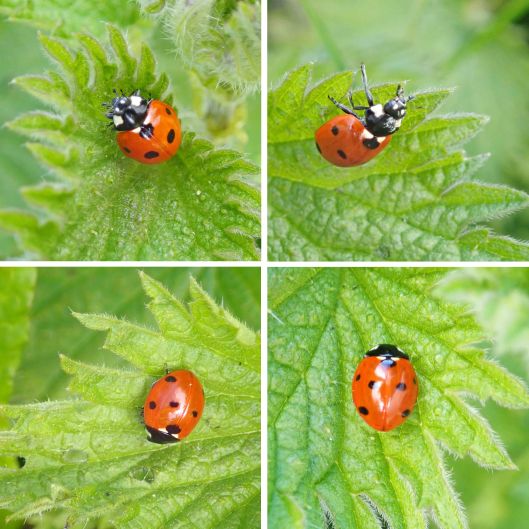
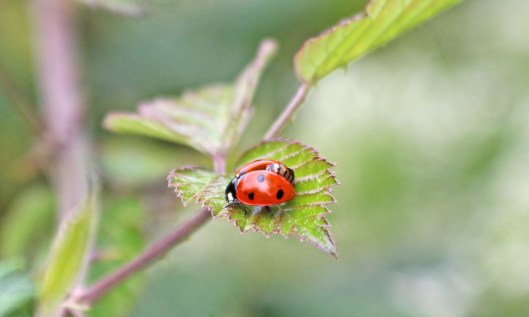
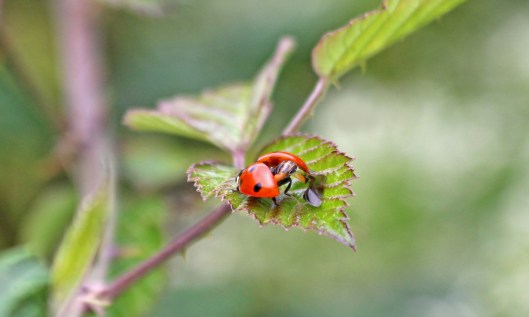
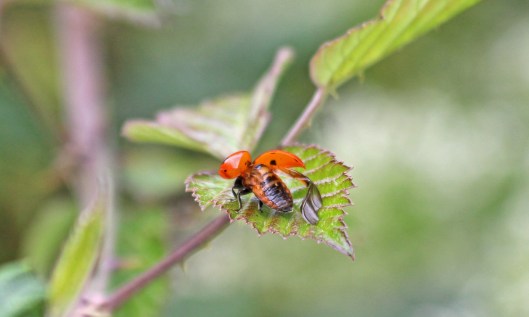
Isn’t it lovely to see ladybirds again? There were at least eight 7-spot ladybirds on these freshly sprouted Nettle plants, possibly more mini-beasties hiding under the leaves, but I wasn’t going to get stung looking for them.

13 Wednesday Apr 2022
Isn’t it lovely to see ladybirds again? There were at least eight 7-spot ladybirds on these freshly sprouted Nettle plants, possibly more mini-beasties hiding under the leaves, but I wasn’t going to get stung looking for them.

11 Thursday Nov 2021
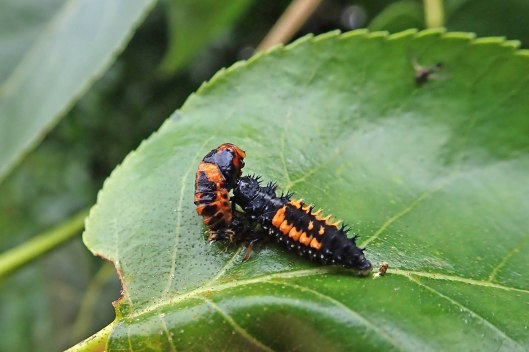
I was really surprised during Tuesday’s walk to see so many ladybirds still about – not only adults but also a lot of larvae, and this one pair of adults that obviously thought it was springtime not late autumn.

On one small section of nettles growing along the road verge there were over 20 ladybirds.

Unfortunately, every single one was a Harlequin ladybird – not a 7-spot or other species to be seen.
05 Thursday Aug 2021
Tags
22-spot ladybird, 22-spot ladybird larvae, British ladybirds, ladybird larvae, Psyllobora vigintiduopunctata
Yesterday was the first time I’ve seen the larvae of the 22-spot ladybird (Psyllobora vigintiduopunctata).

I was checking Lesser burdock plants for their special fly Terellia tussilaginis when I noticed first the distinctive yellow-and-black markings of the adult 22-spot and then, lower down on the big floppy burdock leaves at ground level, several of the also distinctive larvae. I do like it when insects are easy to identify!

15 Thursday Jul 2021
Tags
7-spot ladybird, 7-spot ladybird pupa, British ladybirds, Harlequin eating 7-spot, harlequin ladybird, Harlequin ladybird larva
In the Silence of the Lambs, it was Hannibal Lecter; in the world of ladybirds, it’s Hannibal Harlequin. Yes, folks, though I’m sure you all thought ladybirds were cute, it’s actually a ladybird eats ladybird world out there! In this case, a Harlequin ladybird larva is eating the pupa of a 7-spot ladybird.

05 Monday Jul 2021
Tags
7-spot ladybird, 7-spot ladybird lifecycle, British ladybirds, Coccinella septempunctata, ladybird life cycle
A few weeks ago I wrote about going insecting and showed a few of my recent finds, including what I suspected was a photo of ladybird eggs. Sure enough, when I revisited that particular spot last week, I found ladybirds in various stages of development. When I add in a photo, taken in a previous year, of ladybirds about to mate on a gorse bush, we have the full lifecycle: mating, eggs, larva, larva beginning to pupate, pupa and recently emerged adult (they often emerge quite pale), all of the 7-spot ladybird (Coccinella septempunctata).
18 Thursday Mar 2021
Tags
7-spot ladybird, British ladybirds, Coccinella septempunctata, Seven-spot ladybird, Spring colour
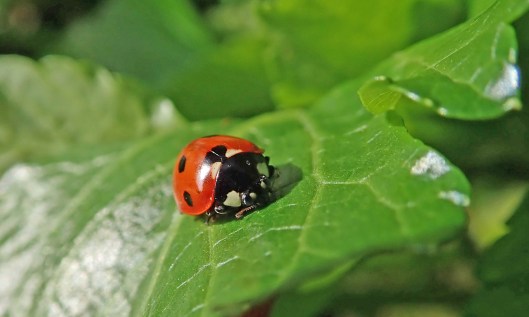
A tiny spot of red caught my eye, and then, close by, another – my first ladybirds of the year, both Seven-spot ladybirds (Coccinella septempunctata).

If you’re lucky, you may have had these little beauties hibernating in your garden shed but, in this case, these two are countryside dwellers so have probably spent the winter inside a plant stem, or perhaps tucked securely within the dense branches of ivy, or maybe in a deep crack in tree bark. A few sunny days and warmer overnight temperatures will have triggered their emergence from hibernation, and produced another spring treat for me to enjoy!

03 Friday Jul 2020
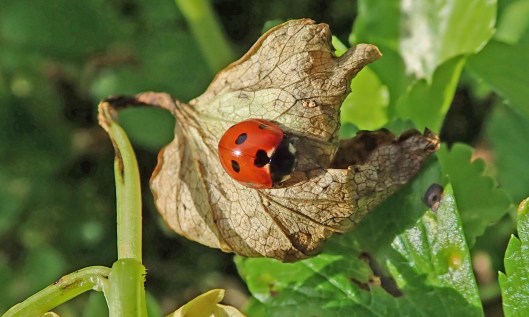
This is a bit of a sad story. During yesterday’s walk, I spotted this Seven-spot ladybird sitting on a leaf alongside the path.

It was acting a bit strangely: opening its elytra (wing cases), raising its abdomen, shutting its elytra, over and over again. It took me a minute to realise that it only seemed to have one full-size wing; the other appeared stunted or perhaps it had been damaged and was no longer able to be extended.

I presume the ladybird was trying to remedy the problem through its movements but they didn’t seem to have any effect, and I fear this ladybird may be forever grounded.

13 Sunday Oct 2019
11 Tuesday Jul 2017
Tags
British ladybirds, Halyzia 16-guttata, Halyzia secedimguttata, ladybird, ladybird larva, ladybug, Orange ladybird

When I’m out and about on my wanders, it’s usually a preponderance of Harlequin ladybirds that I see but this day was different. Instead of Harlequins, there seemed to be beautiful little Orange ladybirds (Halyzia 16-guttata) wherever I looked. And there weren’t just adult ladybirds – almost every leaf I turned over had their larvae as well. And this was across two different parks, not just in one location.
We are constantly warned that the invasive Harlequins, first recorded in Britain in October 2004, are a serious threat to Britain’s native ladybirds, and surveys have shown that most native ladybirds are in serious decline, partly due to the Harlequin but also due to habitat loss. Perhaps the Orange ladybird is fighting back. It has apparently adapted to living on different tree species, first the sycamore and more recently the ash, so this may be aiding its apparent increase in abundance. I certainly hope so!
Don’t forget that we can’t know what’s happening with British ladybirds (or, indeed, any other living species) unless sightings are recorded. You can record yours through your local biodiversity records centre or directly with the UK Ladybird Survey website here.
You must be logged in to post a comment.