Yesterday I spotted my first moth of the year, perched on my favourite park railings, this lovely Angle shades.
If you’ve been following along here for a while, you might remember the saga of Colin, the Angle shades moth I reared from a caterpillar. If you’re new and interested – it’s a lovely little series – these are the posts: Colin the caterpillar, 2 February 2022, followed the next day by Colin’s story; then, on 21 February, Colin the chrysalis; and, an update on his progress, Colin’s coloured up, on 23 February. Then, the final instalment, the joyful announcement, on 26 March 2022, He’s arrived!.
Here’s another find from December, this one attached to the local park railings. It’s the empty cocoon of a Vapourer moth (Orgyia antiqua), covered in the moth’s eggs. (I’ve blogged about finding one of these cocoons before, though that one was very fresh – see A Vapourer cocoon, 13 October 2023, which also included an image of the caterpillar.) Female Vapourers can’t fly (the UK Moths website has a photo of the female, which, at first sight, doesn’t look like a moth at all) – their sole purpose is to attract a mate and lay eggs. Presumably, this female scarcely moved from her cocoon, immediately emitting male-attracting pheromones as soon as she emerged. A male found and mated with her, and her empty cocoon became a very close and convenient place to lay her eggs.
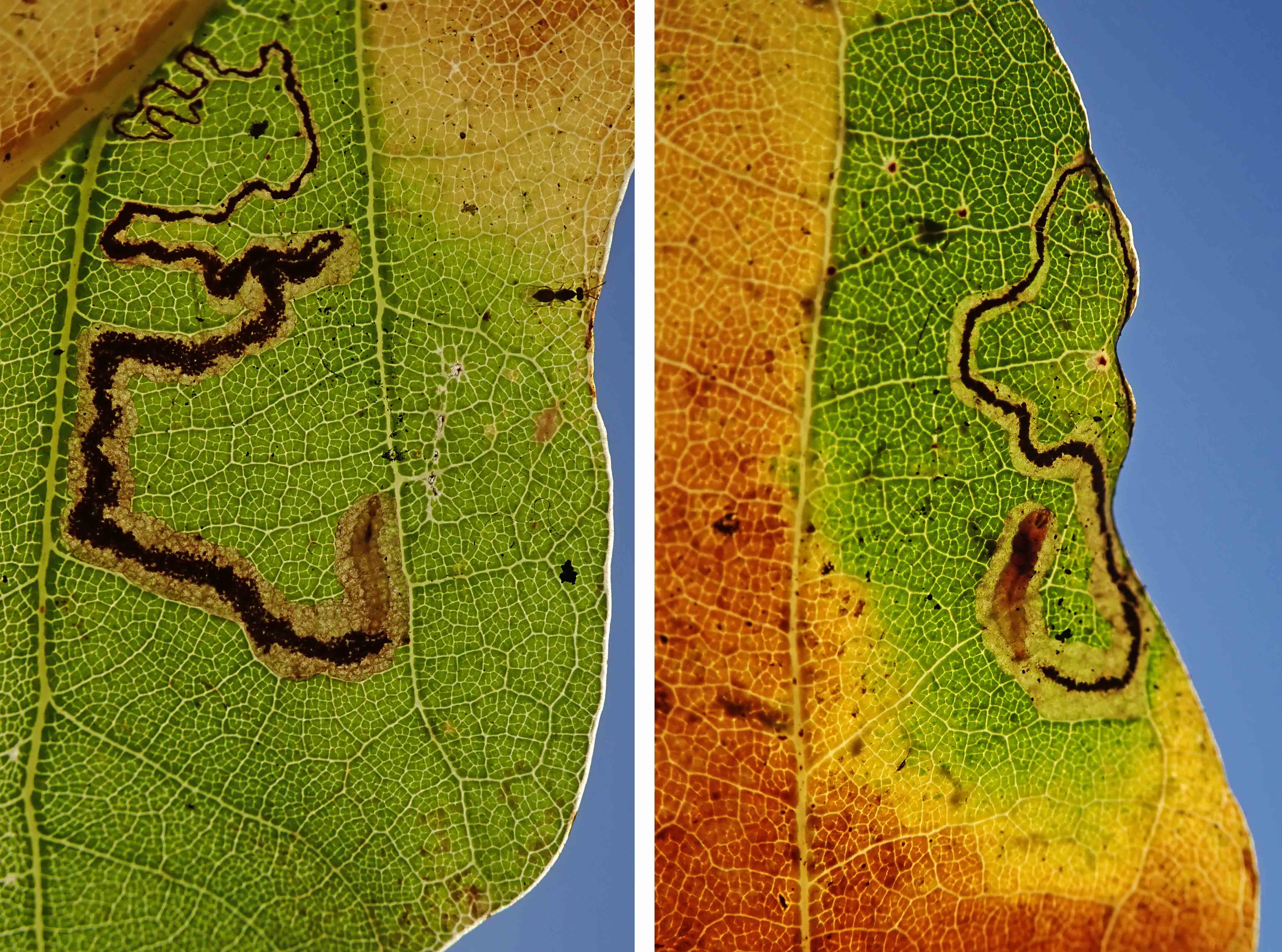
This is the third of the three new leafminers in ‘green islands’ on fallen Oak leaves that I found during one 30-minute period checking leaves in a local park. These are the work of the moth Stigmella atricapitella, the larvae of which you can see inside the mines shown below.
This moth breeds twice each year, so the mines can be seen in June – July and again between September and November, though the mines differ slightly each time (see the information on the British Leafminers website). It is possible to confuse these leafmines with those of Stigmella roborella but, fortunately, S. atricapitella has ‘dark prothoracic sclerites’, the dark marks you can see just below the head of the larvae in my images.
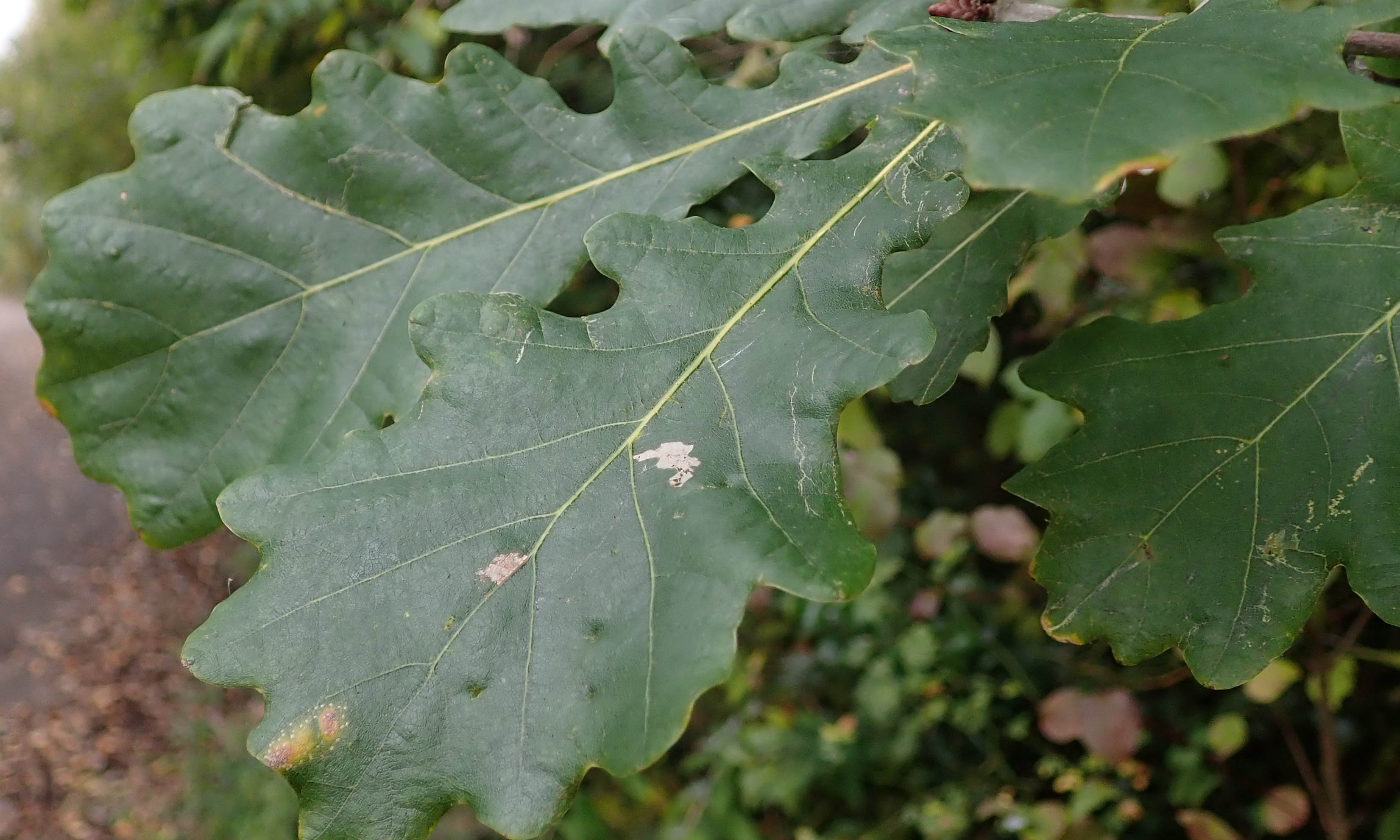
There’s a local park I don’t often visit as it’s a bit too managed for my liking but, recently, when I didn’t have time for a longer walk, I headed in that direction. And I’m very glad I did as, during one 30-minute period of fossicking through fallen Oak leaves, I found three new leafminers, all feeding in the ‘green islands’ their own chemicals had induced in the leaves. This is the first, Ectoedemia heringi, distinguishable from a similar species Ectoedemia albifasciella by the brown head seen here on the larva in the mine. You can read more about this species on the British Leafminers website and see the very attractive adult moth on the UK Moths website.
Two leafmine posts on one week may be a bit much for the uninterested amongst you, but this is really just a postscript to my recent post on the leafmines of two possible Gypsonoma species of moths (Leafmines: Gypsonoma species, 28 October). As I outlined in that blog I hadn’t been able to be precise in my identification as there are two Gypsonoma species that mine the leaves of Poplar. Fortunately for me, there is only one that mines Oak leaves and I managed to find several examples on an Oak sapling at Cardiff’s Grangemoor Park during a walk last week.
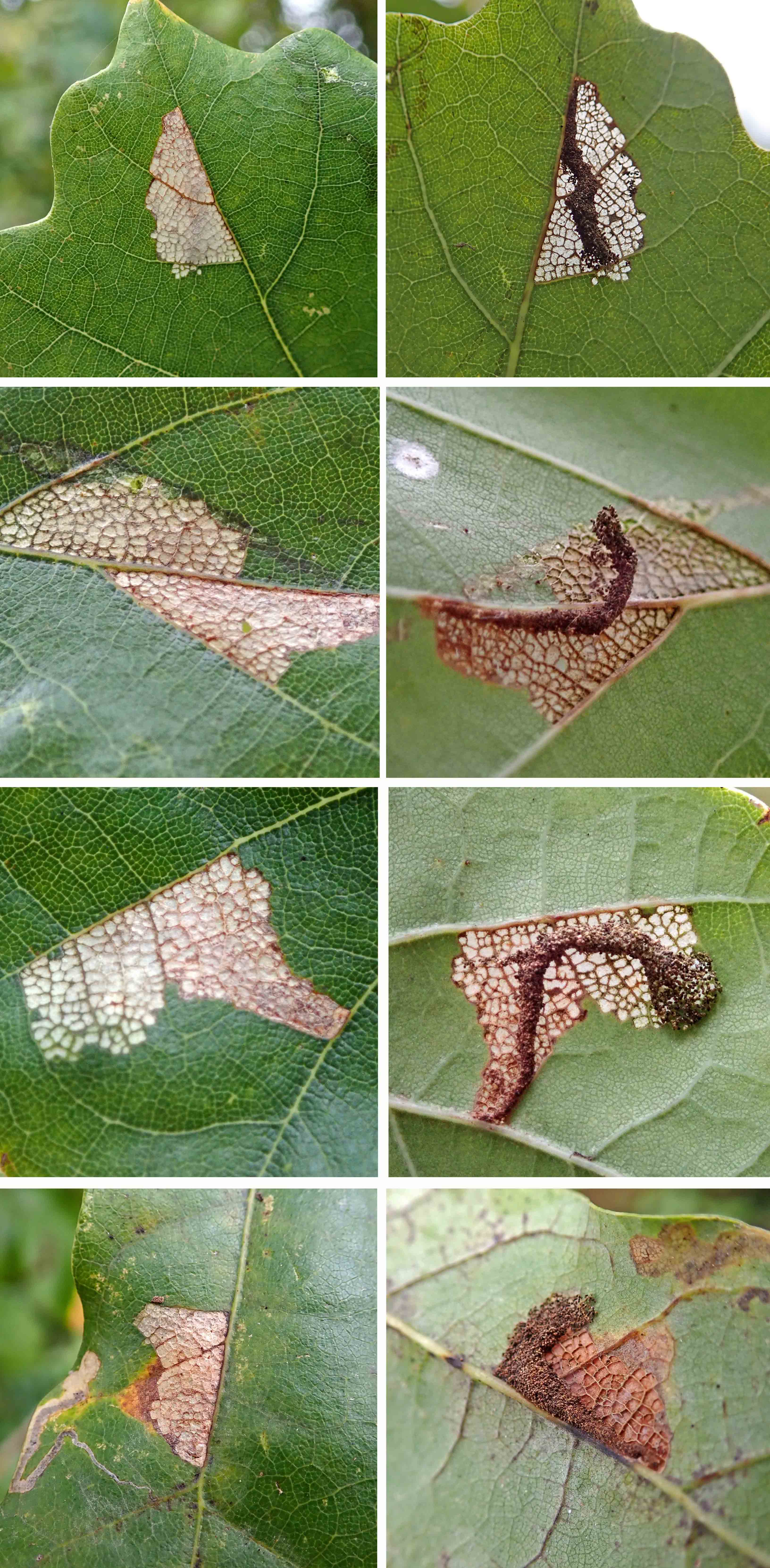
I was investigating any signs of leaf damage, which may have been caused by munching beetles or snails or various other hungry mini-beasties but, in this case, I was lucky to spot these four examples of Gypsonoma dealbana, where the moth larvae have used silk and their own frass to spin themselves tiny tubes to hide in (I’ve shown the upper and lower sides of the leaves so you can get an idea what to look for, if you’re so inclined). I’m not sure if the larvae were still present – I didn’t prod them to find out, though it’s likely they’ve already moved down into the soil below the tree, spun a little cocoon, and begun hibernating the winter months away.
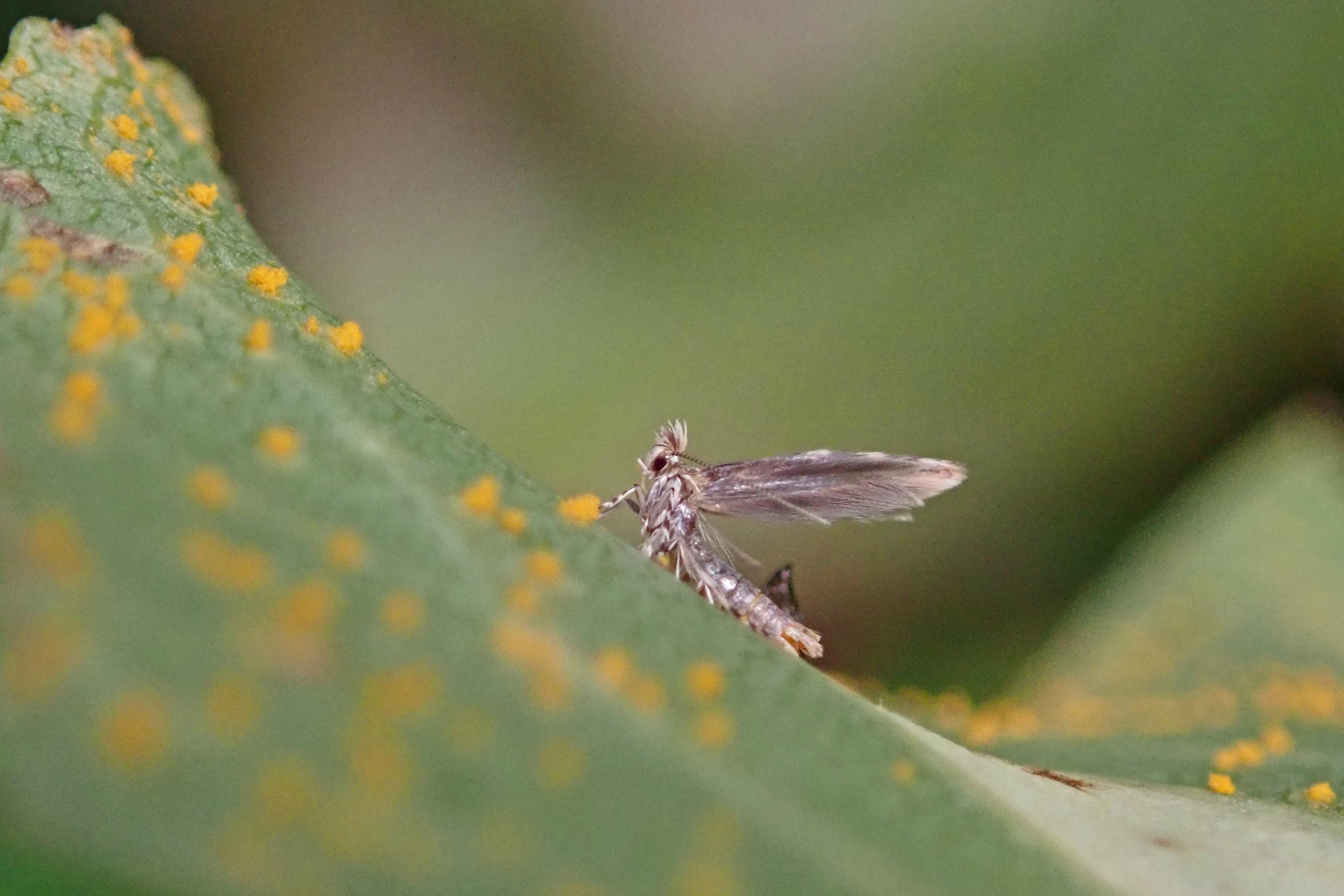
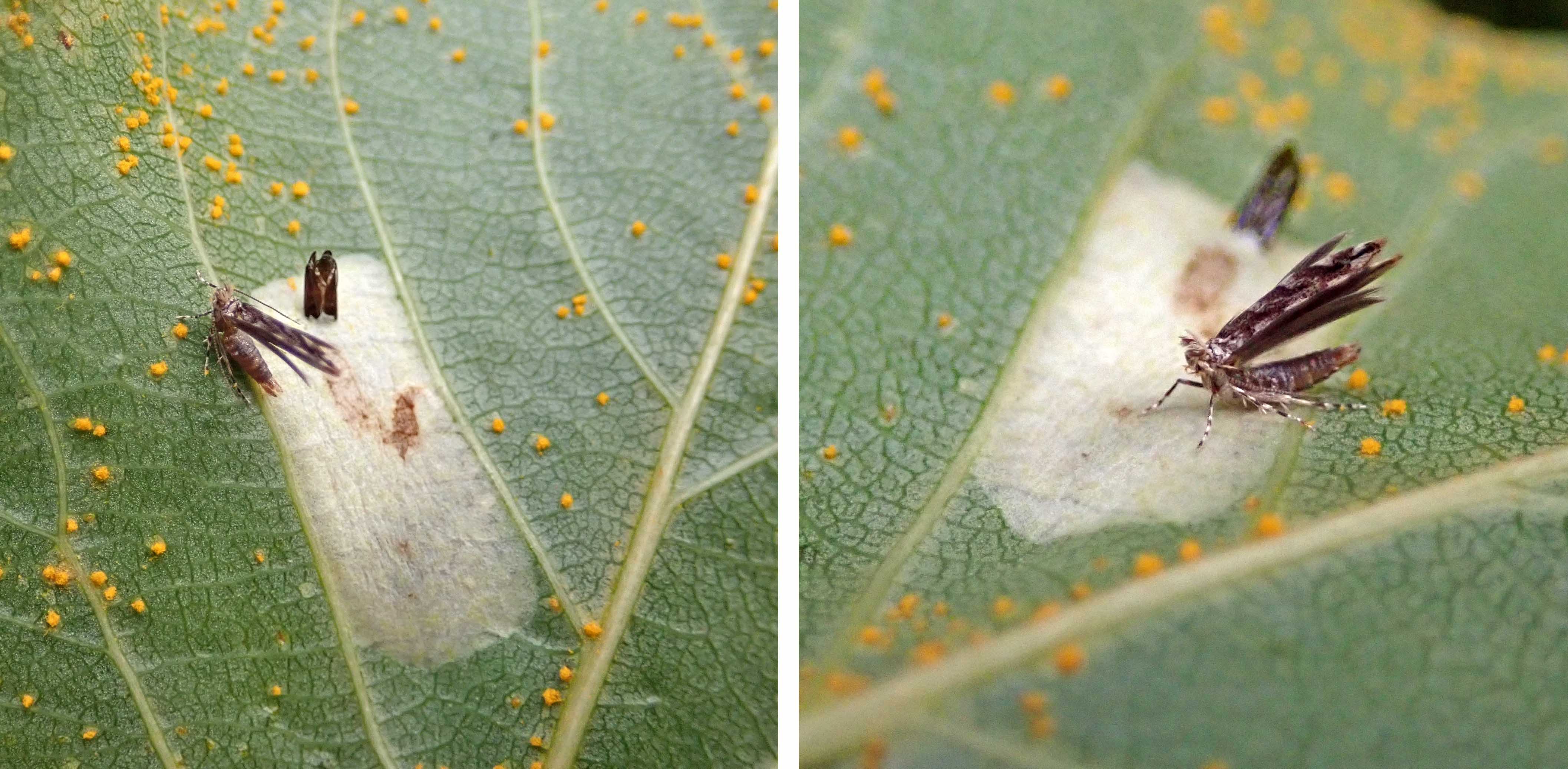
This was a wonderful surprise! I was checking Poplar leaves, not searching for anything in particular, when I turned over a leaf and found this tiny moth, presumably only just emerged from the pupa within its silken mine as its wings had not fully expanded.
I didn’t know what it was until I got home and checked my photos, and then was fairly sure I must have got my identification wrong as the Welsh biodiversity database was showing just four Welsh records, all closer to England, in the county of Gwent. The name I’d come up with was Phyllonorycter comparella (common name Poplar leaf-miner).
The mine certainly looked right, though it was difficult to be certain of the moth from what I had been able to see of its markings. But when I posted photos on social media, one of the moth experts I know almost immediately popped up with a comment ‘Blimey …’ and ‘I can’t think of any plausible alternatives’, and then another expert commented ‘Very good find’. And now my county moth recorder has confirmed my record. You can read more about this Poplar-leaf-mining moth on the British Leafminers website and see better photos of the adult moth on the UK Moths website.
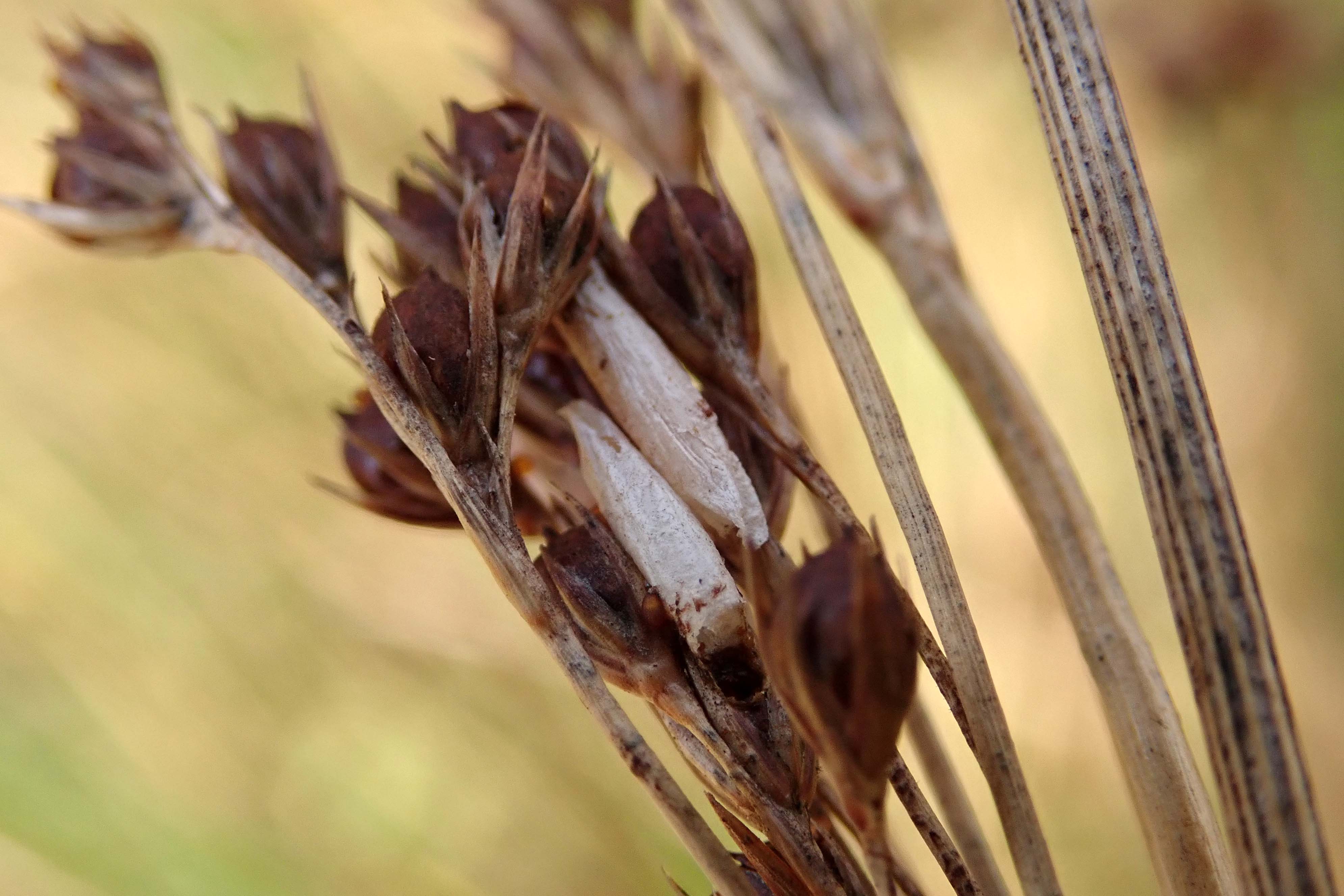
I haven’t posted this in my usual ‘Leafmines Monday’ spot as a) there are no leaves to speak of and b) the larvae actually feed on the seeds of the plants they inhabit. And I’ve never looked at reeds for any kind of leaf-mining creature or the cases of coleophora species of moths before but was, once again, prompted by a post of a rare find by a contact on social media. My find is not the rare one – in fact, I found so many of these in two different locations that they must be one of the most common coleophora species I’ve ever seen.
So, let me introduce you to Coleophora alticolella/glaucicolella; the slash between the two names indicates that these could actually be either Coleophora alticolella or Coleophora glaucicolella but it’s very difficult to differentiate between the two species without examining the larvae, which I didn’t do, or by breeding the larvae through to adulthood and examining their genitalia, which I also won’t be doing.
That social media post, and this find, have now prompted me to learn more about the various species of reed. The finds shown here were on Hard Rush (Juncus inflexus) but the rare species I want to try to find only feeds on two less common rush species. I like how one find leads me to have to learn more to find another!
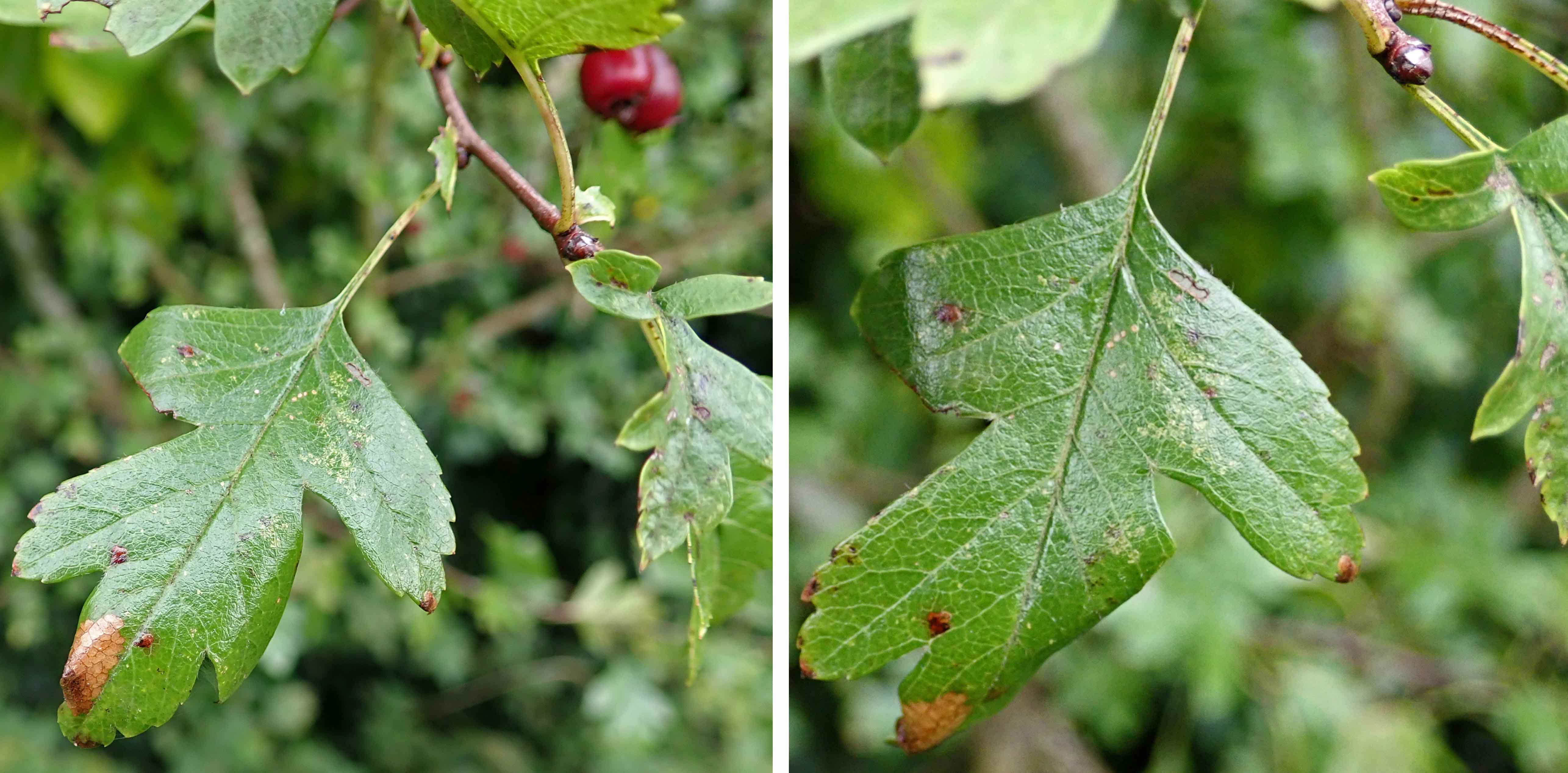
Recently, when checking Hawthorn leaves for leafmines, I spotted two of these larvae spinning on separate but close Hawthorn bushes so took several photos of both and a short video of one.
As the majority of photographs show larvae from above not below, and these both looked to have dark spot-like markings, I was confused about which species they might be, perhapsParornix anglicella or maybe Phyllonorycter oxyacanthae. And I wasn’t the only one scratching my head, as my online expert contacts weren’t sure either – one of them even contacted their own expert to get an opinion. A return visit by me was clearly required, to try to re-find the larvae, possibly get more images, and see what had developed from their spinning activities.
So, while the location was fresh in my memory, I walked that way again the following day, and, amazingly, managed to find one of the leaves – not an easy task finding an individual leaf in a Hawthorn bush but the photo below shows the leaf in question, on consecutive days.
And, when I turned the leaf over, there was the proof of identification, the distinctive cone of Parornix anglicella, still very green as the larva within hadn’t yet had time to eat all the leaf from inside. Turns out the expert’s expert had been correct!
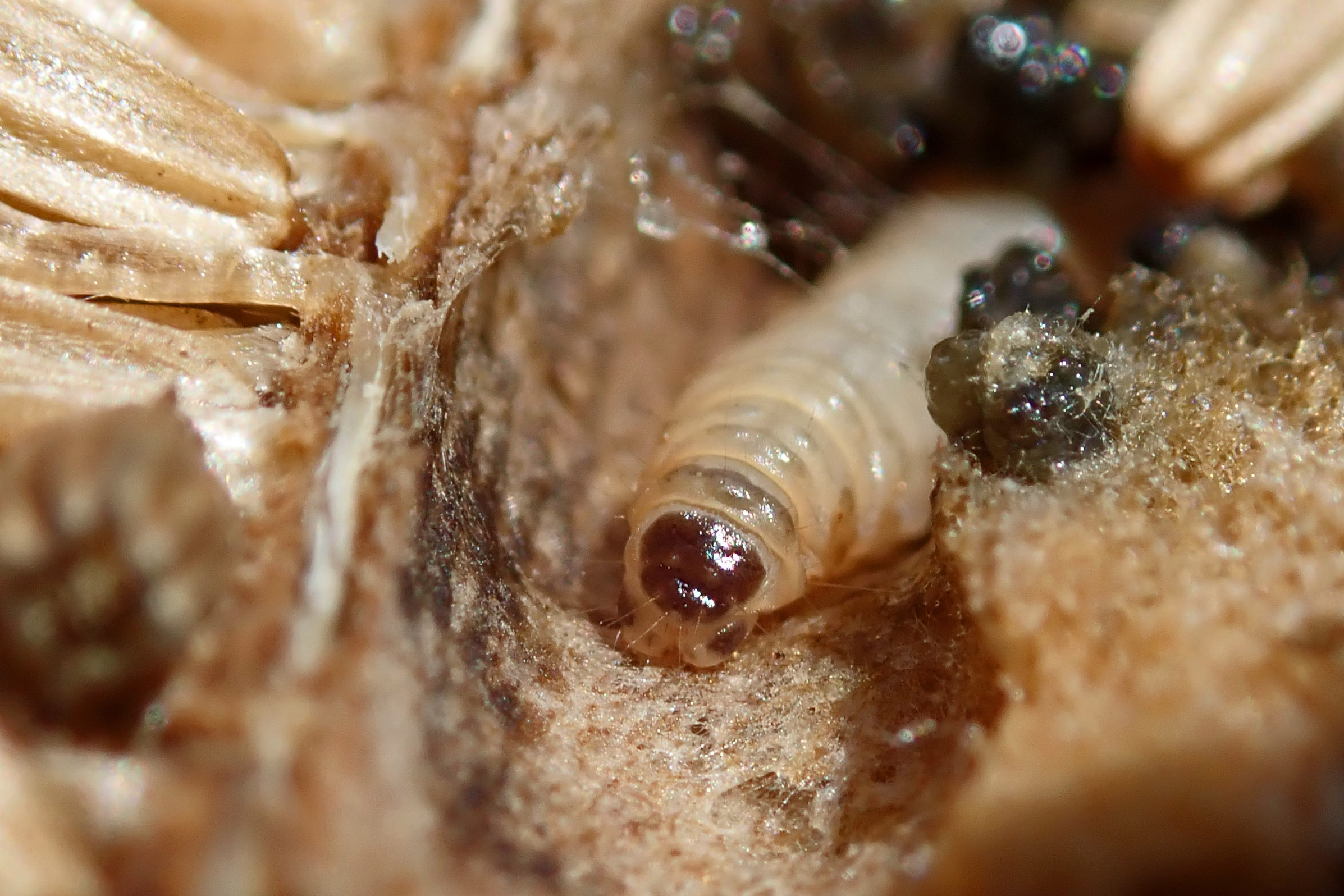
Last Thursday’s blog was about finding an Endothenia marginana larva in a Teasel seedhead. While checking those particular Teasels, I also found the subjects of today’s blog, the larvae of another moth, Cochylis roseana. As its name suggests, the adult is a rather gorgeous rosy coloured moth, though the UK Moths website says that the rosy colour is not always prominent.
As you can see, the larvae, which are white with a greenish tinge, don’t live within the centre space of the Teasel seedhead like the Endothenia, but rather munch their way through the Teasel’s seeds, creating tunnels that circle the centre. The seedhead I opened contained at least three larvae but here may have been more lurking in their hidey holes.
Back in January 2022, I was alerted to the fact that some Teasel seedheads are home to various species of moth larvae, and I blogged about opening three Teasel seedheads to find each one occupied by what proved to be one of the two Endothenia species of moth (Inside a Teasel seed head, 31 January 2022).
At the time of finding the larvae, I hadn’t known that I needed to check their rear ends for what’s known as an anal comb, a tiny tuft of hairs. If the anal comb is not present, then the species is Endothenia gentianaeana. If there is an anal comb, then it’s Endothenia marginana.
On a recent walk, when I found some Teasels that had been cut down, I decided to check the seedheads for any occupants. And, when I found this larva in one, I made sure to take close-up photos of its rear end – not as easy as you might think when the larva doesn’t want to co-operate. It eventually turned around, I got my shots, and, later, at home, I was able to make out an anal comb (indicated with a blue arrow in the photo below) so, as you may have guessed by the title of this blog, this is the larva of Endothenia marginana.









 earthstar
You must be logged in to post a comment.