Despite being in a field full of blooming wildflowers this single buttercup flower was obviously the most delicious as all the little flying insects wanted a part of it.


06 Wednesday Sep 2023
Posted in insects, wildflowers
Despite being in a field full of blooming wildflowers this single buttercup flower was obviously the most delicious as all the little flying insects wanted a part of it.
25 Thursday May 2023
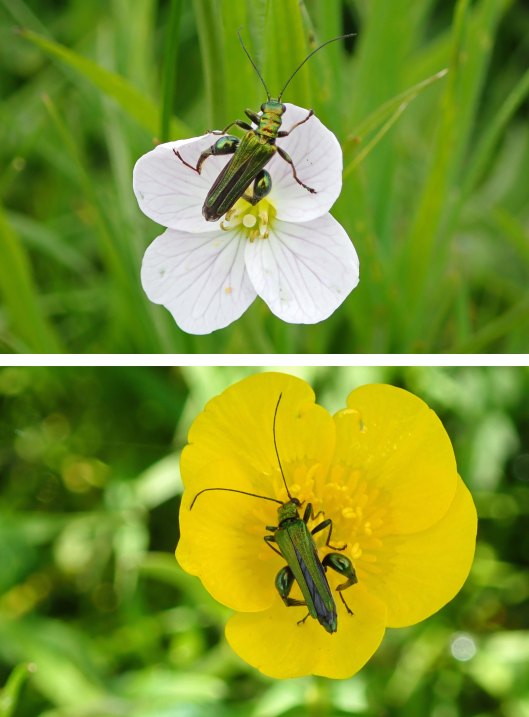
I’m sure you all have things that say ‘it’s almost summer’ to you – when you spot your first Swallow perched on an overhead wire or you hear your first screaming Swifts; when a particular flower blooms; when the morning light wakes you up earlier than your alarm; when you spot your first dragonfly of the year; when it’s warm enough to wear short sleeves. Well, one of the things that says summer to me is the appearance of these metallic-green mini-beasties, the Swollen-thighed beetles, in this case the males with the tell-tale swollen thighs, shown here on a cuckooflower and on a buttercup.
14 Thursday May 2020
Posted in insects, nature, wildflowers
Tags
British insects, Buttercup, Grangemoor Park, Oedemera nobilis, Swollen-thighed beetle, Thick-legged beetle
You know summer’s just around the corner when the Swollen-thighed beetles (Oedemera nobilis) start to appear. The Ox-eye daisies and buttercups were full of them at Grangemoor Park on Tuesday.

11 Sunday Feb 2018
Tags
Buttercup, fly, fly larva, fly puparium, leaf mine on buttercup, leaf mine on Lesser celandine, leaf mines, leafminer, Lesser Celandine, Phytomyza ranunculi
You might think there are no insects around in winter but you’d be wrong, as I’ve been discovering in the past week or so. In my checks for blooming wildflowers, I’ve seen the odd Lesser celandine and Buttercup flower and, looking more closely at the plants, I’ve noticed leaf mines on some. And where there are leaf mines, there are insects laying eggs and larvae developing from those eggs to create the mines.


These particular mines are created by Phytomyza ranunculi, an incredibly tiny fly which I haven’t yet seen. But I have seen – and can show you here – a larva and a puparium. I brought home a couple of Lesser celandine leaves, intending to take better photos of them, but I didn’t reckon on them shrivelling up overnight. On the positive side, when I picked up one leaf, a tiny larva was sitting underneath, presumably having popped out of the leaf as it dried up.


A couple of days later I brought home another couple of leaves, for the same purpose, but this time left them in a sealed container. The next day, when I opened it, I saw this tiny speck in the bottom of the container and realised a larva from one of the leaves must have pupated. I’m trying to hatch it so I – and you – get to see the fly. Fingers crossed!


 earthstar
You must be logged in to post a comment.