• ABOUT
  • BIRDING 2018
  • Birding 2019
  • BLOG POSTS
  • Butterflies 2018
  • Resources

earthstar

~ a celebration of nature

earthstar

Tag Archives: Dunlin

Lesser yellowlegs

04 Sunday Nov 2018

Posted by sconzani in birds, nature

≈ Leave a comment

Tags

American bird, autumn migration, birding, birdwatching, Black-tailed godwit, British vagrant bird, Dunlin, Greenshank, Lesser yellowlegs, RSPB Lodmoor, Tringa flavipes

Its name says it all really – the Lesser yellowlegs (Tringa flavipes) is a slender wader, with long yellow legs, and the smudgy, less defined markings on the breast of this particular bird point to it being a juvenile.

181104 lesser yellowlegs (1)

The Lesser yellowlegs is native to the Americas, spending its summers breeding in the northern forests that lie between Alaska and Quebec and its winters on the United States’ Gulf coast and in parts of South America.

181104 lesser yellowlegs (2)
181104 lesser yellowlegs (3)

The birds we see here in Britain are vagrants, birds that have strayed or been blown off course during their migration. On average, about ten birds are seen in various parts of Britain each year and, amazingly, there was also a Lesser yellowlegs at RSPB Lodmoor when we visited during last year’s Portland trip

181104 lesser yellowlegs (4)
181104 lesser yellowlegs (5)

Two interesting facts about this bird from the Cornell Lab of Ornithology website:

Both the male and female Lesser Yellowlegs provide parental care to the young, but the female tends to leave the breeding area before the chicks can fly, thus leaving the male to defend the young until fledging.

and …

The oldest recorded Lesser Yellowlegs was at least 4 years, 11 months old when it was found in South Dakota in 1965. It had been banded in the Lesser Antilles in 1960.

181104 lesser yellowlegs (6)

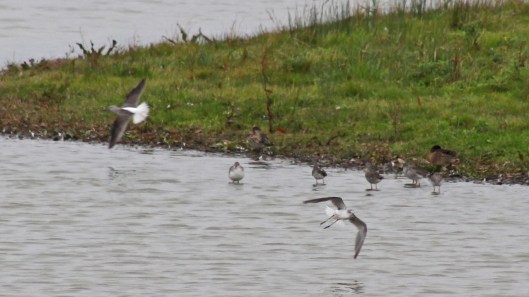
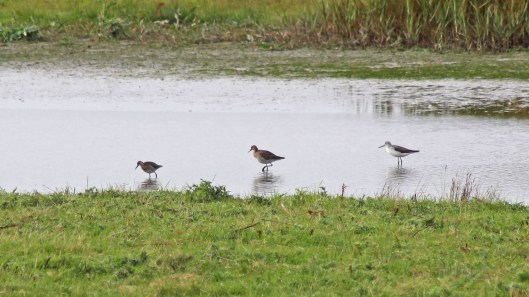
Back here in Dorset, it was great to get such close views of the Lodmoor Lesser yellowlegs and particularly to see it in close company firstly with two Greenshanks and a Black-tailed godwit (photo above), and then with the same two Greenshanks and a Dunlin (below). This really helped to see the relative differences in size, shape and plumage.

181104 lesser yellowlegs (7)

Heck, I even managed to get a short video of the lovely little thing. Enjoy!

Like Loading...

Friday’s walk 1: along Sully beach

29 Saturday Sep 2018

Posted by sconzani in birds, nature, walks

≈ 2 Comments

Tags

birding, birdwatching, British birds, Dunlin, Ringed plover, Sully, Turnstone, Wheatear

I try to time my walks at Sully with a mid-morning high tide – that way I don’t have to get up too early for the bus and I miss the early morning dog walkers. Yesterday was one such day and, though there was a cool wind blowing, it was a lovely day for a long walk. At first, I just sat and scanned the beach and the shoreline and the sea.

180929 Sully birdlife (1)

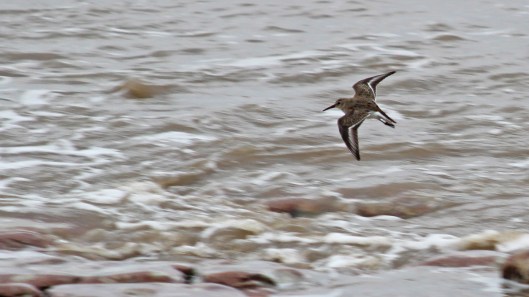
Several Turnstones were browsing the big deposit of seaweed the tide had rolled in and then this Dunlin flew in to join them.

180929 Sully birdlife (2)

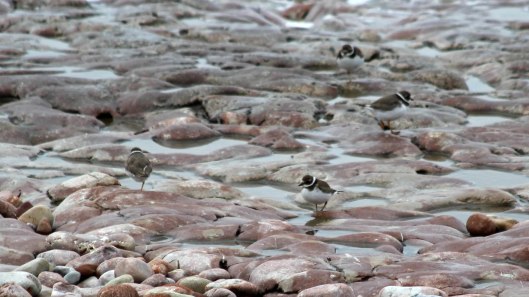
With my bins I followed it in and saw it plop down to join a small number of Ringed plovers by the water’s edge. To me, their dark eye masks make Ringed plovers look like bandits, though very tiny and very cute bandits to be sure.

180929 Sully birdlife (3)

One of the banditos only had one leg but it seemed to be managing to hop along okay. That made me think of Hop-along Cassidy but I was mixing up my masked men – the Lone Ranger was the one who wore the mask and, of course, he was no bandit.

180929 Sully birdlife (4)

At that point a dog and its owner came tootling along the beach, which put all the birds up … and I realised there were, in fact, two Dunlins (the two lower birds in the centre of this photo).

180929 Sully birdlife (5)

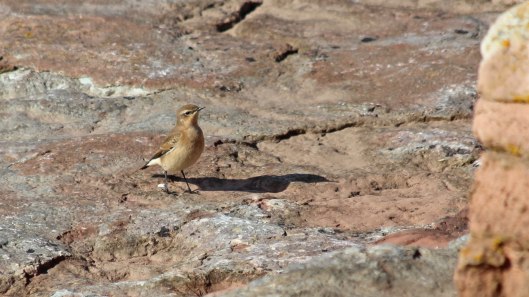
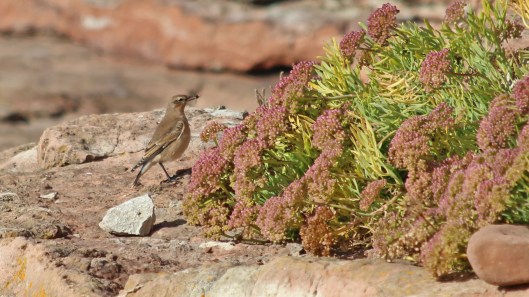
I took this opportunity to walk further along the beach and found myself a spot on the stone wall edging a slipway, a location where my birding friend Ceri said he’d seen a large number of waders the previous day. I hadn’t been sitting there long when a Wheatear flew right over my head and on to a boulder about 10 metres in front of me. I’m not sure who got the biggest surprise!

180929 Sully birdlife (6)

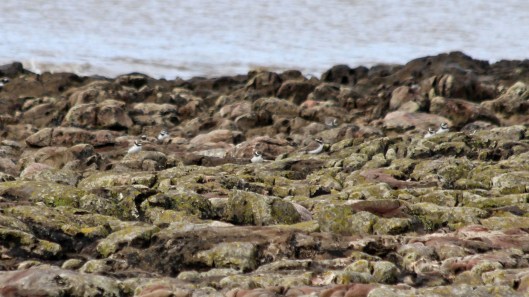
A large group of waders flew across from Sully Island and landed on rocks near the water. They were a bit far away to see clearly but most seemed to be Ringed plovers, a group of perhaps 30.

180929 Sully birdlife (7)

People walking along the coastal path above me scared my little Wheatear friend away but then I realised there were actually two birds flitting along the rocks and scrub.

180929 Sully birdlife (8)

They’re such lovely little birds and this one managed to catch itself a snack, which reminded me that it was almost lunchtime, time for me to be moving along on my walk. More tomorrow …

180929 Sully birdlife (9)

Like Loading...

Definitely a Dunlin

27 Thursday Sep 2018

Posted by sconzani in birds, nature

≈ Leave a comment

Tags

birding, birdwatching, British birds, bundie, Calidris alpina, Dunlin, Kenfig National Nature Reserve, peewee, pickerel, sandmouse, sea lark, Sker Rocks

Here’s another beautiful wader from my recent bird club walk at Kenfig National Nature Reserve.

180927 dunlin (1)

The Dunlin (Calidris alpina) is probably the British wader most people have seen – even if they didn’t realise what it was. With 9,600 breeding pairs and 350,000 Dunlin over-wintering in Britain, it’s certainly the most common.

180927 dunlin (2)
180927 dunlin (3)

And because it’s so common, it’s been given a huge number of common names by the folks that live in different parts of these isles. Some of my favourites are: sand mouse (Westmorland), peewee (Northamptonshire), pickerel (Scotland), bundie (Orkney), and sea lark, from several different locations.

180927 dunlin (4)

Like Loading...

Birding at Dawlish Warren

19 Sunday Nov 2017

Posted by sconzani in birds, nature

≈ 2 Comments

Tags

birding, birdwatching, Brent geese, British birds, Dawlish Warren, Dunlin, Exe estuary, Grey plover, national nature reserve, Oystercatchers, Shelduck

Last Sunday I joined ten hardy souls from the Glamorgan Bird Club (and two of their equally hardy children) to brave the strong polar winds and occasional stinging rain showers to check out the birding delights of south Devon. After a brief stopover at Labrador Bay for the Cirl buntings (see yesterday’s post), we headed to the National Nature Reserve at Dawlish Warren, to check the beach, sand dunes, and mudflats of the Exe estuary.

171119 Dawlish Warren (3)
171119 Dawlish Warren (1)
171119 Dawlish Warren (2)
171119 Dawlish Warren (4)

We had immediate success sea-watching from the beach, with good views of two Red-throated and one Great northern diver – both new birds for me, as well as Great crested grebes, Cormorant and the always-impressive sight of a Gannet crashing headfirst into the waves to dive for fish.

171119 Dawlish Warren (5)171119 Dawlish Warren (6)171119 Dawlish Warren (7)

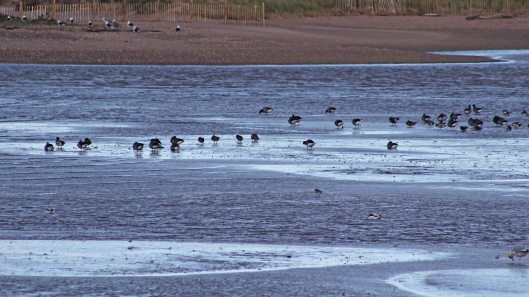
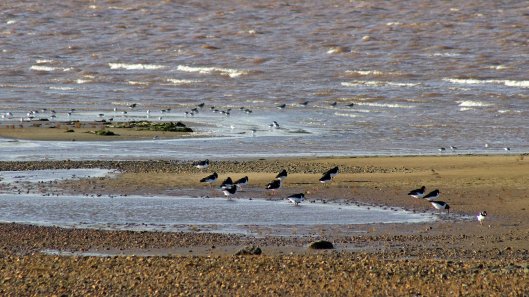
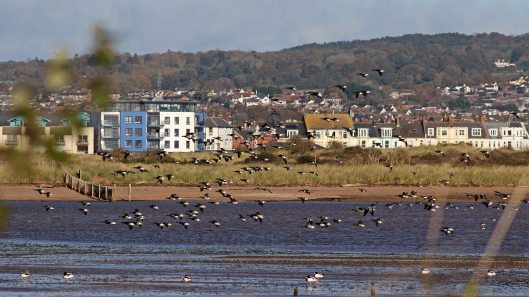
Though half of me got soaked during the walk out to the hide at the end of the sandspit (must invest in good, lined waterproof trousers!), the effort was worth it for the wealth of waders to be seen, feeding along the water’s edge and hunkering down on the sandy beach against the biting winds. As well as large numbers of Oystercatchers and Brent geese, there were also Dunlin and Ringed plover, Shelducks and Sanderlings, Turnstones, Bar- and Black-tailed godwits and a couple of Curlew, plus the ubiquitous gull species.

171119 River Exe (1)171119 River Exe (4)

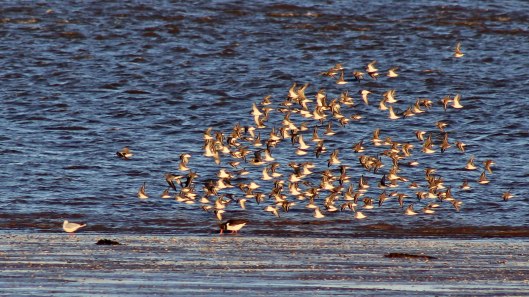
Later, we stopped further up the Exe for a quick look over the river, where I managed to snap three Grey plover amongst a flock of Dunlin flying past. It was a long but grand day’s birding and, with four lifers to add to my sightings’ list, I was well pleased.

171119 River Exe (3)171119 River Exe (5)

You can find out more about the flora and fauna of Dawlish Warren here, and check this link for the latest bird sightings at Dawlish Warren.

171119 River Exe (2)

Like Loading...

Birding at Goldcliff

28 Thursday Sep 2017

Posted by sconzani in birds, nature

≈ 4 Comments

Tags

birding, birdwatching, British birds, Dunlin, Glamorgan Bird Club, Goldcliff lagoons, Greenshank, Knot, Newport Wetlands, Shelduck, Spotted redshank, Wheatear

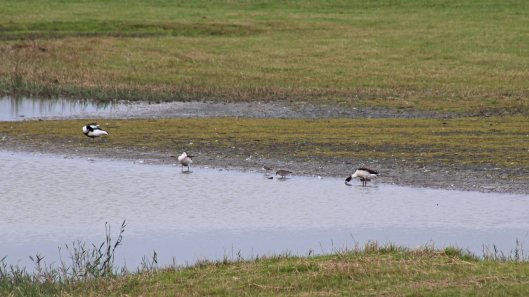
190728 2 mixed flock

I am SO pleased I bought binoculars. My second trip to Goldcliff lagoons and Newport Wetlands with my Glamorgan Bird Club buddies last weekend was just so much better for having them, as there was an incredible diversity of birds to be seen but most were distant views from hides or platforms. Using the bins not only brings the birds closer but it also means I get to watch and learn more of each bird species’ habits and actions, which I really enjoy.

190728 4 spotted redshank dunlin greenshank flying

Though I’m not an obsessive twitcher, I am keeping a personal list of bird sightings this year and saw a few new birds to add to my list (which now totals a respectable but not huge 130). The Club’s list for the day totalled 77 species but I didn’t see (or hear) the Great Crested Grebe, Siskin, Great Spotted Woodpecker, Goldcrest, Song Thrush, Mistle Thrush and Yellow Wagtail, so my total was 69 species: Mute Swan, Canada Goose, Shelduck, Wigeon, Gadwall, Teal, Shoveler, Tufted Duck, Little Grebe, Grey Heron, Little Egret, Cormorant, Marsh Harrier, Buzzard, Kestrel, Sparrowhawk, Peregrine, Water Rail (heard), Moorhen, Coot, Oystercatcher, Ringed Plover, Lapwing, Knot,

190728 1 shelduck knot ringed plover

and Little Stint (below with Ringed plover),

190728 little stint ringed plover

and Dunlin, Ruff (two below with a Greenshank),

190728 3 ruff greenshank

and Snipe, Black-tailed Godwit, Whimbrel, Curlew, Spotted Redshank, Greenshank,

190728 5 greenshank

and Redshank, Black-headed Gull, Lesser Black-backed Gull, Herring Gull, Feral Pigeon, Woodpigeon, Collared Dove, Kingfisher, Magpie, Jay, Carrion Crow, Raven, Blue Tit, Great Tit, Skylark, House Martin, Swallow, Cetti’s Warbler (heard, several times), Long-tailed Tit, Chiffchaff, Willow Warbler, Sedge Warbler, Blackcap, Wren, Starling, Blackbird, Robin, Stonechat, Wheatear (they do like their fenceposts),

190728 6 wheatear
190728 7 wheatear

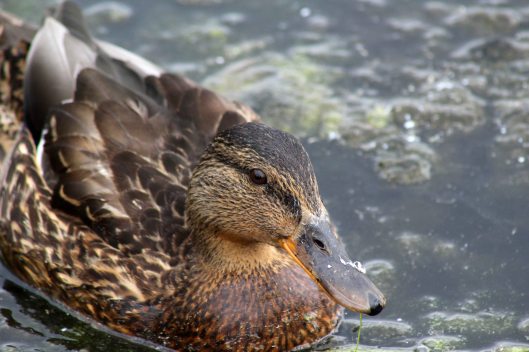
and House Sparrow, Pied Wagtail, Meadow Pipit, Chaffinch, Goldfinch, Linnet, Reed Bunting, and Mallard. It was a wonderful day’s birding.

190728 8 mallard female

Like Loading...

The Sanderlings and the Dunlins

01 Monday May 2017

Posted by sconzani in birds, nature, spring

≈ 2 Comments

Tags

birding, birdwatching, British birds, Calidris alba, Calidris alpina, Dunlin, passage migrant, Sanderling

Yesterday I told you about my chilly but super exciting birdwatching morning on Saturday and showcased two of the highlights, the Whimbrel and the Bar-tailed Godwit. Today, we have the Sanderlings and the Dunlins, both so well camouflaged against the stones on the seashore that, if they hadn’t been almost constantly moving about in their search for insects, they would’ve been very hard to spot.

170501 sanderling (2)
170501 sanderling (3)
170501 sanderling (1)

Sanderlings to the left, Turnstones to the right

Like yesterday’s birds, the Sanderling (Calidris alba) is a passage migrant, seen in parts of coastal Britain during the spring as it heads to its breeding grounds in the Arctic and in the autumn as it heads south to tropical beaches around the world, a journey that can be as long as 6000 miles. During the breeding season, the birds’ grey plumage takes on a much redder hue on the head, neck and back, which you can clearly see on one of these birds (particularly in the photo top left).

170501 dunlin (1)

The Dunlin (Calidris alpina) – like the Sanderling, a member of the Sandpiper family – is a very common sight on Britain’s coast throughout the year, though breeding birds head to the upland areas of Wales, Scotland and England to nest between April and July. The Dunlin also becomes a more rufous colour during the breeding season and acquires the dark tummy feathers you can see on these birds. I’m guessing they’ll be heading for the hills shortly to find a mate.

170501 dunlin (2)
170501 dunlin (3)
Like Loading...
Newer posts →

About me

sconzani

sconzani

I'm a writer and photographer; researcher and blogger; birder and nature lover; countryside rambler and city strider; volunteer and biodiversity recorder.

View Full Profile →

Follow earthstar on WordPress.com

Enter your email address to follow this blog and receive notifications of new posts by email.

Recent blog posts

  • O is for Odonata December 20, 2025
  • N is for nest December 19, 2025
  • M is for mite December 18, 2025
  • L is for lepidopteran lifers December 17, 2025
  • K is for Keeled skimmers December 16, 2025

From the archives

COPYRIGHT

Unless otherwise acknowledged, the text and photographs on this blog are my own and are subject to international copyright. Nothing may be downloaded or copied without my permission.

Fellow Earth Stars!

  • Unknown's avatar
  • Unknown's avatar
  • Unknown's avatar
  • Unknown's avatar
  • Unknown's avatar
  • Unknown's avatar
  • Unknown's avatar
  • Unknown's avatar
  • Unknown's avatar
  • Unknown's avatar
  • Unknown's avatar
  • Unknown's avatar
  • Unknown's avatar
  • Unknown's avatar
  • Unknown's avatar
  • Unknown's avatar
  • Unknown's avatar
  • Unknown's avatar
  • Unknown's avatar
  • Unknown's avatar
  • Unknown's avatar
  • Unknown's avatar
  • Unknown's avatar
  • Unknown's avatar
  • Unknown's avatar
  • Unknown's avatar
  • Unknown's avatar
  • Unknown's avatar
  • Unknown's avatar
  • Unknown's avatar
  • Unknown's avatar
  • Unknown's avatar
  • Unknown's avatar
  • Unknown's avatar
  • Unknown's avatar
  • Unknown's avatar
  • Unknown's avatar
  • Unknown's avatar
  • Unknown's avatar
  • Unknown's avatar
  • Unknown's avatar
  • Unknown's avatar
  • Unknown's avatar
  • Unknown's avatar
  • Unknown's avatar
  • Unknown's avatar
  • Unknown's avatar
  • Unknown's avatar
  • Unknown's avatar
  • Unknown's avatar

Blog at WordPress.com.

Privacy & Cookies: This site uses cookies. By continuing to use this website, you agree to their use.
To find out more, including how to control cookies, see here: Cookie Policy
  • Subscribe Subscribed
    • earthstar
    • Join 667 other subscribers
    • Already have a WordPress.com account? Log in now.
    • earthstar
    • Subscribe Subscribed
    • Sign up
    • Log in
    • Report this content
    • View site in Reader
    • Manage subscriptions
    • Collapse this bar
 

Loading Comments...
 

You must be logged in to post a comment.

    %d