• ABOUT
  • BIRDING 2018
  • Birding 2019
  • BLOG POSTS
  • Butterflies 2018
  • Resources

earthstar

~ a celebration of nature

earthstar

Tag Archives: fungus

Watch your tongue!

04 Tuesday Oct 2016

Posted by sconzani in fungi, nature, trees

≈ 7 Comments

Tags

Alder, Alder tongue, Alnus glutinosa, fungal gall, fungus, galls on alder cones, Taphrina amentorum, Taphrini alni

If you’re out walking through parks and woodlands this month, keep an eye out for these strange-looking growths on the cones of Alder trees (Alnus glutinosa). They’re caused by the fungus Taphrina alni (also known as Taphrina amentorum), common name Alder tongue, a plant pathogen that uses chemicals to persuade the trees to produce these weird and wonderful tongue-shaped galls.

161004-alder-tongue-1
161004-alder-tongue-2
161004-alder-tongue-3

Though common in Western Europe, Alder tongue only appeared in Britain in the 1940s but has now become quite common throughout the isles as spores produced by the ‘tongues’ are easily carried on the wind to other trees. Sometimes the Alder cones have just one tongue, sometimes they have several, usually all emerging from the same spot on the cone and often curling into intriguing shapes (spot the dragons in the images below!). The tongues start off green in colour but then vary from yellow and orange to pink and red (which really would look very tongue-like) before becoming brown and black as they age. They can, in fact, be seen on Alder trees throughout the year, though, for some reason, I’m seeing more of them now, in the autumn months.

161004-alder-tongue-4
161004-alder-tongue-5
Like Loading...

The coral that grows above the ground

01 Saturday Oct 2016

Posted by sconzani in autumn, fungi, nature

≈ 4 Comments

Tags

coral fungus, fungus, Ramaria stricta, Upright Coral Fungus

Once upon a time there was a coral that decided it didn’t like living under the ocean. It didn’t like living on hard unyeilding rocks; it didn’t like always having dirty sand being washed around its clean white branches by the harsh ocean waves; and it certainly didn’t like having all manner of little fishes ducking and diving around and nibbling at its extremities. So, it rebelled! It upped roots and moved to the land, to a place where it could be sheltered by beech trees and conifers, where it could spread its delicate root system through the welcoming piles of buried wood and leaf litter, where it could stretch its little branches straight up towards the sky.

161001-ramaria-stricta-1

Nah, not really! This is a coral fungus, probably Ramaria stricta, the Upright Coral fungus. It is quite common in Britain, and can also be found from late summer through the autumn months in much of Europe and in North America. It looks for all the world like the coral you find on reefs in tropical seas and oceans around the world, hence my fanciful flight of imagination earlier.

161001-ramaria-stricta-2
161001-ramaria-stricta-3
161001-ramaria-stricta-4

At the same location in October 2015

Like Loading...

Sulphur tuft

25 Sunday Sep 2016

Posted by sconzani in autumn, fungi, nature

≈ Leave a comment

Tags

fungus, Hypholoma fasciculare, Sulphur tuft

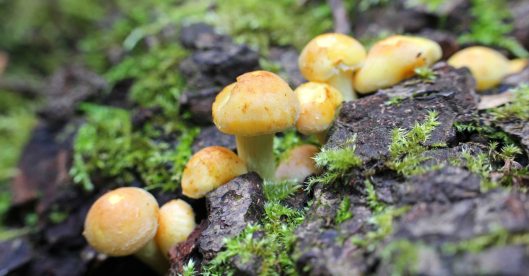
It’s fungi time! Well, strictly speaking, it’s fungi time all year round but autumn, with its rainy days and cooler night-time temperatures, always seems to be the time when fungi are most apparent, their colourful and plentiful fruiting bodies popping up wherever you look. One of the most colourful and plentiful, which can actually appear any time from April through to the time Jack Frost starts leaving his icy crust on the ground, is Sulphur tuft (Hypholoma fasciculare).

160925-sulphur-tuft-1

As you might guess from its name, its cap is usually quite a bright sulphur-yellow, though it sometimes has an orange tinge and a white band around the cap edge. It grows in large tufts or clumps, sometimes numbering several hundreds of individual mushrooms. Sulphur tuft is a wood-rotting fungus that happily devours both conifers and broadleaf hardwood trees, so can usually be seen in mixed woodland areas clustered on old stumps or bursting out of the cracks in the bark of fallen trees. As well as being very common in Britain and much of Europe, it’s also a frequent sight in North American woodlands. Sulphur tuft is poisonous so a feast for the eyes but not the belly.

160925-sulphur-tuft-2
160925-sulphur-tuft-3
160925-sulphur-tuft-4
160925-sulphur-tuft-5
160925-sulphur-tuft-6
160925-sulphur-tuft-7
160925-sulphur-tuft-8
Like Loading...

The Creature from the Black Stump

17 Saturday Sep 2016

Posted by sconzani in fungi, nature

≈ 5 Comments

Tags

fungus, Mycoacia uda, resupinate fungus, resupinate tooth fungus, tooth fungus

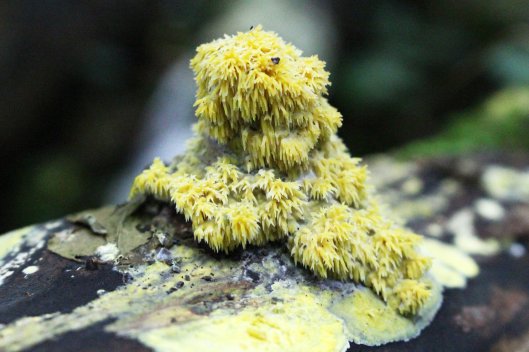
160917-mycoacia-uda

I’ve decided to name it Stumpy, this ‘creature’ that appears to be growing out of a fallen tree at one of my local nature reserves. Its scientific name is Mycoacia uda but that’s a bit of a mouthful.

Last Thursday was the first time I’d encountered one of these but, luckily, one of my Glamorgan Fungi group friends was able to identify it for me. It’s a resupinate tooth fungus and can be found growing on the fallen branches of deciduous trees in Britain, Europe and North America.

But, at night, when no one’s looking, it emerges from its fallen branch and roams the woodland eating stray dogs, howling at the moon, and searching for a mate … Just kidding!

Like Loading...

A Fungi-ful Friday

11 Sunday Sep 2016

Posted by sconzani in fungi, nature, parks

≈ 4 Comments

Tags

Cefn On, fungi foray, fungus

Fifty shades of brown, a soupçon of purple and a smattering of red – that about sums up my Friday fungi foray around Cefn On, one of my local Cardiff parks. A friend had posted a few finds from his walk there the previous day on the Glamorgan Fungi page on Facebook so it looked like a sure bet and, although I get the train up there, it’s a nice long walk back through Coed-y-Felin woods, around Llanishen Reservoir, through Nant Fawr woodland and alongside Roath Lake – about 7 miles all up but almost entirely through woods, parks and green places, so perfect!
160911-cefnon-fungi-1

After the recent rains and with temperatures still warm during the day but dropping now overnight, Cefn On was alive with fungi and I got lots of photographs. Unfortunately, fungi are notoriously difficult to identify. What does it smell like? What colour are the spores? How big / small / wide / tall was it? Was it slimy or dry? Where was it growing? These are just a few of the questions you need to ask. I do try to work out what I have found but some things are only identifiable through microscopic analysis so, these days, I mostly just enjoy looking at them and admiring their multitude of shapes and forms and habits and colours.

160911 CefnOn fungi (2)
160911 CefnOn fungi (3)
160911 CefnOn fungi (4)
160911 CefnOn fungi (5)
160911 CefnOn fungi (6)
160911 CefnOn fungi (7)
160911 CefnOn fungi (8)
160911 CefnOn fungi (9)
160911 CefnOn fungi (10)
Like Loading...

The photo-bombing beetle

03 Sunday Jul 2016

Posted by sconzani in fungi, insects, nature

≈ 10 Comments

Tags

beetle, fungus, inkcap, insect photobomber, mossy log, Red-headed Cardinal beetle, Rhydypennau Wood

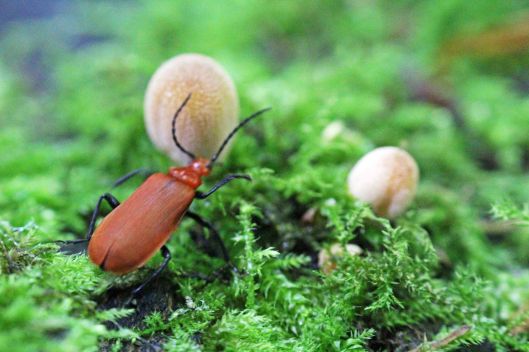
During yesterday’s walk to the stunning wildflower meadows neighbouring Cardiff’s Llanishen Reservoir, I detoured through Rhydypennau Wood to see what fungi might be about. There wasn’t a lot but I spotted some inkcaps sprouting amongst the moss on a fallen log so thought I’d get some photos.

160703 photobombing beetle (1)

The camera was out, I was kneeling in the leaf litter, leaning on the log, and had just taken my first shot when …

160703 photobombing beetle (2)

‘Oi, lady photographer leaning all over MY mossy log, I’m coming through!’, squeaked the Red-headed cardinal beetle.

160703 photobombing beetle (3)

It tootled along the log, through my shot, over MY inkcaps, and on its merry way.

160703 photobombing beetle (4)

And it left me laughing in its wake. Best photo bomb ever!

Like Loading...

What colour is my parachute?

28 Tuesday Jun 2016

Posted by sconzani in fungi, nature

≈ 11 Comments

Tags

Collared parachute, fungus, Marasmius rotula

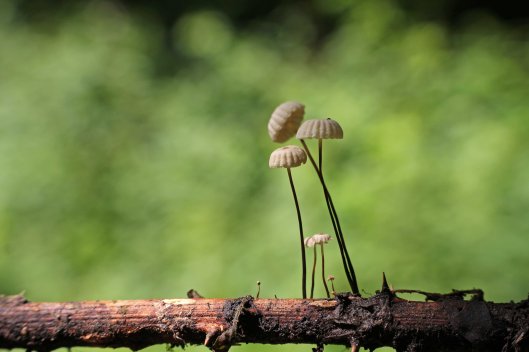
No, this post is not ‘A Practical Manual for Job-Hunters & Career-Changers’ (the book by Dick Bolles). Nor is it about the colour of ‘A cloth canopy which fills with air and allows a person or heavy object attached to it to descend slowly when dropped from an aircraft’ (Oxford Dictionary). This is about Marasmius rotula, the Collared parachute fungus, which seems to be springing up all around at the moment (well, three woodland areas near me, anyway), and the answer to the question is cream.

160628 Collared parachute fungus (1)

This little parachute is tiny: the caps range from 0.5 to 1.5cm across and these fungi grow no more than 7cm high. The epithet rotula refers to its wheel-like shape and, if you have a peep under the cap, you’ll soon seen why – the widely spaced gills are joined to a little collar that encircles the stem and the whole looks very like the spokes on a wheel. Turn it right way up and it looks for all the world like a parachute – but only one suitable for fairies! These grow mostly on the dead wood of deciduous trees and appear from June to September so if you’re out for a woodland walk, keep an eye out for them under the trees.

160628 Collared parachute fungus (2)
160628 Collared parachute fungus (3)
Like Loading...

Dryad’s Saddle

16 Thursday Jun 2016

Posted by sconzani in fungi, nature

≈ 10 Comments

Tags

dryad, Dryad's saddle, fungus, mushroom, Polyporus squamosus

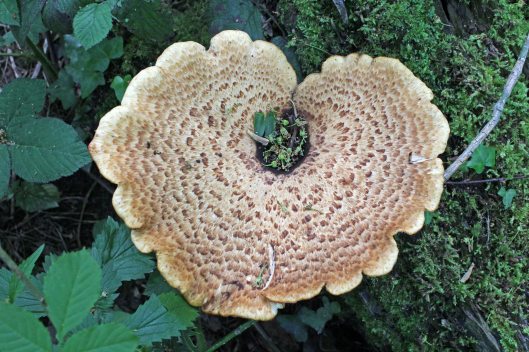
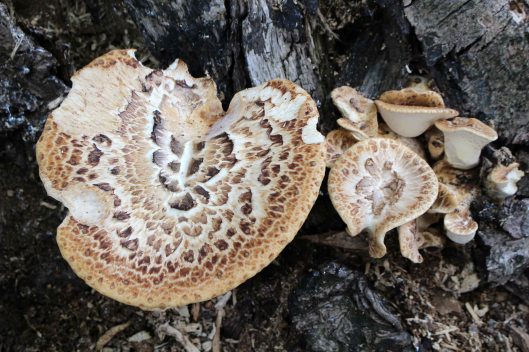
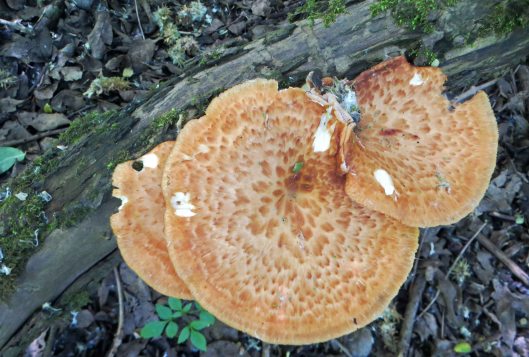
I used to think fungi only appeared in the autumn but I was wrong. I’ve found these three examples of Dryad’s Saddle (Polyporus squamosus) in the past two weeks at three different locations. It’s an edible fungus so I won’t disclose the locations, as the modern trend of foraging all edible fungi can also put some fungi in danger of being over-collected. I prefer just to take photos and leave the fungi to the critters that undoubtedly enjoy it.

160616 dryads saddle (1)

Another common name for this fungus is Pheasant’s back mushroom – as the name implies, the pretty brown colour patterns on the fungus are similar to those seen on the back of a pheasant. The scientific name also refers partly to this patterning (squamosus means scaly), and polyporus means ‘having many pores’ – this is not a gilled mushroom like those you buy at the supermarket; instead, it has a myriad of tiny tubes from which the spores are dispersed.

160616 dryads saddle (3)

The name Dryad’s saddle must have come from someone with a good imagination. In Greek mythology, dryads were tree spirits or nymphs, and the shape of some these fungi does indeed resemble a saddle so, perhaps, when we’re not looking, the dryads emerge from their trees for a gallop around the woodland!

160616 dryads saddle (2)

Like Loading...

The real peel

30 Monday May 2016

Posted by sconzani in fungi, nature

≈ 5 Comments

Tags

Aleuria aurantia, Bute Park, fungus, Orange peel fungus, SEWBReC

I owe the nifty title for this blog to my friend and colleague in fungi and biological recording, Amy, who works at SEWBReC, the South East Wales Biological Records Centre, and who can not only spin a good line but is extremely handy with a microscope. She checked the tiny aspects of my peel to confirm it really was Orange Peel fungus, despite this being entirely the wrong time of year.

160530 Orange peel fungus (1)

Orange peel fungus (Aleuria aurantia) usually appears in the autumn, fruiting between August and November, though anyone who observes the natural world on a regular basis will know that many things have been well out of sequence this year. The fungus starts out as a cup shape but often splits and contorts as it grows, making it appear even more like the discarded skin of an orange. Its bright orange colour makes it easy to spot in its preferred location, the disturbed soil alongside woodland paths, which is exactly where I found these specimens, in Cardiff’s Bute Park.

160530 Orange peel fungus (2)

Like Loading...

Fungi finger prints

06 Sunday Mar 2016

Posted by sconzani in fungi, nature, nature photography, trees

≈ Leave a comment

Tags

fungus, Rhytisma acerinum, sulphur dioxide air pollution, sycamore, Tar spot

Well, they look a bit like finger prints to me – or, perhaps, the wax seals people used to stamp on their communications and documents. But no! These are, in fact, the signs of Tar spot, a disease that most often affects sycamore trees but can also occur in other species of acer, and is caused by the fungus Rhytisma acerinum.

Rhytisma acerinum Sycamore Tarspot (1)

The spots start out yellow in the springtime, then eventually morph into the slightly raised bumpy black spots you can see in my photos. Although they look a little ugly, the spots don’t affect the health of the trees – they merely cause the leaves to drop a little earlier than normal in the autumn.

Rhytisma acerinum Sycamore Tarspot (2)
Rhytisma acerinum Sycamore Tarspot (3)

Though you might not like the look of them, there is one big benefit to seeing these spots on your sycamore tree: as the fungus is particularly sensitive to sulphur dioxide air pollution, its presence indicates your air is relatively clean and healthy.

Rhytisma acerinum Sycamore Tarspot (4)

Like Loading...
← Older posts
Newer posts →

About me

sconzani

sconzani

I'm a writer and photographer; researcher and blogger; birder and nature lover; countryside rambler and city strider; volunteer and biodiversity recorder.

View Full Profile →

Follow earthstar on WordPress.com

Enter your email address to follow this blog and receive notifications of new posts by email.

Recent blog posts

  • City Hall Peregrine January 12, 2026
  • Blackthorn in bloom January 11, 2026
  • Weevil: Mecinus pyraster January 10, 2026
  • Red in beak and claw January 9, 2026
  • Who’s watching who? January 8, 2026

From the archives

COPYRIGHT

Unless otherwise acknowledged, the text and photographs on this blog are my own and are subject to international copyright. Nothing may be downloaded or copied without my permission.

Fellow Earth Stars!

  • Unknown's avatar
  • Unknown's avatar
  • Unknown's avatar
  • Unknown's avatar
  • Unknown's avatar
  • Unknown's avatar
  • Unknown's avatar
  • Unknown's avatar
  • Unknown's avatar
  • Unknown's avatar
  • Unknown's avatar
  • Unknown's avatar
  • Unknown's avatar
  • Unknown's avatar
  • Unknown's avatar
  • Unknown's avatar
  • Unknown's avatar
  • Unknown's avatar
  • Unknown's avatar
  • Unknown's avatar
  • Unknown's avatar
  • Unknown's avatar
  • Unknown's avatar
  • Unknown's avatar
  • Unknown's avatar
  • Unknown's avatar
  • Unknown's avatar
  • Unknown's avatar
  • Unknown's avatar
  • Unknown's avatar
  • Unknown's avatar
  • Unknown's avatar
  • Unknown's avatar
  • Unknown's avatar
  • Unknown's avatar
  • Unknown's avatar
  • Unknown's avatar
  • Unknown's avatar
  • Unknown's avatar
  • Unknown's avatar
  • Unknown's avatar
  • Unknown's avatar
  • Unknown's avatar
  • Unknown's avatar
  • Unknown's avatar
  • Unknown's avatar
  • Unknown's avatar
  • Unknown's avatar
  • Unknown's avatar
  • Unknown's avatar

Blog at WordPress.com.

Privacy & Cookies: This site uses cookies. By continuing to use this website, you agree to their use.
To find out more, including how to control cookies, see here: Cookie Policy
  • Subscribe Subscribed
    • earthstar
    • Join 669 other subscribers
    • Already have a WordPress.com account? Log in now.
    • earthstar
    • Subscribe Subscribed
    • Sign up
    • Log in
    • Report this content
    • View site in Reader
    • Manage subscriptions
    • Collapse this bar
 

Loading Comments...
 

You must be logged in to post a comment.

    %d