• ABOUT
  • BIRDING 2018
  • Birding 2019
  • BLOG POSTS
  • Butterflies 2018
  • Resources

earthstar

~ a celebration of nature

earthstar

Tag Archives: Grey wagtail

Birding at Craig Cerrig Gleisiad and Garwnant

19 Thursday Apr 2018

Posted by sconzani in birds, nature, spring, walks

≈ 2 Comments

Tags

birding, birdwatching, Brecon Beacons, British birds, Craig Cerrig Gleisiad, Dipper, Glamorgan Bird Club, Grey wagtail, Pen-y-fan, Pied flycatcher, Stonechat, Willow tit

Derek the weatherman got the forecast absolutely right for our Glamorgan Bird Club trip yesterday: foggy and a bit mizzly until 10am, then the cloud lifted to leave clear blue skies and t-shirt weather – it almost felt like summer!
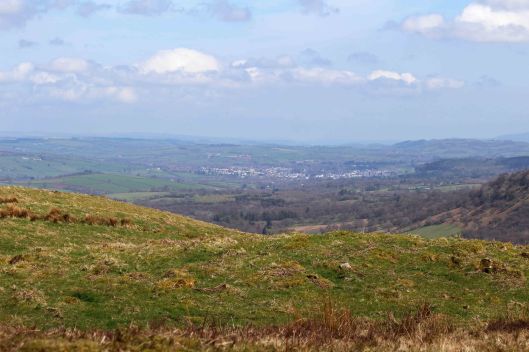
180419 Brecon in the distance

We twenty-two birding enthusiasts had headed north of Cardiff to the Brecon Beacons National Park – when the cloud lifted, we could see Pen-y-fan, at 2,907 feet (886m), Wales’s 10th highest mountain. The plan was to walk the lower slopes of Craig Cerrig Gleisiad National Nature Reserve, in the hope of seeing Ring Ouzels, Whinchats, Redstarts, Wheatears and possibly Pied Flycatcher, amongst other birds.
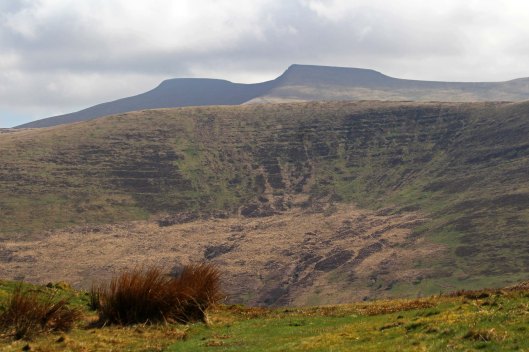
180419 Pen-y-Fan

Because of the damp weather and low cloud, we began the day by exploring the woodland around the Youth Hostel across the road from the reserve and immediately had superb views of Pied flycatchers, and not only male birds but also a female who was making a start on nest building. A Tree pipit sitting high on bushes in the neighbouring fields was also a year tick for me.

180419 Pied flycatcher female
180419 Pied flycatcher male

After a spot of early lunch back at the cars, we climbed the slopes into the dramatic landscape of Craig Cerrig Gleisiad, the southernmost glacial boulder field in Britain. Here we had Willow warblers singing all along the stream, and frequent views of Stonechats and Meadow pipits.

180419 stonechat female
180419 stonechat male

Some of the party went further up the track and were rewarded with views of distant Ring ouzels – I wasn’t one of the lucky ones, but it was great that others got on to them. Then, after regrouping back at the cars, some of us took a small detour on the way home for a quick visit to the Garwnant Forestry Centre, where we saw Grey wagtails and Dippers on the river and a Red kite and Sparrowhawk overhead. And we were very lucky that the resident Willow tit showed well for us near the Centre’s car parking area. It was another splendid day’s birding!

180419 Grey wagtail
180419 Dipper

My species list for the day was: Red Kite, Sparrowhawk, Buzzard, Peregrine, Lesser Black-backed Gull, Woodpigeon, Crow, Raven, Blue Tit, Great Tit, Coal Tit, Willow Tit, Willow Warbler, Blackcap, Wren, Nuthatch, Treecreeper, Dipper, Blackbird, Song Thrush, Robin, Pied Flycatcher, Redstart, Stonechat, Dunnock, Grey Wagtail, Pied Wagtail, Tree Pipit, Meadow Pipit, Chaffinch, and Siskin. And other birds seen (but not by me) were: Kestrel, Marsh Tit, Wheatear, Skylark, Swallow, Goldcrest, Ring Ouzel, and Linnet.
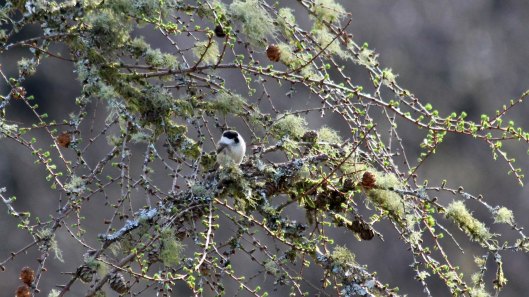
180419 Willow tit

Like Loading...

February on the Ely embankment

03 Saturday Mar 2018

Posted by sconzani in birds, nature, walks, winter

≈ Leave a comment

Tags

birding, birdwatching, British birds, Coot, Ely embankment, Grey wagtail, Redshank, Rock pipit, Turnstone

My first February wander alongside the River Ely was in the late afternoon of Saturday the 3rd. It was quiet – were the birds all watching Wales thump Scotland in the 6 Nations rugby, I asked myself? A faint peep alerted me to a Rock pipit tootling along the embankment path towards me. It had been minding its own business, looking for a lunchtime snack, when it suddenly realised there was a stonking great human standing on the path in front of it … at which point it flew off to the relative safety of the water’s edge.

180303 180203 rock pipit (1)180303 180203 rock pipit (2)180303 180203 rock pipit (3)

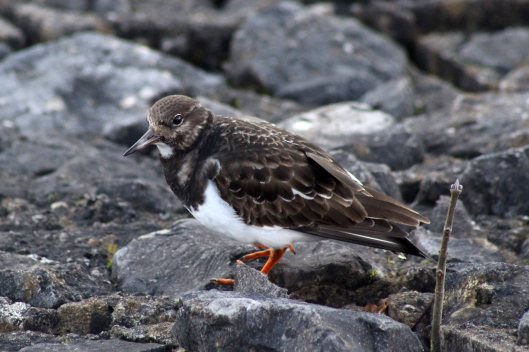
Shortly afterwards, I could see a roundish form that might’ve been a rock but was, in fact, a Turnstone, the only one seen that day. And, as well as those two birds, one Pied wagtail and two Grey wagtails were in residence. One of the Greys had an interesting plumage aberration, as you can see below.

180303 180203 Grey wagtail (1)
180303 180203 Grey wagtail (2)

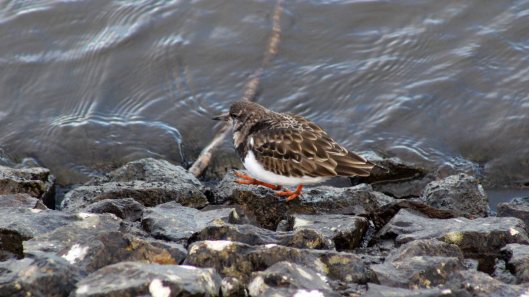
I was away for a week mid February so my next visit to the embankment was on Tuesday 20 February. A strong cold wind was blowing small waves on to the stony shore and, initially, there were no birds to be seen. But, about half way along the embankment path, I spotted a huddle of seven Turnstones, looking sleepy, enjoying a little bit of warmth from a shaft of sunlight that had reached their roosting spot from between the nearby houses. And, a minute or two later, I noticed one further Turnstone who was already meandering along, turning stones as it searched for breakfast bugs. Two Grey wagtails, hardy creatures, were also dotting about.

180303 180220 turnstones

The twenty-seventh of February was a bitterly cold day, as Britain was in the grip of a severe blast of polar weather, blown across Europe from Siberia, and even Cardiff had a few snow showers that day (quite unusual in recent years). Hopefully, the birds had found somewhere more sheltered than the embankment, as the stiff easterly was so cold that icicles were forming on branches that littered the shoreline and there was a slab of ice at least a foot wide coating the rocks along the water’s edge.

180303 180227 (3) turnstone180303 180227 (2) coot

In spite of those bitter conditions, I spied one Grey wagtail, one Turnstone, a pair of Coots, and a solitary Redshank. It made me feel cold just looking at that lovely bird standing in the icy water!

180303 180227 (1) redshank

Like Loading...

January on the Ely embankment

30 Tuesday Jan 2018

Posted by sconzani in birds, nature, walks

≈ 2 Comments

Tags

birding, birdwatching, British birds, Carrion crow, Ely embankment, Goosander, Grey wagtail, little grebe, Pied wagtail, Redshank, River Ely, Rock pipit, Turnstone

31 December 2017 I’m being a bit sneaky here as I managed to fit in one last walk along the embankment before the start of 2018 but after I’d written my December summary. So, on the last day of last year there were 5 Turnstones, 2 Redshanks, 2 Pied wagtails and 2 Grey wagtails, 1 Rock pipit and a couple of Crows.

180130 Ely embankment birds (1)
180130 Ely embankment birds (2)
180130 Ely embankment birds (3)
180130 Ely embankment birds (4)

1 January 2018 The very next day, New Year’s Day, I passed this way as part of a complete circuit of Cardiff Bay. It was a glorious blue-sky day but there were just 3 Turnstones present.

180130 Ely embankment birds (5)

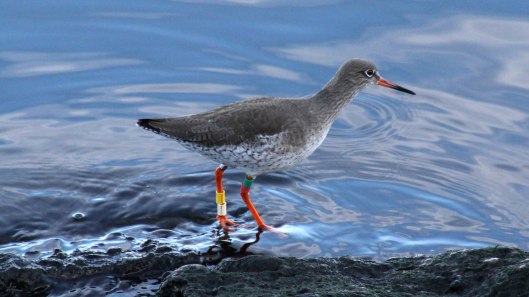
11 January This was another glorious day and another circuit of Cardiff Bay, though in the opposite direction. And it was a bumper day for the Ely embankment, with four Redshanks (including the ringed bird, shown above, which I’ve seen and written about previously), 6 Turnstones, 1 Pied and 4 Grey wagtails, and a Rock pipit.

180130 Ely embankment birds (6)
180130 Ely embankment birds (7)
180130 Ely embankment birds (8)

16 January With 40-mph winds blasting down from snow-covered areas further north, the air temperature was hovering below zero when I walked along the embankment late morning. I wasn’t surprised, then, to find very few birds around – a single Turnstone that was wandering along half way up the embankment (not wanting to put its feet in the chilly water?), which was good for me as it was closer for photos, and just two Grey wagtails. There weren’t many birds on the river either, just a couple of coots, one Great crested grebe and several Black-headed gulls looking hopefully in my direction.

180130 Ely embankment birds

20 January I didn’t get out till late afternoon as it had rained most of the day, so the light was going as I strolled along the embankment path. But I was pleasantly surprised to see a few birds: my friends the Grey wagtails never disappoint (two of those); just one Turnstone poking away amongst the stones; and two Redshanks, including my little buddy the colour-ringed bird. Floating along the river were a Little grebe, a Great crested grebe and a pair of Goosanders – the latter were scared away by a boat cruising by and flew off towards the other side of Cardiff Bay, where I had seen a pair a week or so previously – perhaps the same birds.

180130 Ely embankment birds (9)
180130 Ely embankment birds (10)
180130 Ely embankment birds (11)

25 January I detoured along the embankment on my return from a longer walk and was delighted to find six Turnstones (lovely to see so many), two Redshanks (but not my little ringed mate), two Grey and two Pied wagtails.

Like Loading...

Hope

01 Monday Jan 2018

Posted by sconzani in birds, nature

≈ Leave a comment

Tags

birding, birdwatching, Grey wagtail, Hope is the thing with feathers

180101 Hope

Hope is the thing with feathers
That perches in the soul,
And sings the tune without the words,
And never stops – at all …

~ from the poem ‘Hope is the thing with feathers’ by Emily Dickinson (1830-1886)

Like Loading...

December on the Ely embankment

30 Saturday Dec 2017

Posted by sconzani in birds, nature

≈ Leave a comment

Tags

birding, birdwatching, Black-headed gull, British birds, Cardiff Bay, Ely embankment, Great Crested Grebe, Grey wagtail, River Ely, Turnstone, wren

My first embankment stroll this month was on the third and I saw not a single solitary Turnstone – that hasn’t happened since I started doing a regular weekly count along this embankment back in September. The only birds on the stones were three Grey wagtails, and, though there were two Little grebes in the water, even the numbers of Coot and Mute swan were much reduced.

171230 Ely embankment (1)
171230 Ely embankment (2)
171230 Ely embankment (3)

The 8th of December was a bitterly cold day, with the wind so strong it was whipping up small waves against the stones of the embankment. I’m sure that’s the reason I saw so few birds – a single Grey wagtail flitted back and forth, and only six hardy Coots braved the chilly waters, a tiny number compared to usual. There wasn’t a single Mute swan or Mallard or Turnstone, and even gull numbers were low – those that were about were flying quite low around me, as if hoping for food. I had none to give but I did try to grab some flight photos, this Black-headed gull being the best of a blurry bunch.

171230 Ely embankment (4)

The 16th was cold but not sub-zero so relatively pleasant, and perhaps that’s why the Turnstones had returned – well, two of them had, and it was lovely to see them foraging along the water’s edge. I didn’t think there were many gulls about until a Black-headed gull about 50 metres from me found some food and then gulls flew in from every direction – 37 Black-headed and 5 Lesser black-backs, all wheeling and screeching and squabbling over one slice of bread.

171230 Ely embankment (5)

Apart from those, there were two Mute swans, 3 Mallards, about 6 Coots, 3 Great crested grebes and 1 Grey wagtail. Oh, and I mustn’t forget the littlest of all, a tiny Wren bopping in and out of the rocks in search of insects.

171230 Ely embankment (7)
171230 Ely embankment (6)
Like Loading...

Birding at Lliw Reservoirs

25 Sunday Jun 2017

Posted by sconzani in animals, birds, insects, nature, trees, walks, wildflowers

≈ Leave a comment

Tags

birding, birdwatching, Bog pimpernel, Foxgloves, Glamorgan Bird Club, Grey wagtail, Lliw Reservoirs, Red kite, slow-worm, Tormentil, Victorian dam, Victorian ironwork, Whitethroat

170625 Lliw Reservoirs (3)

I celebrated the solstice with an outing with my Glamorgan Bird Club buddies to Lliw Reservoirs north of Swansea or, perhaps that should read, I sweated through the solstice – it was one of the hottest days of the year and the middle of a mini heatwave. Still, you know what they say about mad dogs and Englishmen (and Welshmen and a Kiwi) …

170625 Lliw Reservoirs (1)

It’s a superb location. The two reservoirs were built in the second half of the 19th century, and still supply water to communities throughout south Wales. We only walked up one side of both reservoirs, through broadleaf woodland and then out onto open areas of grass and scrub and moorland, but there’s an 8-mile circular walk, which would be brilliant in cooler weather and includes large open commons of heath moorland on the hilltops.

170625 Lliw Reservoirs (2)

We heard more small birds than we saw (but that’s helping me learn their songs); buzzards and magnificent red kites were soaring overhead; we heard then saw the elusive grasshopper warbler in flight; dragonflies and damsels and the odd butterfly flitted about; and there were lots of lovely wildflowers (my particular favourites were the foxgloves, tormentil and bog pimpernel). Oh and, most importantly, the locals were friendly and the cafe serves delicious ice cream!

170625 Whitethroat
170625 Tormentil
170625 Slow-worm
170625 Lliw Reservoirs uplands
170625 Peacock
170625 Red kite
170625 Foxglove
170625 Grey wagtail
170625 Victorian ironwork
170625 Bog pimpernel
170625 Welsh sheep
170625 Pines & foxgloves
Like Loading...

Roath Park Bird Walk

15 Sunday Jan 2017

Posted by sconzani in birds, nature, parks

≈ 7 Comments

Tags

birding, birdwatching, British birds, Grey wagtail, Jay, Pied wagtail, Roath Park, Roath Park Lake, robin, Tufted duck

My imminent house-moving was getting to me today and, as I’m already about two-thirds packed with a week still to go, I allowed myself an afternoon off for a long walk around my local parks for a Nature fix.

170115-grey-wagtail

It always amazes me how many species of birds I can see in a walk around Roath Park Lake. Today it was 28: Carrion crow, Magpie, Jay, Robin, Dunnock, Lesser black-backed gull, Black-headed gull, Canada goose, Barnacle goose, Greylag goose, Mallard, Manky mallard and Aylesbury duck, Coot, Moorhen, Pochard, Tufted duck, Teal, Shoveler, Pied wagtail, Grey wagtail, Redwing, Song thrush, Cormorant, Mute swan, House sparrow, Feral pigeon and Woodpigeon (though purists might not count the Aylesbury duck, Manky mallards or Feral pigeons as extra species). Still, I think it’s an impressive total. These are just a very small selection of the photos I took …

170115-jay
170115-pied-wagtail
170115-robin
170115-tufted-duck-female
Like Loading...

A wagtail but which?

23 Sunday Oct 2016

Posted by sconzani in birds, nature

≈ 7 Comments

Tags

birdwatching, Grey wagtail, leucism, Leucistic grey wagtail, Motacilla alba yarrellii, Motacilla cinerea, Pied wagtail, wagtail

I’m sure you’ve all seen wagtails of some description. They’re those cute little birds with the long tails that continuously bob up and down, seemingly not able to sit still – my mother would’ve said they had ants in their pants! Wagtails come in several varieties; on the left below is a Pied wagtail (Motacilla alba yarrellii) and on the right a Grey wagtail (Motacilla cinerea). Nothing unusual here. But then …

161023a-pied-wagtail
161023b-grey-wagtail

This little birdie was on the rooftop of my neighbour’s garden studio a couple of days ago.

161023c-wagtail

It sat, bobbing and calling, for about 10 minutes, so I was able to watch and get some photos (though it was distant and through double glazing, so my images are not the best). Though the colours of both wagtail species vary as the birds mature and through the seasons, this little one appeared to have the head of a Pied wagtail and the body of a Grey wagtail. So, I tweeted photos to the RSPB (The Royal Society for the Protection of Birds) and they responded that it was ‘either a partially leucistic Grey wagtail or colour variation due to being between plumages or a geographical variation and the Grey wagtail has flown over from a different continent.’ It’s one of Nature’s little mysteries …

161023d-wagtail
161023e-wagtail
Like Loading...
Newer posts →

About me

sconzani

sconzani

I'm a writer and photographer; researcher and blogger; birder and nature lover; countryside rambler and city strider; volunteer and biodiversity recorder.

View Full Profile →

Follow earthstar on WordPress.com

Enter your email address to follow this blog and receive notifications of new posts by email.

Recent blog posts

  • P is for Phalarope December 21, 2025
  • O is for Odonata December 20, 2025
  • N is for nest December 19, 2025
  • M is for mite December 18, 2025
  • L is for lepidopteran lifers December 17, 2025

From the archives

COPYRIGHT

Unless otherwise acknowledged, the text and photographs on this blog are my own and are subject to international copyright. Nothing may be downloaded or copied without my permission.

Fellow Earth Stars!

  • Unknown's avatar
  • Unknown's avatar
  • Unknown's avatar
  • Unknown's avatar
  • Unknown's avatar
  • Unknown's avatar
  • Unknown's avatar
  • Unknown's avatar
  • Unknown's avatar
  • Unknown's avatar
  • Unknown's avatar
  • Unknown's avatar
  • Unknown's avatar
  • Unknown's avatar
  • Unknown's avatar
  • Unknown's avatar
  • Unknown's avatar
  • Unknown's avatar
  • Unknown's avatar
  • Unknown's avatar
  • Unknown's avatar
  • Unknown's avatar
  • Unknown's avatar
  • Unknown's avatar
  • Unknown's avatar
  • Unknown's avatar
  • Unknown's avatar
  • Unknown's avatar
  • Unknown's avatar
  • Unknown's avatar
  • Unknown's avatar
  • Unknown's avatar
  • Unknown's avatar
  • Unknown's avatar
  • Unknown's avatar
  • Unknown's avatar
  • Unknown's avatar
  • Unknown's avatar
  • Unknown's avatar
  • Unknown's avatar
  • Unknown's avatar
  • Unknown's avatar
  • Unknown's avatar
  • Unknown's avatar
  • Unknown's avatar
  • Unknown's avatar
  • Unknown's avatar
  • Unknown's avatar
  • Unknown's avatar
  • Unknown's avatar

Blog at WordPress.com.

Privacy & Cookies: This site uses cookies. By continuing to use this website, you agree to their use.
To find out more, including how to control cookies, see here: Cookie Policy
  • Subscribe Subscribed
    • earthstar
    • Join 667 other subscribers
    • Already have a WordPress.com account? Log in now.
    • earthstar
    • Subscribe Subscribed
    • Sign up
    • Log in
    • Report this content
    • View site in Reader
    • Manage subscriptions
    • Collapse this bar
 

Loading Comments...
 

You must be logged in to post a comment.

    %d