
Lady’s-mantle is one of those plants that’s difficult to determine to exact species. The large Garden lady’s-mantle (Alchemilla mollis) has escaped its original garden setting and become naturalised in many places, and, just to increase identification difficulties, some species have hybridised with others. It’s a plant I’ve found growing in a variety of places: in grassland at the local country park, along a nearby woodland ride, on a former coal spoil tip and, below, in a former quarry.
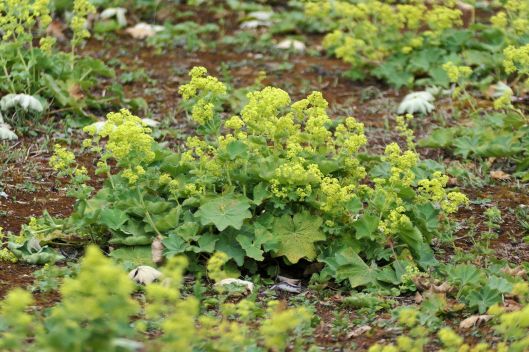
Richard Mabey provides some interesting information about this plant in Flora Britannica:
The often nine-lobed leaves of lady’s-mantle, like cloaks or umbrellas, fold up overnight and catch the dew on their soft hairs. Plant-dew was highly valued by early herbalists … and this made Alchemilla prized as a simple [sic], prescribed for wounds, infertility, and impotence. The alchemists also required the purest dew for turning base metal into gold – hence the name Alchemilla, ‘little alchemist’. Such a powerful and magical herb was bound to be christianised, and some time in the Middle Ages it was named Our Lady’s Mantle, and eventually lady’s-mantle.
 earthstar
You must be logged in to post a comment.