• ABOUT
  • BIRDING 2018
  • Birding 2019
  • BLOG POSTS
  • Butterflies 2018
  • Resources

earthstar

~ a celebration of nature

earthstar

Tag Archives: leaf-mining moth larvae

S is for Stigmella aceris

24 Friday Dec 2021

Posted by sconzani in insects, leaves, trees

≈ 2 Comments

Tags

leaf-mining moth larvae, leaf-mining moths, leafmines, leafmines on Field maple, leafmines on Norway maple, Stigmella aceris

As the leafmine season draws to a close (though I do still have a couple of finds to share early in 2022), I thought I’d post an update on our progress of monitoring the spread of the moth Stigmella aceris in the wider Cardiff area, a moth that was first recorded in Wales in 2019.

211224 stigmella aceris on field maple

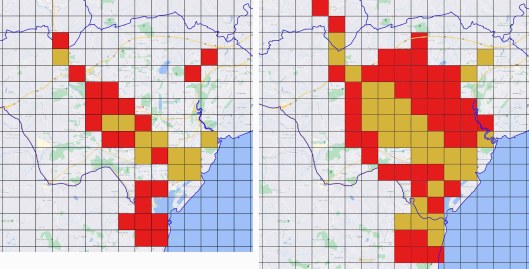
The map on the left below shows 1km squares where the moth’s larval leafmines were present as at 11 November 2020; the map on the right as at 29 November 2021. The red-coloured squares represent new finds during that year; the mustard-coloured squares are finds from previous years, i.e. in the left map, the mustard squares were finds made in 2019; in the map on the right, the mustard squares show the finds at the end of 2020. I am just one of several enthusiastic local members of Team leafmine who have been helping with this surveying, walking many miles to check each 1km square and, as the maps show, we have been able to confirm that Stigmella aceris has spread quite extensively in 2021.
211224 stigmella aceris maps

The moth’s presence, of course, does depend on the presence of its larval food plants, the trees Field maple and Norway maple, so blank squares can indicate an absence of trees, rather than a failure to find any mines. Where the moth has been present for more than a year, it can be prolific, with several mines on each leaf of Field or Norway maple, whereas in newly colonised places, I’ve often found just one or two mines from a whole tree load of fallen leaves. It will be fascinating to check this tiny moth’s progress again in 2022.

211224 stigmella aceris on norway maple

Like Loading...

Leafmines: Bucculatrix thoracella

22 Monday Nov 2021

Posted by sconzani in insects, leaves, plants

≈ Leave a comment

Tags

British leafminers, Bucculatrix thoracella, leaf-mining moth, leaf-mining moth larvae, leafmines on lime

I found these mines on Lime leaves a few weeks ago but they will still be visible on the yellowing leaves, just not occupied any more. The tiny white tick shape is distinctive, making it easy to identify these as the mines of the little brown and yellow moth Bucculatrix thoracella.

211122 Bucculatrix thoracella (1)
211122 Bucculatrix thoracella (2)

After the ‘tick’ has been formed, the moth larvae graze beneath the leaves, creating small bare areas known as feeding windows. When they moult, the larvae retreat to cocoons – one of the leafmining experts calls them ‘cocoonets’ (shown below), but their final cocoons can be found either in the leaf litter below the tree or on the Lime’s trunk. I’ve yet to find one of those.

211122 Bucculatrix thoracella (3)
211122 Bucculatrix thoracella (4)
Like Loading...

Leafmines: Scrobipalpa acuminatella

15 Monday Nov 2021

Posted by sconzani in insects, leaves, plants

≈ Leave a comment

Tags

British leaf mines, leaf-mining larvae, leaf-mining moth larvae, moth larvae, moth larvae in leaf mines, moth larvae on thistles, Scrobipalpa acuminatella

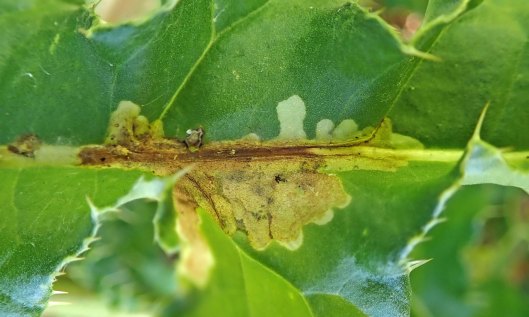
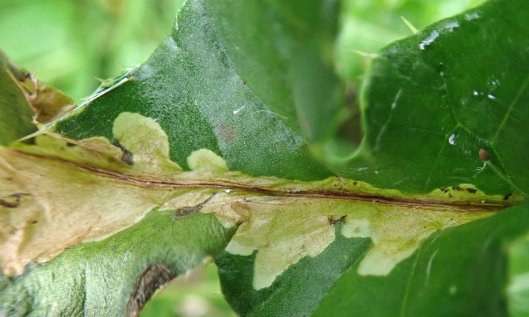
This week’s mines can be found on thistles, on species of both Cirsium and Carduus – in my case, the plant is Creeping thistle (Cirsium arvense).

211115 Scrobipalpa acuminatella (1)

These mines have been made by the larvae of the moth Scrobipalpa acuminatella, the adult of which can be seen on the UK Moths website. As the website points out, these moths have two generations each year, so we get two chances to see the mines.

211115 Scrobipalpa acuminatella (2)

These moth larvae make their home in the midribs of thistle leaves, venturing out to eat during the night and making blotches as they do, then returning to the midrib to shelter during the daytime.

211115 Scrobipalpa acuminatella (3)

Like Loading...

Leafmines: Phyllonorycter platani

01 Monday Nov 2021

Posted by sconzani in insects, leaves, trees

≈ Leave a comment

Tags

British leafmines, leaf mines, leaf-mining moth, leaf-mining moth larvae, leafmines on Plane trees, Phyllonorycter platani, Plane trees

Another #LeafmineMonday, another new leafmine discovery – new to me, that is, not to science or Wales.

Top of leaf on the left; underside on the right

This is another mine that’s created by the larva of a moth, the rather handsome micro moth Phyllonorycter platani, whose larvae feed on the leaves of Plane trees. This moth only appeared in Britain 30 years ago – as it can be found in many countries around the globe, it’s not possible to say where it came from or how it got to London but, since 1989, it has colonised much of southern Britain. Of course, no one knows how it’s managed that either, though I did read some speculation on Twitter that, as the first Cardiff records were noted very near the main car and coach parks, the moths could well have hitched a ride on passing vehicles. As I’ve sometimes seen small moths on trains, I can quite believe that possibility.

211101 phyllonorycter platani (1)
211101 phyllonorycter platani (2)
Like Loading...

Leafmines: Stigmella plagicolella

04 Monday Oct 2021

Posted by sconzani in insects, leaves

≈ Leave a comment

Tags

British leaf mines, leaf-mining larvae, leaf-mining moth, leaf-mining moth larvae, leafminers, leafmines on Blackthorn, Stigmella plagicolella

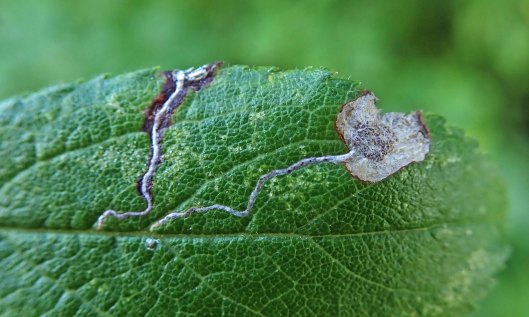
Rob Edmunds, one of the people behind the British Leafminers website, labelled these leafmines ‘tadpoles’ and, as you can see, it’s a very apt description. They are also tiny, as these mines appear on Blackthorn or Sloe (Prunus spinosa), the leaves of which are only 2 – 4cms long.

211004 Stigmella plagicolella (1)

The adults of the moth Stigmella plagicolella, also known as the Scrubland Pigmy, are active twice each year, firstly in May and June, and then again in August, so their larval mines can be seen soon after those periods, in July and then again during September and October. So, this is a mine to look out for when all you gin drinkers out there are collecting the fruit to make Sloe gin.

211004 Stigmella plagicolella (2)
211004 Stigmella plagicolella (3)
Like Loading...

293/366 Stigmella aceris

19 Monday Oct 2020

Posted by sconzani in autumn, insects, leaves, trees

≈ 5 Comments

Tags

British moths, Field maple, leaf mines on maple, leaf-mining moth larvae, leafminer, Norway maple, Scarce Maple pigmy, Stigmella aceris

I’ve been hunting for leaf mines in recent days, the mines made by the larvae of the micro moth Stigmella aceris, which can be found at this time of year on the leaves of Norway and Field maples. Unfortunately, I haven’t made any finds of my own but my Twitter pal Gareth had the honour of finding the first mines in the Vale of Glamorgan last week so I went and checked out his find site to get a look at the mines for myself.

201019 leafmine (1)

According to the UK Moths website, this moth was classified as rare until 40 years ago, when it began increasing its range ‘dramatically’. It can now be found throughout central and southern England, and also in south Wales – it was found for the first time in Cardiff in November 2019.

201019 leafmine (2)

I’ve never seen the adult moth, which has the common name of Scarce maple pigmy – and probably never will – but you can see a photo of it on the British Lepidoptera weebly site here.

201019 leafmine (3)
201019 leafmine (4)

And now I’m heading out to check more Maple trees before their leaves all fall and turn to mush …

201019 leafmine (5)

Like Loading...
Newer posts →

About me

sconzani

sconzani

I'm a writer and photographer; researcher and blogger; birder and nature lover; countryside rambler and city strider; volunteer and biodiversity recorder.

View Full Profile →

Follow earthstar on WordPress.com

Enter your email address to follow this blog and receive notifications of new posts by email.

Recent blog posts

  • City Hall Peregrine January 12, 2026
  • Blackthorn in bloom January 11, 2026
  • Weevil: Mecinus pyraster January 10, 2026
  • Red in beak and claw January 9, 2026
  • Who’s watching who? January 8, 2026

From the archives

COPYRIGHT

Unless otherwise acknowledged, the text and photographs on this blog are my own and are subject to international copyright. Nothing may be downloaded or copied without my permission.

Fellow Earth Stars!

  • Unknown's avatar
  • Unknown's avatar
  • Unknown's avatar
  • Unknown's avatar
  • Unknown's avatar
  • Unknown's avatar
  • Unknown's avatar
  • Unknown's avatar
  • Unknown's avatar
  • Unknown's avatar
  • Unknown's avatar
  • Unknown's avatar
  • Unknown's avatar
  • Unknown's avatar
  • Unknown's avatar
  • Unknown's avatar
  • Unknown's avatar
  • Unknown's avatar
  • Unknown's avatar
  • Unknown's avatar
  • Unknown's avatar
  • Unknown's avatar
  • Unknown's avatar
  • Unknown's avatar
  • Unknown's avatar
  • Unknown's avatar
  • Unknown's avatar
  • Unknown's avatar
  • Unknown's avatar
  • Unknown's avatar
  • Unknown's avatar
  • Unknown's avatar
  • Unknown's avatar
  • Unknown's avatar
  • Unknown's avatar
  • Unknown's avatar
  • Unknown's avatar
  • Unknown's avatar
  • Unknown's avatar
  • Unknown's avatar
  • Unknown's avatar
  • Unknown's avatar
  • Unknown's avatar
  • Unknown's avatar
  • Unknown's avatar
  • Unknown's avatar
  • Unknown's avatar
  • Unknown's avatar
  • Unknown's avatar
  • Unknown's avatar

Blog at WordPress.com.

Privacy & Cookies: This site uses cookies. By continuing to use this website, you agree to their use.
To find out more, including how to control cookies, see here: Cookie Policy
  • Subscribe Subscribed
    • earthstar
    • Join 669 other subscribers
    • Already have a WordPress.com account? Log in now.
    • earthstar
    • Subscribe Subscribed
    • Sign up
    • Log in
    • Report this content
    • View site in Reader
    • Manage subscriptions
    • Collapse this bar
 

Loading Comments...
 

You must be logged in to post a comment.

    %d