• ABOUT
  • BIRDING 2018
  • Birding 2019
  • BLOG POSTS
  • Butterflies 2018
  • Resources

earthstar

~ a celebration of nature

earthstar

Tag Archives: native orchids

152/366 Pyramids and bees

31 Sunday May 2020

Posted by sconzani in nature, wildflowers

≈ 3 Comments

Tags

Anacamptis pyramidalis, Bee orchid, British orchids, Grangemoor Park, native orchids, Ophrys apifera), Pyramidal orchid

You might be wondering what pyramids and bees have in common. Well, in this case, they’re both orchids: the Pyramidal orchid (Anacamptis pyramidalis) and the Bee orchid (Ophrys apifera), and I was very pleasantly surprised to see rather a lot of them, especially the Bees, during my most recent walk around Grangemoor Park.
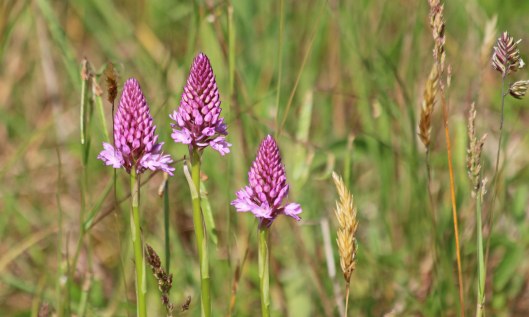
200531 pyramidal orchid (1)

With their classic triangular shape, Pyramidal orchids are easy to identify. They usually flower during June and July, and each flower spike can contain up to a hundred individual flowers. Interesting fact: the Pyramidal orchid is the county flower of the Isle of Wight.
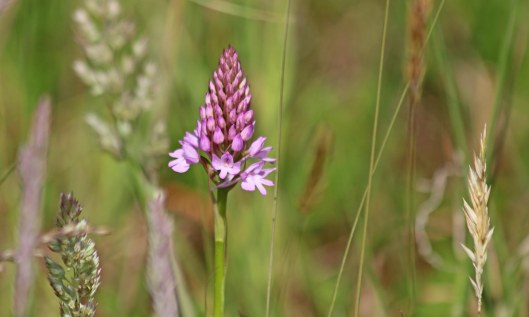
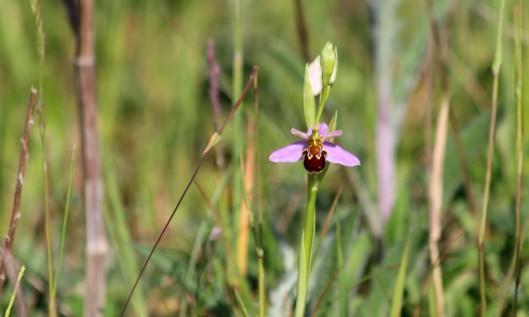
200531 pyramidal orchid (2)200531 bee orchid (2)

Bee orchids are my favourite orchids. Their markings and furry texture may be intended to attract bumblebees (and the flowers also produce a female bee smell, apparently) but it’s their laughing ‘faces’ that enchant me and always make me smile. And the people of Bedfordshire made the perfect choice when they selected the Bee orchid as their county flower.

200531 bee orchid (1)

Like Loading...

145/366 Common spotteds

24 Sunday May 2020

Posted by sconzani in flowers, nature, wildflowers

≈ 5 Comments

Tags

British orchids, Common spotted orchid, Cosmeston Lakes Country Park, native orchids

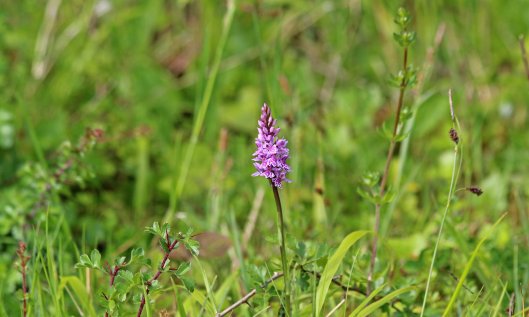
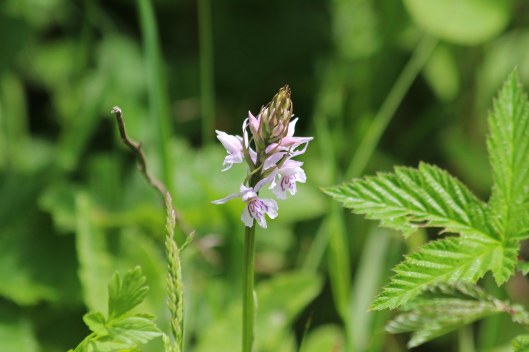
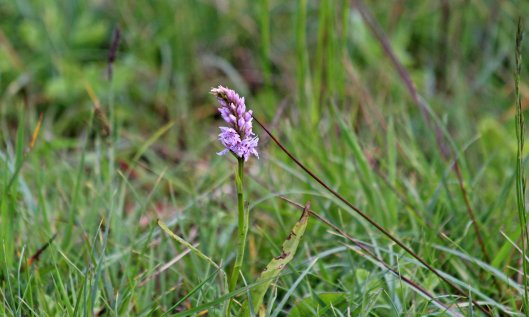
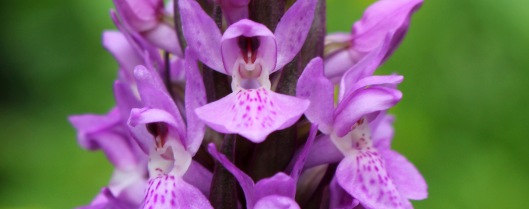
The occasional smatterings of rain we’ve had in the last few days have eased, ever so slightly, the drought conditions hereabouts, and the flush of new growth that was evident during this morning’s early walk through the fields at Cosmeston included my first Common spotted orchids of the year. Superb!

200524 common spotted orchid (1)200524 common spotted orchid (2)200524 common spotted orchid (3)200524 common spotted orchid (4)

Like Loading...

110/366 Even earlier purples

19 Sunday Apr 2020

Posted by sconzani in flowers, nature, spring, wildflowers

≈ 2 Comments

Tags

British orchids, Early purple orchid, native orchids, Orchis macula

I spotted 8 flower spikes of Early-purple orchid (Orchis macula) during my walk last Wednesday, 15 April, though not all the flowers were yet open.

200419 early-purple orchids (1)

This sighting was earlier than last year’s, which was on 23 April and which the locals told me was earlier than usual. It seems like climate change keeps changing the goal posts for these orchids.

200419 early-purple orchids (2)
200419 early-purple orchids (3)

200419 early-purple orchids (4)

Like Loading...

209/365 Broad-leaved helleborines

28 Sunday Jul 2019

Posted by sconzani in 365DaysWildin2019, flowers, nature, wildflowers

≈ 6 Comments

Tags

British orchids, Broad-leaved helleborine, Grangemoor Park, native orchids

I almost left it too late!

190728 broad-leaved helleborines (1)

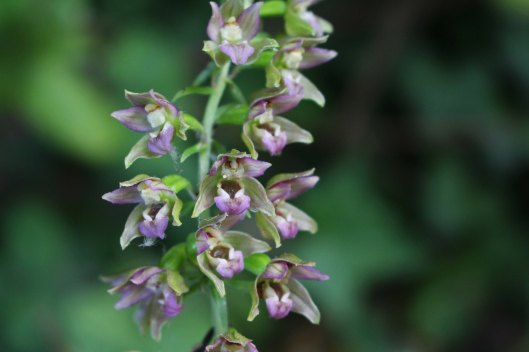
I’ve been keeping an eye on these Broad-leaved helleborines for over a month now: at my first visit, the flowers scarcely showed a tinge of red; at my second visit, on 14 July, a couple were in bloom but most still to open; and this morning, many of them had already started to go over.

190728 broad-leaved helleborines (5)
190728 broad-leaved helleborines (6)
190728 broad-leaved helleborines (7)

And, as today was quite windy, my photos are not very sharp so I’ve added in a couple from two weeks ago.

190728 broad-leaved helleborines (2)

Hey ho, at least I managed to see them in all their beauty before they disappear for another year.

190728 broad-leaved helleborines (3)
190728 broad-leaved helleborines (4)
Like Loading...

185/365 Beauty and the Beast

04 Thursday Jul 2019

Posted by sconzani in 365DaysWildin2019, flowers, nature, wildflowers

≈ 2 Comments

Tags

#365DaysWild, British orchids, Epipactis palustris, Marsh helleborine, native orchids, orchids, orchids at brownfield site, Rhoose Point Nature Reserve

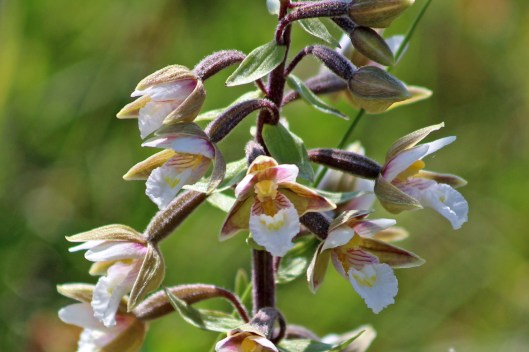
Like many brownfield sites, the former limestone quarries at Rhoose Point, the southernmost point in Wales, are now a nature-filled paradise, and yesterday one area was positively teeming with these beautiful Marsh helleborines (Epipactis palustris).

190704 marsh helleborines (1)

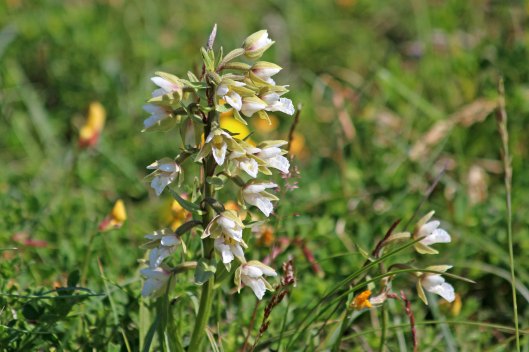
As their name implies, these orchids need water to flourish: the First Nature website says ‘This plant thrives in habitats which are usually submerged with water during the winter and maintain high levels of moisture during the summer. Dune slacks are often home to vast colonies, as are fens which are fed by alkaline springs running through limestone rocks – chalk being the other essential element to enable the Marsh Helleborine to flourish.’

190704 marsh helleborines (3)

I love what Richard Mabey has to say about orchids in Flora Botannica:

These days [their lightweight seed] often fetches up on artificially open habitats, low in nutrients and free of competition (quarries, for example), which replicate orchid-rich natural habitats such as sand dunes and cliff tops. It is this paradoxical, opportunistic quality of many orchids – the exquisite bloom transforming the spoil tip – that has become the basis for the true modern myth of the family, a botanical version of Beauty and the Beast.

190704 marsh helleborines (2)

The Marsh helleborines (and the many other species of orchid) that grow so well in the old Rhoose quarries are a stunning example of this transformation.

190704 marsh helleborines (4)

Like Loading...

145/365 An orchid update

25 Saturday May 2019

Posted by sconzani in 365DaysWildin2019, flowers, nature, wildflowers

≈ 4 Comments

Tags

Aberbargoed Grasslands, Bee orchid, British orchids, Common spotted orchid, Cosmeston Lakes Country Park, Early purple orchid, Heath spotted-orchid, Lavernock Nature Reserve, native orchids

As more and more orchids are now appearing, I thought I’d post a few photos of those I’ve seen so far this year. The first were the aptly named Early purples (Orchis macula), though this year they were even earlier than usual I’m told – I spotted these beauties at Lavernock Nature Reserve on 23 April.

190525 early purple orchids

Next up were these pretty little Heath spotted-orchids (Dactylorhiza maculata) found growing at the Aberbargoed Grasslands National Nature Reserve on 15 and 21 March, when I was visiting for the Marsh fritillaries.

190525 heath spotted-orchid

During Monday’s wander at Lavernock I spotted the first open flower of a Common spotted-orchid (Dactylorhiza fuchsia) and on Thursday, 23 May, I found the first couple of these at Cosmeston Lakes Country Park.

190525 common spotted lavernock190525 common spotted cosmeston

And today’s delightful discovery, also at Cosmeston, was my first Bee orchid (Ophrys apifera) for 2019. I look forward to the warm summer days when the fields at Cosmeston are awash with (mostly Common spotted) orchids – they’re a joy to behold!

190525 bee

Like Loading...

Orchid overdose!

09 Friday Jun 2017

Posted by sconzani in flowers, nature, wildflowers

≈ 6 Comments

Tags

Anacamptis pyramidalis, Bee orchid, British flora, British orchids, Common spotted orchid, Cosmeston Lakes Country Park, Dactylorhiza fuchsii, Greater butterfly-orchid, native orchids, Ophrys apifera), orchid, Platanthera chlorantha, Pyramidal orchid

170609 Orchids Cosmeston

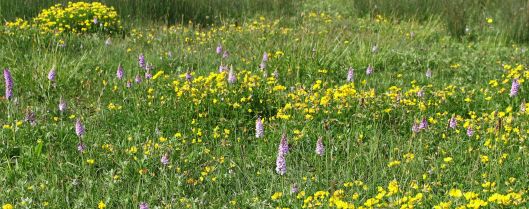
The meadows at Cosmeston Lakes Country Park are awash with orchids, Common spotted-orchids, (Dactylorhiza fuchsii), Bee orchids (Ophrys apifera), Pyramidal orchids (Anacamptis pyramidalis) and, in a secluded location off the beaten track, a tiny smattering of Greater butterfly-orchids (Platanthera chlorantha). To walk along the paths amongst these beauties is simply magical!

170609 Greater butterfly-orchid Cosmeston (2)
170609 Greater butterfly-orchid Cosmeston (3)
170609 Pyramidal orchids Cosmeston (3)
170609 Pyramidal orchids Cosmeston (1)
170609 Bee orchid Cosmeston (1)
170609 Common spotted-orchid Cosmeston (1)
170609 Common spotted-orchid Cosmeston (3)
170609 Bee orchid Cosmeston (2)
170609 Common spotted-orchid Cosmeston (2)
170609 Bee orchid Cosmeston (3)
170609 Greater butterfly-orchid Cosmeston (1)
170609 Pyramidal orchids Cosmeston (2)
Like Loading...

Marsh orchids at Kenfig

07 Wednesday Jun 2017

Posted by sconzani in flowers, nature, wildflowers

≈ 3 Comments

Tags

British flora, British orchids, Dactylorhiza incarnata, Dactylorhiza praetermissa, Dactylorhiza purpurella, Early Marsh-orchid, Kenfig National Nature Reserve, native orchids, Northern Marsh-orchid, orchid, Southern marsh orchid

170607 Southern marsh-orchid (2)

Apart from 18 species of rust, there wasn’t a lot of fungi to be found during our foray at Kenfig National Nature Reserve last Saturday but what we did see was a lot of stunning marsh orchids.

170607 Southern marsh-orchid (1)
170607 Southern marsh-orchid (3)
170607 Southern marsh-orchid (4)
170607 Southern marsh-orchid (5)

Identifying these beauties can be extremely tricky, even for trained botanists, partly because they look very similar, partly because their colouration can vary quite a lot within species, and partly because they hybridise easily with each other. So, although the chances are that these are Southern Marsh-orchids (Dactylorhiza praetermissa), there may also be some Northern Marsh-orchids (Dactylorhiza purpurella) or a mixture of both. Whatever they are, they’re beautiful!

170607 Early marsh-orchid (1)
170607 Early marsh-orchid (2)

I am, however, quite sure about these next pictures. These are Early Marsh-orchids (Dactylorhiza incarnata). They thrive in damp calcareous habitats so the dune systems at Kenfig suit them perfectly – or, at least they will as long as the dune systems are managed to prevent scrub and trees taking hold: the orchids actually grow best when wind and rain are allowed to destabilise the dunes and move sand and plants around a bit.

Like Loading...

The bees that don’t buzz

02 Friday Jun 2017

Posted by sconzani in flowers, nature, wildflowers

≈ 6 Comments

Tags

Bee orchid, British orchids, British wildflowers, native orchids, Ophrys apifera), orchid

Finding my very first Bee orchids (Ophrys apifera) in a local park this week made my day! I know they’re designed to entice male bees to attempt mating with their flowers in order to facilitate pollination but to me they actually look like jolly smiling and laughing mouths.

170602 Bee orchid Ophrys apifera (1)
170602 Bee orchid Ophrys apifera (2)

I had to find out more, and I have to say that, when it comes to wild plants, I love the Plantlife website – as well as giving you the straight facts and figures about British plants, they also include the most interesting fact-lets, like these:

*  The aim of the mimicry is to attract passing male bees in the hope they will try to mate and thus aid pollination. In Britain, however, Bee orchids self-pollinate so the deception is not really required.
*  This wild flower was once called the “Humble Bee” orchid (Humble being a variation of Bumble).
*  According to Roman natural historian Pliny the Elder it was used by womenfolk to darken their eyebrows.
*  The Bee orchid is the County Flower of Bedfordshire.
*  In the Language of Flowers it stands for error and industry.

170602 Bee orchid Ophrys apifera (3)
170602 Bee orchid Ophrys apifera (4)
Like Loading...

Two orchids

26 Friday May 2017

Posted by sconzani in flowers, nature, wildflowers

≈ Leave a comment

Tags

Common twayblade, Dactylorhiza maculata, Heath spotted-orchid, Merthyr Mawr National Nature Reserve, native orchids, Neottia ovata, orchid, Twayblade

Of the estimated 25,000 different species of orchid that can be found around the world, 56 are native to Britain and, as some of those 56 are now coming in to bloom, I thought I’d share a couple for this week’s Floral Friday.

170526 Twayblade (2)
170526 Twayblade (1)

Twayblade (Neottia ovata)
First up is the Twayblade I saw growing quite prolifically in the woodland at Merthyr Mawr a couple of weeks ago. It’s one of Britain’s most common species but is often overlooked, perhaps because its yellow-green flowers often blend in with their woodland, scrub or grassland habitats. Twayblade means two leaves, as there usually are just two leaves, from the centre of which sprouts the flower stalk, though, like all living things, there are exceptions to the rule and plants with three to five leaves are sometimes found. The thing that most fascinates me about these orchids is the manikin-shaped flower.

170526 Heath spotted-orchid (1)
170526 Heath spotted-orchid (2)

Heath spotted-orchid (Dactylorhiza maculata)
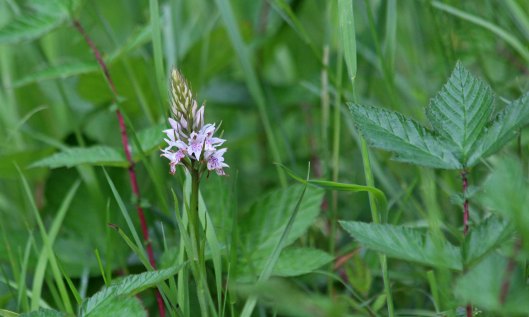
Luckily I was with a group of botanists when I saw my first Heath spotted-orchids last weekend, as they can easily be confused with Common spotted-orchids, though the fact that we were in a damp boggy field at the time was probably also a good species indicator. As the name ‘heath’ implies, this orchid likes to get its feet wet, relishing the sogginess of peaty moors and boggy heaths. As well as being common throughout Europe, this orchid can also be found throughout the British Isles, though it does show a marked preference for northern and western areas. Its gorgeous flowers can be seen from around the middle of May through to mid July.

Like Loading...
← Older posts
Newer posts →

About me

sconzani

sconzani

I'm a writer and photographer; researcher and blogger; birder and nature lover; countryside rambler and city strider; volunteer and biodiversity recorder.

View Full Profile →

Follow earthstar on WordPress.com

Enter your email address to follow this blog and receive notifications of new posts by email.
Recent blog posts

  • Birch polypore January 30, 2026
  • The Marl Med gull January 29, 2026
  • Recording Grey squirrels January 28, 2026
  • Jimmy Wren January 27, 2026
  • Millipede: Nanogona polydesmoides January 26, 2026

From the archives

COPYRIGHT

Unless otherwise acknowledged, the text and photographs on this blog are my own and are subject to international copyright. Nothing may be downloaded or copied without my permission.

Fellow Earth Stars!

  • Unknown's avatar
  • Unknown's avatar
  • Unknown's avatar
  • Unknown's avatar
  • Unknown's avatar
  • Unknown's avatar
  • Unknown's avatar
  • Unknown's avatar
  • Unknown's avatar
  • Unknown's avatar
  • Unknown's avatar
  • Unknown's avatar
  • Unknown's avatar
  • Unknown's avatar
  • Unknown's avatar
  • Unknown's avatar
  • Unknown's avatar
  • Unknown's avatar
  • Unknown's avatar
  • Unknown's avatar
  • Unknown's avatar
  • Unknown's avatar
  • Unknown's avatar
  • Unknown's avatar
  • Unknown's avatar
  • Unknown's avatar
  • Unknown's avatar
  • Unknown's avatar
  • Unknown's avatar
  • Unknown's avatar
  • Unknown's avatar
  • Unknown's avatar
  • Unknown's avatar
  • Unknown's avatar
  • Unknown's avatar
  • Unknown's avatar
  • Unknown's avatar
  • Unknown's avatar
  • Unknown's avatar
  • Unknown's avatar
  • Unknown's avatar
  • Unknown's avatar
  • Unknown's avatar
  • Unknown's avatar
  • Unknown's avatar
  • Unknown's avatar
  • Unknown's avatar
  • Unknown's avatar
  • Unknown's avatar
  • Unknown's avatar

Blog at WordPress.com.

Privacy & Cookies: This site uses cookies. By continuing to use this website, you agree to their use.
To find out more, including how to control cookies, see here: Cookie Policy
  • Subscribe Subscribed
    • earthstar
    • Join 670 other subscribers
    • Already have a WordPress.com account? Log in now.
    • earthstar
    • Subscribe Subscribed
    • Sign up
    • Log in
    • Report this content
    • View site in Reader
    • Manage subscriptions
    • Collapse this bar
 

Loading Comments...
 

You must be logged in to post a comment.

    %d