• ABOUT
  • BIRDING 2018
  • Birding 2019
  • BLOG POSTS
  • Butterflies 2018
  • Resources

earthstar

~ a celebration of nature

earthstar

Tag Archives: Nomada species

Nomad bees

29 Wednesday Mar 2023

Posted by sconzani in insects

≈ 3 Comments

Tags

kleptoparasitism, Nomad bees, Nomada fucata, Nomada species, Painted nomad bee

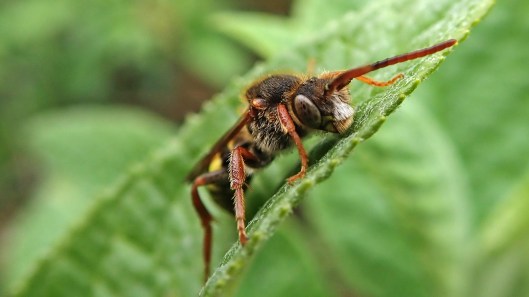
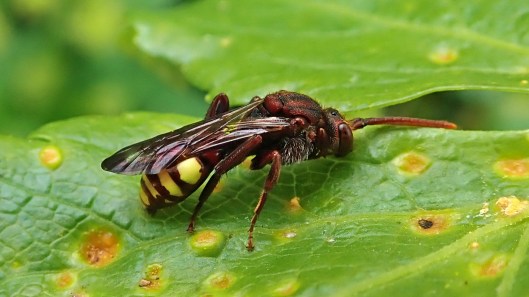
Despite their kleptoparasitic behaviour (laying their eggs in the burrows of other bees rather than doing the rearing themselves), I rather like Nomad bees so was delighted to find this dandelion, as the only local pollen source, had attracted a small congregation. As usual at the beginning of bee season, I optimistically thought I’d try to identify these and was almost immediately reminded of how tricky that can be, despite some really excellent visual resources being available online (BWARS, the Bees, Wasps & Ants Recording Society, has very good species galleries, and Steven Falk has excellent collections of species photographs on his flickr site). Having pored through a ton of images, I have tentatively identified my Nomads as Painted nomad bees (Nomada fucata) and recorded them as such. When/if my record is ever verified (or rejected), I’ll add a postscript here.

230329 nomad bees

p.s. I’m adding a larger version of one of the above photos, as this might help with positive identification.

nomada fucata 230327 lavernock ST17946781 (4)

Like Loading...

Cuckoo bees

26 Thursday Apr 2018

Posted by sconzani in insects, nature

≈ Leave a comment

Tags

British bees, Cuckoo bees, Nomada bees, Nomada goodeniana, Nomada marshamella, Nomada ruficornis, Nomada species

Is it a bird? Is it an insect? Well, it’s definitely an insect but one that’s pretending to be something it’s not in order to act as a kleptoparasite on other insects, hence the name cuckoo. The ‘cuckoo bees’, the Nomada species, consist of some 850 species of bee worldwide, over 30 of which can be found in Britain. Rather than collect pollen, they lay their eggs in the nests of other bees and let those bees do all the pollen-collecting and egg-rearing.

180426 Nomada ruficornis maybe (1)
180426 Nomada ruficornis maybe (3)

I thought I’d got reasonably good photos of these two Nomada bees but they are notoriously difficult to identify so, according to the experts I consulted, the bee in the photos above may perhaps be Nomada ruficornis and that in the photos below could be Nomada marshamella or N. goodeniana. Despite their parasitic habits, I still find these bees attractive.

180426 Nomada marshamella or goodeniana (3)
180426 Nomada marshamella or goodeniana (1)

180426 Nomada marshamella or goodeniana (2)


Like Loading...

The Cuckoos of the bee world

15 Monday May 2017

Posted by sconzani in insects, nature

≈ Leave a comment

Tags

bees, Cuckoo, Cuckoo bees, Nomada bees, Nomada species

You’ve no doubt heard of the Cuckoo bird that lays its eggs in the nests of other birds to get them to do all the hard work of feeding and raising their chicks but have you heard of the Cuckoo bees? These are the Nomada species, a huge group of bees with over 850 species worldwide, though only about 30 of these can be found in Britain. Even so, it is extremely difficult to tell those 30 species apart so I’m not even going to attempt to identify those in my photos.

170509 Nomada sp Cuckoo bees (3)

As you may have guessed, these bees lay their eggs in the nests of other bee species, primarily the Andrena species. When they hatch, the Cuckoo bee larvae eat the eggs of their host and then consume the food the Andrena had gathered for their own young. It’s very cunning if rather nasty behaviour.

170509 Nomada sp Cuckoo bees (1)
170509 Nomada sp Cuckoo bees (5)
170509 Nomada sp Cuckoo bees (2)
170509 Nomada sp Cuckoo bees (4)
Like Loading...

About me

sconzani

sconzani

I'm a writer and photographer; researcher and blogger; birder and nature lover; countryside rambler and city strider; volunteer and biodiversity recorder.

View Full Profile →

Follow earthstar on WordPress.com

Enter your email address to follow this blog and receive notifications of new posts by email.

Recent blog posts

  • N is for nest December 19, 2025
  • M is for mite December 18, 2025
  • L is for lepidopteran lifers December 17, 2025
  • K is for Keeled skimmers December 16, 2025
  • J is for Jersey tiger December 15, 2025

From the archives

COPYRIGHT

Unless otherwise acknowledged, the text and photographs on this blog are my own and are subject to international copyright. Nothing may be downloaded or copied without my permission.

Fellow Earth Stars!

  • Unknown's avatar
  • Unknown's avatar
  • Unknown's avatar
  • Unknown's avatar
  • Unknown's avatar
  • Unknown's avatar
  • Unknown's avatar
  • Unknown's avatar
  • Unknown's avatar
  • Unknown's avatar
  • Unknown's avatar
  • Unknown's avatar
  • Unknown's avatar
  • Unknown's avatar
  • Unknown's avatar
  • Unknown's avatar
  • Unknown's avatar
  • Unknown's avatar
  • Unknown's avatar
  • Unknown's avatar
  • Unknown's avatar
  • Unknown's avatar
  • Unknown's avatar
  • Unknown's avatar
  • Unknown's avatar
  • Unknown's avatar
  • Unknown's avatar
  • Unknown's avatar
  • Unknown's avatar
  • Unknown's avatar
  • Unknown's avatar
  • Unknown's avatar
  • Unknown's avatar
  • Unknown's avatar
  • Unknown's avatar
  • Unknown's avatar
  • Unknown's avatar
  • Unknown's avatar
  • Unknown's avatar
  • Unknown's avatar
  • Unknown's avatar
  • Unknown's avatar
  • Unknown's avatar
  • Unknown's avatar
  • Unknown's avatar
  • Unknown's avatar
  • Unknown's avatar
  • Unknown's avatar
  • Unknown's avatar
  • Unknown's avatar

Blog at WordPress.com.

Privacy & Cookies: This site uses cookies. By continuing to use this website, you agree to their use.
To find out more, including how to control cookies, see here: Cookie Policy
  • Subscribe Subscribed
    • earthstar
    • Join 667 other subscribers
    • Already have a WordPress.com account? Log in now.
    • earthstar
    • Subscribe Subscribed
    • Sign up
    • Log in
    • Report this content
    • View site in Reader
    • Manage subscriptions
    • Collapse this bar
 

Loading Comments...
 

You must be logged in to post a comment.

    %d