• ABOUT
  • BIRDING 2018
  • Birding 2019
  • BLOG POSTS
  • Butterflies 2018
  • Resources

earthstar

~ a celebration of nature

earthstar

Tag Archives: oak tree

Oak galls: ram’s-horns and silk buttons

18 Monday Sep 2017

Posted by sconzani in insects, nature, trees

≈ 12 Comments

Tags

Andricus aries, gall wasps, galls on oak trees, Neuroterus numismalis, oak galls, oak tree, Ram’s-horn gall wasp, Silk button gall wasp

I can’t resist just one more post about oak galls, because I’ve just this week found one that’s not commonly recorded. So, today we have one that’s uncommon and one that’s very common. Let’s start with the former.

First identified in eastern Europe in 1859, the Ram’s-horn gall wasp, Andricus aries, has slowly been heading westwards and finally reached Britain in 1997. Since that first sighting in Berkshire, it has spread over much of southern England and into Wales. Though there are only a few records in the Aderyn database of Welsh biological records, two of my friends have also found Ram’s-horn galls in the past week so I suspect it’s more common that records suggest.

170918 Andricus aries Ramshorn gall wasp on oak (1)
170918 Andricus aries Ramshorn gall wasp on oak (2)
170918 Andricus aries Ramshorn gall wasp on oak (3)

Like other gall-inducing wasps, Andricus aries lays its eggs on various species of oak and its larvae cause the oak to produce a gall, in this case with an elongated, sometimes spiralling shape, hence aries and its common name Ram’s-horn. Not much is yet known about this wasp, so if you see the gall, please do record it.
170918 Neuroterus numismalis Silk button gall wasp (3)

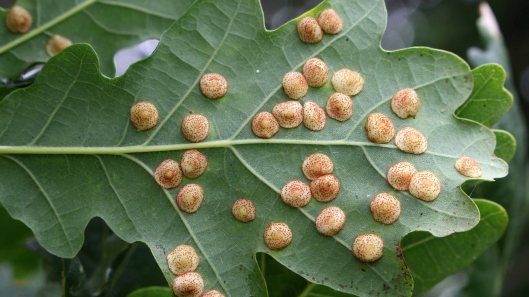
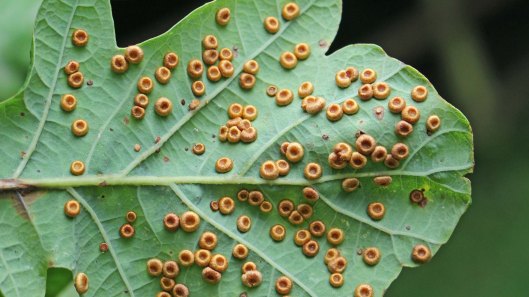
My second gall today is one many people will have seen, I’m sure, as its beautifully crafted silk-like button-shaped galls are very common on the undersides of oak leaves during the summer months. This gall contains the agamic generation (females needing no males to reproduce) of the Silk button gall wasp, Neuroterus numismalis. The galls fall to the ground in autumn and the larvae within pupate over the winter months. When the all-female wasps emerge in springtime, they lay their eggs on the edges of oak leaves and on the male catkins, where their larvae cause a different blister-shaped gall – that’s another one for me to seek out next spring. It is the female and male wasps of this second, sexual generation produced in the Blister gall that go on to mate and lay the eggs that result in the silk buttons. And so the cycle continues …

170918 Neuroterus numismalis Silk button gall wasp (1)
170918 Neuroterus numismalis Silk button gall wasp (2)
Like Loading...

Oak galls: spangles & oysters

09 Saturday Sep 2017

Posted by sconzani in insects, nature, trees

≈ 1 Comment

Tags

gall wasps, galls on oak trees, Neuroterus albipes, Neuroterus anthracinus, Oak gall wasps, oak galls, oak tree, Oyster gall, Smotth spangle gall

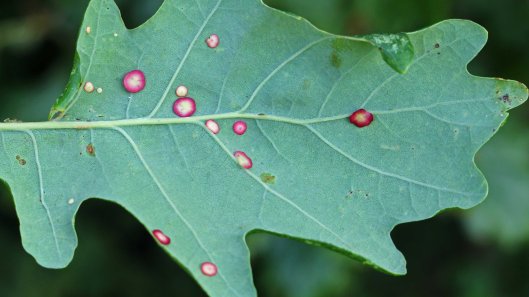
I know you’re all just dying to find out more about oak galls, right? RIGHT? I also know that I covered spangles in a previous post (see Currants & spangles here) but there are two different spangle galls to be found on the much be-galled oak tree: one is the hairy Common spangle and this is the second, the Smooth spangle gall.

170909 Smooth spangle gall (1)

This pretty little gall comes in combinations of pink and yellowish-green. It’s the work of Neuroterus albipes, a tiny wasp that you will probably never see, and inside each colourful saucer is a single larva that you will also probably never see. The galls drop to the ground in autumn and the larvae pupate over winter then female-only wasps hatch out in Spring to lay eggs that cause the entirely different Schenck’s gall (not one I’ve yet seen), from which male and female wasp hatch in the summertime. And so the cycle begins again.

170909 Smooth spangle gall (2)
170909 Smooth spangle gall (3)
170909 Smooth spangle gall (4)

This second gall, the Oyster gall, is also caused by a tiny wasp that has two distinct generations and forms two different galls. The wasp is Neuroterus anthracinus and the Oyster gall also contains the agamic generation of wasps (i.e. the females that need no males to fertilise their eggs). As you can see, these galls form on the veins on the undersides of oak leaves – once they’ve fallen to the ground, you can still see the two brown flaps of tissue where they were attached to the veins. 

170909 Oak Oyster gall (1)
170909 Oak Oyster gall (2)

Once again, the sexual generation of wasps hatch in the Spring to mate and lay their eggs, this time in the buds of the oak tree, hence the name of the gall they produce: the April-bud gall. That’s another I need to look out for come the Spring.

170909 Oak Oyster gall (3)


Like Loading...

Oak galls: marbles and apples

24 Thursday Aug 2017

Posted by sconzani in insects, nature, trees

≈ 4 Comments

Tags

Andricus kollari, Biorhiza pallida, gall wasps, galls on oak trees, Marble galls, Oak apple galls, Oak apples, oak galls, Oak marbles, oak tree

Though there are many more galls to be found on oak trees than the six I have covered in this and my previous two posts (knoppers and artichokes, and currants and spangles), I’ll make this the last lot for now. Otherwise, it might be just too galling for words!

170824 Andricus kollari Oak Marble gall (1)

So, to finish off this mini series, today we have Marble and Apple galls. Let’s start with the Marble galls and another tiny wasp, Andricus kollari, which lays its eggs on the twigs of any species of oak. This causes small perfectly round spheres to develop on these twigs. The spheres start off green but brown with age and will often remain on the twigs for a year or more. You can tell that the wasp has fled its larval home when you see tiny holes in the sphere. And although these do look just like brown marbles, I’m not sure you could use them to play the once-popular childhood game – they’re a little too light to shoot with.

170824 Andricus kollari Oak Marble gall (2)
170824 Andricus kollari Oak Marble gall (3)

And so to Oak apples. With their basic green colour and pink tinges, these do resemble immature apples but their surface texture and spongy feel are all wrong. The wasp Biorhiza pallida is the culprit this time, and these ‘apples’ contain several larvae, not just one.

170824 Biorhiza pallida Oak apple gall (3)
170824 Biorhiza pallida Oak apple gall (2)

Like many such wasps, both the Marble gall wasp and the Apple gall wasp have a sexual and an agamic (asexual) reproduction cycle. I have not seen the sexual galls produced by Andricus kollari which, interestingly, are produced only on Turkey oak (Quercus cerris) – the Marble galls are produced by the agamic (all female, no mating required) generation. Oak apple galls are produced by the sexual generation of Biorhiza pallida: the agamic generation lay their eggs on the roots of oak trees, so I haven’t seen those yet either.

170824 Biorhiza pallida Oak apple gall (1)

I find the whole concept of two different types of reproduction and, indeed, the way these wasps can cause such galls to form very intriguing!

Like Loading...

Oak galls: knoppers and artichokes

23 Wednesday Aug 2017

Posted by sconzani in insects, nature, trees

≈ 4 Comments

Tags

Andricus foecundatrix, Andriscus quercuscalicis, Artichoke gall, galls caused by wasps, galls on oak trees, Knopper gall, oak galls, Oak hop gall, oak tree, Pedunculate Oak, Quercus petraea, Quercus robur, Sessile oak

Following quickly on from yesterday’s oak galls, part 1, we have oak attack, part 2, a sorry tale of knoppers and artichokes – and, no, you can’t eat them!

170823 Andricus quercuscalicis Oak knopper gall (2)
170823 Andricus quercuscalicis Oak knopper gall (1)

First the knoppers, which are caused by Andriscus quercuscalicis, a wasp with chemical weapons. The wasp lays its eggs in buds on oak trees and the larvae, when they hatch, secrete a chemical that causes the developing acorn to distort into a knobbly lump, thus forming a home for themselves. The galls are structurally interesting but not so good for the oak tree, as the acorn is no longer a viable seed for the tree and I presume the knopper gall also makes the acorn unsuitable as food for wildlife as well. Apparently, this wasp only arrived in Britain in the 1960s but its spread has been rapid, with the galls now found throughout Wales and England and in southern Scotland, though only on the Pedunculate oak (Quercus robur).

170823 Andricus foecundatrix Oak artichoke gall (1)
170823 Andricus foecundatrix Oak artichoke gall (2)
170823 Andricus foecundatrix Oak artichoke gall (3)

Artichoke galls – also known as hop galls due to their resemblance to flower of the hop plant – are also the result of chemical distortion by a wasp. This time it’s Andricus foecundatrix that does the damage. Using its sharp ovipositor, it lays its eggs in the leaf buds of both the Pedunculate oak and the Sessile oak (Quercus petraea). Like yesterday’s Spangle-causing wasp, Andricus foecundatrix also has both a sexual and an asexual generation. The asexual wasp hatches from her artichoke home in the springtime and lays her eggs in oak catkins, causing a small oval-shaped gall to develop – I don’t yet have any photos of these galls but you can see images here.

Like Loading...

Oak galls: Currants and spangles

22 Tuesday Aug 2017

Posted by sconzani in insects, leaves, nature, trees

≈ 7 Comments

Tags

Common spangle gall, Currant gall, galls on oak, Neuroterus quercusbaccarum, Oak gall, Oak gall wasp, oak tree, Spangle gall

This is part one of the story of Oak galls – there will be a sequel (possibly two) because the poor old oak tree, one of the most iconic of British trees, the one almost everyone can identify, is also one of the trees most attacked by galls (though, in this case, the galls do little, if any, damage to the actual tree). This first Oak attack story is a bit like the chicken and the egg – which came first? – as Neuroterus quercusbaccarum, a wasp so tiny that only expert spotters ever actually see it, has the ability to reproduce both sexually and asexually, producing two types of gall on oak trees: the sexual generation is produced inside the Currant galls and the asexual generation develops inside the Common spangle galls.

170822 Neuroterus quercusbaccarum Oak Currant gall (1)
170822 Neuroterus quercusbaccarum Oak Currant gall (2)
170822 Neuroterus quercusbaccarum Oak Currant gall (3)

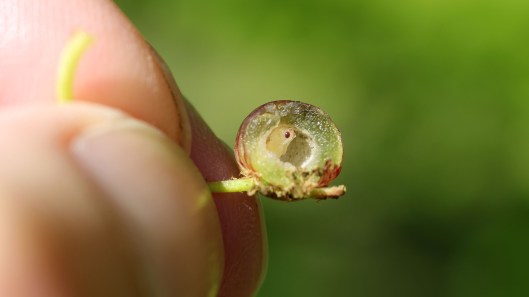
Let’s start with the Currants. As their name suggests, they look a little like currants or berries, maturing in colour from yellow and green to red and purple. In spring, you can find these attached to an Oak’s catkins or to the undersides of leaves.

170822 Neuroterus quercusbaccarum Oak Currant gall

Inside, tiny larvae develop, emerging as adult wasps in June. These wasps are either male or female, they mate soon after emerging, then lay their eggs within the epidermis on the undersides of oak leaves.

170822 Neuroterus quercusbaccarum Spangle gall (1)
170822 Neuroterus quercusbaccarum Spangle gall (2)
170822 Neuroterus quercusbaccarum Spangle gall (3)

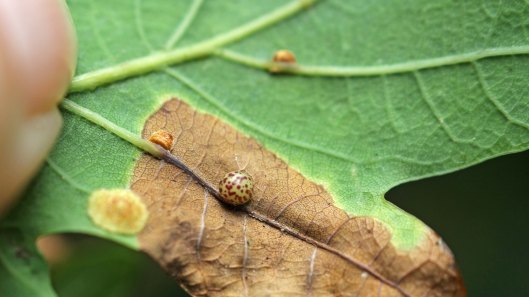
Now to the Spangles. When the eggs of the Currant gall generation hatch and their larvae begin to develop within the oak leaves, they create Spangle galls on the undersides of those leaves. The galls look a little like inverted saucers, with a slight hump in the middle. They are hairy and often quite a bright pinkish red to begin with, maturing eventually to a dull brown. Once mature, in late summer, the spangles detach and fall to the ground to be covered by the leaves of the oak, when they fall in autumn. The larvae overwinter in their cosy spangles, hatching in the spring when, without the need to mate, they lay their eggs on the oak’s leaves and catkins, thus producing the alternate generation of Currant galls. And so the cycle continues …
170822 Neuroterus quercusbaccarum Spangle gall (4)

Like Loading...

‘Dedicated Naturalist’: Crafty grey squirrels

02 Tuesday Aug 2016

Posted by sconzani in 'Dedicated Naturalist' Project, animals, nature

≈ 6 Comments

Tags

acorn, acorn weevil, Dr Mary Gillham, grey squirrel, Mary Gillham Archive Project, oak tree

A snippet from my volunteer work on the ‘Dedicated Naturalist’ Project, helping to decipher and digitise, record and publicise the life’s work of naturalist extraordinaire, Dr Mary Gillham. This is an extract from a piece called ‘Oak trees and rabbits helped by those crafty grey squirrels’, written by Mary for the Cardiff Naturalists’ Society newsletter, June 1997:

We hear a lot about the squirrels’ intelligence in overcoming man’s best efforts to deter them from appropriating victuals put out for others. Recent work … has revealed their native wisdom in dealing with more natural foods.

160802 grey squirrel (1)

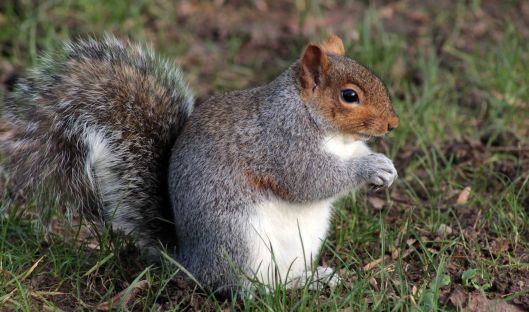
Many acorns are invaded by weevils, which are as acceptable as squirrel food as is the surrounding nut, but which shorten the life and viability of the fruit. Acorns collected are assessed for longevity by the squirrels, the infected ones eaten and the sound ones buried for another day. This guarantees them a surer food supply for winter and benefits the oak population by giving a higher than average viability of the acorns left to germinate and provide tender shoots for rabbits, rodents and sheep.

The squirrels’ ability … [is] from a high level of intellect evolved to better their own lot and – as part of the general wider plan governing the complex web of nature – to benefit others. Natural mechanisms of behaviour have more repercussions than are at first apparent!

160802 grey squirrel (2)
160802 grey squirrel (3)

For the full story about the Mary Gillham Archive Project, check out our website,  and follow our progress on Facebook and on Twitter.

Like Loading...
Newer posts →

About me

sconzani

sconzani

I'm a writer and photographer; researcher and blogger; birder and nature lover; countryside rambler and city strider; volunteer and biodiversity recorder.

View Full Profile →

Follow earthstar on WordPress.com

Enter your email address to follow this blog and receive notifications of new posts by email.

Recent blog posts

  • Q is for Quercus December 22, 2025
  • P is for Phalarope December 21, 2025
  • O is for Odonata December 20, 2025
  • N is for nest December 19, 2025
  • M is for mite December 18, 2025

From the archives

COPYRIGHT

Unless otherwise acknowledged, the text and photographs on this blog are my own and are subject to international copyright. Nothing may be downloaded or copied without my permission.

Fellow Earth Stars!

  • Unknown's avatar
  • Unknown's avatar
  • Unknown's avatar
  • Unknown's avatar
  • Unknown's avatar
  • Unknown's avatar
  • Unknown's avatar
  • Unknown's avatar
  • Unknown's avatar
  • Unknown's avatar
  • Unknown's avatar
  • Unknown's avatar
  • Unknown's avatar
  • Unknown's avatar
  • Unknown's avatar
  • Unknown's avatar
  • Unknown's avatar
  • Unknown's avatar
  • Unknown's avatar
  • Unknown's avatar
  • Unknown's avatar
  • Unknown's avatar
  • Unknown's avatar
  • Unknown's avatar
  • Unknown's avatar
  • Unknown's avatar
  • Unknown's avatar
  • Unknown's avatar
  • Unknown's avatar
  • Unknown's avatar
  • Unknown's avatar
  • Unknown's avatar
  • Unknown's avatar
  • Unknown's avatar
  • Unknown's avatar
  • Unknown's avatar
  • Unknown's avatar
  • Unknown's avatar
  • Unknown's avatar
  • Unknown's avatar
  • Unknown's avatar
  • Unknown's avatar
  • Unknown's avatar
  • Unknown's avatar
  • Unknown's avatar
  • Unknown's avatar
  • Unknown's avatar
  • Unknown's avatar
  • Unknown's avatar
  • Unknown's avatar

Blog at WordPress.com.

Privacy & Cookies: This site uses cookies. By continuing to use this website, you agree to their use.
To find out more, including how to control cookies, see here: Cookie Policy
  • Subscribe Subscribed
    • earthstar
    • Join 667 other subscribers
    • Already have a WordPress.com account? Log in now.
    • earthstar
    • Subscribe Subscribed
    • Sign up
    • Log in
    • Report this content
    • View site in Reader
    • Manage subscriptions
    • Collapse this bar
 

Loading Comments...
 

You must be logged in to post a comment.

    %d