• ABOUT
  • BIRDING 2018
  • Birding 2019
  • BLOG POSTS
  • Butterflies 2018
  • Resources

earthstar

~ a celebration of nature

earthstar

Tag Archives: Petty spurge

Green-flowered wildflowers

17 Sunday Mar 2024

Posted by sconzani in flowers, plants, wildflowers

≈ Leave a comment

Tags

British wildflowers, Dog's mercury, Euphorbia peplus, green flowers, green-flowered wildflowers, Helleborus foetidus, Mercurialis perennis, Petty spurge, Stinking hellebore

As the Wildflower Hour team wrote on social media when announcing this week’s challenge: ‘Some of the loveliest wildflowers are green! Can you find one for this week’s challenge?’. Well, yes, I can. In fact, I found three on yesterday’s meander, and I’m sure there must be more that I missed. My finds are:
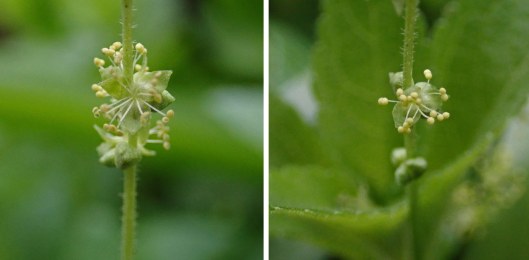
240317 dog's mercury

Dog’s mercury (Mercurialis perennis). I didn’t know until today, when I was reading the First Nature website, that ‘Dog’s Mercury is an extremely poisonous plant and when eaten it has been known to cause vomiting, jaundice and coma.’ Of course, you’d have to be pretty stupid to eat it, but some foragers are pretty stupid!

240317 petty spurge

Petty spurge (Euphorbia peplus), a common sight along the edges of lanes and pavements, and scattered across any patch of waste ground. It’s just getting started again in my area after being knocked back by the cooler winter weather and the interminable rain.
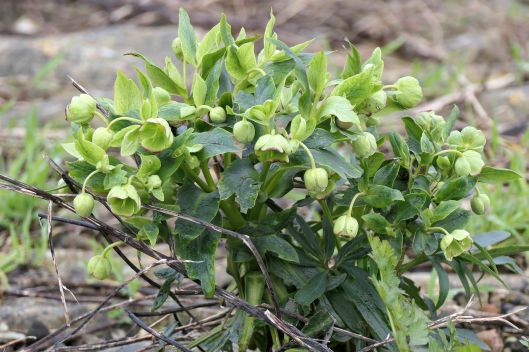
240317 stinking hellebore

Stinking hellebore (Helleborus foetidus). This was a surprise find along a local river embankment and, though Stinking hellebore is a UK native, because of its sudden appearance in that location, I think this particular specimen is probably a garden escapee.

Like Loading...

239/366 Spurges

26 Wednesday Aug 2020

Posted by sconzani in nature, plants, wildflowers

≈ Leave a comment

Tags

British wildflowers, Cypress spurge, Euphorbia cyparissias, Euphorbia helioscopia, Euphorbia peplus, Petty spurge, spurge, Sun spurge

The Oxford Dictionary tells me that the word spurge was first used in Late Middle English and is a ‘shortening of Old French espurge, from espurgier, from Latin expurgare “cleanse” (because of the purgative properties of the milky latex)’. If you have sensitive skin, you may want to be wary of touching that latex, which both the stem and leaves will exude if broken, as it can irritate.

200826 Petty spurge (1)
200826 Petty spurge (2)

In fact, the latex in Petty spurge (Euphorbia peplus) is so caustic that it’s used in medications for the removal of warts and veruccas. This is the spurge I see most often, as it seems to enjoy the edges of pavements and lanes, road verges and waste ground and, though an annual, it can be seen over a long period, from April right through to October.

200826 sun spurge (2)

Sun spurge (Euphorbia helioscopia) is superficially similar to Petty spurge but is slightly larger and has a shorter growing period, from May to August. The easiest way to tell one spurge from the other is by counting the rays in the umbel: Petty spurge has three rays while Sun spurge has five. Although Sun spurge supposedly enjoys a similar growing environment to Petty spurge, I don’t see it very often in my urban area: as the photo below indicates, my find was growing in an arable field (where no crops were sown this season, but some residue crops have sprouted).

200826 sun spurge (1)

Perhaps because of its irritant sap, Sun spurge has a wealth of interesting common names. These are from the Royal Horticultural Society’s website: cat’s milk, churn staff, little good, little goody, mad woman’s milk, mare’s milk, mouse milk, wart grass and wartwort.

200826 cypress spurge (2)
200826 cypress spurge (1)

Cypress spurge (Euphorbia cyparissias) is the most unusual and intriguing of today’s spurges. I found a large area of this very attractive plant growing on top of the Aberbargoed coal spoil tip on 29 July but it’s taken a couple of weeks to get the identification confirmed. I’m not sure how the plant came to be on the tip – my guide book says Cypress spurge is ‘possibly native’ in southern Britain but a probable garden escape elsewhere (The Wild Flower Key).

Like Loading...

My week in wildflowers

13 Friday Apr 2018

Posted by sconzani in flowers, nature, spring, wildflowers

≈ 2 Comments

Tags

Barren strawberry, Bluebell, British flora, British wildflowers, Common Stork's-bill, Cornsalad, Danish scurvygrass, gorse, Grape hyacinth, Petty spurge, Ragwort, Red dead-nettle, Three-cornered leek

Though the weather has been pretty miserable most of this week, I have been seeing more and more wildflowers when I’m out on my wanders.

Barren strawberry

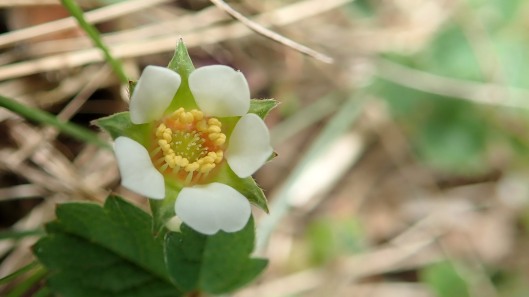
There will be no big fat juicy red berries from this little strawberry as this is a Barren strawberry (Potentilla sterilis) (it has fruit but they don’t become ‘fleshy and red’). I can tell which species it is from the top of the leaf that’s showing – the ‘terminal tooth’ is shorter than those on either side of it.

Bluebell

Last Sunday I saw my first Bluebells (Hyacinthoides sp.) of the year, almost certainly Spanish or hybrids rather than native Bluebells, but still beautiful to my eye.

Common stork's-bill

I think this is Common stork’s-bill (Erodium cicutarium), a nice surprise growing amongst the grass at Cardiff Bay Wetland Reserve.

Cornsalad

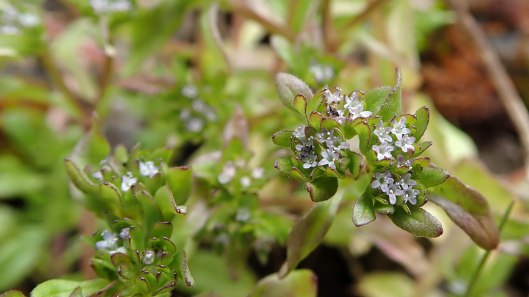
Cornsalad is such a dainty little plant, with very delicate, pale blue flowers. I almost missed these growing by the path at Grangemoor Park and have since seen them in a couple of places. This is probably Common cornsalad (Valerianella locusta), but the only way to be sure it’s not one of the other four varieties is to check the fruit, which won’t be possible till later in the season.

Danish scurvygrass

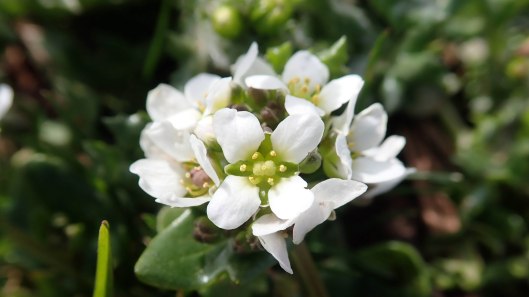
This is Danish scurvygrass (Cochlearia danica), originally a seaside plant that has now become widespread by following the road-salting trucks along the roads of Britain.

Gorse

Gorse (Ulex sp.) never seems to stop flowering, though the truth is that there are two Gorse species and, when one stops flowering, the other takes over.

Grape hyacinth

These Grape hyacinth (Muscari sp.) have become naturalised in my local cemetery, probably spreading from one or two deliberate grave-top plantings, or from nearby home gardens. I love their blue.

Petty spurge

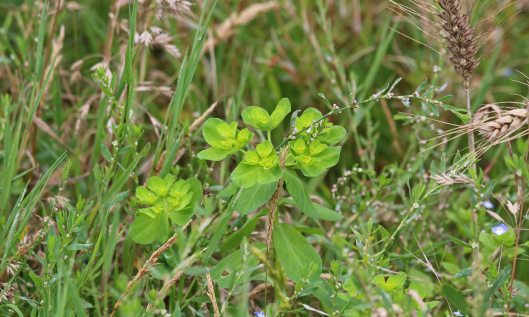
Petty spurge (Euphorbia peplus) is a very common little wildflower that’s often overlooked.

Common ragwort

Spotting this flowering Ragwort by the roadside near Cardiff Bay was a bright surprise. It’s probably Common ragwort (Senecio jacobaea).

Red dead-nettle

Red dead-nettle (Lamium purpureum). I’m a big fan of all the dead-nettles – the ‘dead’ in their name refers to the fact that they aren’t covered in stinging hairs!

Three-cornered leek

Allium triquetrum, the Three-cornered leek, is a pretty, if somewhat smelly flower but considered an alien invasive plant species here in Britain.

Like Loading...

About me

sconzani

sconzani

I'm a writer and photographer; researcher and blogger; birder and nature lover; countryside rambler and city strider; volunteer and biodiversity recorder.

View Full Profile →

Follow earthstar on WordPress.com

Enter your email address to follow this blog and receive notifications of new posts by email.

Recent blog posts

  • O is for Odonata December 20, 2025
  • N is for nest December 19, 2025
  • M is for mite December 18, 2025
  • L is for lepidopteran lifers December 17, 2025
  • K is for Keeled skimmers December 16, 2025

From the archives

COPYRIGHT

Unless otherwise acknowledged, the text and photographs on this blog are my own and are subject to international copyright. Nothing may be downloaded or copied without my permission.

Fellow Earth Stars!

  • Unknown's avatar
  • Unknown's avatar
  • Unknown's avatar
  • Unknown's avatar
  • Unknown's avatar
  • Unknown's avatar
  • Unknown's avatar
  • Unknown's avatar
  • Unknown's avatar
  • Unknown's avatar
  • Unknown's avatar
  • Unknown's avatar
  • Unknown's avatar
  • Unknown's avatar
  • Unknown's avatar
  • Unknown's avatar
  • Unknown's avatar
  • Unknown's avatar
  • Unknown's avatar
  • Unknown's avatar
  • Unknown's avatar
  • Unknown's avatar
  • Unknown's avatar
  • Unknown's avatar
  • Unknown's avatar
  • Unknown's avatar
  • Unknown's avatar
  • Unknown's avatar
  • Unknown's avatar
  • Unknown's avatar
  • Unknown's avatar
  • Unknown's avatar
  • Unknown's avatar
  • Unknown's avatar
  • Unknown's avatar
  • Unknown's avatar
  • Unknown's avatar
  • Unknown's avatar
  • Unknown's avatar
  • Unknown's avatar
  • Unknown's avatar
  • Unknown's avatar
  • Unknown's avatar
  • Unknown's avatar
  • Unknown's avatar
  • Unknown's avatar
  • Unknown's avatar
  • Unknown's avatar
  • Unknown's avatar
  • Unknown's avatar

Blog at WordPress.com.

Privacy & Cookies: This site uses cookies. By continuing to use this website, you agree to their use.
To find out more, including how to control cookies, see here: Cookie Policy
  • Subscribe Subscribed
    • earthstar
    • Join 667 other subscribers
    • Already have a WordPress.com account? Log in now.
    • earthstar
    • Subscribe Subscribed
    • Sign up
    • Log in
    • Report this content
    • View site in Reader
    • Manage subscriptions
    • Collapse this bar
 

Loading Comments...
 

You must be logged in to post a comment.

    %d