• ABOUT
  • BIRDING 2018
  • Birding 2019
  • BLOG POSTS
  • Butterflies 2018
  • Resources

earthstar

~ a celebration of nature

earthstar

Tag Archives: SEWBReC

The real peel

30 Monday May 2016

Posted by sconzani in fungi, nature

≈ 5 Comments

Tags

Aleuria aurantia, Bute Park, fungus, Orange peel fungus, SEWBReC

I owe the nifty title for this blog to my friend and colleague in fungi and biological recording, Amy, who works at SEWBReC, the South East Wales Biological Records Centre, and who can not only spin a good line but is extremely handy with a microscope. She checked the tiny aspects of my peel to confirm it really was Orange Peel fungus, despite this being entirely the wrong time of year.

160530 Orange peel fungus (1)

Orange peel fungus (Aleuria aurantia) usually appears in the autumn, fruiting between August and November, though anyone who observes the natural world on a regular basis will know that many things have been well out of sequence this year. The fungus starts out as a cup shape but often splits and contorts as it grows, making it appear even more like the discarded skin of an orange. Its bright orange colour makes it easy to spot in its preferred location, the disturbed soil alongside woodland paths, which is exactly where I found these specimens, in Cardiff’s Bute Park.

160530 Orange peel fungus (2)

Like Loading...

‘Dedicated Naturalist’: Scientific names

05 Thursday May 2016

Posted by sconzani in 'Dedicated Naturalist' Project, nature

≈ 9 Comments

Tags

binomial nomenclature, biological recording, biological records, Dr Mary Gillham, scientific names, SEWBReC, volunteering

A snippet from my volunteer work on the ‘Dedicated Naturalist’ Project, helping to decipher and digitise, record and publicise the life’s work of naturalist extraordinaire, Dr Mary Gillham.
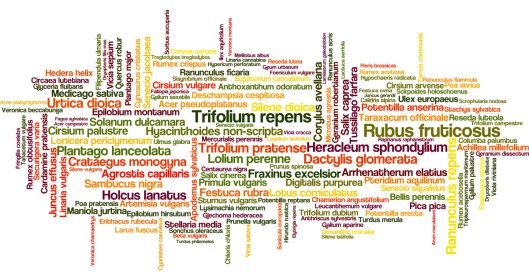
160505 Scientific names

When project officer Al Reeve sent round his monthly volunteer newsletter, he attached this image of the many and varied scientific names we volunteers have been typing up from Dr Mary Gillham’s records. It makes a pretty picture but these things are the stuff of volunteer nightmares! Seriously, what was Linnaeus thinking when he invented binomial nomenclature?

Take, for example, the Eurasian wren, a delicate and tiny bird but its scientific name, Troglodytes troglodytes, makes it sounds like a huge stomping dinosaur. Admittedly, the double-barrel names are easier to remember. There’s Pica pica the Eurasian magpie, Buteo buteo the Common buzzard and Anser anser the Greylag goose.
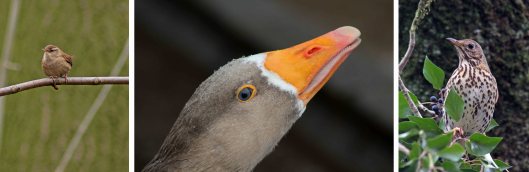
160505 wren greylag thrush

Troglodytes troglodytes, Anser anser and Turdus philomelos

I feel sorry for the rather unfortunately named Turdus family of true thrushes. There are more than 50 family members, with names like Turdus pilaris the Fieldfare, Turdus merula the Blackbird, and Turdus philomelos the melodic Song Thrush.

Then there are the plants with girls’ names, or should that be girls with plant names? Whenever I type Prunella (as in Prunella vulgaris, the herb Selfheal) I always think of Prunella Scales, the actress who played John Cleese’s exceedingly patient wife in Fawlty Towers, and, though it’s not spelt the same, Silene dioica, the pretty wildflower Red campion, reminds me of singer Celine Dion. And there are plenty more: Veronica, Iris, Lotus, Viola …
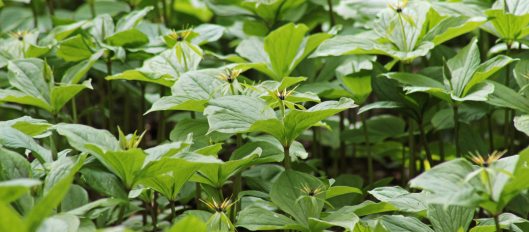
160505 Herb Paris

Then there are the misnomers. You might quite reasonably expect names beginning with Trifolium (tri = three, folio = leaf) to have three leaves, except that plants are often not true to their names: witness Trifolium repens, which can, if you’re lucky, be a four leaf clover! Or there’s Paris quadrifolia, the supposedly four-leaf Herb Paris (shown above), which can have from 5 to 8 leaves.

It’s enough to drive a volunteer to drink, so I’ll end with my favourite cocktail, Sambucus nigra. Cheers!

You can follow our progress with this project on Facebook and on Twitter. A website will follow soon.

Like Loading...

See it, smell it, record it!

12 Tuesday Apr 2016

Posted by sconzani in nature, plants

≈ 8 Comments

Tags

Allium ursinum, biological recording, Ramsons, SEWBReC, Wild garlic

Perhaps, my title for this post should read smell it, see it, record it, as you usually smell Wild garlic (Allium ursinum) before you see it – that’s how pungent its aroma can be! This cousin to the chive, which grows in many parts of Europe and Asia, is also known as Ramsons, and can be found in parks and woodlands throughout Wales – or can it?

160412 wild garlic (1)

The database for the South East Wales Biodiversity Records Centre (SEWBReC) was only showing 1400 records at the start of this month but they’re certain there must be many many more areas where this prolific plant is growing. So, SEWBReC have nominated Wild garlic as their plant of the month and they’re asking as many people as possible to record their sightings.

160412 wild garlic (2)
160412 wild garlic (3)

So, come on Citizen Scientists of Wales. This is a very easily recognisable plant – no detailed analysis needed, no microscope required – just a good nose (more info here, if you’re not entirely sure). And entering your findings into the SEWBReC database is also easy peasy (instructions here). I expect there’ll be so many records by the end of April that the Welsh national emblem will change from leek to Wild garlic!

160412 wild garlic (4)

Like Loading...

Recording the biology around us

16 Tuesday Feb 2016

Posted by sconzani in nature

≈ 8 Comments

Tags

biological recording, biological recording centre, citizen scientist, SEWBReC

Yesterday I went on a free training course, ‘An introduction to biological recording’, run by the friendly and extremely knowledgeable folk at SEWBReC, the South East Wales Biodiversity Records Centre. The course was intended to introduce the participants to:

The basics of biological recording: what we need to record and why; and
How to turn wildlife sightings into biological records which will be used to protect, conserve and enhance the local environment.

I’m sold on the idea! I had already signed on to their system to record a couple of unusual things I had seen but, of course, we shouldn’t just record the unusual, we should record everything – or, at least, as much as we possibly can of what we can positively identify.

160216 SEWBReC course

Searching for specimens to practise recording

As course instructor and SEWBReC manager Adam Rowe explained, we won’t know if something previously thought of as plentiful is in danger unless we record it and thereby, over time, notice a decline in its numbers. He gave as an example the American Passenger pigeon which once numbered between 3 and 5 billion – yes, billion! – but became extinct upon the death of the last surviving bird, ‘Martha’, in 1914.

There are biological recording centres in most countries around the world these days so, if you enjoy the natural world around you, please consider doing your bit as a citizen scientist.

Like Loading...
Newer posts →

About me

sconzani

sconzani

I'm a writer and photographer; researcher and blogger; birder and nature lover; countryside rambler and city strider; volunteer and biodiversity recorder.

View Full Profile →

Follow earthstar on WordPress.com

Enter your email address to follow this blog and receive notifications of new posts by email.

Recent blog posts

  • N is for nest December 19, 2025
  • M is for mite December 18, 2025
  • L is for lepidopteran lifers December 17, 2025
  • K is for Keeled skimmers December 16, 2025
  • J is for Jersey tiger December 15, 2025

From the archives

COPYRIGHT

Unless otherwise acknowledged, the text and photographs on this blog are my own and are subject to international copyright. Nothing may be downloaded or copied without my permission.

Fellow Earth Stars!

  • Unknown's avatar
  • Unknown's avatar
  • Unknown's avatar
  • Unknown's avatar
  • Unknown's avatar
  • Unknown's avatar
  • Unknown's avatar
  • Unknown's avatar
  • Unknown's avatar
  • Unknown's avatar
  • Unknown's avatar
  • Unknown's avatar
  • Unknown's avatar
  • Unknown's avatar
  • Unknown's avatar
  • Unknown's avatar
  • Unknown's avatar
  • Unknown's avatar
  • Unknown's avatar
  • Unknown's avatar
  • Unknown's avatar
  • Unknown's avatar
  • Unknown's avatar
  • Unknown's avatar
  • Unknown's avatar
  • Unknown's avatar
  • Unknown's avatar
  • Unknown's avatar
  • Unknown's avatar
  • Unknown's avatar
  • Unknown's avatar
  • Unknown's avatar
  • Unknown's avatar
  • Unknown's avatar
  • Unknown's avatar
  • Unknown's avatar
  • Unknown's avatar
  • Unknown's avatar
  • Unknown's avatar
  • Unknown's avatar
  • Unknown's avatar
  • Unknown's avatar
  • Unknown's avatar
  • Unknown's avatar
  • Unknown's avatar
  • Unknown's avatar
  • Unknown's avatar
  • Unknown's avatar
  • Unknown's avatar
  • Unknown's avatar

Blog at WordPress.com.

Privacy & Cookies: This site uses cookies. By continuing to use this website, you agree to their use.
To find out more, including how to control cookies, see here: Cookie Policy
  • Subscribe Subscribed
    • earthstar
    • Join 667 other subscribers
    • Already have a WordPress.com account? Log in now.
    • earthstar
    • Subscribe Subscribed
    • Sign up
    • Log in
    • Report this content
    • View site in Reader
    • Manage subscriptions
    • Collapse this bar
 

Loading Comments...
 

You must be logged in to post a comment.

    %d