• ABOUT
  • BIRDING 2018
  • Birding 2019
  • BLOG POSTS
  • Butterflies 2018
  • Resources

earthstar

~ a celebration of nature

earthstar

Tag Archives: spring flowers

Signs of Spring, 2

24 Friday Feb 2017

Posted by sconzani in flowers, nature, seasons, spring, wildflowers

≈ 2 Comments

Tags

Cardiff Bay, Colt's-foot, Coltsfoot, signs of spring, spring flowers, Tussilago farfara

170224-coltsfoot

Determination. Persistence. Resistance. Constancy.
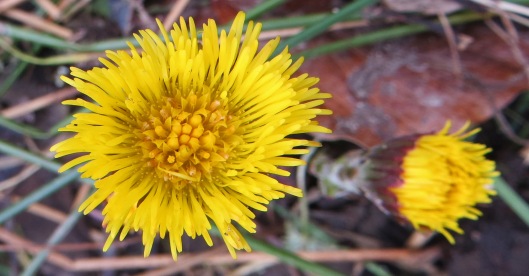
Humans have cleared the land of ‘weeds’; laid a gravel path edged with a concrete strip; planted a bed of ornamental shrubs (many of which have died); and mulched that garden bed with metal chips yet, in spite of all that destruction of its habitat, this little Colt’s-foot (Tussilago farfara) has managed to push through and begin to flower.
Admiration!

Like Loading...

Signs of Spring, 1

18 Saturday Feb 2017

Posted by sconzani in flowers, nature, seasons, spring, wildflowers

≈ 4 Comments

Tags

blooming flowers, crocus, sign of spring, spring flowers

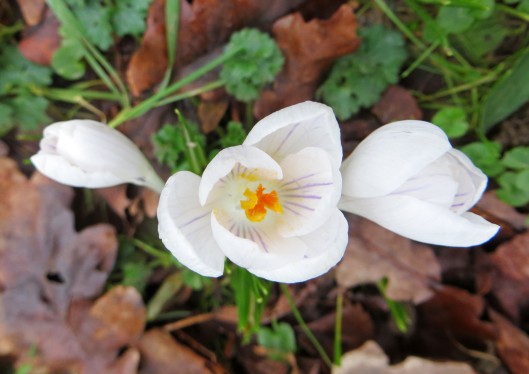
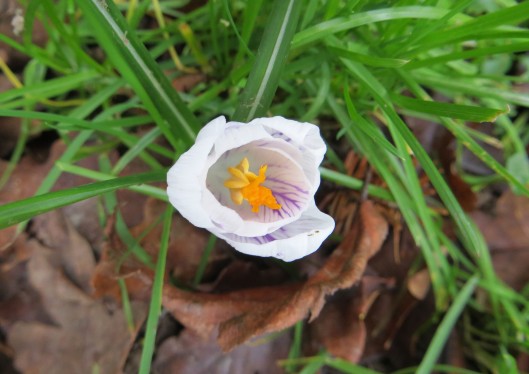
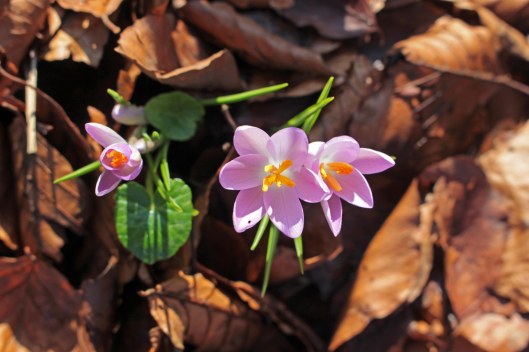
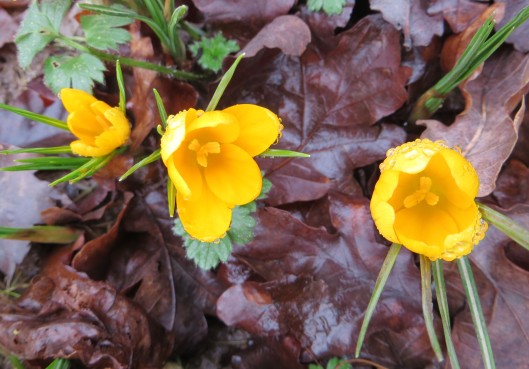
I went for a lovely long walk around parts of Cardiff Bay yesterday and it was sunny and warm, so warm that I had to strip off my scarf and the thin jumper I was wearing over my t-shirt and under my fleece. Spring was definitely in the air and, on my return walk home, I discovered I wasn’t the only one to be feeling the temperature change. These crocuses were putting on a glorious display in the churchyard of St Augustine’s and in the small grassy area just down the hill from the church. Beautiful!

170218-crocuses-1
170218-crocuses-2
170218-crocuses-3
170218-crocuses-4
170218-crocuses-5
170218-crocuses-6
Like Loading...

Floral Friday: The yellowing

03 Friday Jun 2016

Posted by sconzani in flowers, nature, wildflowers

≈ Leave a comment

Tags

spring flowers, summer flowers, yellow flowers, yellow wildflowers

Yellow is the colour of happiness, optimism, enlightenment, creativity, hope, cheerfulness, sunshine … and the quintessential colour of Spring.
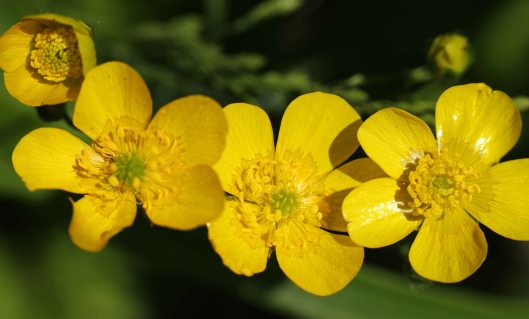
160603 yellow wildflowers (1)

Yellow is also the most luminous in the colour spectrum – the colour that most easily catches the human eye but, more importantly, the eyes of bees, so it’s no surprise that yellow is the most common flower colour. Here in Wales, after experiencing only my second British winter in thirty-odd years, I have been delighted by the coming of Spring, and both charmed and uplifted by the yellow wildflowers everywhere. First came the Dandelion and Daffodil, the Lesser celandine and the paler shade of the Primrose and, in boggy places, the Marsh marigold.

Now, as spring becomes summer, the succession of yellow continues with fields and meadows carpeted in yellow. We have the many varieties of Buttercup, vibrant Bird’s foot trefoil and Yellow archangel, the Dandelion look-alike Cat’s ear and Nipplewort, and in boggy places, Yellow flag iris. It is truly glorious.

160603 yellow wildflowers (3)
160603 yellow wildflowers (10)
160603 yellow wildflowers (12)
160603 yellow wildflowers (8)
160603 yellow wildflowers (4)
160603 yellow wildflowers (9)
160603 yellow wildflowers (11)
160603 yellow wildflowers (6)
160603 yellow wildflowers (5)
160603 yellow wildflowers (2)
160603 yellow wildflowers (7)
Like Loading...

Wildflowers at the cemetery

13 Friday May 2016

Posted by sconzani in nature, spring, wildflowers

≈ 6 Comments

Tags

#FloralFriday, Cathays Cemetery, spring flowers

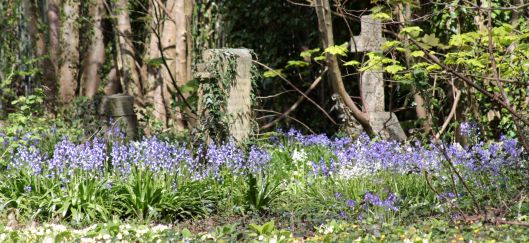
I am fortunate to have a magnificent location for wildflowers just a short walk from where I live. Cathays Cemetery’s 110-acre grounds have remained largely undisturbed since the cemetery closed to new burials about 35 years ago so it has the perfect habitat for wild plants to thrive… as long as the mowers and strimmers aren’t used too often.

160513 cemetery

There are native Bluebells (Hyacinthoides non-scripta) though many of the Spanish variety have also been planted here. The Bulbous buttercups (Ranunculus bulbosus) are always cheerful, as is the Cuckooflower or Lady’s smock (Cardamine pratensis). They may be common but I’m a big fan of the Daisy (Bellis perennis) and the Dandelion in its many forms (Taraxacum officinale agg.). Dog violets (Viola riviniana) and Germander speedwell (Veronica chamaedrys) give pretty bursts of blue and lilac, and Herb Robert (Geranium robertianum) add its special touch of pink. Though now past their best, Lesser celandine (Ficaria verna) and Primrose (Primula vulgaris) are both still flowering, while the Red clover (Trifolium pratense) is just beginning to bloom. Ribwort plantain (Plantago lanceolata) is abundant, as is Wild strawberry (Fragaria vesca). And the last flower I couldn’t identify, so if anyone can help with that, I’d be grateful.

160513 Bluebell Hyacinthoides non-scripta
160513 bulbous buttercup Ranunculus bulbosus
160513 Cardamine pratensis Cuckooflower or lady's smock
160513 daisy bellis perennis
160513 dandelion Taraxacum officinale agg
160513 Dog violet Viola riviniana
160513 germander speedwell Veronica chamaedrys
160513 lesser celandine Ficaria verna
160513 primrose primula vulgaris
160513 red clover Trifolium pratense
160513 ribwort plantain Plantago lanceolata
160513 Wild strawberry Fragaria vesca
160513 zz unknown
Like Loading...

The stars that fell to earth

29 Tuesday Mar 2016

Posted by sconzani in flowers, nature, spring, wildflowers

≈ 11 Comments

Tags

Anemone nemorosa, Cathays Cemetery, spring flowers, Wood anemone

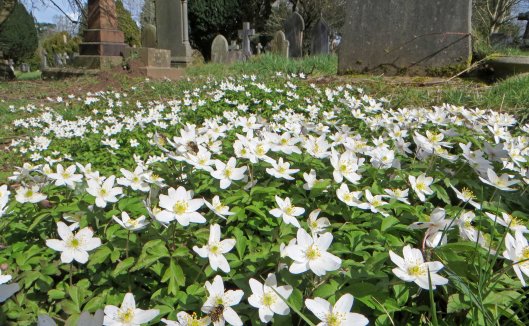
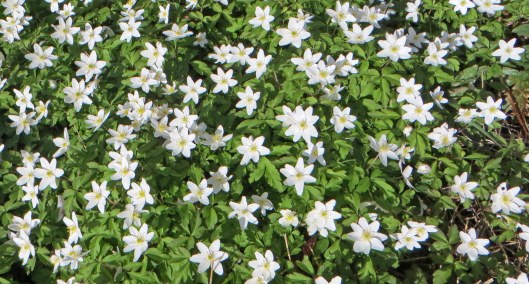
I saw my first wood anemones for this spring last weekend, dotted about the Nant Fawr woodland here in Cardiff, but it wasn’t until yesterday that I saw these wonderful lush displays in Cathays Cemetery. The wood anemone (Anemone nemorosa) is often to be found in the older graveyards throughout the British Isles, as well as in parks, gardens and ancient woodland. Its gorgeous white flowers, usually blooming from March through to May, have been likened by some to a late fall of snow blanketing the ground but, to my somewhat vivid imagination, it seems rather that the stars of the Milky Way have fallen to earth.

160329 wood anemone (1)

The wonderfully informative Plantlife website gives some interesting nuggets of information about this springtime favourite: it symbolises expectation, brevity and forlornness, and, in China, the flower’s pale, somewhat ghostly appearance has earned it the name ‘Flower of Death’. It is also the county flower of Middlesex.

160329 wood anemone (2)
160329 wood anemone (3)
160329 wood anemone (4)

I also discovered yesterday that the flowers of the wood anemone, though poisonous to humans, are favourites of hoverflies – in my ignorance I thought they were bees – and I got photos of 3 different species feasting on their pollen (but I’m saving those for a future blog.)

160329 wood anemone (5)

Like Loading...

Merry marsh marigolds

25 Friday Mar 2016

Posted by sconzani in flowers, nature, wildflowers

≈ 2 Comments

Tags

Caltha palustris, marsh marigold, spring, spring flowers

Yellow is the colour of happiness, optimism, enlightenment, creativity, hope, cheerfulness, and sunshine. Yellow is also the most luminous in the colour spectrum – the colour that most easily catches our eye and the eyes of bees so it’s no surprise that yellow is the most common flower colour, and the quintessential colour of Spring.

marsh marigold

One of the wonderfully vibrant plants whose flowers have been catching my eye over the past couple of weeks is the Marsh marigold (Caltha palustris). As its name implies, this wildflower likes the dampness of marshes, fens, ditches and the wetter areas of my local woodlands. According to Wikipedia, it ‘is probably one of the most ancient native plants, surviving the glaciations and flourishing after the last retreat of the ice in a landscape inundated with glacial meltwaters.’
marsh marigold (1)

The Marsh marigold is commonly known as Kingcup – its Latin name Caltha comes from the Greek word for goblet and its large golden cup-shaped flowers certainly look glorious enough to adorn the table of a king.
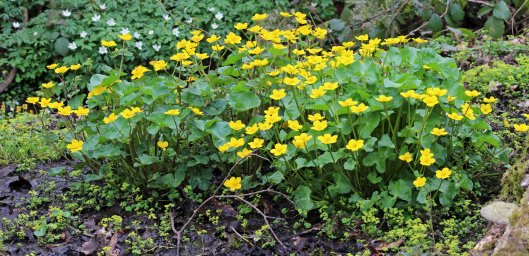
marsh marigold (2)

Like Loading...

The far too Common gorse

02 Wednesday Mar 2016

Posted by sconzani in nature, plants

≈ 7 Comments

Tags

Common gorse, gorse, invasive weed, spring flowers

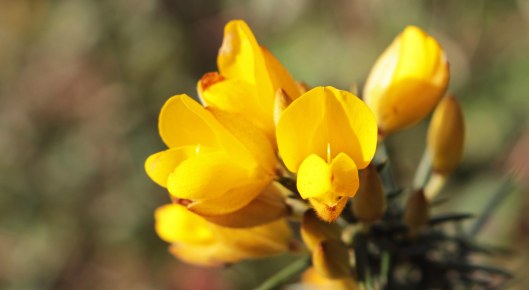
Mention gorse to a farmer in New Zealand and he’ll curse and swear and grab the nearest strong weed-killer. It’s considered the country’s worst agricultural weed, and millions of dollars have been spent trying to eradicate it. Obviously, then, it is not a New Zealand native but was introduced in the very early days of colonial settlement for use as hedges and windbreaks. Little did those early settlers realise how invasive the plant would become in New Zealand’s temperate climate or how much angst they would cause their descendants.

160302 gorse (1)

So, you will, I hope, forgive me for not waxing lyrical about the joys of gorse in my newly adopted country of Wales. Yes, I recognise it has a very pretty flower, and I also acknowledge that it is a useful source of pollen when very few other plants are flowering. Apparently, the scent of its flowers reminds people of the smell of coconut – I admit I haven’t given them the sniff test. And I have read that gorse provides shelter and a good nesting habitat for a range of birds, including the stonechat, yellowhammer and linnet. But, in this instance, I just can’t set my heritage aside – to my eye, it’s a weed, and always will be!

160302 gorse (3)
160302 gorse (2)
160302 gorse (4)
Like Loading...

Coltsfoot for your cough?

26 Friday Feb 2016

Posted by sconzani in nature, nature photography, wildflowers

≈ 4 Comments

Tags

Coltsfoot, spring, spring flowers

I saw my first coltsfoot in bloom this week. Though it looks a little like a dandelion, coltsfoot (Tussilago farfara) is actually a member of the sunflower family. It is favoured by herbalists as its leaves and flowers apparently make an effective cough remedy – the scientific name tussilago comes from the Latin tussis, which means cough, and ago, which means to act on. However, coltsfoot has been found to cause problems with the liver so long-term constant use is probably not wise.

coltsfoot (7)

This is another wildflower with a multitude of common names including, not surprisingly, coughwort, but also tash plant, ass’s foot, bull’s foot, foal’s foot, foalswort, and horse foot. Apparently, all those references to ‘foot’ result from the fact that the leaves are a similar shape to animal hooves, though I haven’t yet seen the leaves myself – they don’t appear until the flower has set its seed.

coltfoot (2)

In Britain, there is also a confection called Coltsfoot Rock, made exclusively by Stockley’s Sweets, in Oswaldtwistle, in Lancashire. Though its exact recipe is secret, this rock candy is flavoured using the leaves of coltsfoot. I wonder if any of my readers can tell us what it tastes like.

coltsfoot (5)
coltsfoot (8)
Like Loading...

Sweet early Flower

10 Wednesday Feb 2016

Posted by sconzani in flowers, nature, spring, wildflowers

≈ 3 Comments

Tags

primrose, spring flowers

From Samuel Taylor Coleridge’s poem, ‘To a Primrose’

Thy smiles I note, sweet early Flower,
That peeping from thy rustic bower
The festive news to earth dost bring,
A fragrant messenger of Spring.

160210 primrose (1)

As Coleridge noted, the primrose (Primula vulgaris) is one of the first spring flowers, blooming as early as December when the weather is as mild as it has been so far this winter, and continuing on until May. The primrose was the favourite flower of British Prime Minster Benjamin Disraeli (1804-81) and so was used as the emblem for the Primrose League, an organisation founded a couple of years after Disraeli’s death and active until the 1990s, whose purpose was to promote the ideals of the Conservative Party throughout Britain.

160210 primrose (2)

In the language of flowers, the primrose has several somewhat conflicting meanings: it’s symbolic of timidity but also of fickleness, it can refer to young love but can also convey the message ‘I can’t live without you’. In Norse mythology, the primrose was sacred to Freya, the goddess of love, and in England there is a superstition that you must always bring 13 primrose flowers into the home – any more or any less means bad luck.

Like Loading...

‘The Crocus’s Soliloquy’

26 Tuesday Jan 2016

Posted by sconzani in flowers, nature, nature photography, spring, wildflowers

≈ 4 Comments

Tags

crocus, spring flowers, wildflowers

160126 crocus (1)

‘Soon as the frost will get out of my bed,
From this cold dungeon to free me,
I will peer up with my little bright head;
And all will be joyful to see me.

Then from my heart will young petals diverge,
As rays of the sun from their focus;
I from the darkness of earth shall emerge
A happy and beautiful Crocus!’

From the poem ‘The Crocus’s Soliloquy’ by Miss H. F. Gould in The Poetry of Flowers and Flower of Poetry, ed. Frances Sargent Locke Osgood, J. B. Lippincott & Co, Philadelphia, 1863.

160126 crocus (2)160126 crocus (3)160126 crocus (4)160126 crocus (5)160126 crocus (6)160126 crocus (7)160126 crocus (8)

Like Loading...
Newer posts →

About me

sconzani

sconzani

I'm a writer and photographer; researcher and blogger; birder and nature lover; countryside rambler and city strider; volunteer and biodiversity recorder.

View Full Profile →

Follow earthstar on WordPress.com

Enter your email address to follow this blog and receive notifications of new posts by email.

Recent blog posts

  • Our celebrity Redshank February 19, 2026
  • My first moth of the year February 18, 2026
  • Three Common sandpipers February 17, 2026
  • Beetle: Athous bicolor February 16, 2026
  • Crocus flower power February 15, 2026

From the archives

COPYRIGHT

Unless otherwise acknowledged, the text and photographs on this blog are my own and are subject to international copyright. Nothing may be downloaded or copied without my permission.

Fellow Earth Stars!

  • Unknown's avatar
  • Unknown's avatar
  • Unknown's avatar
  • Unknown's avatar
  • Unknown's avatar
  • Unknown's avatar
  • Unknown's avatar
  • Unknown's avatar
  • Unknown's avatar
  • Unknown's avatar
  • Unknown's avatar
  • Unknown's avatar
  • Unknown's avatar
  • Unknown's avatar
  • Unknown's avatar
  • Unknown's avatar
  • Unknown's avatar
  • Unknown's avatar
  • Unknown's avatar
  • Unknown's avatar
  • Unknown's avatar
  • Unknown's avatar
  • Unknown's avatar
  • Unknown's avatar
  • Unknown's avatar
  • Unknown's avatar
  • Unknown's avatar
  • Unknown's avatar
  • Unknown's avatar
  • Unknown's avatar
  • Unknown's avatar
  • Unknown's avatar
  • Unknown's avatar
  • Unknown's avatar
  • Unknown's avatar
  • Unknown's avatar
  • Unknown's avatar
  • Unknown's avatar
  • Unknown's avatar
  • Unknown's avatar
  • Unknown's avatar
  • Unknown's avatar
  • Unknown's avatar
  • Unknown's avatar
  • Unknown's avatar
  • Unknown's avatar
  • Unknown's avatar
  • Unknown's avatar
  • Unknown's avatar
  • Unknown's avatar

Blog at WordPress.com.

Privacy & Cookies: This site uses cookies. By continuing to use this website, you agree to their use.
To find out more, including how to control cookies, see here: Cookie Policy
  • Subscribe Subscribed
    • earthstar
    • Join 670 other subscribers
    • Already have a WordPress.com account? Log in now.
    • earthstar
    • Subscribe Subscribed
    • Sign up
    • Log in
    • Report this content
    • View site in Reader
    • Manage subscriptions
    • Collapse this bar
 

Loading Comments...
 

You must be logged in to post a comment.

    %d