
Tags
bee mating frenzy, bees, bees on ivy, British bees, Colletes hederae, Ivy bee, Ivy bee mating ball, ivy flowers
Some days are just magical! I went out looking for birds – instead I got mobbed by Red admiral butterflies while walking along the coastal path, which made me grin like a Cheshire cat, and then I found these little buzzers.


They’re Ivy bees (Colletes hederae) and, as their name suggests, they feed on ivy flowers so they don’t appear until early autumn, when most other bees are winding down activities for the year. With an orange woolly thorax and orange-and-black striped abdomen, these bees are easy to identify, though Colletes hederae was only described as a separate species back in 1993 (before that it was confused with two other species of Colletes). Ivy bees only arrived in Britain from Europe in 2001 but have since gradually spread across southern England and in to south Wales: the extent of their spread is being tracked by BWARS, the Bees, Wasps and Ants Recording Society, so please do log your sightings, either on their website here or with your local records centre.


I had seen my first Ivy bees for the year the previous week but this new sighting was more special because it was a colony. Though the Ivy bee is a solitary bee (it doesn’t form a hive), a group of females will often excavate their individual burrows and underground chambers together in a sandy bank or similar area of loose earth. And, as the BWARS website explains, male bees often wait by the burrows for females to return and then pounce on them. When the other males spot what’s happening, they also want a piece of the action, jumping on the mating couple to form a writhing mass or mating ball. I was lucky enough to see one of these happen, as shown below.
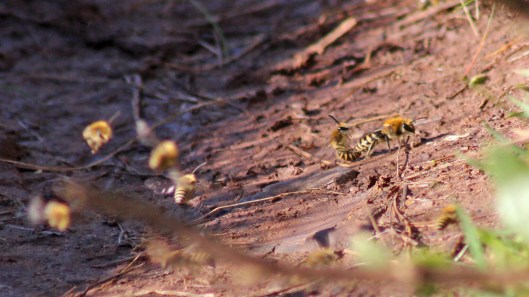
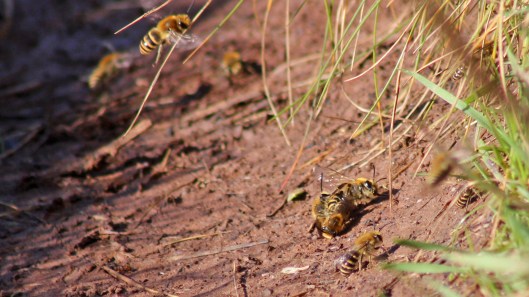

 earthstar
Pingback: 257/365 Ivy bees | earthstar
I’ve not seen these bees before, though we did have a solitary bee (miner? I’m not sure) a couple of years back digging a hole for itself in our garden.)
Oh, you’re also being mobbed by butterflies? We’ve had loads of them for about a week in our garden, though they have something they love here – a beauty bush which has deep throated pink flowers that are obviously full of nectar because there are always bees and butterflies feeding at it.
LikeLiked by 1 person
That day was one out of the record books!
And how wonderful to have a critter-attracting bush. Enjoy!
LikeLiked by 1 person
Lucky indeed to get those images! The colony I ‘found’ last year at the bottom of my daughter’s road survived and thrived and has become active over the last couple of weeks, but despite there being a good lot of them, getting pics of the frantically hormonal males is more luck than judgement for me!
LikeLiked by 1 person
It was pure luck for me, Theresa. I didn’t want to get too close as I had a nasty reaction to a bee sting recently but the drama just unfolded in front of me. 🙂
LikeLiked by 1 person