King Alfred’s been busy baking his famous cakes in my local woodland – and, amazingly, he hasn’t yet burnt them all. This batch looks particularly tasty!

~ King Alfred’s cakes (Daldinia concentrica)

18 Friday Feb 2022
Posted in fungi
King Alfred’s been busy baking his famous cakes in my local woodland – and, amazingly, he hasn’t yet burnt them all. This batch looks particularly tasty!
~ King Alfred’s cakes (Daldinia concentrica)
17 Thursday Feb 2022
Posted in insects
I’ve been log-diving again, checking under small rotting branches and logs to see what might be seen. Woodlice and slugs, small spiders and snails there were a’plenty but the only creature I found with even a modicum of colour was this little springtail. I think this is Neanura muscorum, an insect which couldn’t be less true to its name if it tried – no tail to be seen and certainly not very springy.

16 Wednesday Feb 2022
Posted in birds
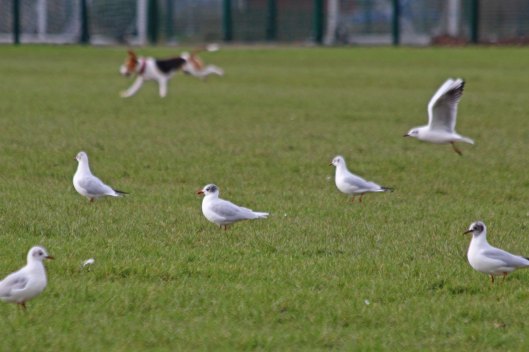
I managed to clock up the 89th species on my 2022 patch birding list on Friday after bumping in to the bird’s finder at the Cardiff Bay Wetlands Reserve. John had, about an hour earlier, spotted a Mediterranean gull among the flock at The Marl playing fields, so I strode in that direction, hoping the bird would still be present. At first I couldn’t find it as The Marl is popular with dog walkers and their pooches were constantly unsettling the large flock of Black-headed gulls prospecting diligently for worms in the lush grass. But, eventually, the birds settled down again and a thorough scan for a white rear end (adult Med gulls have no black on their wing or tail feathers) produced my bird.
15 Tuesday Feb 2022
Posted in nature
Moult (US molt): noun and verb; (of an animal) shed old feathers, hair, or skin to make way for new growth; origin: Middle English moute, from an Old English verb based on Latin mutare ‘to change’ (Oxford Dictionary).
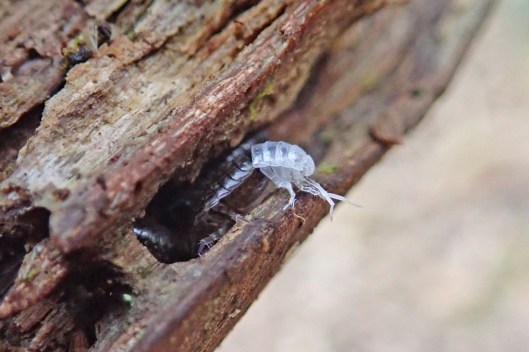
Today’s word is inspired by this moulting Woodlouse I found in nearby woodland last week.
14 Monday Feb 2022
Posted in birds
Tags
birding, birdwatching, British birds, Cardiff Bay birding, Cardiff Bay Wetlands Reserve, Water rail
What a lovely surprise I got during a recent walk through Cardiff Bay’s wetland reserve when this Water rail pranced showily out from where it had been sitting preening in the sunshine and along the water’s edge, surprising not only me but also two of the resident Mallards.

13 Sunday Feb 2022
Posted in plants
This is a personal learning journey that I thought I would share, and some of you can probably help along the way. Call me mad if you want, but I’m trying to work out what plants will become from looking at their early growth. This may be a very short journey as I may get so frustrated that I quickly give up, particularly as I’m already uncertain about one of today’s examples, but here goes…. Working from left to right, I think these are Creeping thistle (Cirsium arvensis) and Daisy (Bellis perennis), then Teasel (Dipsacus fullonum) and today’s head-scratcher. It may be Prickly sow-thistle (Sonchus asper). It may be I’m biting off far more than I can chew trying to identify this plant at this early stage. Any ideas anyone?


12 Saturday Feb 2022
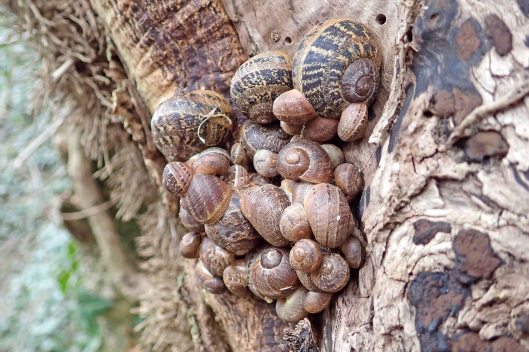
The secrets of life for over-wintering snails:
1) find a friend, or twenty, to huddle with
2) create a mucus seal around your shell opening to conserve moisture
3) slow down your metabolism and snooze.
11 Friday Feb 2022
Posted in fungi
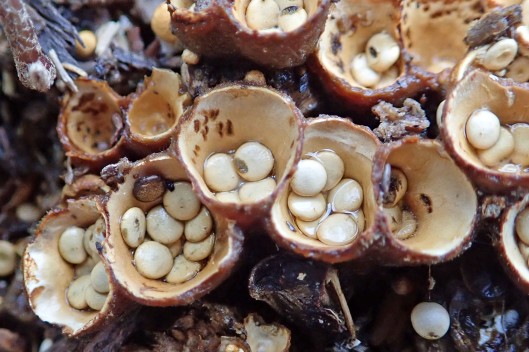
Tuesday’s walk took me past the site where I found the Shooting star and Common bird’s-nest fungi last month. Both are still thriving, and I thought I’d share this photo, which shows the bird’s-nest fungi much more clearly than in my previous post. It’s easy to see how they got their name.
10 Thursday Feb 2022
Posted in nature
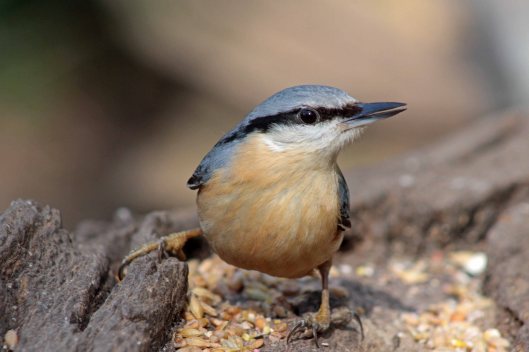
Today’s lovely long meander took me to Cosmeston Lakes Country Park, where I watched a large flock of Fieldfares and Redwings worming in the west paddock, enjoyed the antics of the almost-tame Crows that are feed daily by a regular visitor and now expect all humans to feed them, and chuckled at the small birds squabbling over which would get the sunflowers amongst the seed I dished out. The Nuthatches won that game most of the time, repeatedly nabbing two and three at a time to take away and stash for later consumption.
09 Wednesday Feb 2022
Tags
Aceria ilicis, British galls, gall mites, galls, galls on oak trees, Holm oak, mite galls, mite galls on Holm oak
During yesterday’s walk, when checking for leaf mines on the leaves of Holm oak (large numbers of Ectoedemia heringella present – you can see one in the photo below), I noticed a huge abundance of small bumps covering many of the leaves.
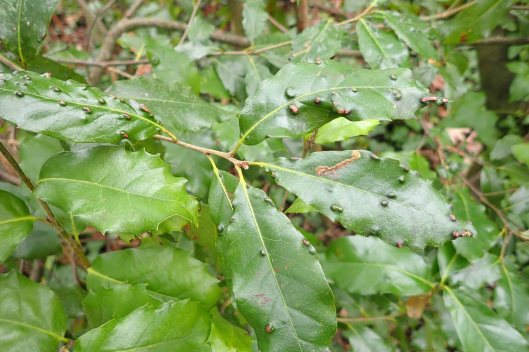
These are the galls caused by the miniscule mite Aceria ilicis. On the underside (though sometimes also on top), the depression in the leaf is filled with tiny brown hairs (an erineum) where the mites make their home. The galls can be seen throughout the year, so next time you spot a Holm oak, check out its leaves.


 earthstar
You must be logged in to post a comment.